Fosbury flop mechanics reveal 4 essential secrets to clear impossible heights
By bending the body into an inverted crescent, elite high jumpers exploit a bizarre quirk of classical physics where their balance point travels beneath the crossbar. Unpack the brilliant biomechanics, rotational forces, and flight dynamics that forever changed track and field.

Mastering Fosbury flop mechanics transformed athletic flight forever by proving that human bodies can pass over a crossbar while their balance point dips beneath it. When an unorthodox jumper first sprinted in a wide arc, turned his back to the sky, and arched over the bar like an inverted ribbon, the track world stood stunned. Spectators thought the maneuver looked comical, almost reckless. Critics dismissed the technique as a quirky stunt enabled solely by the arrival of cushioned foam landing pits. Yet the underlying physics was unassailable.
By curving the spine backward over the bar in sequential waves, a jumper manipulates classical mechanics to achieve what looks like visual trickery. An elite competitor can sail cleanly over an obstacle set at seven and a half feet while their physical center of mass never rises higher than seven feet and three inches. Understanding this gravity-defying feat requires stripping away the spectacle and dissecting the kinetic chain that translates raw sprint speed into parabolic flight.
The counterintuitive physics of bending around a crossbar
To unpack the foundational reality of Fosbury flop mechanics, you have to look at the center of mass, the theoretical point in space where the entire mass of an object concentrates. In a rigid body like an iron kettlebell or a wooden javelin, that point stays locked inside the object’s physical material. The human body, however, is a dynamic chain of articulated bone levers, fluid muscles, and connective joints. Shifting an arm, throwing back the skull, or hyper-extending the spine redistributes the exact coordinates of this invisible balance point.
In classical jumping styles such as the straddle, scissors, or Western roll, the athlete crosses the bar facing downward or sitting upright. Because the torso, limbs, and head occupy a relatively flat horizontal plane simultaneously, the center of mass must rise several inches above the bar to prevent a devastating knockdown. Raising a two-hundred-pound frame that high demands massive kinetic energy. Just as our breakdown of how emulsion stability mechanics reveal 4 proven secrets to stop heartbreaking sauce breaks demonstrates the power of microscopic balance, athletic flight demands an identical mastery of physical equilibrium.
In a properly executed backward arch, the jumper crosses the bar in discrete, flowing segments. The head and shoulders clear first and immediately plunge downward toward the pit. The hips rise to crest the bar, followed by a sudden hip drop that whips the lower legs skyward. Because the head drops down on the far side while the feet trail below on the near side, the body forms a deep crescent. Under this specific geometry, the mathematical center of mass travels entirely beneath the crossbar. The jumper clears the height without ever generating the impossible muscular force needed to elevate their whole body above it.
The J-curve approach that builds invisible rotational force
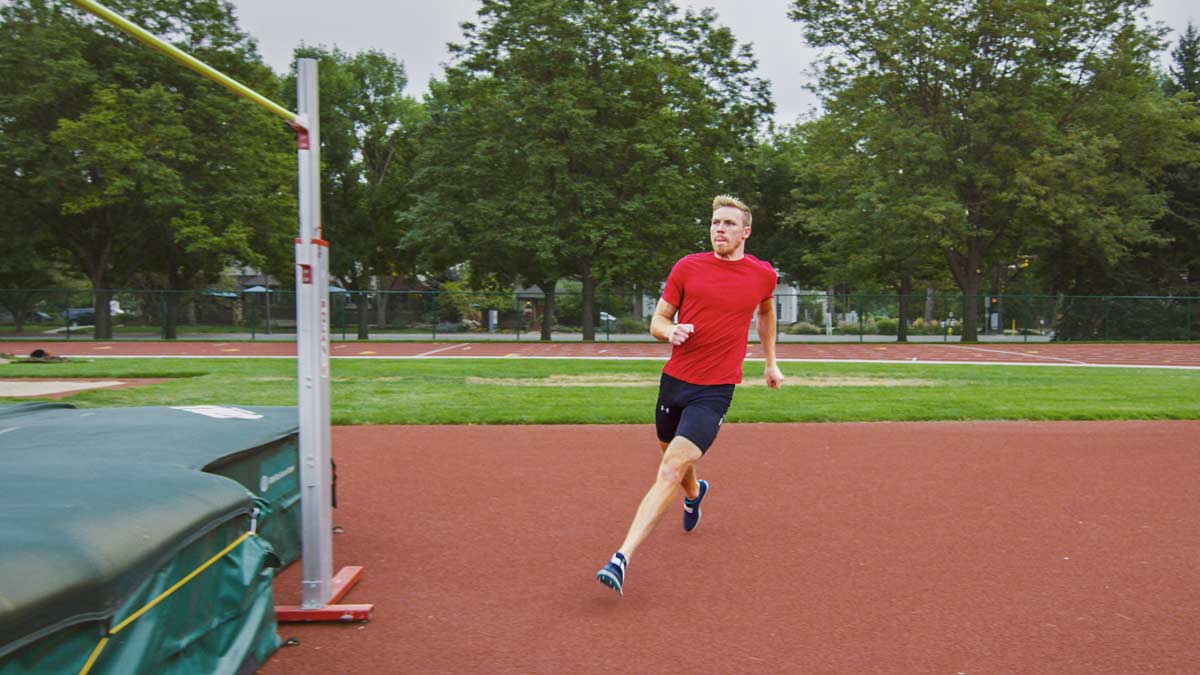
Great leaps do not originate at the takeoff board; they are built ten strides back on the apron. Coaches who dissect Fosbury flop mechanics often note that novice jumpers obsess over the arch while neglecting the ground. The trademark approach run forms a distinctive J-shape, beginning with four to five linear strides of aggressive acceleration before carving into a sharp, progressive radius over the final four or five strides.
This curved path is far more than an aesthetic flourish. Scurrying along an arc generates significant inward centripetal acceleration. To counteract the centrifugal sensation pulling them outward, the jumper naturally leans inward toward the center of the turn. This natural lean accomplishes something brilliant: it lowers the athlete’s center of mass before they prepare to jump, without requiring them to bend their knees excessively and shed forward speed.
Furthermore, running the curve generates torque. When the athlete plants the takeoff foot along a line tangential to the curve, the sudden brake against inward lean converts into a combination of explosive vertical propulsion and somersaulting angular momentum. Without this curved approach run, an athlete attempting a backward leap would have to jerk their head and neck violently backward at takeoff, which ruins vertical thrust and causes wild, dangerous trajectory errors. The J-curve generates the required rotational momentum naturally, leaving the athlete free to channel every ounce of energy straight into the ground.
Four biomechanical phases that unlock peak bar clearance
Examining Fosbury flop mechanics reveals that the final two strides govern everything that happens ten feet in the air. The transition from horizontal speed to vertical ascension unfolds across four tightly synchronized phases where timing errors of fifty milliseconds mean the difference between a gold medal and a bruised shin.
The penultimate stride and takeoff plant
The transformation of horizontal track velocity into vertical lift hinges on the relationship between the final two strides. On the second-to-last stride, the jumper lowers their hips through a slightly lengthened, rolling foot placement. This subtle dip sets up an aggressive, rock-solid plant on the final stride. The takeoff foot strikes the apron ahead of the jumper’s center of mass, landing flat with a locked ankle to act as a rigid vaulting pole.
As the body pivots over this planted foot, the horizontal speed collides with ground friction, generating massive vertical ground reaction forces that often exceed five times the athlete’s body weight. Simultaneously, the free knee and both arms punch skyward in a violent driving motion. This upward surge boosts vertical launch velocity and elevates the center of mass before the takeoff spikes have even parted company with the track apron.
Conservation of angular momentum and the midair twist
The split second the jumper leaves the apron, the laws of projectile motion seize total control. In midair flight, angular momentum is strictly conserved because no external torques can be generated against thin air. An athlete cannot conjure new rotation while floating; they can only redistribute the angular momentum generated while their shoes were still touching the rubber.
During the curved approach and asymmetric arm drive, the jumper picks up two distinct rotational vectors: a backward somersault along the transverse axis and a twist along the longitudinal axis. According to World Athletics technical analysis, managing this rotational combination is the primary technical barrier for developing jumpers. By pulling the lead knee across the chest and adjusting arm extension, the jumper alters their rotational moment of inertia, controlling the twist to align their spine perpendicular to the bar at the apex of the flight arc.
Segmented arching and center of mass suppression
As the jumper’s hips reach the elevation of the crossbar, the spine initiates deep hyperextension. The athlete relaxes the hip flexors and abdominal wall, allowing the pelvis to push toward the clouds while the head, neck, and shoulders drop heavily into the pit. This counterintuitive phenomenon lies at the core of why Fosbury flop mechanics dominate modern track and field.
By hanging the head and arms low on one side of the bar and dangling the lower legs low on the approach side, the athlete forms an inverted U-shape. Gravity pulls the system down along a predetermined parabolic arc. Because the extremities hang low while the pelvis crowns the summit, the physical crossbar fits neatly between the human arch and the center of mass traveling beneath it.
Dynamic snap and hip clearance recovery
Clearing the pelvis over the bar is only half the puzzle. The moment the hips slide past the fiberglass, the trailing calves and heels are on a direct collision course with the bar. Without an immediate countermovement, the jumper’s own legs will rake the obstacle off its pegs.
To avoid this heartbreak, the jumper initiates a rapid flexion known as the snap or kick. By driving the chin hard into the chest and engaging the abdominal muscles, the athlete creates an equal and opposite physical reaction. Tucking the chin causes the hips to drop rapidly toward the mat while whipping the lower legs straight upward and forward. This reflex lifts the calves and heels clear of the bar at the exact microsecond the upper back absorbs the impact of the landing foam.
Why the straddle technique vanished almost overnight
When sports scientists compare historical methods, the kinetic elegance of Fosbury flop mechanics explains the complete extinction of the straddle. Half a century ago, the straddle was celebrated as the ultimate test of high jumping power. Dominant athletes hurled their bodies face-down over the obstacle, rolling their chests around the bar with astonishing athleticism. Yet the straddle hid inescapable physical liabilities.
First, the straddle carried a steep physical tax. Because the jumper crossed the bar with their torso and legs roughly parallel to the ground at the same moment, their center of mass had to climb several inches higher than the bar itself. Athletes wasted staggering amounts of muscular power just fighting this built-in clearance penalty.
Second, the straddle required a nearly linear approach path, severely limiting the athlete’s capacity to build and store rotational momentum. Jumpers had to throw a straight lead leg skyward with violent muscular force, subjecting hips, hamstrings, and knee ligaments to punishing torque. The introduction of deep synthetic foam pits removed the need to land safely on one’s feet in a shallow sawdust trench, permitting athletes to land backward onto their shoulders and unlocking the full potential of curved flight.
Refining flight paths for modern athletic mastery
Modern sports biomechanists view high jump flight paths as precise kinetic equations rather than raw physical gambles. High-speed stereoscopic cameras and force plates track foot angles and ground reaction forces down to the millisecond, letting coaches sculpt the radius of the approach curve to match an athlete’s personal sprint speed and height.
Jumpers spend countless hours conditioning their vestibular systems to master blind spatial awareness. Because the athlete turns their back to the crossbar midway through takeoff, they must execute complex midair adjustments using internal kinetic cues and peripheral vision rather than direct sightlines. Ultimately, the lasting legacy of Fosbury flop mechanics lies in demonstrating that human performance boundaries are dictated as much by geometry as raw muscle. When physics and biomechanics align, human beings can literally bend the laws of perception to conquer heights once thought completely out of reach.