Emulsion stability mechanics reveal 4 proven secrets to stop heartbreaking sauce breaks
Few culinary disasters feel as heartbreaking as watching a luscious, velvety sauce curdle into an oily puddle. Unpack the microscopic physics of emulsion stability mechanics to command flawless culinary sauces every time.
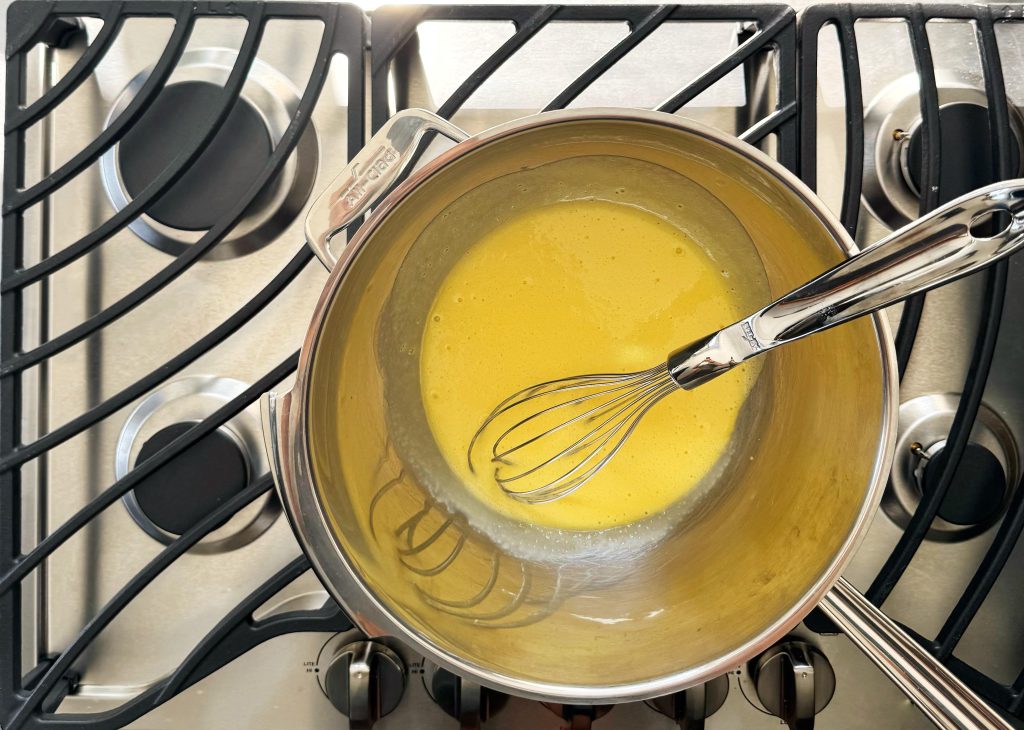
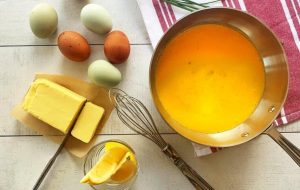
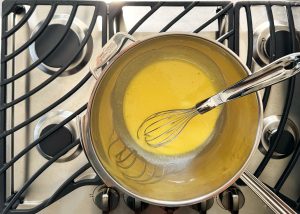
Mastering emulsion stability mechanics separates timid home cooks from intuitive culinary artisans who command sauces with supreme confidence. Few kitchen failures deliver such immediate heartbreak as watching a glossy, silky hollandaise suddenly curdle into a grainy sludge floating in yellow grease. You whisk faster, your forearm burns, and panic sets in, yet the oily pool stubbornly refuses to bind. The sauce is dead, or so it seems. Most cooks treat this catastrophic separation as sheer bad luck or blame their wrist speed, but sauces do not break because of culinary misfortune. They break because of thermodynamics.
Sauces are not passive mixtures; they are high-energy suspensions held together against their natural thermodynamic inclinations. When you blend fat and liquid, you are actively defying the universe’s tendency toward entropy and phase separation. By shifting your perspective from frantic recipe-following to deliberate physical manipulation, you transform fragile kitchen rituals into repeatable triumphs of physics and sensory pleasure.
The microscopic physics of forcing oil and water into peaceful harmony
At its fundamental core, emulsion stability mechanics governs an eternal conflict between two chemical opposites: hydrophobic lipids and polar water molecules. Water molecules are intensely social, clinging tightly to one another through potent hydrogen bonds. Neutral fats and oils, composed of nonpolar triglycerides, possess no electric charge and cannot participate in this intermolecular bonding dance. Left to their own devices, water molecules squeeze oil droplets out of their network, forcing the lighter lipids to float to the surface where they coalesce into a continuous layer with the lowest possible surface area.
To bridge this molecular chasm, you need a surfactant, an amphiphilic molecule possessing both a water-loving polar head and a fat-loving nonpolar tail. In classical French sauces, nature supplies these marvelous peacekeepers in abundance. Egg yolk delivers lecithin, a phospholipid whose lipophilic tails anchor themselves firmly inside suspended fat droplets while its hydrophilic head extends outward into the surrounding water. As researchers demonstrate in the Harvard University Science and Cooking educational laboratory, reducing the radius of suspended fat globules exponentially increases the interfacial surface area, requiring an astonishing amount of surfactant coverage to prevent coalescence.
When you whisk vigorously, your mechanical energy tears bulk fat into billions of microscopic sphere droplets. The lecithin molecules immediately race to coat these newborn spheres, wrapping each droplet in a negatively charged chemical shield. Because like charges repel, these coated oil droplets bounce off one another rather than merging upon collision. The resulting mixture scatters incoming light in every direction, turning once-translucent golden butter and pale yolks into an opaque, gleaming pale-yellow velvet.
The physical mechanics of continuous and dispersed culinary phases
Understanding culinary emulsion stability mechanics requires visualising how space is divvied up inside your mixing bowl. Every emulsion consists of two distinct domains: the dispersed phase, which is fragmented into trillions of microscopic droplets, and the continuous phase, the fluid ocean in which those droplets float. In a standard culinary emulsion such as mayonnaise, hollandaise, or vinaigrette, oil serves as the dispersed phase while water, lemon juice, or vinegar acts as the continuous phase.
The texture and viscosity of your sauce do not stem from the thickness of the oil itself, but rather from the microscopic traffic jam you create between these dispersed spheres. As you incorporate more oil droplets, they pack closer and closer together within the continuous water barrier. When the volume fraction of the dispersed phase surpasses roughly sixty percent of the total mixture, the droplets begin jostling against one another. They can no longer slide past freely without deformation, transforming runny liquid into a luxurious, spoonable gel that clings effortlessly to a poached egg or grilled asparagus spear.
However, this structural marvel carries a severe physical vulnerability known as the maximum packing limit. If the concentration of dispersed oil droplets climbs past roughly seventy-four percent of the total volume without additional water present to cushion them, the droplets smash into each other with overwhelming force. The surfactant film ruptures under excessive packing strain, the continuous phase collapses, and the entire architecture breaks in the blink of an eye into an inverted, curdled disaster.
Four proven rules to command indestructible sauce emulsions every time
Creating sauces that hold their structural integrity across varying service temperatures requires strict adherence to physical boundaries. When you respect these fundamental physical guardrails, you eliminate guesswork entirely.
Master droplet diameter through gradual mechanical shear
The very first operational principle of emulsion stability mechanics hinges on gradual mechanical shear. In the opening moments of building an emulsion, your continuous phase contains very little dispersed fat. If you pour a generous stream of oil into the bowl right away, the volume of oil overwhelms the limited water, creating massive floating fat slicks that cannot be sheared down by hand whisking. The sheer surface tension of massive oil slicks resists droplet division, smothering the emulsion before it can ever form its matrix.
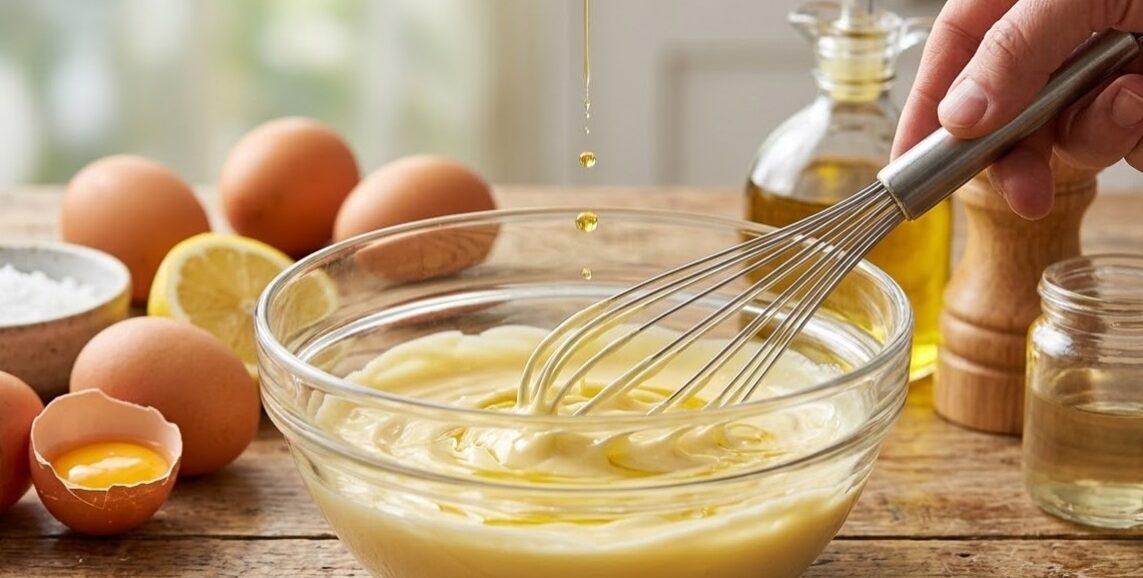
Begin by introducing your fat drop by drop, beating with maximum kinetic vigor against the side of the bowl. By forcing a tiny droplet of oil through the narrow gap between your whisk wires and the bowl basin, you generate immense shear force that shatters the fat into sub-micron droplets. Once a stable base of trillions of microscopic spheres is established, you can gradually accelerate your pouring stream into a steady ribbon, secure in the knowledge that your existing droplet army will readily assimilate the incoming lipids.
Respect thermodynamic temperature limits to preserve fragile emulsifiers
Thermal stability dictates the life and death of warm emulsions such as hollandaise, béarnaise, and beurre blanc. In egg-yolk-based sauces, heat plays a contradictory role. Gentle warmth is mandatory to relax and unfold the coiled yolk proteins, exposing their hidden lipophilic bonding sites to the fat. However, exceed 158°F (70°C), and those delicate proteins denature irreversibly, cross-linking into a tight, rubbery curd matrix that expels water and squeezes out fat.
Controlling this delicate kinetic balance mirrors the disciplined coordination where the Patriots Game Today Delivers 4 Major Strategic Battles in Primetime Week 7 Showdown, reminding us that flawless execution demands sharp situational awareness under intense heat. Maintain your sauce between 120°F and 145°F (49°C to 63°C). Too cold, and butter fats solidify into jagged crystals that slice through the protective surfactant film; too hot, and the egg curds cook into scrambled catastrophe.
Protect the continuous phase volume to avoid steric crowding
This critical ratio represents another core pillar of emulsion stability mechanics where cooks mistakenly blame fat content for what is actually hydration exhaustion. As you whisk more butter into a developing béarnaise, the sauce grows increasingly stiff, shiny, and viscous. An inexperienced cook interprets this growing resistance as a sign of perfection and continues adding more fat. Suddenly, the sauce fractures into greasy yellow oil and chalky curds.
The sauce did not break from excess agitation; it broke because it ran out of free water. As the oil droplet population exploded, every drop of available continuous water was consumed to form the thin lubricating layer between spheres. The solution is remarkably simple. Whenever your sauce becomes overly stiff and heavy on the whisk, immediately beat in a teaspoon of warm water, stock, or lemon juice. Replenishing the continuous phase loosens the microscopic traffic jam, lowers the packing fraction below the dangerous threshold, and instantly restores elasticity.
Deploy complementary surfactant networks for resilient binding strength
Single-surfactant systems are inherently fragile and easily disrupted by sudden temperature shifts, acidic shocks, or mechanical standing. Savvy culinarians engineer indestructible stability by stacking complementary emulsifiers that work via completely different chemical mechanisms. While egg yolk relies on small, mobile phospholipids like lecithin, plant-based culinary additives offer large macromolecular polysaccharides that stabilize mixtures mechanically.
Adding a half-teaspoon of Dijon mustard to a classic vinaigrette or mayonnaise introduces complex plant mucilages and sinapine. These long carbohydrate chains do not just coat oil droplets; they physically tangle in the water phase, dramatically increasing the continuous phase’s viscosity. This thickened fluid dramatically slows down droplet movement, preventing fat spheres from colliding and coalescing even when the sauce sits stationary at room temperature for hours.
Emergency resuscitation techniques when a sauce catastrophically splits
When a sauce inevitably splits, analyzing your emulsion stability mechanics allows you to diagnose the exact failure point and salvage dinner without throwing a single ounce of expensive butter into the trash. Sauces break in one of two ways: either they get cooked past the thermal point of protein destruction, or the dispersed phase outgrows the continuous phase. Diagnosing which occurred tells you exactly how to execute a flawless rescue.
If the sauce feels greasy, cold, or excessively thick before fracturing, the break stems from hydration depletion or phase inversion. Whisk a single tablespoon of warm water in a clean, warm stainless steel bowl. Take your broken sauce and treat it precisely as you did the original melted butter: introduce it drop by drop into the fresh water base while whisking hard. The clean water provides an abundant, uncrowded continuous phase, instantly accepting the broken fat droplets and restoring the silky matrix within sixty seconds.
If the sauce overheated and the proteins clumped into visible yellow grits, simple water will not suffice because the native surfactants have suffered permanent thermal denaturation. In this scenario, grab a fresh egg yolk and whisk it in a clean bowl with a teaspoon of lemon juice over gentle residual steam until slightly foamy. Use this newly hydrated, uncompromised surfactant engine as your new continuous base, slowly streaming the broken, curdled sauce into it. The fresh yolk wraps around the liberated butterfat, smoothing over the coagulated protein flecks and turning culinary disaster into an unblemished triumph.
Sensory cues and muscle memory for lifelong saucier mastery
Relying on kitchen thermometers and rigid volumetric measurements will only take your saucier skills so far. True culinary mastery lives in your hands, ears, and eyes. An experienced saucier monitors an emulsion through sensory feedback loops that communicate physical phase transitions long before a break occurs.
Listen closely to the sound of your whisk against the copper or stainless bowl. In the beginning, the whisk produces a sharp, splashing, hollow clatter as it cuts through thin liquid. As the oil disperses into billions of tight spheres and the viscosity climbs, the acoustic pitch deepens into a muffled, rhythmic thud. That heavy, slapping sound is the auditory signature of high dispersed-phase packing, warning you that the continuous phase is nearing its physical saturation point.
Visually, watch how the sauce falls from the whisk tines. A healthy, thriving emulsion flows in smooth, elastic ribbons that fold gently upon the surface for two seconds before disappearing seamlessly into the glossy body. If the surface appears dull, greasy, or reveals tiny pinprick beads of sweat along the rim of the bowl, stop adding fat immediately. That sweat is unencapsulated lipid signaling imminent collapse. Ultimately, developing an instinctive feel for emulsion stability mechanics frees you from rigid ingredient ratios and fragile recipes, giving you the supreme culinary confidence to bend fat, water, and heat entirely to your will.