Foley sound design mechanics and 4 proven rules that create unforgettable sonic realism
Cinema relies on an elaborate acoustic illusion to make audiences believe what they see. Explore how Foley sound design mechanics transforms everyday props into unforgettable cinematic realism.
Mastering Foley sound design mechanics requires understanding that what human ears accept as visceral reality on screen is almost entirely an acoustic fabrication. When an actor strides across cracked gravel or unzips a heavy canvas parka, the production microphone rarely captures anything usable. Location dialogue recording intentionally isolates the actor’s mouth, deploying directional shotgun microphones that reject incidental rustles, footsteps, and background clatter. Without customized audio layered frame by frame during post-production, a scene feels strangely disembodied, akin to a silent dress rehearsal staged in a vacuum. The images on screen remain distant two-dimensional projections until physical touch breathes tactile weight into the frame.
Named after Jack Foley, an early cinema innovator who performed synchronized physical effects against projected silent footage in the late 1920s, the trade is far more nuanced than simple mimicry. A Foley artist does not duplicate noise for the sake of reproduction. They decode emotional subtext, narrative pacing, spatial distance, and character psychology. Every scuff of a worn boot heel, the faint creak of floorboards in an abandoned hallway, or the gentle slide of porcelain across a table informs the audience how to interpret the emotional atmosphere.
The acoustic illusion bridging physical movement and human psychology
Why does an audience instantly believe that twisting a head of celery represents the catastrophic fracture of human bone, or that squeezing wet cornstarch recreates footsteps pressing into arctic snow? The human brain is remarkably indifferent to spectral realism as long as the temporal attack and dynamic decay sync with the visual impact. At its core, Foley sound design mechanics functions through the exploit of psychoacoustics, specifically the cross-modal perceptual phenomenon known as the ventriloquism effect. When the visual cortex registers a physical contact, the brain demands immediate acoustic confirmation. If a sound registers within twenty to forty milliseconds of that visual contact, our sensory processing fuses the two inputs into an unshakeable illusion of singular causality.
Sound practitioners evaluate every noise by dissecting its acoustic envelope, specifically the transient attack, sustain, and decay. In unvarnished reality, a fist striking a human jaw yields a muted, underwhelming thud that lacks cinematic drama. Screen storytelling requires an auditory representation of pain, bone mass, tissue displacement, and kinetic violence. Foley teams manufacture this composite experience through layered acoustic deception. A leather glove slapped across wet flagstone yields the stinging high-frequency snap of skin contact, snapped celery stalks provide the crunch of cartilage fracture, and an old leather medicine ball dropped onto heavy timber provides the low-frequency concussive inertia. According to Audio Engineering Society research on psychoacoustics and spatial audio perception, the human ear binds these separate physical events together because their transient peaks align with mathematical precision against the screen action.
The anatomical layout of a professional soundstage pit
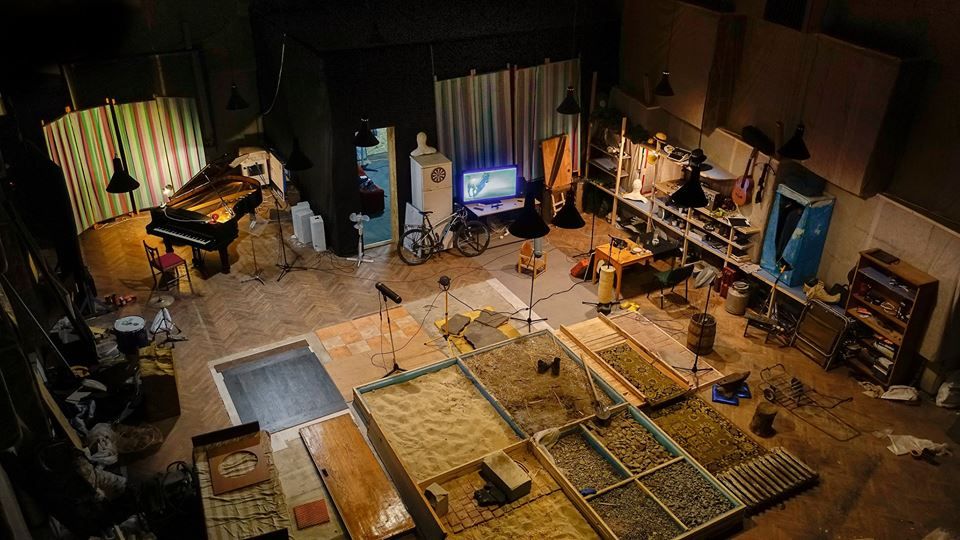
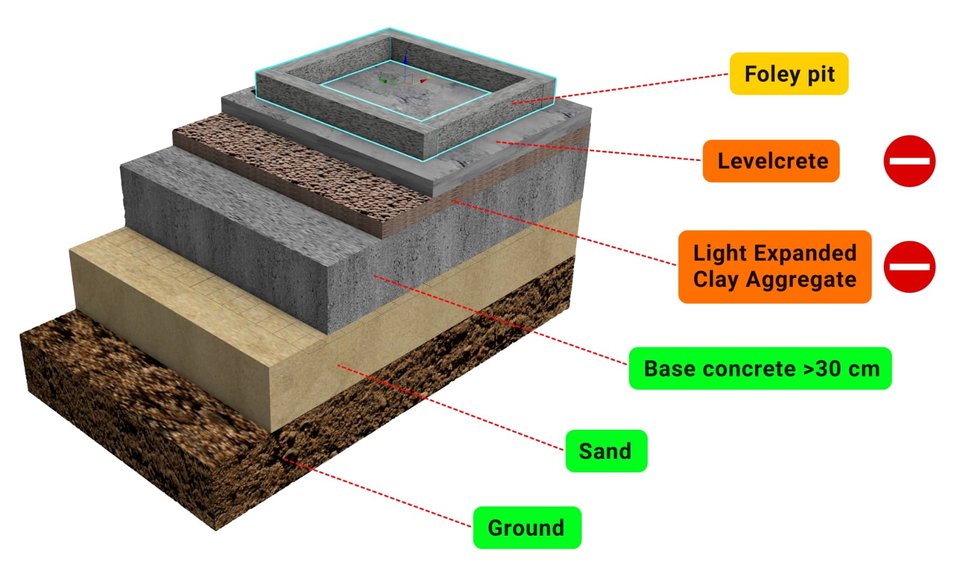
Step across the threshold of a premier post-production stage and the room resembles an eccentric architectural laboratory. Foley stages are acoustic sanctuaries, built with isolated floating concrete foundations and attenuated ventilation systems engineered to pull ambient noise floors below fifteen decibels. In the center of the recording space sit sunken, compartmentalized troughs known as Foley pits. Each pit is filled with a distinct architectural or natural surface, including rough pea gravel, fine river sand, unsealed flagstone, aged tongue-and-groove white oak, cracked asphalt, and deep loam soil.
Every physical architectural detail inside a dedicated Foley studio is calibrated to support these Foley sound design mechanics with surgical repeatability. Walking pits must never have hollow resonance chambers underneath; they are backfilled with tons of poured concrete to ensure footsteps sound solid rather than hollow and boxy. Along the perimeter walls rest arrays of tactile oddities: vintage automotive doors clamped to mobile wooden frames, heavy barn hinges, stacks of mismatched crockery, and racks of diverse textiles ranging from stiff denim to silken taffeta. Experienced artists catalog dozens of shoe pairs by heel construction, from hard leather dress soles to crepe rubber wedges and spiked steel heels. The composition of that heel strike dictates whether a character strides with imperial authority, slips away in panic, or stumbles under exhausting grief.
Four proven rules that elevate Foley sound design mechanics from mimicry to pure narrative power
Transforming raw physical noise into compelling cinematic emotion depends on mastering fundamental audio craftsmanship across four distinct disciplines.
Decouple visual source identity from auditory texture
Inexperienced recordists often fall into the trap of literalism. They bring actual tree limbs into a studio to recreate a woodland fire, only to discover the resulting playback sounds thin, brittle, and lifeless. Seasoned Foley artists understand that what an object looks like rarely matches what produces its most convincing sound profile on a studio microphone. Snapping dry pine twigs registers as flat static; slowly twisting a fresh sheet of crinkled cellophane wrap inches from a large-diaphragm condenser capsule generates the crackle and roaring heat of a wildfire.
This decoupling principle requires the practitioner to discard visual assumptions and analyze sounds purely by their acoustic properties: transient sharpness, harmonic density, resonant decay, and frictional resistance. When sound artists need to create the terrifying crunch of an armored exoskeleton breaking, they do not search for insects; they crush stale fried taco shells wrapped tightly inside a damp kitchen towel. To simulate ancient knightly armor clattering across a stone floor, heavy steel logging chains swaddled in rough burlap communicate a terrifying sense of heavy metallic inertia that modern props cannot duplicate. Separating visual origin from auditory texture allows the artist to build hyper-real textures that resonate with visceral psychological power.
Anchor performance cadence to character weight and emotional friction
Footsteps and clothing rustle constitute the overwhelming majority of Foley recording time, yet they quickly become monotonous if executed mechanically. Walking is never an indifferent, rhythmic metronome; it is a direct projection of internal character psychology. A despondent character drags their feet, causing the shoe sole to scrape along the floorboards with prolonged friction and a hesitant decay. A nervous intruder walks on the balls of their feet, rolling weight along the outer edges of the sole to damp vibrational impact and suppress room reverberation.
This is where Foley sound design mechanics diverges sharply from standard sound effects editing: the artist acts through their own limbs in kinetic conversation with the screen. The Foley artist breathes in sync with the onscreen actor, matching their center of mass, posture, and muscular tension. When a character freezes in fear before turning a brass doorknob, the accompanying cloth movement—performed using a heavy twill work shirt twisted in the artist’s hands—must reflect that frozen, held breath. If the cloth track suddenly cuts out or sounds detached, the scene collapses emotionally. Every swish of cotton, friction of leather, or whisper of silk communicates subconscious emotional cues to the viewer.
Match microphone proximity to lens focal length and acoustic perspective
A persistent mistake in cinematic sound happens when ultra-close audio is pasted over a distant wide-angle visual. If a lone traveler walks across an expansive desert dune, recording their boot steps with a shotgun microphone positioned three inches above the sand induces profound cognitive dissonance. The sound arrives dry, suffocatingly close, and stripped of atmospheric space, instantly pulling the audience out of the narrative trance.
A masterful Foley performance relies on a collaborative relationship between the performer and the recording engineer, who constantly modulates microphone choice, position, and preamplification to match the director’s visual framing. An intimate close-up framing demands a directional hypercardioid microphone placed within twelve to eighteen inches of the prop, capturing micro-textures like fingertip friction and cloth fibers rubbing together. For wide establishing shots, the engineer backs the primary microphone away several meters or blends in a matched stereo pair positioned across the live room to capture ambient room reflections. By mirroring the optical focal length with spatial acoustic depth, the Foley tracks seat themselves naturally within the image instead of hovering like synthetic stickers on the screen.
Carve precise frequency pockets around dialogue and musical arrangement
Foley does not exist in an isolated audio showcase. It must survive inside a dense final mix where it constantly tussles for acoustic bandwidth against critical spoken dialogue, booming sound effects, and soaring orchestral scores. A thunderous boot step possessing rich sub-bass around 80 Hz might sound majestic in solo playback, but in the final theatrical mix it will violently clash with the bass guitar, orchestral timpani, and the natural chest resonance of the lead actors.
Master craftsmen carve acoustic space before their audio ever encounters digital equalization plugins. If the dialogue in a sequence occupies heavy lower-midrange frequencies, the Foley performer deliberately selects hard-soled dress shoes or metallic props that generate bright, articulate high-frequency transient clicks rather than dull, heavy thuds. If an action sequence features a blaring brass fanfare, the artist performs footsteps with crisp, short attacks that slice effortlessly between the rhythmic pauses of the musical horns. Treating physical props as dynamic orchestral instruments prevents sonic overcrowding, guaranteeing that every delicate scrape, click, and rustle registers with crystal clarity without obscuring narrative clarity.
The delicate friction between tactile authenticity and cinematic exaggeration
Cinema has never functioned as an objective transcript of real-world physics; it is an elaborate illusion engineered to evoke emotional conviction. Just as biographical dramas frequently sacrifice literal biographical timelines to heighten dramatic stakes—an issue highlighted when Kerry Kennedy Details 3 Painful Truths Hollywood Got Completely Wrong—the sound designer routinely abandons documentary fidelity in pursuit of psychological truth. If a post-production team recorded actual footsteps on an ordinary corporate carpet using clinical documentary techniques, the resulting playback would feel thin, distant, and curiously lifeless against the dramatic tension of the story.
Examining practical Foley sound design mechanics reveals that human perception prioritizes emotional resonance over textbook accuracy. During an intimate police interrogation, the director does not want the modest acoustic signature of an office chair scraping across cheap vinyl tiles; they want the grating, nerve-wracking shriek that exposes the suspect’s crumbling composure. The Foley artist obliges by tilting the chair frame at an unnatural angle, digging one metal leg sharply into the surface to generate piercing high-frequency friction. Realism in narrative cinema is rarely about capturing the truth of what an object sounds like in nature. It is about discovering what physical sound makes the audience believe the emotional reality unfolding on the screen.
The enduring human pulse beneath modern digital signal processing
With the meteoric rise of massive sample libraries, procedural audio engines, and algorithmic sound generation tools, some industry observers predicted that physical Foley stages would inevitably vanish into cinematic history. Yet digital libraries, regardless of how many gigabytes of multi-sampled impacts they contain, suffer from a fundamental structural flaw: they are static acoustic snapshots detached from spontaneous dramatic context. A sound editor triggering pre-recorded footsteps cannot intuitively mirror an actor’s sudden stagger, hesitate slightly on a wooden floorboard to reflect mounting dread, or subtly shift weight to convey exhaustion.
Ultimately, sophisticated Foley sound design mechanics will never be entirely replaced by synthetic generators or static sound libraries. The craft remains irreducibly human because it is fundamentally an exercise in embodied empathy. Foley artists are not machine operators; they are silent physical actors who stand in darkened rooms beneath giant projection screens, breathing in synchrony with the characters and translating psychological vulnerability into kinetic friction. That intuitive, flesh-and-blood connection is what bridges the gulf between light on a screen and genuine human belief, ensuring that the magic of cinema retains its beating pulse.