Emulsion stability mechanics reveal 4 proven secrets to master velvety sauces
Few kitchen failures sting quite like watching a glossy sauce split into an oily, curdled puddle. Understanding the molecular choreography of fat and water transforms your culinary confidence from frantic guesswork into pure mastery.
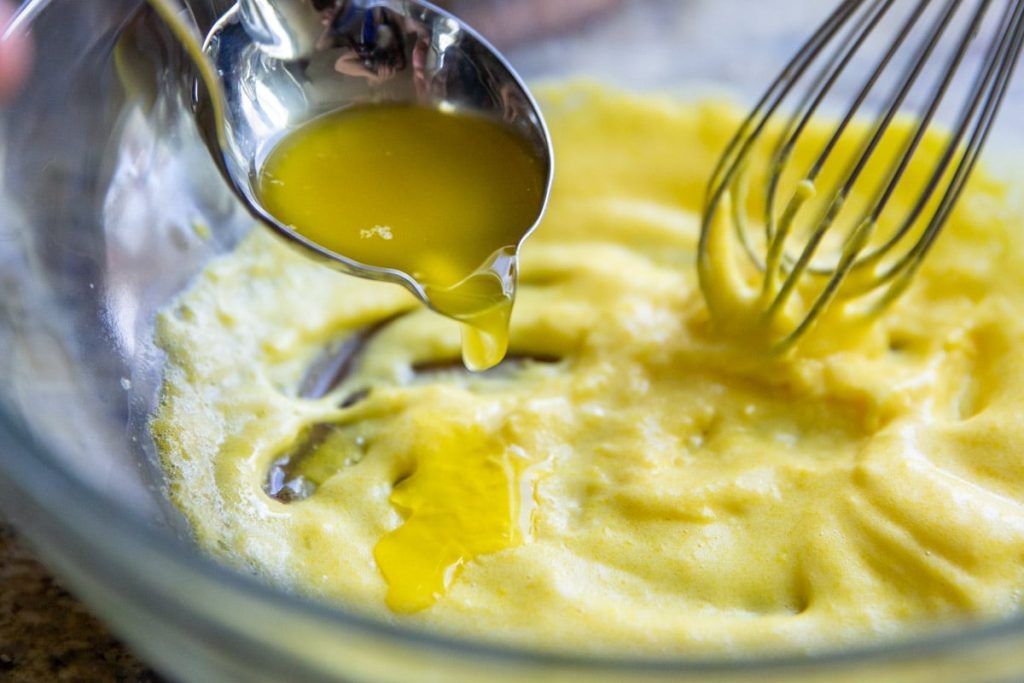
Mastering emulsion stability mechanics gives home cooks an almost unfair advantage over temperamental pan sauces, glossy hollandaise, and velvety dressings. We have all watched in horror as a silky béarnaise suddenly separates into a tragic yellow pool of liquid fat floating atop grainy curds. It feels like bad luck or culinary betrayal, but it is actually just physics asserting its dominance over an unstable liquid blend.
Sauces are rarely static mixtures. In truth, an emulsion is a precarious ceasefire negotiated between two natural enemies that desperately want nothing to do with each other. When you whisk oil into vinegar or melted butter into egg yolks, you are forcing trillions of stubborn molecules into an unnatural physical arrangement. Once you recognize why those droplets stay suspended or suddenly collapse, the kitchen ceases to be a house of cards.
The Invisible War Between Oil and Water
At the fundamental molecular scale, water molecules are tiny, intense dipoles. They carry partial electrical charges that pull them toward one another with relentless enthusiasm, forming dense networks of hydrogen bonds. Fats and oils, by contrast, are large, nonpolar hydrocarbon chains. They possess no electrical charge and have zero interest in sharing space with polar liquids. Drop a spoonful of olive oil into water, and the water molecules snap together like tiny magnets, squeezing the nonpolar oil molecules away until they pool on the surface.
Thermodynamics always favors the lowest possible energy state. For a mixture of oil and water, that lowest energy state is two completely separate layers with minimal contact surface between them. Forcing them to mix requires tremendous mechanical energy to break the oil into microscopic droplets. Yet no matter how violently you shake a jar of simple oil and vinegar, the droplets eventually bump into one another, fuse, and separate back into distinct strata within minutes. Pure kinetic agitation alone cannot conquer interfacial tension.
Bridging this thermodynamic gulf demands a profound shift in technique. Much like how Maillard reaction mechanics reveal 4 proven secrets to unlock unbelievable flavor and crust through precise thermal controls, understanding emulsion stability mechanics turns what seems like culinary luck into repeatable science. You do not need good fortune to hold a sauce together; you need molecular scaffolding.
How Molecular Surfactants Anchor Liquid Suspensions
To prevent dispersed oil droplets from snapping back together, you need an intermediary. In food science, these peacemakers are known as surface-active agents, or surfactants. Surfactants are amphiphilic molecules possessing a split personality. One end of the molecule is hydrophilic, loving water and binding eagerly to polar liquids. The opposite end is lipophilic, craving fats and embedding itself deeply into oil droplets.
When you introduce a surfactant into a liquid mixture, these molecules immediately swarm the boundary layer between the two immiscible fluids. Their oily tails bury themselves into the suspended fat droplets, while their water-loving heads stick outward into the surrounding water matrix. This orientation creates a protective electrical or physical shield around every single droplet. Because all the outward-facing heads carry similar electrostatic charges or bulky molecular structures, they physically repel one another whenever droplets drift close.
At the very core of emulsion stability mechanics sits the amphiphilic molecule, serving as a microscopic shock absorber that prevents droplets from coalescing. Without these boundary guardians, even the most vigorous mechanical whipping will collapse the moment you lay down your whisk.
Emulsion Stability Mechanics Reveal 4 Proven Secrets for Flawless Sauces
Creating velvety restaurant-quality sauces does not require formal culinary school training. Applying emulsion stability mechanics allows any chef to create emulsions that hold their structure through heat, resting, and plating.
Controlling Temperature to Prevent Phase Separation
Temperature dictates both the physical state of your fats and the structural integrity of your protein surfactants. Consider butter, which is already an emulsion of roughly eighty percent milkfat suspended within sixteen percent water and four percent milk solids. When making a hollandaise or a classic French beurre blanc, heat is your most volatile variable. If your pan drops below roughly 85 degrees Fahrenheit, the butterfat begins to crystallize, forming jagged microscopic solid fat crystals that puncture droplet membranes and trigger rapid separation.
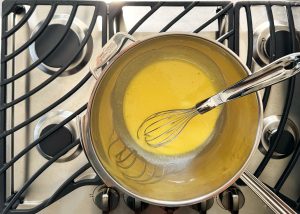
Conversely, excessive heat spells immediate catastrophe for warm egg-based sauces. The egg yolk proteins act as your primary surfactant shield, but once the pan surpasses 155 degrees Fahrenheit, those proteins denature aggressively and cross-link into tight, rubbery ropes. Instead of coating your butter droplets, the curdled proteins knot together, violently squeezing out water and releasing all the trapped butterfat into an unappetizing greasy slick. Keeping your sauce gently warmed within a narrow sweet spot between 115 and 140 degrees Fahrenheit preserves liquid lipid flow without cooking the protective protein barrier.
Calibrating the Mechanical Shearing Speed and Volume Ratio
The size of your suspended droplets directly influences whether an emulsion survives. Large droplets have high buoyancy and easily collide, whereas sub-microscopic droplets stay suspended almost indefinitely due to natural kinetic motion. Achieving those tiny droplets requires deliberate mechanical shear. A hand whisk applies moderate shear, but an immersion blender generates extreme shear, spinning at thousands of revolutions per minute to slice fat droplets into uniform micro-spheres within seconds.
However, shearing means nothing if you flood the continuous phase with too much oil too early. When starting a mayonnaise or hollandaise, adding oil faster than your mechanical tool can shear it creates gigantic oil slicks that drown the water phase. You must add oil drop by agonizing drop at the start, ensuring each droplet is thoroughly sheared and coated in surfactant before introducing more. As researchers documented through the Harvard University Science and Cooking program, this delicate ratio governs emulsion stability mechanics by dictating whether droplets remain suspended or collide with catastrophic momentum.
Harnessing Natural Amphiphilic Molecules as Stabilizers
Savvy cooks deliberately choose ingredients packed with powerful natural surfactants. Egg yolks are the gold standard because they contain high concentrations of lecithin, a phospholipid whose phosphate head is intensely polar while its fatty acid chains bond tightly with neutral fats. A single egg yolk contains enough lecithin to emulsify dozens of cups of oil, provided there is sufficient water present to keep the continuous phase flowing freely.
Plant-based stabilizers provide equally formidable reinforcement. Prepared Dijon mustard contains complex polysaccharides, proteins, and mucilage extracted from the crushed mustard seeds. Adding a tiny teaspoon of Dijon mustard to a basic red wine vinaigrette introduces enough surface-active carbohydrates to keep your dressing cohesive for days rather than seconds. Similarly, crushing fresh garlic releases allicin and plant surfactants that make traditional Spanish alioli remarkably stable without requiring a single drop of egg yolk.
Managing Viscosity to Lock Suspended Droplets in Place
Liquid thickness provides the final defensive barricade against a split sauce. According to Stokes’ Law, the speed at which suspended droplets float to the top or sink to the bottom is inversely proportional to the viscosity of the continuous liquid. A thin, watery liquid allows fat droplets to zip around freely, drastically increasing the probability that they will crash into one another, merge, and cause a breakdown. A dense, viscous liquid acts like thick mud, freezing droplets in space and preventing them from touching.
You can artificially manipulate continuous phase viscosity to safeguard your emulsion. Adding a splash of heavy cream introduces pre-emulsified milkfat and casein micelle structures that immediately thicken the base liquid. Whisking in cold cubes of butter at the very end of a reduction sauce, a classic technique known as monter au beurre, builds an instant structural matrix where butterfat droplets become physically trapped in a dense web of liquid and milk solids before they ever have the chance to pool.
Rescuing a Broken Sauce Before Dinner Is Ruined
Even seasoned culinary veterans occasionally push an emulsion too far. A moment of distraction over high heat or an overzealous pour of clarified butter can instantly cause your velvety sauce to tear apart. The fatal mistake most cooks make at this stage is panic-whisking the broken mess. Violently beating a separated mixture only pushes free oil against free oil, compounding the problem and making the separation permanent.
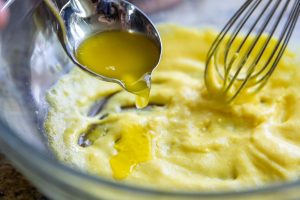
To repair the damage, you must re-establish the continuous phase from scratch. Take a clean bowl and add a single tablespoon of warm water, lemon juice, or an egg yolk. This fresh liquid serves as your new continuous landing pad. Now, slowly trickle your broken, oily sauce into this fresh base while whisking with relentless rhythm. The fresh water phase and uncompromised surfactants immediately grab the incoming dispersed droplets, re-coating them one by one. Within thirty seconds, the broken liquid transforms back into a luxurious, glossy sheen. Remember, when you understand emulsion stability mechanics, a broken sauce is not a disaster; it is merely an unfinished suspension waiting for an extra dose of surface area.
The Lifelong Intuition of an Instinctive Cook
Once you see sauces through the lens of physical mechanics rather than superstitious culinary folklore, the anxiety evaporates from your kitchen. You no longer measure ingredients with trembling hands, wondering if your vinaigrette will humiliate you at the dinner table. You begin to read the sensory cues that your eyes and whisk convey.
You notice the subtle color shift from translucent to opaque as droplets break down into microscopic light-scattering particles. You feel the distinct tactile drag against your whisk wires as viscosity locks the dispersed phase into place. You recognize the greasy warning ring forming at the pan’s edge before a split becomes irreversible. Ultimately, embracing emulsion stability mechanics frees you from recipe anxiety forever, giving you the practical intuition to build, balance, and sustain breathtaking sauces that elevate every meal you make.