Emulsion sauce stability mechanics and 4 proven rules that prevent devastating culinary splits
Unravel the fluid dynamics and microscopic forces that govern delicate culinary suspensions. Learn how to balance shear force, surfactants, and thermal thresholds to guarantee unbreakable sauces every time.
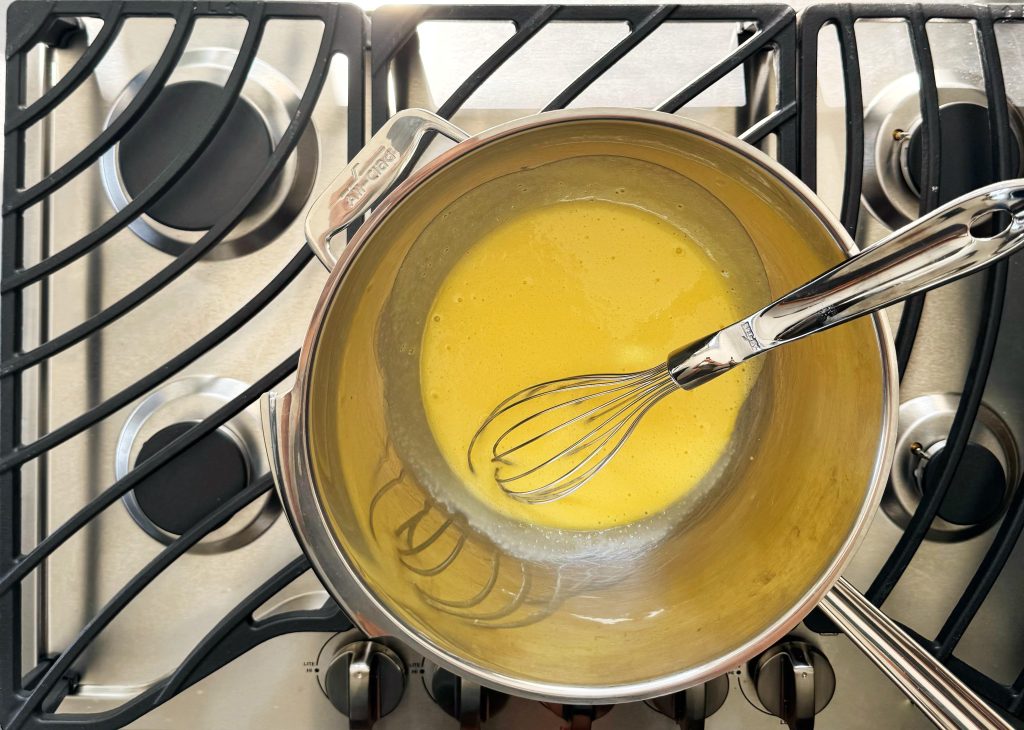
Mastering emulsion sauce stability mechanics transforms chaotic kitchen guesswork into predictable, razor-sharp culinary precision. Every cook has watched in quiet horror as a glossy, velvety hollandaise or delicate beurre blanc suddenly curdles into a tragic puddle of separated grease and curd-like flecks. It feels like betrayal, but the failure is purely physical. At its heart, a culinary emulsion represents an unnatural alliance. You are compelling two fundamentally hostile substances, water and lipid molecules, to occupy the same space without pulling apart.
Success has little to do with luck and everything to do with fluid dynamics, interfacial surface tension, and molecular geometry. Once you understand the physical forces at play across your whisk, you cease to be a fearful recipe follower and become the undisputed master of your pan. Whether crafting a silky mayonnaise, a rich béarnaise, or an ethereal pan sauce, the underlying laws of physical chemistry remain identical.
The Thermodynamic Tightrope Inside Every Classic Suspension
Water molecules are fiercely loyal to their own kind. Bound together by relentless hydrogen bonding, water forms an intensely cohesive, highly polar network that vigorously squeezes out nonpolar hydrocarbons. Drop vegetable oil or clarified butter into liquid, and the hydrophobic effect immediately kicks into gear. Water maximizes its internal hydrogen bonds by pushing the oil away, driving individual fat droplets toward one another until they merge into the smallest possible surface area: a single, uninterrupted layer floating on top.
This thermodynamic reality illustrates the fundamental premise of emulsion sauce stability mechanics, which rests entirely on defeating entropy. Thermodynamic equilibrium always favors phase separation because an unbroken boundary minimizes the interfacial free energy between liquid and fat. To suspend billions of tiny oil droplets throughout an aqueous medium, you must expend mechanical energy while simultaneously introducing physical barriers that prevent those droplets from colliding and merging. It is a state of kinetic metastability. An emulsion is never truly permanent in the eyes of physics; it is merely an engineered delay of an inevitable collapse, sustained by structural obstacles that make separation infinitely slow.
The Microscopic Architecture of Fat and Water Molecules
To prevent microscopic fat globules from fusing back together upon contact, the continuous aqueous phase requires amphiphilic mediators known as surfactants. These molecules possess a split personality: a polar, hydrophilic head that eagerly binds to water, and a nonpolar, hydrophobic hydrocarbon tail that anchors itself securely inside the lipid droplet. When whisked into an incipient sauce, surfactants align themselves along the boundary between the two fluids, coating each lipid sphere in a protective, charged perimeter that repels neighboring spheres.
Egg yolks provide the quintessential culinary surfactant in the form of lecithin, alongside a complex matrix of low-density lipoproteins. In dairy-based emulsions like beurre blanc or pan gravies, milk proteins such as casein take on this critical defensive role. According to research popularized by the Harvard John A. Paulson School of Engineering and Applied Sciences, phase stability in food systems relies on precise control over interfacial tension and droplet packing fractions. A comprehensive grasp of emulsion sauce stability mechanics requires seeing these surfactants as structural rebar rather than passive flavor additives. Without sufficient surfactant coverage, shearing oil into tiny droplets is entirely pointless. The newly formed interfaces remain raw and exposed, causing the droplets to instantly coalesce back into bulk oil the second your whisk pauses.
The 4 Proven Rules That Anchor Unbreakable Emulsions
Mastering everyday emulsion sauce stability mechanics demands strict adherence to physical principles rather than superstitious culinary folklore. If you violate the spatial and thermodynamic laws governing fluid mixtures, the emulsion will disintegrate regardless of your intentions. Adhering to four mechanical principles guarantees structural integrity under any culinary pressure.
1. Controlling Continuous Phase Volume Before Dispersing Fat
The fatal error in most failed sauces occurs during the opening seconds. Before introducing a single drop of fat, you must establish an adequate continuous water phase. In mayonnaise or hollandaise, that initial aqueous volume is supplied by egg yolks, vinegar, lemon juice, or wine reductions. If you pour oil into an insufficient volume of water, the lipid droplets will immediately crowd one another past the theoretical limit of spherical packing, roughly 74 percent dispersed phase volume, forcing a catastrophic phase inversion where the sauce flips into an unpalatable water-in-oil dispersion.
Beginning with roughly one to two tablespoons of continuous liquid per yolk provides the physical elbow room needed for droplets to swim freely without colliding prematurely. Applying emulsion sauce stability mechanics during active pan service begins with this geometric foundation: you cannot construct a suspension if there is nowhere for the dispersed droplets to hide.
2. Generating Microscopic Droplets Through High Velocity Kinetic Shear
Pouring fat slowly accomplishes nothing if your physical agitation lacks adequate shear force. Shearing is the mechanical act of tearing large globules of fat into trillions of microscopic spheres. A standard balloon whisk driven by rapid wrist rotation stretches the oil droplets across liquid velocity gradients, pulling them into thin threads that snap into sub-micron spheres. Immersion blenders accelerate this process exponentially by using spinning blades to induce catastrophic hydrodynamic cavitation.
If your whisking technique is slow, sluggish, or circular rather than rapid and cross-cutting, the oil enters the mixture as massive globules. Large droplets carry high kinetic momentum and collide aggressively, overpowering the repulsive electrostatic forces of your surfactants. High shear generates astronomical droplet counts with infinitesimal individual volumes. The smaller each droplet is, the more resistant it becomes to both gravitational creaming and impact coalescence, locking the sauce into an unshakeable, satin-like suspension.
3. Balancing Thermal Energy to Protect Delicate Surfactant Proteins
Temperature acts as both the engine and the assassin of warm emulsions like hollandaise, béarnaise, and beurre monté. Heat provides essential kinetic energy, reducing the viscosity of the fat phase so it shears effortlessly into tiny droplets. In egg-based sauces, gentle heat partially unfolds the coiled yolk proteins, exposing their hydrophobic cores so they can lock onto fat droplets and build a sturdy three-dimensional network.
However, exceeding the critical denaturation threshold transforms your protective surfactant matrix into scrambled solids. Once egg proteins heat beyond 68 degrees Celsius (155 degrees Fahrenheit), they cross-link irreversibly, ejecting the bound water from their structure and abandoning the fat globules entirely. Conversely, letting butterfat drop below its melting point of roughly 32 degrees Celsius (90 degrees Fahrenheit) causes crystalline fat structures to pierce through the surfactant barrier, prompting immediate collapse. Maintaining a gentle thermal sweet spot between 45 and 60 degrees Celsius ensures maximum surfactant resilience.
4. Regulating Viscosity and Packing Density to Halt Coalescence
As more dispersed fat enters the bowl, the internal geography of the sauce tightens. Droplets crowd against one another, dramatically raising the sauce’s apparent viscosity. This thickening is not merely cosmetic; it is an active stabilization mechanism. High continuous phase viscosity dampens droplet mobility, curbing Brownian motion and slowing down potential collisions that could lead to coalescence.
Yet this packing density creates a perilous tipping point. When the dispersed phase approaches that 74 percent spatial threshold, the emulsion becomes rigid, fragile, and prone to sudden splitting. Professional chefs combat this by interweaving micro-doses of water, stock, or lemon juice as the sauce thickens. Thinning the continuous phase resets droplet spacing, lowers internal tension, and reopens spatial capacity for further fat incorporation without risking structural collapse.
Diagnosing Broken States and Re-establishing Interfacial Equilibrium
Sauce degradation is not an amorphous mystery; it follows specific morphological patterns. Creaming occurs when low-density fat droplets drift to the top without merging, creating a visible gradient. Flocculation happens when droplets clump together into loose aggregates while retaining their individual membranes. The fatal stages are coalescence, where droplet boundaries dissolve into larger pools, and phase inversion, where the sauce completely turns inside out.
Analyzing failed gravies or broken hollandaise through the lens of emulsion sauce stability mechanics reveals that almost any break can be mechanically reversed. Because the chemical components remain intact, you only need to re-establish the correct geometric and thermodynamic parameters. The remedy is simple: place a fresh teaspoon of water or egg yolk in a clean bowl to establish a new continuous phase, then slowly whisk the broken mixture into it, drop by drop. The fresh surfactant and abundant water reset the continuous stage, capturing the free oil and dragging it back into organized spherical confinement.
Translating Laboratory Physics into Instinctive Kitchen Mastery
Mastery does not mean working with a microscope and a lab notebook at the stove. It means translating fluid mechanics into tactile, sensory intuition. You feel the changing resistance of the sauce against the tines of your whisk. You watch the surface transition from a dull, flat matte into a light-scattering, brilliant mirror gloss as droplet diameters shrink below the wavelength of visible light. You listen to the wet slap of the emulsion against the copper bowl shift from a thin splash into a heavy, rhythmic pulse.
In many ways, manipulating physical tension over heat mirrors the artistic balance found in classical stagecraft. Just as Film noir lighting mechanics and 4 proven rules that forge unforgettable cinematic tension rely on balancing stark shadows and hard key lights to construct dramatic visual cohesion, a great saucier balances incompatible phases of liquid and fat to achieve culinary harmony. Ultimately, internalizing emulsion sauce stability mechanics bridges the divide between sterile food science and instinctive restaurant execution, empowering you to command delicate sauces with calm, unshakeable authority.