Cast iron seasoning mechanics and 4 proven secrets to build indestructible nonstick cookware
Unravel the lipid chemistry and thermal physics that transform porous gray iron into an indestructible, glass-smooth cooking surface. Learn how proper cross-linking permanently solves sticky pans, flaking patina, and kitchen frustration.
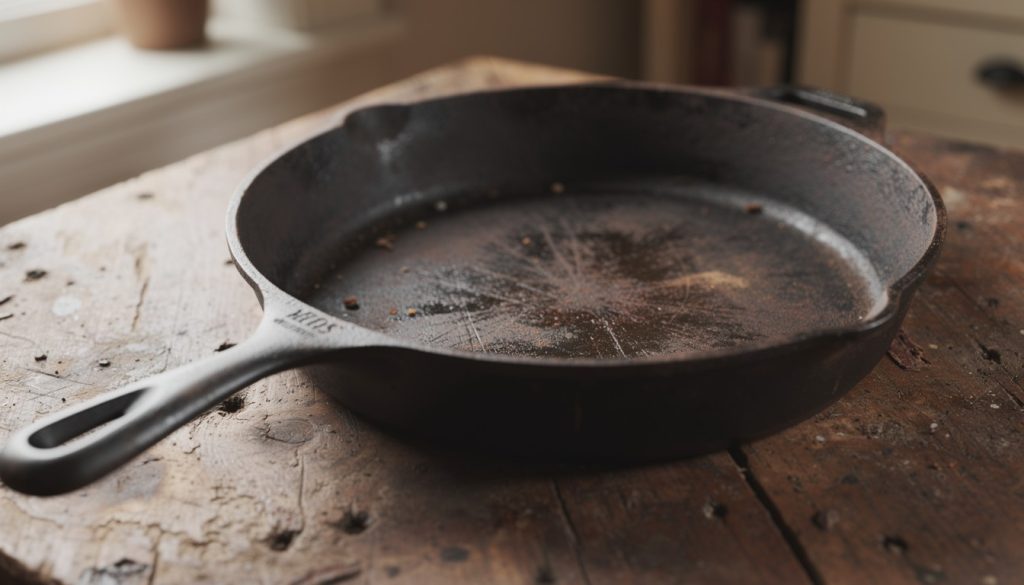
Grasping fundamental cast iron seasoning mechanics allows anyone to transform a dull, porous iron skillet into a slick, mirror-black heirloom. Most home cooks mistakenly treat seasoning as a delicate, mystical varnish built through superstitious grease rituals. In reality, the black patina coating an exceptional skillet is neither residual bacon fat nor simple burnt carbon. It is an ultra-thin, highly organized synthetic polymer created entirely through organic chemistry, thermal oxidation, and molecular cross-linking.
When liquid cooking fats meet molten metal thresholds inside an oven, fatty acid monomers unravel and bond directly to the microscopic crystal lattice of the iron substrate. Once bonded, this synthetic polymer provides an impermeable shield against atmospheric moisture while flattening microscopic peaks that would otherwise grip delicate proteins. Understanding this transformation strips away the guesswork and replaces culinary anxiety with pure material science.
The Molecular Transformation of Raw Metal into Black Glass
Cast iron is not a uniform, mirror-smooth metal slab. When viewed through a metallurgical microscope, gray cast iron reveals a coarse terrain littered with graphite flakes, interstitial voids, and jagged microscopic craters. These microscopic cavities create immense capillary suction and offer vast surface area for raw food proteins to latch onto. When heat breaks down cellular protein structures in raw meat or eggs, reactive sulfur and nitrogen atoms rapidly form covalent and ionic bonds directly with bare iron ions at the surface, gluing the food to the skillet.
Bridging this microscopic expanse requires more than just brushing on grease. Here at the core of cast iron seasoning mechanics, liquid fats surrender their fluidity through thermal oxidation and radical cross-linking, shifting from free-flowing triglycerides into a solid, insoluble plastic skin. Under prolonged heat exposure past an oil’s thermal cracking limit, unsaturated carbon-carbon double bonds break apart. Free radicals form instantly, seeking adjacent fatty acid chains and snapping them together into durable carbon-carbon matrices.
This cross-linked lattice anchors directly inside the pores of the metallic iron matrix. As multiple microscopic coats cure sequentially, each newly polymerized sheet bonds to the previous tier. The result is a smooth, glass-like sheet that buries the iron’s jagged microscopic ridges beneath a chemically inert surface. Moisture cannot penetrate down to fuel oxidation, and fragile egg proteins slide across the floor without finding a single bare iron ion to seize.
Why Most Home Cooks Accidentally Strip Their Pans
The culinary mythos surrounding iron care causes immense confusion, leading cooks to either neglect cleanliness or destroy their hard-earned seasoning. Folklore insists that modern dish soap instantly dissolves seasoning. In the nineteenth century, soaps were produced through home saponification using harsh wood-ash lye, leaving excess sodium or potassium hydroxide capable of tearing through organic ester bonds. Modern dish detergents, however, are gentle surfactants that lift surface fats without damaging polymerized carbon networks. Running away from soap usually leaves rancid, sticky lipid grease behind rather than bare metal.
The true enemies of a resilient seasoning layer are sustained acid exposure and violent thermal shifts. Weak culinary acids like tomatoes, vinegar reductions, and wine will not destroy a mature pan during a brief three-minute pan sauce. However, simmering an acidic tomato ragu for two hours drives hydronium ions directly into microscopic fissures in the patina. These protons leach raw iron beneath the polymer skin, separating the organic sheet from its anchor points until the seasoning peels away in flakes.
Thermal shock presents an even more sudden peril. Dunking a screaming-hot pan into a sink of cold tap water forces the outer crystalline layers to contract while the interior core remains thermally swollen. The resulting uneven strain tears along graphite flake boundaries, generating violent fissures in the same way that Terremoto Tremors Expose 4 Critical Realities Behind Deadly Latin American Seismic Disasters through unyielding concrete foundations. Warping or catastrophic iron fractures ruin pans instantly, yet both stem from ignoring fundamental thermal kinetics.
Furthermore, when novice cooks disregard cast iron seasoning mechanics, they mistake carbonized food debris for durable, bonded protective layers. Black crust scraped from the bottom of an unwashed pan is brittle ash, not polymer. Burnt food lacks elasticity and cross-linking strength. The moment water or heat hits charred soot, it sloughs off into your scramble, exposing bare, vulnerable iron beneath.
Mastering the 4 Pillars of Unbreakable Polymeric Patina
Building an indestructible cooking surface does not require decades of generational cooking. Approaching your skillet with intentional thermodynamic discipline creates a commercial-grade seasoning profile in a single afternoon. Investigating authentic cast iron seasoning mechanics dispels the folklore that has long burdened classic kitchen castware.
1. Selecting Lipids with Optimal Iodine Value and Linolenic Bonds
Not all culinary fats possess the chemical architecture necessary to create durable polymers. Saturated fats like beef tallow, lard, and coconut oil contain zero double carbon bonds, meaning they cannot participate extensively in radical cross-linking. While our ancestors used lard out of agricultural abundance, modern polymer science confirms that polyunsaturated fatty acids yield far tougher crystalline networks.
The metric that determines an oil’s seasoning capability is its iodine value, which measures the amount of available carbon double bonds ready to open and weave molecular polymers. Oils packed with linoleic and alpha-linolenic acids, such as high-grade unrefined flaxseed oil, grapeseed oil, or standard refined canola oil, undergo rapid free-radical polymerization. Flaxseed oil provides maximum hardness, though its rigid crystal lattice can turn brittle if applied too thickly. Refined grapeseed and canola oils strike the ideal compromise, creating flexible, hard, and shock-resistant polymer networks that flex seamlessly with iron expansion.
2. Applying Microscopic Thin Coats to Prevent Gummy Pyrolysis
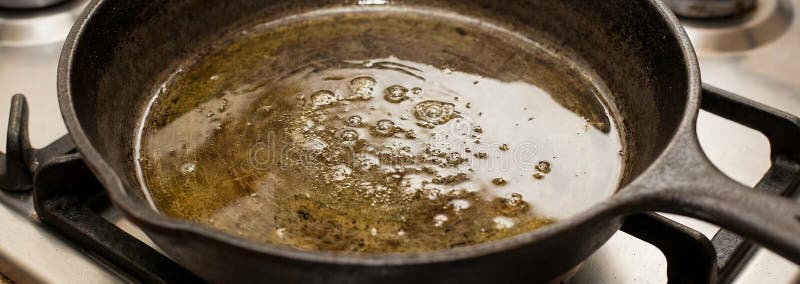
The single most destructive blunder in skillet maintenance is oil pooling. When oil cures as a puddling liquid, heat drives off volatile compounds from the outer surface while trapping wet, unpolymerized monomers underneath. This creates a sticky, amber sludge that smells rancid and acts like industrial flypaper against fresh food.
Application must be micro-thin. Pour a nickel-sized puddle of chosen oil into a lukewarm pan, rub it vigorously into every square millimeter of metal with a clean cotton rag, and then grab a completely dry cloth. Buff the pan aggressively as if trying to remove every single drop of oil you just applied. The iron should look completely dry and matte before it goes anywhere near an oven. What remains trapped in the microscopic pore structure is a film just a few molecules thick, which aligns directly with foundational cast iron seasoning mechanics, because excessively thick fat deposits boil rather than polymerize into glassy sheets.
3. Dialing Thermal Thresholds Beyond the True Monomer Glass Transition
A polymer layer cannot mature if your curing temperature lingers beneath the oil’s smoke point. The smoke point marks the precise kinetic threshold where triglycerides degrade, releasing glycerol and initiating radical decomposition. Baking below this temperature merely dries the oil into a tacky varnish that quickly dissolves during cooking.
Set your oven to at least 450 degrees Fahrenheit, or roughly 25 to 50 degrees above the specific smoke point of your chosen fat. Place the pan upside down to prevent any lingering micro-droplets from settling onto the cooking surface. Hold this thermal ceiling for at least sixty minutes. As described in LibreTexts chemistry research on lipid autoxidation and radical cross-linking, sustaining this energy allows polyunsaturated chains to transition past their glass transition phase into an insoluble, three-dimensional thermoset plastic. Turn off the oven and let the pan cool slowly inside over several hours to relieve interior stress within the new matrix.
4. Managing Mechanical Abrasion and Daily Culinary Maintenance
Many cooks handle seasoned cookware as if it were fragile porcelain, terrified that a metal utensil will scrape away months of hard work. In practice, a flexible, beveled stainless steel spatula is the best tool for accelerating nonstick performance. As you cook, the straight edge of a metal spatula shears off tall carbon burrs and planishes the higher microscopic peaks of the seasoning layer.
Over weeks of cooking, mechanical scraping flattens the topography without tearing away the flexible polymer anchoring within the deep valleys. When washing up, hot tap water and a stiff nylon brush or chainmail scrubber lift stubborn solids with ease. Rinse thoroughly, dry the skillet over medium heat on your stovetop for two minutes to vaporize all residual moisture, and wipe on a drop of neutral oil while the metal is warm. This daily cadence maintains the structural integrity of your patina without turning cleanup into a chore.
Diagnosing Flaking Rust and Sticky Residual Build-Up
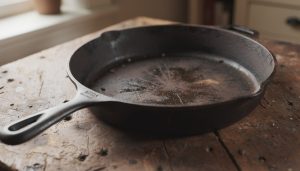
Skillets communicate their mechanical health plainly through texture and color. When a skillet feels gummy or tacky under your fingers, unpolymerized oil has accumulated on the floor. Fix this without stripping the whole pan by placing it dry into a 450-degree oven for an hour to finish the incomplete cross-linking, or scour the surface with coarse kosher salt and a splash of neutral oil to buff away the soft layer.
Flaking, however, signals a structural failure between the iron and the base polymer layer. This usually occurs when oil was applied over unremoved rust or baked in coats that were far too thick. Once a section begins to peel like blistered paint, spot-patching rarely holds. The foundational cast iron seasoning mechanics dictate that true polymers adhere only to cleanly exposed microscopic iron peaks. Scrape the loose material with stainless steel wool, scrub down to bright gray raw iron, and rebuild three micro-thin coats sequentially.
Rust occurs when bare iron encounters ambient oxygen and liquid water without an oily barrier. Light surface rust is purely superficial. It can be wiped away with a Scotch-Brite pad dampened with a mild vinegar solution, neutralized with clear water, and dried instantly over an open flame. Re-season immediately to reseal the exposed metal lattice before atmospheric moisture can spark fresh oxidation.
The Lifelong Payoff of Scientific Skillet Stewardship
Working with cast iron connects culinary craft directly to material science. Skillets forged over a century ago perform just as exquisitely today as the morning they left the foundry, purely because the chemical principles governing lipid polymerization do not degrade over time. Iron possesses incredible volumetric heat capacity, holding onto thermal energy and delivering aggressive crusts that light nonstick pans simply cannot replicate.
Freeing yourself from kitchen folklore transforms your relationship with heavy cookware. You no longer need to whisper around a skillet or panic if someone touches it with a drop of dish soap. By understanding oil chemistry, thermal limits, and physical abrasion, you turn raw, industrial metal into a responsive cooking instrument that improves with every sear. Possessing genuine mastery of cast iron seasoning mechanics shifts cooking from a timid gamble against sticking eggs into an effortless display of kitchen physics.