Emulsion stability mechanics and 4 proven secrets that stop disastrously broken sauces
A greasy, split sauce can ruin hours of careful culinary preparation in seconds. Uncover the colloidal physics behind emulsion stability mechanics to guarantee silkiness in every pan glaze, vinaigrette, and hollandaise.
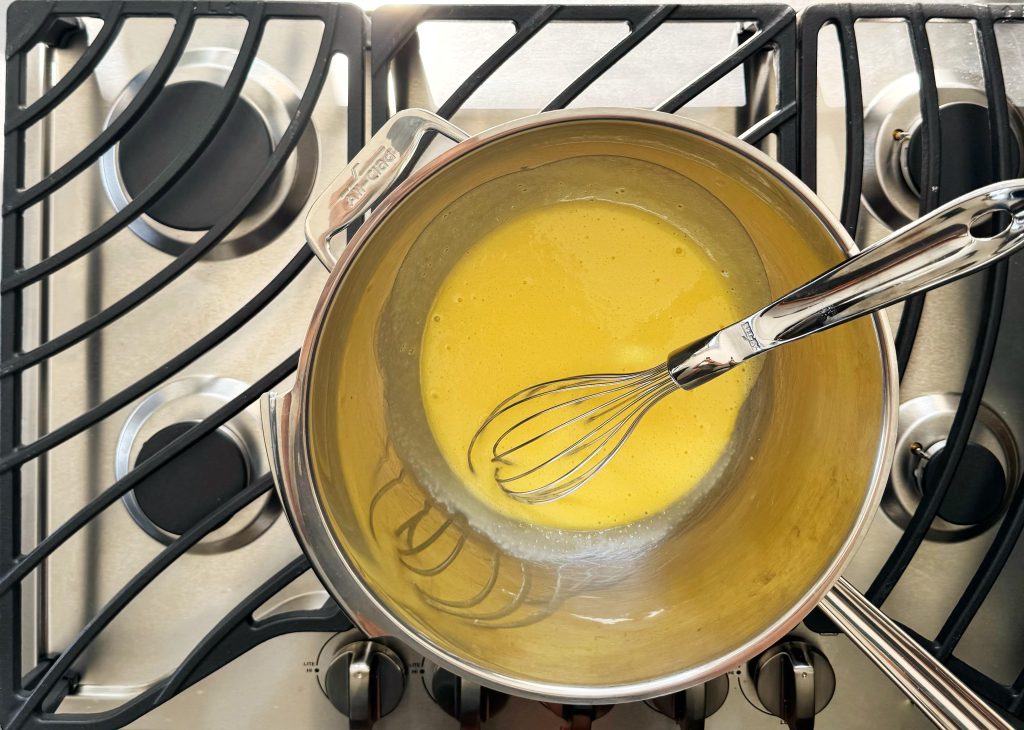
Mastering emulsion stability mechanics separates a hesitant cook from an instinctive practitioner who commands silky pan sauces and dressings without ever fearing an oily separation. There are few moments in the kitchen more demoralizing than watching a lustrous, velvety sauce abruptly fracture into a greasy puddle floating atop a dull, watery sludge. Whether you are whipping a delicate béarnaise over low heat, mounting cold butter into a reduced pan glaze, or shaking a basic vinaigrette, that heartbreaking curdling is not bad luck. It is colloidal physics in action.
Sauces are not simple liquid mixtures. They are delicate mechanical negotiations between two liquids that fundamentally despise each other. When you force fat and water into the same vessel, you are fighting the thermodynamic laws of entropy and surface tension. Without an understanding of the mechanical and chemical bridges required to bind them, the mixture will inevitably self-destruct. Once you understand the physical forces governing liquid suspensions, you can construct sauces that hold their gloss for hours, survive temperature swings, and rescue almost any split mixture in minutes.
The hidden molecular physics behind culinary suspensions
Every culinary emulsion consists of two distinct components known as the continuous phase and the dispersed phase. In an oil-in-water suspension, which encompasses mayonnaise, hollandaise, vinaigrettes, and pan glazes, water serves as the continuous phase. It forms the surrounding liquid ocean through which microscopic droplets of fat, the dispersed phase, must float freely without bumping into one another and recombining.
The central obstacle in this arrangement is interfacial tension. Water molecules are strongly polar, forming powerful hydrogen bonds that pull them tightly toward one another. Fat molecules are nonpolar and hydrophobic. When water encounters fat, the water molecules turn inward toward their own kind, squeezing the lipid molecules out. Left undisturbed, microscopic fat droplets collide, merge through a process called coalescence, and form progressively larger globules until they separate entirely into a distinct upper lipid layer, which forms the foundational pillar of emulsion stability mechanics in classical cuisine.
To overcome this natural drive toward phase separation, cooks must supply two things that nature does not provide on its own. The first is intense kinetic energy to physically shatter fat into billions of microscopic droplets. The second is an amphiphilic molecular agent that coats each droplet and prevents it from fusing with its neighbors when they inevitably collide.
How surfactant molecules anchor fragile culinary bonds
Brute force whisking can temporarily shatter oil into droplets, but mechanical agitation alone produces nothing more than a momentary truce. Within minutes, surface tension draws those droplets back together. This is why a simple mixture of olive oil and vinegar splits almost immediately after shaking. To achieve true permanence, a deeper look into emulsion stability mechanics reveals that chemical intermediaries are non-negotiable.
These intermediaries are surfactants, or surface-active agents. A surfactant molecule possesses an amphiphilic architecture, meaning it contains a hydrophilic polar head that loves water and a lipophilic nonpolar tail that binds to fat. When introduced into a developing suspension, millions of these molecules arrange themselves around the perimeter of every individual fat droplet. The fatty tails embed themselves directly into the oil droplet, while the water-loving heads point outward toward the surrounding liquid.
This microscopic armor creates an electrostatic and steric barrier. When two surfactant-coated fat droplets drift toward each other in a saucepan, their outward-facing hydrophilic shells repel one another, preventing coalescence. In the kitchen, we encounter these remarkable molecules across dozens of familiar ingredients. Egg yolks supply lecithin, butter carries casein proteins, Dijon mustard contributes complex plant mucilage, and garlic provides natural saponins. Each of these culinary anchors provides the physical scaffolding that keeps unruly lipid droplets securely suspended in water.
Four proven rules that guarantee flawless emulsion stability
Mastering emulsion stability mechanics requires controlling how mechanical energy is transferred into liquid interfaces rather than relying on desperate hoping and wild whisking. By standardizing four critical variables during preparation, you eliminate the risk of a sauce breaking regardless of recipe variations.
Control droplet size with intense initial shear force
The stability of any culinary suspension is inversely proportional to the diameter of its dispersed fat droplets. Large oil droplets possess high buoyancy and collide frequently, accelerating phase collapse. Microscopic droplets, measuring mere micrometers across, experience brownian motion, a chaotic thermal jostling that keeps them suspended indefinitely throughout the liquid. Generating these microscopic droplets requires severe mechanical shear during the opening seconds of emulsification.
Much like how mastering tennis serve mechanics and 4 proven secrets that build blistering ace power relies on focused torque and kinetic chain efficiency rather than brute arm flailing, generating high mechanical shear in a sauce pan requires rapid, directional whisking strokes that stretch and fracture lipid droplets into microscopic spheres. Swirling a whisk lazily around the base of a bowl accomplishes nothing because the liquid simply rotates along with the wires. You must pull the whisk through the mixture in rapid, alternating zig-zag strokes that create maximum shear stress against the bowl walls, or deploy the ultra-high rotational velocity of an immersion blender to tear fats into sub-microscopic droplets instantaneously.
Regulate phase volume ratios with progressive liquid additions
A frequent mistake in home kitchens is pouring fat into a sauce base too quickly. At the start of an emulsion, the continuous phase has very little volume. If you introduce a massive volume of oil into a single tablespoon of lemon juice or vinegar, the dispersed phase violently overwhelms the continuous phase, causing an immediate phase inversion where the sauce snaps into a greasy curd.
The fundamental rule of volume addition is progressive pacing. The first twenty percent of your fat must be incorporated drop by drop. Each droplet must be thoroughly sheared and coated with surfactants before the next drop enters the bowl. Once you have established a dense, stable baseline lattice of micro-droplets, the viscosity of the base increases significantly. At that stage, the continuous phase can easily accommodate larger additions, allowing you to pour the remaining fat in a steady, thin ribbon while whisking continuously.
Manage thermal thresholds to protect protein matrix integrity
Thermal regulation is the primary failure point for warm emulsified sauces such as hollandaise, béarnaise, and beurre blanc. Warm emulsions walk a razor-thin tightrope between two distinct thermodynamic traps, demonstrating how emulsion stability mechanics depend directly on temperature kinetics.
If the sauce drops below roughly 45 degrees Celsius, butterfat begins to crystallize. Solid fat crystals possess sharp, jagged molecular structures that pierce surfactant membranes, forcing trapped droplets to rupture and bleed liquid fat into an oily slick. Conversely, if the temperature climbs above 65 degrees Celsius, the egg yolk proteins that provide your surfactant shield begin to denature and coagulate into solid curd clumps. Once those proteins bind irreversibly to themselves, they abandon the fat droplets entirely, causing the sauce to instantly break. Maintaining your pan within the sweet spot between 50 and 60 degrees Celsius ensures fats remain fully liquid while proteins stay supple and intact.
Leverage physical viscosity to decelerate droplet coalescence
The speed at which suspended droplets float upward and collide is dictated by fluid dynamics, specifically governed by principles detailed in the Exploratorium science of culinary emulsions. According to Stokes’ Law of sedimentation, the velocity of droplet movement drops dramatically as the viscosity of the continuous liquid increases. Simply put, droplets trapped in a thick fluid cannot move fast enough to crash together and coalesce.
You can actively manipulate viscosity to safeguard delicate sauces. In pan deglazing, reducing stock until its natural collagen transforms into rich, gelatinous gelatin thickens the continuous water base, making it virtually impossible for butter mounted into the sauce to separate. Similarly, whisking a quarter-teaspoon of prepared mustard into a salad dressing introduces soluble plant polysaccharides that thicken the vinegar base, granting the vinaigrette days of refrigerated stability without a single droplet of oil rising to the surface.
Practical rescue tactics for bringing split sauces back from the brink
Even seasoned professional cooks encounter an occasional broken sauce during high-volume service. The difference between an amateur and a master lies in diagnostic recovery. When a sauce breaks, applying emulsion stability mechanics provides an immediate diagnostic roadmap rather than a blind panic.
If a sauce splits due to heat, take it off the flame immediately. Whisking furiously into an overheated pan will only accelerate the protein curdling. Instead, grab a clean bowl and add one single tablespoon of warm water, cream, or a fresh egg yolk. This clean base establishes a brand-new continuous phase packed with fresh, uncompromised surfactants.
Now, treat your broken, greasy sauce not as ruined garbage, but simply as raw fat waiting to be incorporated. Take the broken liquid and begin whisking it into your clean baseline one teaspoon at a time. The fresh surfactants and pristine continuous phase will capture the ruptured lipid droplets, pulling them back into a structured colloidal lattice. Within ninety seconds of steady whisking, the broken, curdled mess will re-emerge as a mirror-smooth, luxuriously glossy glaze with all of its original seasoning intact.
The quiet confidence of mastering kitchen chemistry
Culinary mastery is rarely about rigidly following printed ingredient lists. It is about recognizing the physical forces at work beneath the surface of your cookware. By respecting emulsion stability mechanics, you no longer rely on kitchen luck or superstitious rituals to produce world-class dressings, pan reductions, and velvety warm emulsions. You control droplet diameter through shear, balance phase volumes with measured additions, guard protein boundaries against thermal shocks, and utilize viscosity as a physical brake on molecular decay. With these four principles fixed firmly in your culinary intuition, every sauce you touch will hold its velvety finish from the first whisk to the final plate.