Emulsion sauce mechanics and 4 proven rules that prevent disastrous breaking
Few kitchen failures sting quite like an emulsion sauce splitting into a greasy, curdled puddle right before service. By mastering the core physics of suspended fat and surface tension, you can command hollandaise, mayonnaise, and beurre blanc with absolute confidence.
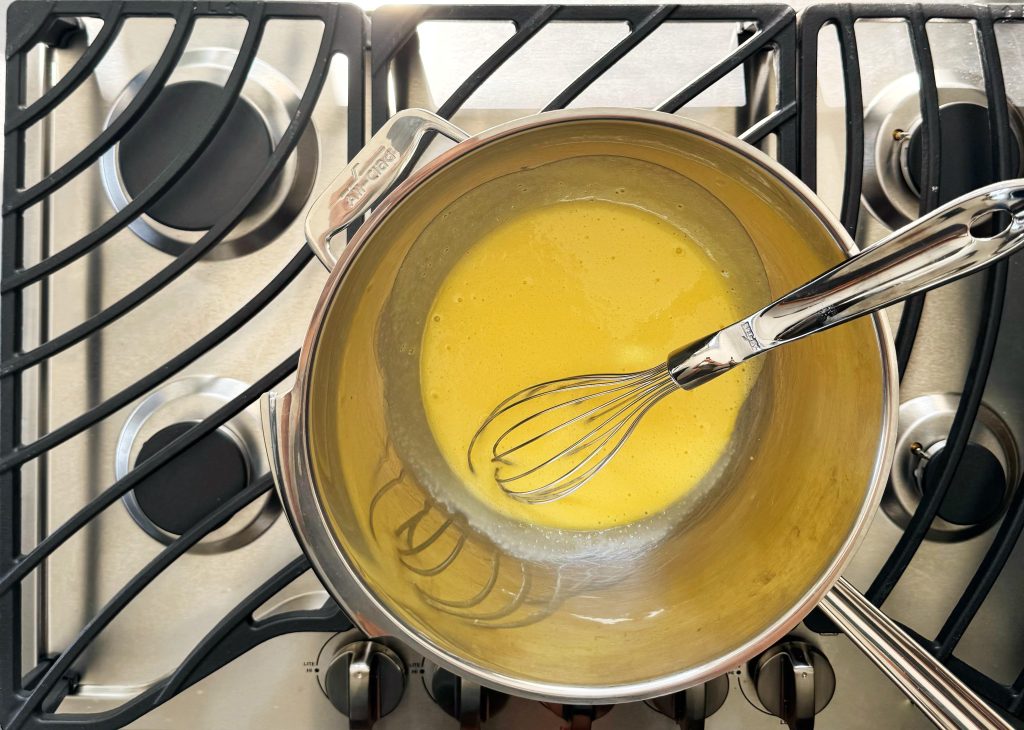
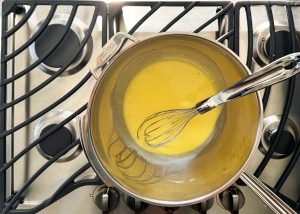
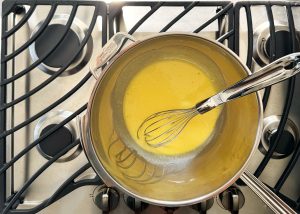
Mastering emulsion sauce mechanics transforms cooking from a nerve-wracking gamble into a repeatable, magnificent craft of suspension chemistry and kitchen confidence. Every cook eventually experiences the sudden tragedy of a sauce splitting. One second your hollandaise looks like liquid satin draping off the whisk, and the next second it collapses into a miserable pool of yellow grease sitting atop scrambled curds. The instinctive reaction is panic, followed by frantic, futile whisking that only speeds up the catastrophe.
Great pan sauces, velvety mayonnaise, glossy beurre blanc, and airy béarnaise do not hold together by luck or kitchen superstitions. They thrive under specific laws of physical chemistry. When you understand what is happening at the microscopic frontier where water meets oil, you stop fearing the whisk and begin manipulating liquids with effortless precision.
The delicate physics of holding oil and water together
A foundational grasp of emulsion sauce mechanics reveals that these liquids are fundamentally hostile roommates forced into an uneasy truce. Water molecules are intensely polar, clinging to one another with stubborn hydrogen bonds. Fat molecules, composed of long nonpolar hydrocarbon chains, share no electrical affinity with water. Dump oil directly into water without an intermediary, and the water molecules snap together, squeezing the fat outward until it coalesces into a separate floating layer to minimize its surface area.
Creating an emulsion requires forcing that oil to shatter into billions of microscopic droplets, each measuring merely a few micrometers across, and dispersing them evenly throughout a continuous water base. As these droplets shrink and multiply, the surface area between the fat and water expands by thousands of times. The thermodynamic drive for those droplets to bump into each other, merge, and float free is relentless.
The secret that prevents immediate collapse is viscosity coupled with surface disruption. When you beat liquid fat into an aqueous solution with enough energy, you create an obstacle course where droplets struggle to travel through the dense liquid matrix to reconnect. Yet physical resistance alone is temporary. Without a microscopic stabilizing agent holding the perimeter, thermal vibration and resting surface tension will inevitably cause the dispersed droplets to reunite, destroying your sauce within minutes.
Why chemical emulsifiers matter more than sheer whisking speed
This is where emulsion sauce mechanics depend entirely on amphiphilic molecules, the chemical bridge-builders known as emulsifiers. An amphiphilic molecule possesses a split personality. One end is hydrophilic, carrying an electrical charge that loves water, while the opposite end is lipophilic, an uncharged tail that happily embeds itself into fat.
Egg yolks serve as the quintessential culinary emulsifier because they are packed with lecithin, a phospholipid that positions itself precisely along the borderline of each fat droplet. The lipophilic tails anchor deep into the butter or vegetable oil, while the charged heads project outward into the surrounding water. Because these protruding heads carry similar electrical charges, they repel one another. When two shielded oil droplets drift close together in the bowl, their like charges push them apart like opposing magnets, preventing them from fusing together.
Egg yolks are not the only culinary tools offering this molecular armor. The mucilage found in mustard seeds, the proteins in milk solids, the garlic compounds in classic aioli, and even pulverized plant starches can stabilize dispersed fats. While muscle power separates the fat into microscopic beads, it is the surfactant barrier that guarantees structural immortality. Understanding the work of these surfactants, documented thoroughly in the Exploratorium science of food research on culinary suspensions, frees cooks from relying on raw speed and allows them to focus on chemical balance.
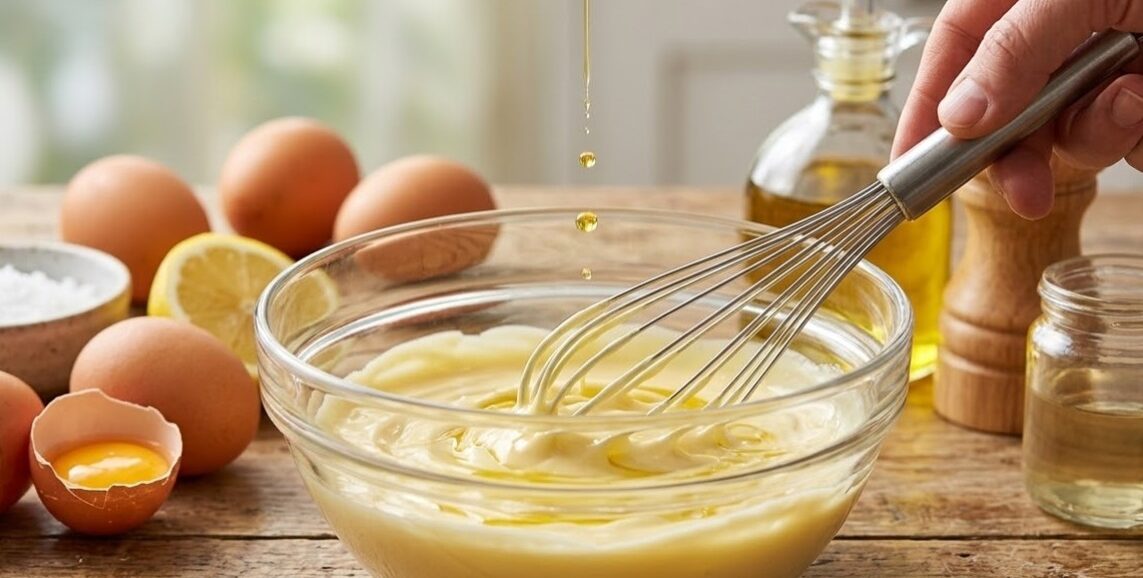
Four proven rules to master culinary emulsions every single time
Applying sound emulsion sauce mechanics on a weeknight demands a clear strategy rather than superstition. Regardless of whether you are hand-whisking a delicate béarnaise over a double boiler or emulsifying a vinaigrette in a high-speed blender, these four rules govern structural success.
Establish a microscopic continuous base before adding fat
The most common cause of an immediate sauce split is dumping oil into an empty bowl alongside an unworked yolk. Emulsions require a well-developed continuous phase before the dispersed phase ever arrives. The yolk, vinegar, citrus juice, or water must first be beaten thoroughly until the liquid stretches into a pale, slightly frothy foundation.
This initial aeration and hydration expands the volume of the water phase and dissolves the yolk proteins, making their protective head groups fully available to coat incoming fat. If you introduce fat before this continuous base is mobilized, the fat surrounds the tiny droplets of water instead, causing a disastrous phase inversion where water is trapped inside oil, creating a greasy, heavy mess that refuses to thicken into a silky ribbons.
Regulate thermal boundaries to protect structural proteins
Heat acts as a double-edged sword when building warm emulsions like hollandaise or beurre blanc. Warmth softens saturated butterfats into free-flowing liquids and unfolds coiled egg proteins, allowing them to interlock and thicken the sauce. However, crossing thermal boundaries will instantly ruin your work.
If the mixture stays below roughly 115 degrees Fahrenheit, butterfat begins to crystallize, forming jagged microscopic solids that puncture surfactant barriers and trigger greasy separation. Conversely, if the temperature creeps past 150 degrees Fahrenheit, the egg proteins denature completely, coagulating into tight, rubbery strands that squeeze out trapped moisture. Maintaining your sauce within this comfortable thermal corridor protects the delicate protein lattice from structural collapse.
Control shearing force and droplet subdivision rate
The rate at which you introduce fat dictates droplet size. At the beginning of the process, add the oil or melted butter literally drop by drop. Each individual droplet must be torn apart into smaller spheres by the mechanical shear of your whisk before the next addition arrives.
Much like the kinetic energy management analyzed in sprint acceleration mechanics and 4 proven principles that unlock explosive speed, shearing fat droplets requires a sustained, rhythmic application of power rather than an erratic, flailing burst. Moving the whisk in a rapid side-to-side shearing motion creates far more physical turbulence than lazy circular paddling. Once a thick, glossy core forms and the emulsion takes hold, the droplet subdivision happens almost instantaneously, allowing you to pour the remaining fat in a steady, thin ribbon.
Manage volume thresholds with strategic water replenishment
Every seasoned saucier understands that emulsion sauce mechanics dictate a strict mathematical limit to how much oil a fixed quantity of water can suspend. A single large egg yolk contains enough lecithin to stabilize several gallons of oil in theory, but in practice, it only contains a few teaspoons of water.
As you incorporate more and more fat droplets, they pack together so tightly that they run out of room to maneuver. The sauce becomes exceedingly thick, shiny, and stiff. If you continue pouring fat into a dehydrated base, the crowded droplets collide with such violent force that the film ruptures, causing catastrophic separation. The preventative measure is remarkably simple. Whenever your sauce begins to look overly stiff or greasy around the edges, whisk in a tablespoon of warm water, stock, or lemon juice. Replenishing the continuous phase immediately spreads the droplets apart, making room for more fat.
Emergency triage when an emulsion splits on the stove
When a sauce collapses, understanding emulsion sauce mechanics provides an immediate diagnostic blueprint. Do not throw the broken mixture into the trash; the ingredients are still perfectly intact, merely uncoupled. Triage begins by identifying the root cause: did the sauce split because it got too hot, too cold, or simply ran out of water?
If the sauce broke because it overheated and curdled the egg proteins, you must cool it down immediately. Take a fresh bowl, add a teaspoon of cold water, and begin whisking tiny amounts of the broken sauce into the water. If the eggs have not completely scrambled, the mechanical shearing will often reconstruct the suspension. If the proteins are cooked through, whisk a fresh raw yolk with a splash of water in a clean bowl until frothy, then slowly stream the broken sauce into the new yolk base exactly as if it were fresh oil.
If the sauce separated because it chilled and the butter solidified, warm a stainless steel bowl over steam, add a tablespoon of hot water, and gradually whisk the broken sauce in over gentle heat. The warmth reliquefies the crystallized fats while the additional moisture restores the crowded continuous phase. The sauce will snap back into a lustrous, velvety state within seconds.
The permanent shift toward intuitive sauce mastery
Once you internalize these fundamental emulsion sauce mechanics, the terror of splitting vanishes from your repertoire. You no longer measure ingredients with anxious hesitation or fear sudden heat spikes. Instead, you develop an intuitive awareness of viscosity, sheen, and resistance.
You will recognize the subtle warning signs long before a sauce actually fails: the slight dulling of the gloss, the oily fringe creeping along the perimeter of the pan, the unnatural resistance against the whisk wires. Armed with physical chemistry instead of blind hope, a simple splash of water or a quick adjustment of heat keeps your sauces perpetually balanced, velvety, and immaculate.