Braising meat mechanics and 4 essential rules that create melt in your mouth tenderness
Unravel the thermodynamic and biochemical secrets behind slow-cooked meat. Learn how gentle heat, collagen conversion, and deliberate resting turn stubborn cuts into unctuous feasts.
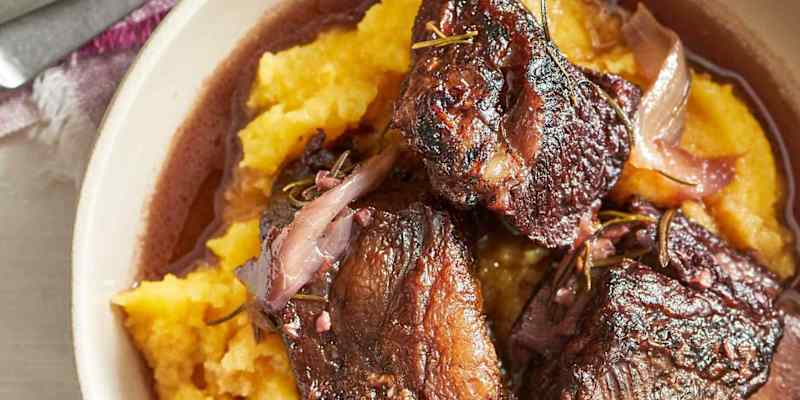
Understanding braising meat mechanics transforms tough, connective tissue-laden cuts of beef chuck, pork shoulder, and lamb shank into unctuous, spoon-tender culinary masterpieces. Most home cooks encounter braising as an act of faith rather than precision. They sear a slab of meat, submerge it haphazardly in stock, slap on a heavy lid, and hope that four hours in an oven will forgive every shortcut. Sometimes the meat emerges soft yet oddly chalky, stripped of moisture despite swimming in liquid. Other times, the sauce remains thin, greasy, and disconnected from the protein it was meant to elevate.
Great cooking is never an accident of heat and time. When culinary technique aligns with molecular reality, cooking ceases to be a guessing game and becomes an exacting, repeatable craft. Braising represents one of the oldest human methods for making the inedible magnificent, bridging the gap between brute heat transfer and delicate biochemical alchemy. To command your kitchen, you must first decipher what happens beneath the enamel lid of your Dutch oven.
The Hidden Biochemistry of Collagen and Heat Transfer
Meat is not a uniform block of protein. It is an intricate bundle of muscle fibers wrapped in protective scaffolding called connective tissue. When examined through the lens of braising meat mechanics, this culinary alchemy is an intricate duel between protein denaturation and thermal conductivity. The muscle fibers themselves consist primarily of actin and myosin. As meat heats past 120°F (49°C), myosin begins to denature and contract. By the time the internal temperature crosses 140°F (60°C), actin denatures violently, wringing out intracellular water like a clenched fist squeezing a wet sponge.
If you were cooking a lean tenderloin or a ribeye, exceeding these thresholds would spell dry disaster. Working cuts like brisket, shank, and oxtail survive because of an entirely different structural macromolecule known as collagen. Collagen consists of a tight triple-helix of amino acid chains that sheath individual muscle fibers, bundle them into fascicles, and anchor muscle to bone. This structure withstands tremendous tension on a living animal, and it is notoriously impervious to flash frying or quick grilling.
Hydrolyzing that stubborn collagen into luscious, water-soluble gelatin requires sustained thermal energy over prolonged periods, a dynamic carefully documented in the Exploratorium Science of Cooking meat breakdown research. Starting around 160°F (71°C) and accelerating near 180°F (82°C), water molecules wedge their way between the cross-linked peptide chains of collagen. The rigid triple-helix unwinds and dissolves into gelatin. Gelatin possesses an extraordinary capacity to trap water molecules, coating dried muscle fibers in a slippery, rich matrix that human palates perceive as succulent juiciness.
Why Traditional Boiling Destroys What Braising Preserves
A thorough appreciation of braising meat mechanics prevents the ubiquitous home-kitchen tragedy of the stringy, parched pot roast. The fatal flaw of many failed braises lies in confusing a braise with a boil. When liquid vigorously boils at 212°F (100°C), the violent agitation of bubbling steam physically batters the meat, dislodging delicate structural fibers before collagen has had sufficient time to melt gracefully.
High temperatures also force muscle fibers to constrict past their elastic limit. When actin and myosin knot together under intense heat, they squeeze out virtually all their natural moisture. Even if you hold meat submerged in rich stock, boiled muscle fibers cannot reabsorb exterior water once their structural matrix has collapsed. You end up with meat that is paradoxically dry while completely drenched in soup.
True braising relies on gentle thermal gradients. In culinary arts as in elite athletics, mastery requires understanding the hidden forces at play rather than merely relying on raw power. Just as examining curveball pitching mechanics and 4 proven rules that generate unhittable break reveals how subtle fingertip friction and rotational torque dictate an unreadable trajectory, manipulating heat and moisture during a braise demands an identical respect for kinetic transfer and structural resistance. The goal is to keep the cooking medium hovering in a sub-simmer zone between 180°F and 200°F (82°C to 93°C), where collagen dissolution outpaces fiber shrinkage.
Four Essential Rules That Unlock Flawless Braised Texture
Translating theoretical braising meat mechanics into a foolproof kitchen workflow requires mastering four fundamental pillars. Each rule addresses a specific phase of heat exchange, phase transition, and surface chemistry.
Aggressive Dry Searing Before Any Liquid Enters the Pan
Browning meat is not a cosmetic ritual. It is the vital foundation of savory depth. The Maillard reaction occurs when amino acids and reducing sugars react at temperatures above 300°F (150°C), forming hundreds of novel flavor compounds that produce deep roastiness, umami, and complex aromas. Because water cannot exceed 212°F (100°C) at atmospheric pressure, meat cannot undergo the Maillard reaction while wet. Any residual surface moisture consumes valuable thermal energy through steam evaporation before browning can even begin.
Pat your meat thoroughly dry with paper towels before it ever approaches the pan. Season generously with salt, and use a heavy-bottomed enameled cast iron Dutch oven heated with a high-smoke-point oil. Sear each surface without crowding the pan until a deep mahogany crust forms. Do not settle for pale gray edges. That dark crust not only locks in structural stability during the initial braise but leaves behind a rich layer of caramelized proteins, known as fond, anchored to the pan floor awaiting deglazing.
The Golden Liquid Level That Balances Evaporation and Submersion
A classic braise is defined by partial submersion, distinguishing it fundamentally from a stew. Pouring liquid until the meat is drowning dilutes flavor compounds, slows down evaporation, and robs you of the textural interplay between tender submerged meat and a crisp, caramelized top crown.
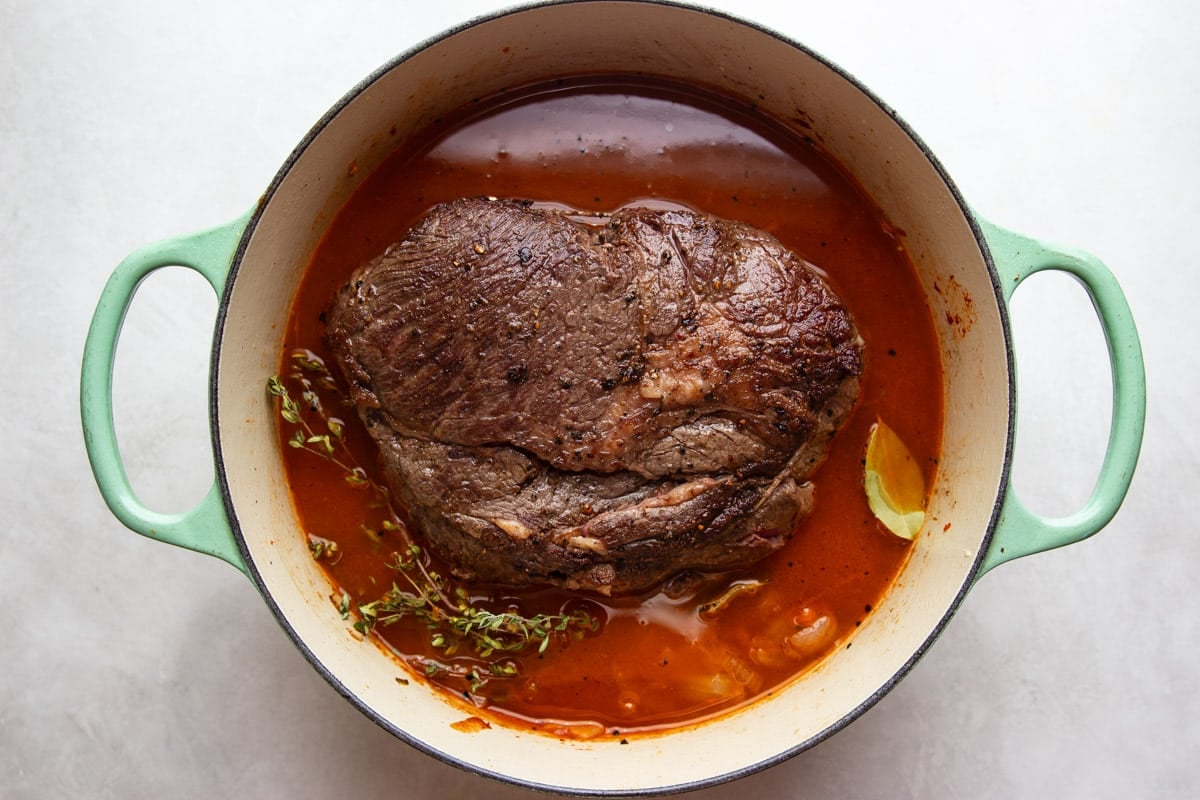
The optimal liquid volume sits between one-third and halfway up the side of the meat. This specific depth turns the Dutch oven into a dual-action vessel. The lower half of the meat cooks via gentle conduction through the simmering broth, steadily dissolving collagen into the sauce. Meanwhile, the upper half cooks in a micro-climate of radiant heat and humid steam. As steam condenses on the exposed crust, it bastes the meat continuously, concentrating surface juices and building a rich lacquered exterior that fully submerged boiling could never achieve.
Sub Simmer Chamber Control Using Low Oven Heat
Never braise exclusively on a stovetop burner. Stovetop burners generate directional heat focused squarely on the base of your pot, creating hot spots that scorch the bottom vegetables and provoke unpredictable convective rolling boils. A central rule of braising meat mechanics is maintaining an internal liquid temperature that never breaks into an aggressive rolling boil.
Transfer your lidded vessel to a preheated oven set to 275°F to 300°F (135°C to 150°C). Oven heat envelops the heavy walls of the Dutch oven from every angle, delivering ambient, uniform warmth. To ensure the surface never dries out or boils rapidly, cut a circle of parchment paper with a small steam vent in the center, known as a cartouche, and press it directly onto the surface of the liquid before securing the pot lid. The cartouche creates a localized micro-climate of humidity, retarding surface evaporation and keeping the liquid at a tranquil, collagen-dissolving quiver.
The Essential Cool Down Phase Inside the Braising Liquor
Pulling braised meat out of the pot the moment it tests fork-tender is the single most common mistake in home cookery. While hot, the muscle fibers remain tightly coiled, under pressure, and unable to hold onto fluid. If you slice or shred a braise straight out of a hot oven, you will watch its precious juices drain across the cutting board in steam, leaving you with dry threads.
Overlooking the cooling stage violates one of the most critical braising meat mechanics, leaving otherwise perfectly cooked muscle fibers parched and hollow. Turn off the heat and allow the meat to rest directly inside its warm braising liquid for at least 45 minutes to an hour. As the temperature drops below 140°F (60°C), the muscle fibers relax, opening their internal spaces. Through capillary action, the meat reabsorbs the surrounding liquid, drinking back in the gelatin-infused, flavorful broth it released earlier. This rest makes the difference between meat that tastes dry despite being tender and meat that bursts with rich flavor in every bite.
Building a Luxurious Glaze from Leftover Cooking Juices
Once the meat has completed its gentle cooling phase, the liquid left behind in the pot is a goldmine of extracted flavor, aromatic oils, and dissolved gelatin. Leaving this liquid thin and watery squanders half the work you invested. A refined braise concludes with the transformation of this braising liquor into a glossy, velvety sauce that clings to the back of a spoon.
Lift the rested meat carefully from the pot and set it aside, tented under foil. Strain the braising liquid through a fine-mesh sieve into a wide skillet or saucepan, discarding the exhausted aromatics and spent vegetable pieces. Allow the liquid to sit undisturbed for five minutes so the rendered fat floats to the surface, then skim off the majority of this oil with a wide ladle.
Set the skillet over medium-high heat and bring the strained liquid to an active simmer. Wide skillets maximize surface area, accelerating water reduction without scorching delicate gelatin molecules. As steam billows away, the concentration of natural gelatin thickens the liquid into a viscous sauce, an authentic culinary glaze known as a demi-glace shortcut. Swirl in a tablespoon of cold butter off the heat, a classic French technique called monter au beurre. The butter’s natural milk solids and fat globules form a temporary emulsion with the water-bound gelatin, yielding a mirror-smooth shine and a decadent mouthfeel that ties the entire dish together.
The Transformative Wisdom of Patient Low Temperature Cooking
Braising demands an intentional recalibration of pace. In a modern culture accustomed to high-pressure appliances, microwave shortcuts, and flash-cooked convenience, the deliberate slowness of an enameled pot resting in an oven invites patience back into the kitchen. Cooking connective tissue into succulent gelatin cannot be rushed by ratcheting up the dial on your thermostat. Heat is a blunt instrument, but thermal management is an art form.
When you command these braising meat mechanics, the humblest cuts of meat become your most formidable, deeply satisfying culinary triumphs. You no longer depend on expensive prime cuts to deliver show-stopping dinners. Instead, you possess the structural insight and culinary patience required to bend connective tissue, heat gradients, and gelatin extraction entirely to your will.