Pan searing mechanics and 4 proven rules that create flawless golden crusts
A soggy, pale steak is never an accident; it is the predictable outcome of misunderstood physics. Here is how heat transfer, moisture vaporization, and surface contact create the ultimate culinary crust.

Mastering pan searing mechanics separates cooks who merely warm food from culinary artisans who engineer profound savory flavor. Almost every home cook has experienced the quiet heartbreak of pulling a pale, rubbery protein from a hot pan. You anticipated a glistening mahogany crust with a satisfying crackle, but instead delivered a soggy cut sitting in an unappetizing pool of gray cooking liquid. That disappointment is not bad luck. It is the predictable outcome of running counter to the physics of thermodynamics and surface chemistry.
Achieving a crisp, savory exterior on a steak, a scallop, or a dense block of tofu is not an innate gift handed down by celebrity chefs. It is an engineering challenge governed by quantifiable laws of energy transfer, phase shifts of water, and organic chemical cascades. When you grasp how heat moves through metal into raw tissue, you gain total control over texture, color, and aroma. Cooking shifts from an unpredictable gamble into an intentional, repeatable discipline.
The Thermodynamic War Between Moisture and Flavor
To produce an exceptional sear, you must first navigate the Maillard reaction. Named after French physician Louis-Camille Maillard, this intricate cascade occurs when amino acids and reducing sugars collide under high heat. The resulting recombination creates hundreds of new flavor compounds, generating notes of roasted nuts, cocoa, savory richness, and crisp malt. This is not caramelization, which involves pure sugars melting at high thresholds; this is an intricate protein transformation that requires specific operational conditions.
The Maillard cascade begins to accelerate at roughly 280°F (138°C) and peaks between 300°F and 350°F (149°C to 177°C). The problem is that meat is primarily water. Raw beef, poultry, and fish consist of roughly 70 to 75 percent moisture. When water is present at the interface between the food and your skillet, basic physics halts your browning completely.
Water cannot exceed 212°F (100°C) at normal atmospheric pressure until it undergoes a complete phase shift into steam. More critically, converting liquid water into water vapor requires an astronomical amount of energy, known as the latent heat of vaporization. It takes only one calorie to raise a gram of water by one degree Celsius, but it takes roughly 540 calories to vaporize that exact same gram of water without raising its temperature by a single degree.
When you analyze pan searing mechanics at the molecular tier, you discover that your primary adversary is not heat, but liquid water. If an unmanaged film of water coats your food, every unit of thermal energy radiating from your burner is hijacked to evaporate that surface moisture. While your stove labors to boil away that boundary layer, the temperature of the protein surface remains trapped at 212°F. The Maillard reaction cannot occur. Instead of searing, your food steams in its own expelled juices, turning gray, flaccid, and rubbery while the interior overcooks.
Why Thermal Mass Dictates Skillet Performance
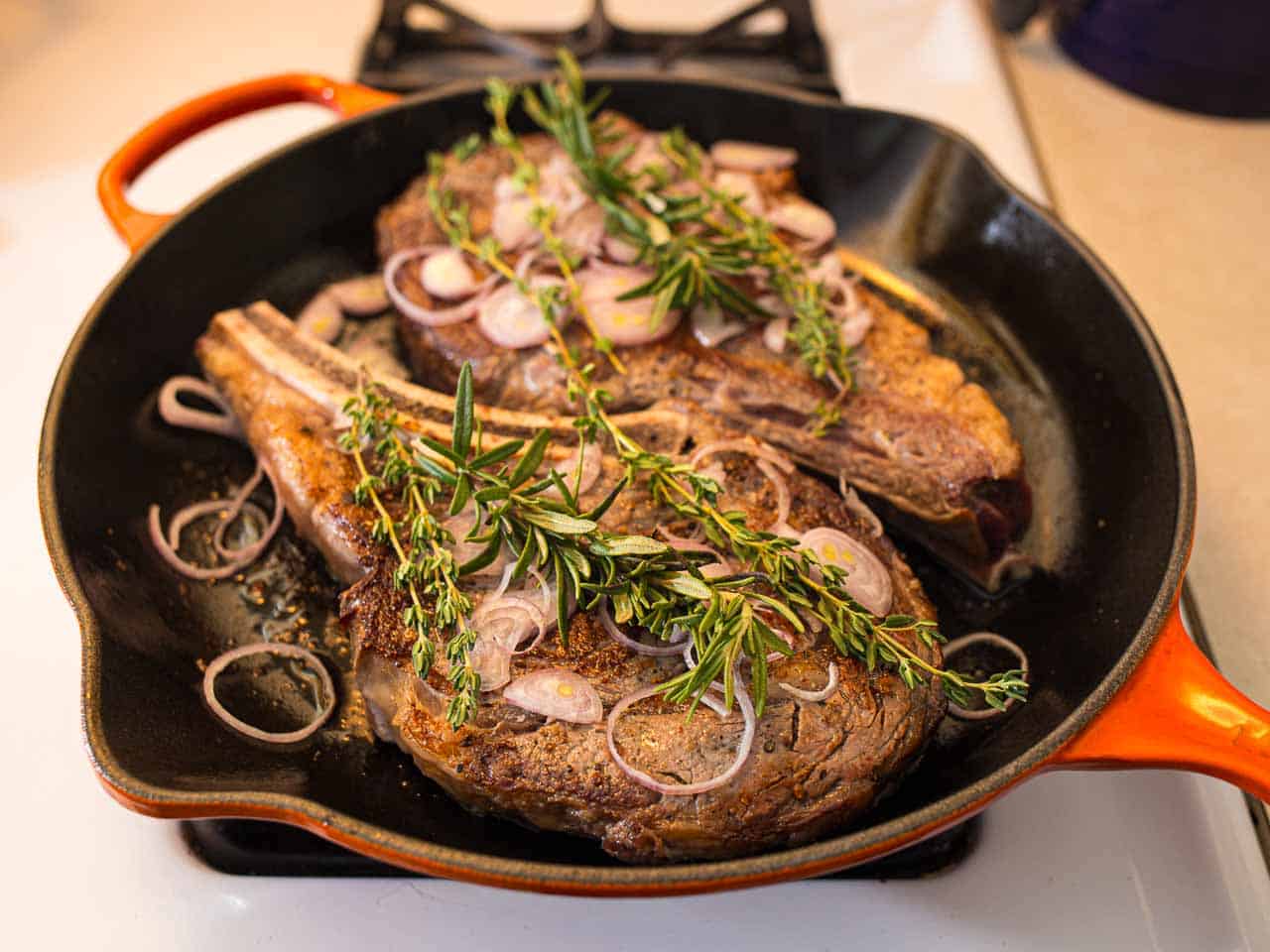
Cookware behaves as a thermal battery. When you drop a thick, refrigerated 12-ounce strip steak into a skillet, you are introducing a massive cold sink into a hot environment. If your pan is lightweight, stamped aluminum or cheap nonstick sheet metal, its stored heat evaporates in seconds. The temperature of the cooking surface collapses instantly, dropping far below the threshold necessary for rapid surface dehydration.
Dense materials such as cast iron, carbon steel, and thick heavy-gauge stainless steel possess substantial thermal mass. While cast iron is actually an inferior conductor of heat compared to copper or aluminum, it compensates through volumetric heat capacity. It holds an immense reservoir of thermal energy. When cold protein strikes hot cast iron, the pan barely notices. The stored heat drives off microscopic surface moisture and initiates browning before the core of the meat can absorb destructive ambient heat.
According to foundational Exploratorium science of cooking meat research, the rate at which heat moves from the exterior to the interior determines the thickness of the overcooked gray zone directly beneath the crust. To minimize that gray band, you need extreme surface heat transfer delivered rapidly, creating a razor-thin crust while leaving the interior precisely cooked. Thin pans simply lack the thermal inertia to execute this maneuver.
Four Proven Rules That Produce Flawless Golden Crusts
Applying disciplined pan searing mechanics requires transforming these physical principles into repeatable pan habits. By eliminating the environmental factors that promote steaming and heat loss, you establish the exact conditions required for immediate, high-impact crust development.
Strip Surface Moisture Long Before Heat Touches the Meat
Dabbing meat with a single paper towel five seconds before it hits the skillet is woefully inadequate. Deep moisture trapped in the exterior muscle fibers will migrate toward the surface the moment cell walls rupture under initial heat. Real surface preparation requires time and deliberate dehydration.
Salting meat heavily with coarse kosher salt at least twelve to twenty-four hours in advance transforms the surface via osmosis. Salt draws internal moisture to the exterior, dissolves into a concentrated brine, and is gradually reabsorbed back into the muscle tissue, seasoning the meat deeply and altering its protein structure so it retains moisture during cooking. When left uncovered on a wire rack inside a refrigerator, the cold, circulating, low-humidity air acts as a dynamic dehydrator. The exterior dries into a tight, glossy skin called a pellicle. When that dry pellicle contacts hot oil, energy is not wasted boiling surface moisture; the Maillard reaction detonates instantly.
Command Thermal Mass and Match Oil to Target Temperatures
Patience during preheating is non-negotiable. Place a heavy cast iron or carbon steel skillet over medium heat for several minutes rather than blasting it on high heat for sixty seconds. Gradual preheating allows the metal to saturate completely with thermal energy, eliminating hot and cold spots across the cooking floor. Understanding how pan searing mechanics interact with metallurgical properties prevents this thermal crash.
Once the pan is thoroughly saturated with heat, introduce an oil with a high smoke point, such as avocado oil, clarified butter (ghee), or refined neutral seed oil. Virgin olive oil and unclarified butter burn at temperatures far below the optimal searing zone, leaving acrid, bitter ash across your protein. The oil is not merely a lubricant to prevent sticking; it serves as a continuous liquid conduit. Because food surfaces and pan surfaces are full of microscopic peaks and valleys, air pockets insulate the meat from direct heat. The oil fills those microscopic voids, transferring heat across every square millimeter of surface area instantaneously.
Establish Absolute Surface Contact Through Intentional Pressure
Proteins undergo rapid mechanical deformation when exposed to sudden high heat. As the muscle fibers along the searing face contract, they pull inward, causing the edges of a steak, pork chop, or fish fillet to curl upward. The moment that protein buckles, contact with the pan floor is lost. Air cushions form, steam gathers in the resulting cavities, and your sear develops an uneven patchwork of dark spots and pale voids.
For the first thirty to forty-five seconds after food hits the skillet, apply gentle, uniform downward pressure using a firm metal spatula or a dedicated chef press. You do not want to crush the meat or squeeze out precious intra-muscular juices; you are simply forcing the entire face of the protein to sit flat against the oil film. This physical contact ensures that thermal energy flows evenly across the entire surface plane before contraction sets in.
Control the Internal Gradient to Eradicate the Gray Band
The old culinary myth claiming you should only flip a piece of meat once is fundamentally flawed. Flipping a protein once yields an asymmetrical thermal gradient, forcing one side to bake in passive pan heat while deep layers overcook, resulting in a thick, spongy gray ring around a small core of pink meat.
Frequent flipping—every thirty to forty seconds—keeps surface temperatures high enough to continue browning while allowing the internal layers to dissipate excess heat into the air. This rapid alternation cooks the center gently while building an exceptional, even crust on both exteriors. Alternatively, employing the reverse sear method—warming the interior gently in a low-temperature oven before finishing with an explosive, sixty-second pan sear—delivers absolute precision from edge to edge.
Diagnosing Overcrowded Skillets and Steam Collapse
The most frequent error cooks make occurs before the meat even begins to brown: overcrowding the pan. Crowding three large chicken breasts or six sea scallops into a standard ten-inch skillet is an invitation to culinary failure. Each piece of cold food acts as an energy sink, absorbing heat faster than your home stove burner can replenish it. The overall temperature of the metal plummets.
Simultaneously, the water vapor escaping from the edges of each piece has nowhere to go. In a spacious skillet, water vapor expands and disperses into the kitchen air. In a crowded skillet, moisture from adjacent pieces hits neighboring protein walls, condenses, and cascades back down into the pan base. Within moments, the skillet floor drops below 212°F, the oil cools into an emulsion of fat and watery juice, and your food boils. Searing requires spatial breathing room. Always leave at least an inch of open metal between food items, or cook in successive batches.
Mastering these thermal balances requires precision and muscle memory, much like mastering athletic disciplines. The kinetic discipline found in the kitchen mirrors the mechanical timing found in athletic training, much like how understanding tennis serve mechanics and 4 proven rules that unlock explosive court power relies on fluid energy transfer rather than brute force. When you stop fighting the physics of the pan and align your timing with how heat actually travels, consistent excellence becomes effortless.
When amateurs abandon basic pan searing mechanics, they inevitably run into the dreaded gray band—that thick collar of overcooked, rubbery flesh framing an undercooked interior. This happens when cooks crank a lightweight pan to scorching temperatures, throw ice-cold, wet meat inside, and leave it motionless out of fear that touching it will ruin the crust. The exterior burns before heat reaches the center, or the bottom steams while the top dries out.
The Sensory Mastery of the Final Sizzle
Cooking at a high level eventually transcends timers and checklists, settling into sharp sensory awareness. Your ears tell you everything you need to know about what is happening on the bottom of the skillet. A violent, deep-throated roar means heavy moisture is flashing violently into steam. As that roaring sizzle attenuates into a higher-pitched, crackling hiss, you know the surface water has largely cleared, and the Maillard reaction is underway.
Trust your sense of smell as well. The aroma of scorched fat signals that the pan is drifting toward carbonization, meaning it is time to drop the heat, add a knob of cold butter for temperature control and basting, or pull the food entirely. Look at how the meat moves. A protein that is actively searing will initially seize and stick stubbornly to stainless steel or cast iron. Do not tear it loose. As the surface proteins dehydrate and brown into a cohesive crust, the food naturally releases itself from the metal floor. The pan literally tells you when the sear is finished.
Once you assimilate these fundamental pan searing mechanics into your kitchen instincts, cooking ceases to be an anxious guessing game. You no longer dread the cut of meat sticking to the pan, nor do you endure another insipid, gray pork chop. With dry surfaces, massive thermal batteries, clean oil contact, and deliberate heat management, you command the pan with absolute authority, unlocking golden, deeply flavorful results every single time.