Dry brining mechanics and 4 proven rules that guarantee unbelievably juicy meat
Discover how salting meat ahead of time rewrites protein chemistry to lock in moisture and produce blistering crusts. These four essential kitchen rules demystify dry brining for culinary perfection.
Mastering dry brining mechanics transforms an ordinary supermarket steak or holiday roast into a fork-tender masterpiece with an impossibly deep, crackling crust. For decades, home cooks were told that salting raw meat hours ahead of cooking would draw out precious moisture and leave dinner leathery and parched. This outdated kitchen myth ignored fundamental biophysics. When applied with deliberate technique, salt acts as a microscopic biochemical key, unlocking tightly bound muscle protein networks so they hold water fiercely through intense cooking heat.
Rather than wrestling with messy buckets of seasoned water or masking dry meat with heavy sauces, salting in advance relies on the natural fluids already contained inside muscle cells. The process rewires how protein strands respond to thermal energy, yielding unmatched flavor intensity. By breaking down the microscopic behavior of muscle fibers, any home cook can move past blind recipes and cook with absolute confidence.
The molecular journey of salt through muscle tissue
Understanding dry brining mechanics begins at the cellular level, where two sequential physical phenomena govern the entire transformation: osmosis and diffusion. When coarse sodium chloride crystals hit the moist exterior of raw meat, they dissolve almost instantly in the residual surface water. This creates an extremely dense, hypertonic saline solution on the outside of the protein.
Nature demands balance across semi-permeable cell membranes. In the opening minutes, osmotic pressure pulls cellular water out of the meat toward the higher solute concentration on the surface. Within ten to fifteen minutes, your pristine steak appears wet and beads with droplets of liquid brine. An inexperienced cook might panic at this stage, assuming the meat is bleeding out its juiciness. Patience reveals the genius of the chemical process.
As the salt dissolves completely into that pooled moisture, concentration gradients shift. Diffusion takes command. The sodium and chloride ions, moving from an area of higher concentration to lower concentration, begin their journey into the deep muscle tissue. Capillary action and molecular migration pull the salty liquid back inside the meat. Over several hours, the dissolved salt travels millimeter by millimeter into the core of the cut, season-curing the flesh from within rather than leaving a salty exterior over bland, unseasoned center fibers.
Why wet brines dilute flavor while dry salt concentrates it
Traditional wet brining submerges meat in a bath of water, sugar, and salt. While this technique does plump up poultry, the extra weight gained is primarily tap water. When that bird roasts, the trapped water dilutes the natural savory notes of the chicken or turkey. More critically, that excess water creates severe culinary engineering problems during cooking.
Water boils at 212°F (100°C), while the Maillard reaction—the complex chemical cascade responsible for deep browning and rich savory aromas—requires temperatures above 300°F (150°C). When meat emerges from a wet brine, its surface tissues are sodden sponges. In the pan or oven, all available thermal energy is consumed by the latent heat of vaporization, boiling the surface instead of crisping it. You end up with pale, rubbery poultry skin or gray, steamy steaks.
This is precisely which makes dry brining mechanics superior for high-heat roasting and searing. Dry salting uses only the meat’s intrinsic juices, leaving the natural flavors concentrated and undiluted. Furthermore, when left uncovered on a wire rack inside a modern frost-free refrigerator, the moving dry air evaporates extraneous surface moisture while the salt works inward. You achieve the culinary ideal: deep intracellular moisture combined with bone-dry exterior skin ready to blister into an ethereal crackle.
4 proven rules that unlock ultimate tenderness and crust
Executing dry brining mechanics in a home kitchen requires unyielding consistency and an appreciation for physical variables. Applying salt randomly without measuring mass or time leads to inconsistent seasoning and subpar textures. Follow these four foundational rules to maximize moisture retention, tenderness, and crust development every time.
Rule 1. Calculate precise sodium mass per pound of protein
Culinary precision demands weighing salt rather than scooping it with volume spoons. Different brands of kosher salt vary wildly in crystal density. A tablespoon of dense, fine-grained table salt can weigh nearly twice as much as a tablespoon of flaky Diamond Crystal kosher salt, making volume measurements dangerously inaccurate.
The golden ratio for optimal protein hydration without harsh salinity sits between 0.75% and 1.25% of the meat’s total weight in salt. For beef roasts and thick-cut steaks, a 1% salt concentration hits the structural sweet spot. For poultry with delicate skin, 0.8% to 1.0% yields balanced seasoning. Using a digital kitchen scale eliminates guesswork: multiply the weight of your meat in grams by 0.01 to find your exact salt target. Sprinkle the measured crystals evenly from twelve inches above the meat to create an uninterrupted, snow-like distribution over all surfaces.
Rule 2. Grant adequate diffusion time based on cut geometry
Salt diffusion is bounded by thermal kinetics and the physical geometry of the meat cut. In a cold refrigerator held between 34°F and 38°F (1°C to 3°C), sodium ions penetrate dense muscle tissue at an average speed of roughly one-half inch every twelve to twenty-four hours. Attempting to rush this process produces uneven, salty outer layers and under-seasoned cores.
Tailor your timeline directly to the thickness of the muscle cut:
- Thin cuts (pork chops, skirt steaks, boneless chicken breasts): 45 minutes to 2 hours is sufficient for surface reabsorption and mild protein conditioning.
- Thick steaks (1.5 to 2.5 inches): 12 to 24 hours allows the solute to penetrate deeply and hydrate interior myofibrils.
- Large roasts and whole poultry (prime rib, whole chickens): 24 to 48 hours ensures the ions traverse dense breast meat and thick fat boundaries.
- Massive holiday birds (14 to 20-pound turkeys): 48 to 72 hours provides the necessary window for complete equilibrium across deep thigh and breast muscle groups.
Rule 3. Maintain uncovered refrigeration for pellicle development
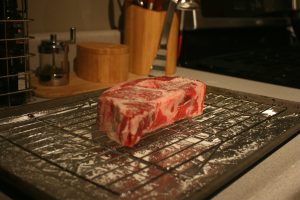
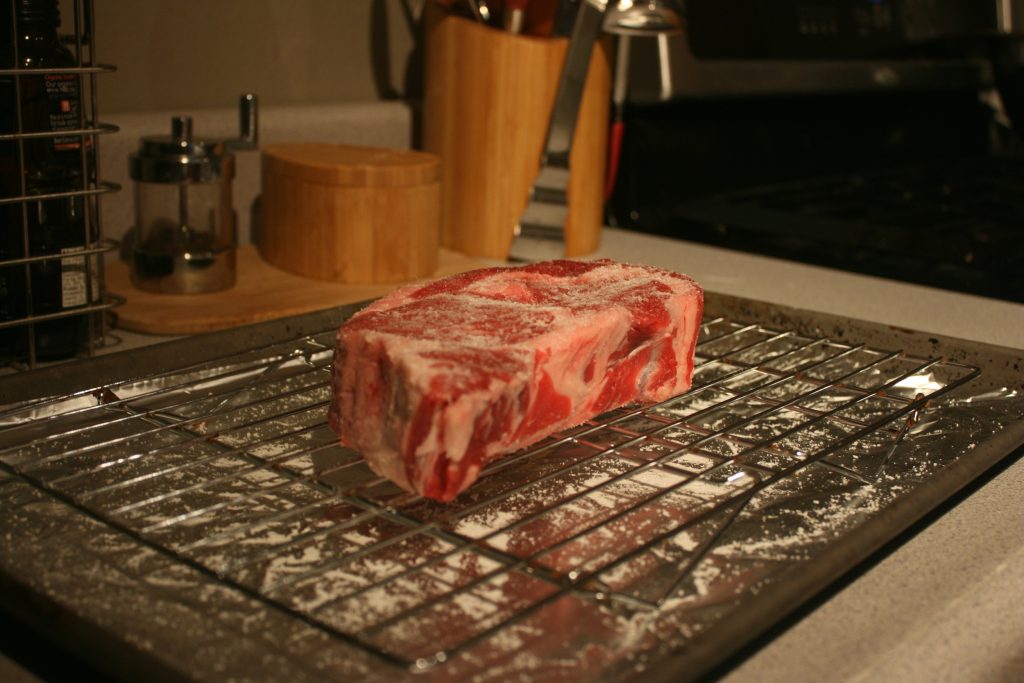
Never wrap dry-brining meat in plastic wrap or seal it in airtight containers. Trapping humidity inside wrapping ruins the secondary objective of the process: complete surface dehydration. Place the salted protein on an elevated stainless steel wire rack set inside a rimmed baking sheet.
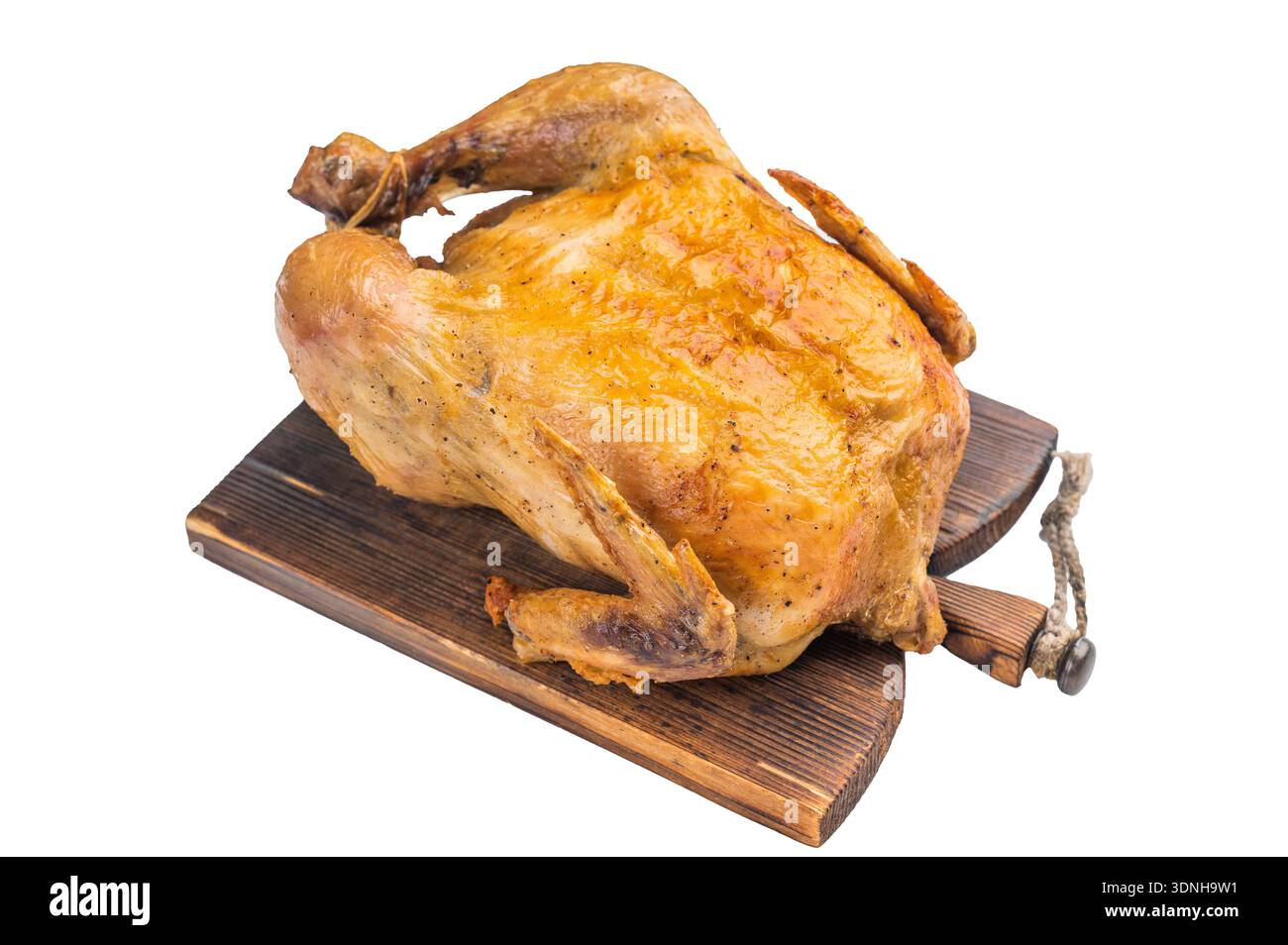
The elevated wire rack allows cold refrigerator air to circulate under, over, and around the meat simultaneously. Modern refrigerators act as effective dehumidifiers, steadily drawing moisture out of the surrounding air. As the surface water evaporates, proteins cross-link at the exterior boundary to create a micro-thin, glossy, tack-like surface called a pellicle. This dehydrated pellicle serves as an impenetrable barrier that keeps juices inside during cooking while instantly frying into a paper-thin, shatteringly crisp skin upon contact with smoking oil or radiant oven heat.
Rule 4. Balance thermal heat transfer during the final sear
Because dry-brined meat features conditioned protein networks and a dry pellicle, it behaves differently under heat than fresh, unseasoned meat. The absence of surface water means the Maillard reaction ignites in seconds rather than minutes. If your cooking oil or skillet is scorching without control, the exterior can char before the interior reaches target doneness.
Pair dry brining with low-and-slow ambient heat followed by a fierce finishing sear, commonly known as the reverse sear. Bring the internal temperature up gradually in a gentle 225°F (107°C) oven, allowing the interior to heat without contracting muscle fibers violently. Just as the biomechanics of high-velocity muscle contraction in human performance require precise timing—as explored in our breakdown of sprinting mechanics and 4 proven rules that unleash breathtaking human speed—the microscopic relaxation of animal protein fibers relies on delicate biophysical equilibrium. Once your meat is within ten degrees of its culinary target, finish it in a blistering cast-iron skillet for sixty seconds per side to forge a dark mahogany crust without overcooking the tender core.
The culinary chemistry of moisture retention and muscle protein denaturing
Why does salt make meat juicier rather than drying it out? The foundational science behind dry brining mechanics lies in the structure of muscle tissue. Meat is composed of roughly 75% water, held captive inside a tight structural framework of protein filaments known as actin and myosin. Under normal cooking conditions, heat causes these tightly coiled filaments to denature and tighten violently, behaving like wringing out a wet towel. This muscular contraction pushes bound water into the intercellular space, where it drains into the pan as lost pan juices.
Salt disrupts this destructive mechanical contraction. When sodium and chloride ions diffuse into muscle cells, they alter the electrical charges of the protein filaments. Positively charged sodium ions bind to the protein strands, creating mutual electrostatic repulsion. Instead of remaining tightly wound, the filaments push apart from one another and loosen.
According to Michigan State University research on muscle protein hydration, this structural alteration allows muscle proteins to swell, forming a matrix that traps water molecules through capillary action. When heated, these relaxed proteins cannot contract with their usual crushing force. The meat retains up to 10% more of its natural juices through the cooking process compared to unsalted or immediately salted meat, delivering an unmistakably juicy, buttery mouthfeel.
Common mistakes that ruin salted meat before it hits the pan
Even with a firm grasp of dry brining mechanics, careless shortcuts can undermine your results. The most frequent misstep is using iodized table salt. Table salt contains anticaking agents and potassium iodide, which can impart an acrid, metallic aftertaste when concentrated through surface dehydration. Stick strictly to coarse kosher salt or pure sea salt with no additives.
Another catastrophic error is cooking meat during the mid-phase of the salt cycle. If you salt a steak and drop it into a hot pan at the thirty-minute mark, you are hitting the meat at its worst possible moment. The salt has pulled water to the surface via osmosis, but diffusion has not had time to draw that moisture back inward. You are searing a pool of exterior water, boiling the meat and ruining your crust. Either cook immediately within three minutes of salting, or wait the full duration until the surface has reabsorbed the brine and dried completely.
Finally, avoid crowding pieces together on a single rack. If chicken thighs or pork chops touch during refrigeration, cold air cannot circulate between their contact points. Moisture pools in the crevices, preventing pellicle formation and leaving soggy patches of pale skin. Provide at least one inch of clearance between every piece of meat to guarantee uniform drying and consistent heat exposure.
Mastering culinary physics at the cutting board
Cooking is fundamentally applied physics and chemistry disguised as art. Relying on intuition or frantic pan-basting cannot rescue meat that has surrendered its cellular water to thermal shock. By respecting the physical realities of dry brining mechanics gives cooks total control over texture, flavor concentration, and crust development.
Once you see the transformation unfold on your own wire rack—from initial wet beads to a taut, deep-red pellicle—the kitchen stops feeling like an unpredictable gamble. Measure your salt by weight, respect the clock of molecular diffusion, and embrace the power of refrigerated airflow. The reward is a dining experience defined by deep savory richness, unmatched tenderness, and the unmistakable crunch of a truly flawless sear.