Curveball aerodynamics mechanics and 4 proven forces that forge unhittable movement
A deep dive into the fluid dynamics and biomechanics that make a baseball curve, drop, and fool the human brain. Discover the physics behind unhittable breaking balls.

Mastering curveball aerodynamics mechanics reveals why a pitch tracking toward the middle of the strike zone suddenly drops into the dirt. A batter standing sixty feet and six inches from the rubber has approximately four hundred milliseconds to read the release, calculate the trajectory, and launch a three-pound piece of turned ash or composite maple through a swing path measured in millimeters. The human visual cortex processes flight paths along anticipated parabolic lines. When an athlete swings wildly at empty space where the baseball was predicted to be, they are not suffering a lapse in concentration. They are falling victim to the relentless laws of atmospheric friction and fluid dynamics.
The ball does not actually defy gravity or make sudden ninety-degree turns as optical illusions often suggest to the naked eye. Instead, the projectile executes a continuous, mathematically predictable trajectory governed entirely by how a rough sphere interacts with air molecules. To appreciate why a curveball behaves like a guided missile, one must abandon the idea that air is empty space. Air is a thick, viscous soup of nitrogen, oxygen, and trace gases that resists, grabs, and redirects every object moving through its embrace.
The Invisible Fluid War Behind Every Breaking Pitch
At its core, curveball aerodynamics mechanics operate inside an ocean of fluid air that spectators take for granted. When a regulation baseball leaves a pitcher’s fingers at eighty miles per hour, it travels through an atmospheric medium possessing a standard density of roughly 1.2 kilograms per cubic meter at sea level. The ball is not a smooth, polished steel bearing. It consists of two interlocking cowhide dumbbells stitched together by hand with exactly one hundred and eight raised, double-threaded red stitches. These stitches protrude roughly one millimeter from the surface, creating microscopic terrain that completely disrupts smooth fluid flow.
As the sphere punches through the air, it establishes a specific flow regime defined in fluid mechanics by the Reynolds number. For a baseball moving between seventy and ninety miles per hour, the Reynolds number lands in a critical transition zone between laminar and turbulent flow. If the ball traveled without spin, it would push a massive wedge of high-pressure air directly in front of its leading face while trailing a chaotic, low-pressure wake of turbulent vortices behind it. This symmetric wake creates pure drag, which gently slows the ball down along a standard gravitational arc.
Add fierce topspin into that equation, and the symmetry instantly dissolves. The top surface of the baseball rotates forward into the oncoming wind, meeting the air stream head-on and accelerating atmospheric friction. Simultaneously, the bottom surface of the ball rotates backward, retreating in the same direction that the oncoming wind is flowing. This speed differential transforms the atmosphere around the ball from a passive obstacle into an active steering engine.
Why Spin Axis Dictates Pitch Deception Across Home Plate
Advanced high-speed optical tracking transformed our understanding of curveball aerodynamics mechanics by demonstrating that raw spin rate alone does not guarantee movement. For decades, traditional scouting relied on the simplistic belief that more revolutions per minute automatically equated to sharper break. High-speed cameras and radar tracking shattered that myth by exposing the geometry of the spin axis.
A baseball spinning in three-dimensional space rotates around an imaginary axle that can point in any direction. Pitchers and biomechanists visualize this orientation using a standard clock face viewed from behind the pitcher’s mound. A classic twelve-to-six curveball features a spin axis tilted horizontally at the three o’clock and nine o’clock marks, with the top of the ball rolling toward twelve and the bottom spinning toward six. This creates pure forward roll, directing aerodynamic forces straight toward the dirt.
However, true movement depends heavily on spin efficiency, also known as transverse spin percentage. If a pitcher releases a ball with significant gyroscopic spin—resembling a spiraling football or a bullet leaving a rifled barrel—that portion of the rotation cuts directly into the wind without deflecting air upward or downward. Gyro spin produces virtually zero lateral or vertical deviation because the rotational vector aligns parallel to the trajectory rather than perpendicular to it. Only the transverse component of the spin can generate aerodynamic pressure differentials. An eighty-mile-per-hour pitch spinning at two thousand revolutions per minute with ninety-five percent spin efficiency will break far more violently than a pitch spinning at twenty-six hundred revolutions per minute with only fifty percent efficiency.
The 4 Proven Aerodynamic Forces That Generate Sharp Breaking Movement
Deconstructing curveball aerodynamics mechanics reveals four discrete atmospheric phenomena working simultaneously across the sixty-foot flight path. While popular baseball commentary tends to bunch these factors under generic labels, each force governs a distinct component of the ball’s final path.
Magnus Force Differential Pressure
The primary engine driving a curveball downward is the Magnus effect. As established by classical fluid mechanics, when a spinning sphere moves through a fluid, it drags a thin film of air molecules—known as the boundary layer—along with its rotating surface. On the top of a topspinning baseball, the boundary layer collides directly with the oncoming air stream. This collision retards airflow velocity and generates a high-pressure zone above the ball.
On the bottom of the ball, the rotating skin pulls air along in the same direction that oncoming air is already moving. This reduces resistance, accelerates local airflow speed, and produces a distinct low-pressure zone beneath the sphere. According to Bernoulli’s principle, an increase in fluid velocity coincides with a decrease in local pressure. The intense pressure above pushes down, while the lower pressure below pulls, generating a net downward aerodynamic force. Formal testing documented in the NASA Glenn Research Center analysis on baseball aerodynamics shows that this lift force acts perpendicular to the flight path and points toward the low-pressure side, adding artificial acceleration on top of standard gravity.
Seam Shifted Wake Dynamics
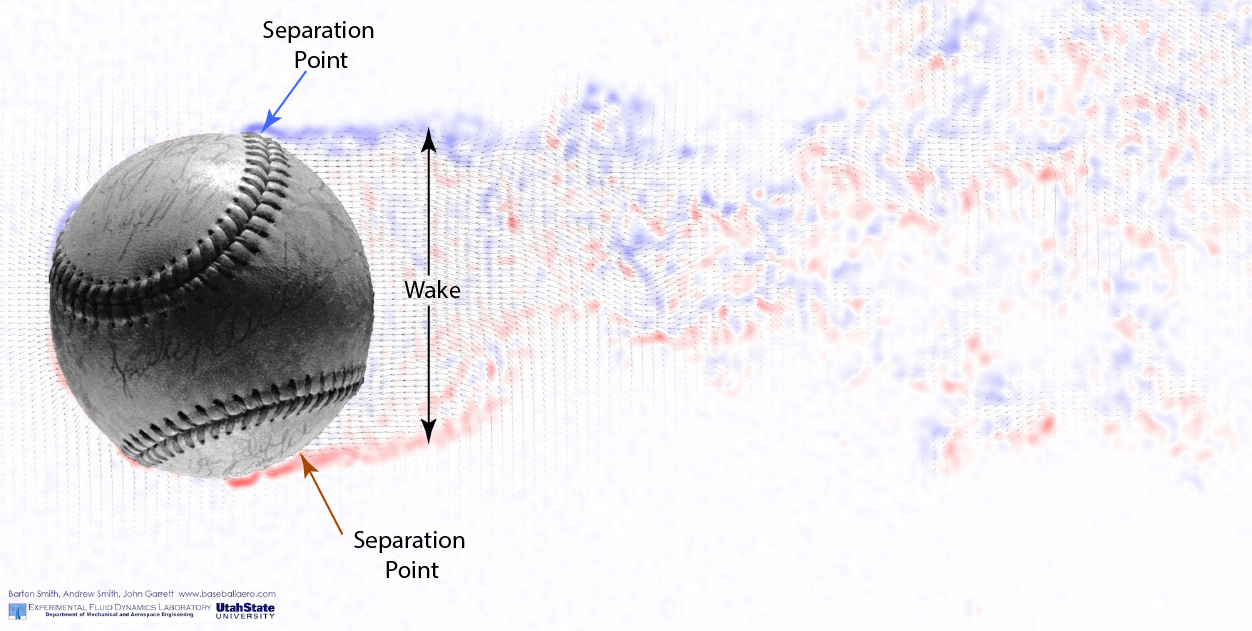
For more than a century, physicists assumed the Magnus effect was the sole driver of pitch movement. Recent particle image velocimetry research revealed a secondary, equally potent mechanism called seam-shifted wake. Because a baseball possesses asymmetrical raised seams, the air boundary layer does not separate from the surface at symmetrical locations on both sides of the ball.
When air encounters smooth leather, it tends to detach cleanly from the sphere earlier, creating an early wake boundary. When air encounters a raised, rough seam, the seam trips the air into local micro-turbulence, which actually causes the boundary layer to remain attached to the ball’s curved surface for a longer distance before breaking away into the wake. If a pitcher orientates the baseball so that a seam trips the boundary layer on only one side while smooth leather governs the other, the wake behind the baseball tilts sideways or upward. Under Newton’s third law, whenever air is shoved off-axis in one direction, the baseball itself must accelerate in the opposite direction. This seam-induced asymmetry revolutionized curveball aerodynamics mechanics inside modern research wind tunnels, explaining how pitchers generate unexpected, late-breaking horizontal sweep without altering their wrist angle.
Boundary Layer Boundary Turbulence and Viscous Drag
Air friction against a moving sphere is not a uniform braking force. It is an active boundary layer interaction that dictates the thickness of the turbulent wake trailing the projectile. Just as microscopic fluid pressure gradients alter cellular structures in unexpected ways—much like the physical shifts analyzed in Meat brining mechanics and 4 proven rules that prevent disastrously dry roasts—the microscopic disturbance created by baseball stitches forces the surrounding air to adhere longer to one hemisphere of the ball.
As the baseball hurtles forward, the air molecules directly touching the leather match the ball’s surface velocity through the physical no-slip condition. Just millimeters outward, however, the air moves at the speed of the ambient atmosphere. The turbulent transition created by the seam stitches delays wake detachment, fundamentally altering the total drag coefficient. When a curveball maintains an organized, highly asymmetric boundary layer, viscous drag works hand-in-hand with downward deflection to aggressively sap forward velocity right as the ball enters the hitting zone.
Angular Momentum Decay and Velocity Dissipation
One of the most persistent myths among athletes is the concept of a pitch that suddenly breaks during its final three feet. The human brain perceives this sudden plunge because human binocular vision struggles to track acceleration changes along the line of sight. Yet, there is a profound physical reality underlying that perception: velocity decays exponentially faster than spin.
From the moment of release to the instant of impact at home plate, aerodynamic drag strips away roughly eight to ten percent of the pitch’s forward velocity. A curveball released at eighty-two miles per hour crosses the plate closer to seventy-four miles per hour. Rotational energy, however, experiences remarkably little air friction. The spin rate of the baseball decays by less than two percent over that same sixty-foot journey. Because the ball spends more time traveling through the second thirty feet of its flight path than the first, and because aerodynamic deflection compounds as a function of time squared, the absolute physical displacement per linear foot of forward travel increases dramatically over the final third of the plate journey.
Biomechanical Execution from Release Point to Ball Flight
When pitchers translate curveball aerodynamics mechanics into physical execution on the mound, fingertip pressure dictates everything. Many developing pitchers mistakenly believe a curveball requires snapping or violently twisting the wrist upon release. In reality, modern biomechanical capture indicates that twisting the wrist during the acceleration phase places catastrophic torsional stress on the ulnar collateral ligament while generating inefficient gyro spin.
Elite breaking ball artists set the wrist into a pre-set supinated angle before the arm moves forward. The grip is anchored along the horseshoe of the seam, with the middle finger bearing the primary workload. The thumb rests directly beneath the ball on smooth leather or an opposing seam to create a rigid pivot point. As the arm accelerates downward through release, the middle finger pulls down hard against the raised cotton stitching, slicing the ball forward off the thumb. The index finger merely rests alongside the middle finger as a stabilizer, avoiding parasitic friction that could rob the pitch of transverse spin.
By pulling directly downward across the front of the sphere while maintaining a stable forearm axis, the pitcher imparts nearly pure topspin without subjecting the elbow joint to destructive shearing forces. The resulting release launches the ball slightly upward out of the hand before aerodynamic forces take over, creating an initial trajectory that mimics a fastball before diving beneath the hitter’s barrel.
Mastering Pitch Flight Realities on the Field
Atmospheric physics does not exist in a vacuum. Pitchers quickly learn that weather conditions fundamentally alter ball flight. At high altitudes, such as Denver, Colorado, air density drops by nearly twenty percent compared to sea-level venues. Thinner air presents fewer fluid molecules for the raised seams to deflect. Consequently, both Magnus force and seam-shifted wake dynamics weaken considerably. Pitchers who rely on dramatic vertical bite find their breaking balls hanging flat in the zone, presenting easy targets for opposing hitters.
Similarly, temperature and humidity manipulate air density in counterintuitive ways. Warm air is less dense than cold air, and humid air is actually slightly less dense than dry air because water vapor molecules weigh less than diatomic nitrogen and oxygen. On hot, humid summer afternoons, the reduced air density allows pitches to travel faster with less drag, but simultaneously dampens the total deflection generated by the seams.
Ultimately, mastering curveball aerodynamics mechanics bridges the gap between atmospheric physics and world-class athletic execution. When a pitcher balances spin axis efficiency, seam orientation, and finger leverage, they transform a static piece of leather and yarn into a precision aerodynamic instrument. The resulting flight path is not magic, but an extraordinary mastery over the invisible air currents that dictate every millimeter of the strike zone.