Tennis serve mechanics and 4 proven rules that create devastating court power
Raw arm strength does not produce an unreturnable tennis serve. True serving mastery relies on an elastic kinetic chain that transfers ground energy directly through the racquet tip.
Mastering modern tennis serve mechanics separates erratic club hitters from players who dictate every single service game with effortless, explosive authority. Watch an elite server from courtside and the delivery looks almost lazy. The ball floats upward, the body uncoils in a smooth, continuous ribbon of movement, and the ball explodes off the string bed at speeds exceeding one hundred and twenty miles per hour. Yet recreational players often spend years sweating through high-effort swings that barely clear the net tape.
The discrepancy lies in how the human brain instinctively conceptualizes power. Untrained athletes perceive the serve as an aggressive throwing motion dominated by the bicep, chest, and shoulder. They muscle the racquet toward the ball, locking their joints into rigid, fighting patterns that hemorrhage velocity and chew up delicate connective tissue. The result is inconsistent ball placement, chronic rotator cuff inflammation, and a persistent inability to win easy service points.
Real court power behaves like an elastic wave rather than a mechanical push. When you peel back the layers of high-velocity deliveries, you discover an elegant transfer of momentum that starts against the court surface and travels through a coordinated series of bodily links. By dismantling common misconceptions and implementing biomechanically sound movement laws, any committed player can unlock natural pace, razor-sharp accuracy, and long-term joint durability.
The kinetic chain foundation behind elite delivery
True power emerges from understanding how tennis serve mechanics transform the human body into a coordinated biological whip. In sports biomechanics, this sequencing is termed the kinetic chain. The principle states that force generated in the largest, most powerful segments of the body passes sequentially into smaller, faster segments, accumulating speed along the way until it unleashes at the distal extremity.
According to a peer-reviewed biomechanical analysis of tennis strokes, over fifty percent of total kinetic energy and force delivered to the tennis ball originates in the hip-knee-ankle complex and trunk rotation, not the hitting arm. The legs compress into the court surface to initiate ground reaction force. As the lower limbs forcefully extend, that energy travels upward through the pelvic girdle, igniting torso coiling and lateral spine flexion.
Each subsequent anatomical segment accelerates and decelerates in an exact mathematical cadence. When the hips reach maximum rotational speed and begin to brake, they transfer their momentum into the torso. As the torso reaches peak rotation and decelerates, energy fires into the shoulder, down the humerus, through the flexing elbow, and finally through the wrist and racquet frame. If any single segment fires out of order, or if a joint stiffens prematurely, the energetic wave breaks, forcing the smaller downstream muscles to compensate under dangerous loads.
The dangerous myth of upper body muscular dominance
Amateur tennis courts are filled with players who strangle the racquet grip with white-knuckle intensity. They believe that gripping harder and swinging the arm faster generates raw pace. In reality, excessive grip tension locks the wrist and forearm flexors, paralyzing the natural hinging mechanisms that multiply racquet head acceleration at the top of the swing path.
When you attempt to generate racquet speed purely through upper-body muscle contraction, you truncate the acceleration path. The shoulder joint becomes a bottleneck rather than a conduit. This muscular strangulation represents a fundamental breakdown in tennis serve mechanics that invites chronic shoulder impingement and elbow tendonitis. The smaller muscles of the rotator cuff are designed for joint stabilization and micro-adjustments, not primary propulsion.
Elite servers treat the arm as a loose, supple rope attached to a rotating torso engine. The shoulder muscles stay relaxed through the loading phase, allowing the elastic tissues to stretch under tension like a drawn archery bow. True serving velocity is not a display of brute force; it is the physical consequence of loose muscles undergoing rapid, involuntary elastic recoil.
Four proven rules that transform serving execution
When evaluating elite tennis serve mechanics, performance coaches and biomechanists look for four unshakeable physical rules that govern the delivery. Mastering these four interconnected phases shifts your game from unpredictable arm swings to a repeatable, lethal weapon.
Rule 1 Establish an unshakeable platform and trophy position
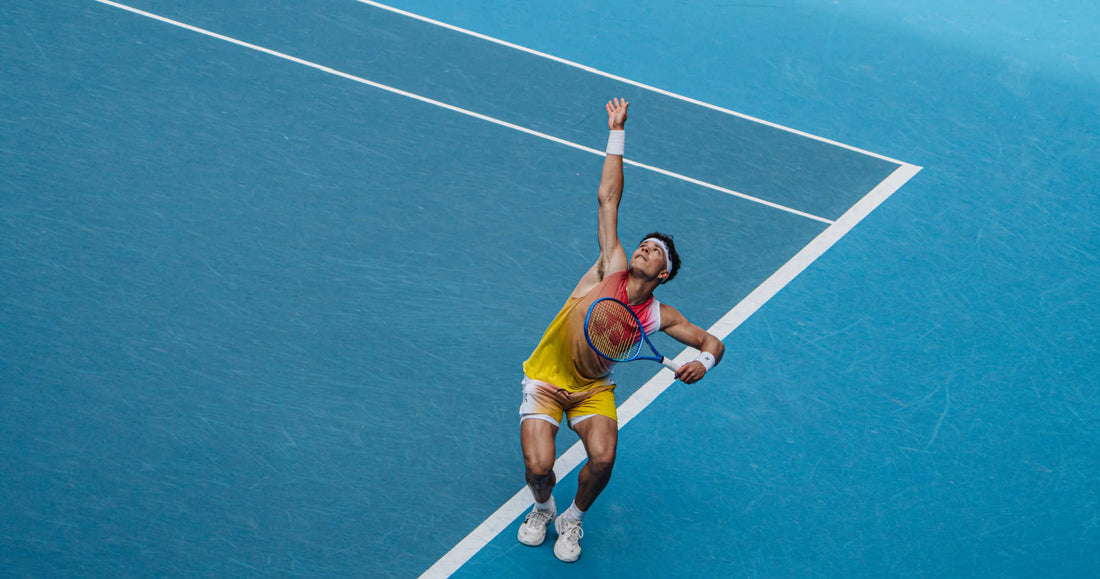
Everything in the serve hinges on the toss and the subsequent trophy position. An erratic toss guarantees erratic biomechanics, as the body contorts awkwardly to chase a drifting target. The tossing arm must rise straight from the shoulder like an elevator, releasing the ball smoothly from the fingertips at eye level with minimal spin. Simultaneously, the racquet arm moves into the loaded trophy stance.
In an optimal trophy position, your dominant elbow aligns slightly below the shoulder plane, your chest angles upward toward the sky, and your hips coil away from the baseline. Whether you favor a platform stance with stationary feet or a pinpoint stance where the back foot slides forward, your weight must load heavily into the rear hip and the balls of both feet. This loaded position creates the potential energy reservoir that feeds the entire swing.
Rule 2 Synchronize dynamic leg drive with the deep racquet drop
Power leaks occur when players separate the lower-body drive from the racquet movement. The instant your legs push aggressively upward off the court, your hitting hand must not push forward toward the ball. Instead, vertical leg drive triggers the deep racquet drop behind your back.
As your body explodes upward into the court, inertial resistance causes the racquet head to drop downward along your spine. This is not a deliberate muscle action where you manually scratch your back with the racquet frame. It is a passive, elastic stretching of the chest and anterior shoulder capsule caused by explosive upward body propulsion. The deeper and looser this natural drop occurs, the greater the stretch-shortening cycle across your pectoral muscles, priming the racquet for blistering upward acceleration.
Rule 3 Unleash aggressive internal shoulder rotation and forearm pronation
Club players frequently attempt to hit flat serves by pushing the strings square into the back of the ball like a frying pan. This mechanical error instantly caps serve velocity at amateur levels. World-class servers bring the racquet up on edge, leading with the frame bevel as if chopping the ball with an axe, before uncoiling through rapid internal shoulder rotation and forearm pronation.
This specific phase represents the sharpest dividing line in developmental tennis serve mechanics. Approaching the ball on edge allows the arm to travel along an unrestricted anatomical path. In the final thirty milliseconds before contact, the forearm pronates violently outwards, turning the racquet face flush into the ball at the absolute apex of your reach. Internal shoulder rotation and pronation alone contribute roughly forty percent of final ball speed, providing both blistering pace and naturally generated topspin that pulls the ball down inside the service box.
Rule 4 Decelerate smoothly through a balanced kinetic landing
An explosive kinetic chain requires an equally coordinated braking system. Hitting the ball does not terminate the movement; your body must safely absorb immense rotational and vertical forces. Amateurs frequently stop their follow-through abruptly or fall backward onto their heels, creating dangerous shear forces in the lower lumbar spine.
A biomechanically sound delivery pulls you forward across the baseline into the court. Your non-dominant foot lands softly on the court surface while your dominant leg kicks backward as a dynamic counterweight to maintain balance. The racquet follows a sweeping diagonal arc across the opposite side of your torso, allowing the posterior shoulder muscles to decelerate the arm over the longest possible distance. Smooth deceleration preserves your joints and places you in an athletic, balanced split-step position ready to crush the weak return.
Diagnosing structural power leaks across the motion
Because the delivery happens in a fraction of a second, diagnosing breakdowns in tennis serve mechanics requires isolating where the energy transmission stalls. A sudden drop in serve speed or an onset of shoulder stiffness is rarely an isolated problem. It is almost always a downstream symptom of a breakdown that occurred earlier in the kinetic sequence.
Just as investigative teams depend on rigorous protocols outlined in Newsroom Verification Mechanics and 4 Proven Rules That Expose Costly Media Hoaxes to verify raw reports before broadcasting them, a tennis analyst must systematically verify every joint angle before diagnosing a power leak. You must track the chain from the ground up: inspect foot placement, verify hip tilt, analyze knee flexion depth, and evaluate toss stability before tweaking the wrist or shoulder.
The most common culprit is the premature collapse of the tossing arm. When a player drops their non-dominant arm too early, the hitting shoulder dips prematurely, destroying the upward diagonal angle of the shoulders. Keeping the tossing arm extended high toward the ball until the hitting arm initiates its upward strike keeps the chest elevated, preserves the upward launch angle, and ensures maximum contact height.
Building repeatable motor patterns through deliberate practice
Ingraining durable tennis serve mechanics demands deliberate neuromuscular training rather than mindless bucket-emptying at the local park. Hitting one hundred flat serves with exhausted muscles simply reinforces dysfunctional movement patterns and inflames connective tissue. High-level motor learning requires slow, focused repetitions that build synaptic pathways.
Begin training sessions without a ball. Perform slow-motion shadow swings in front of a mirror or glass window, checking each checkpoint: the continental grip, the coiled trophy position, the loose drop, and the pronated finish. Introduce throwing drills using light medicine balls or American footballs, which inherently require correct kinetic sequencing, hip-shoulder separation, and a loose arm to achieve distance.
When you transition to live ball practice, set a hard ceiling of forty to fifty deliberate serves per session. Film your motion from both the side and the rear using high-frame-rate video on a smartphone. Reviewing footage exposes the blind spots between what your swing feels like and what your body is actually doing in physical space. Once you replace brute force with fluid kinetic transfer, the serve ceases to be a point of anxiety and transforms into the most dominant, unstoppable stroke in your athletic arsenal.