Emulsion stability mechanics and 4 proven rules that prevent disastrous broken sauces
A broken sauce is not a stroke of bad kitchen luck but a predictable failure of interfacial physics. Here is the definitive guide to harnessing colloidal science for velvety, bulletproof culinary emulsions.
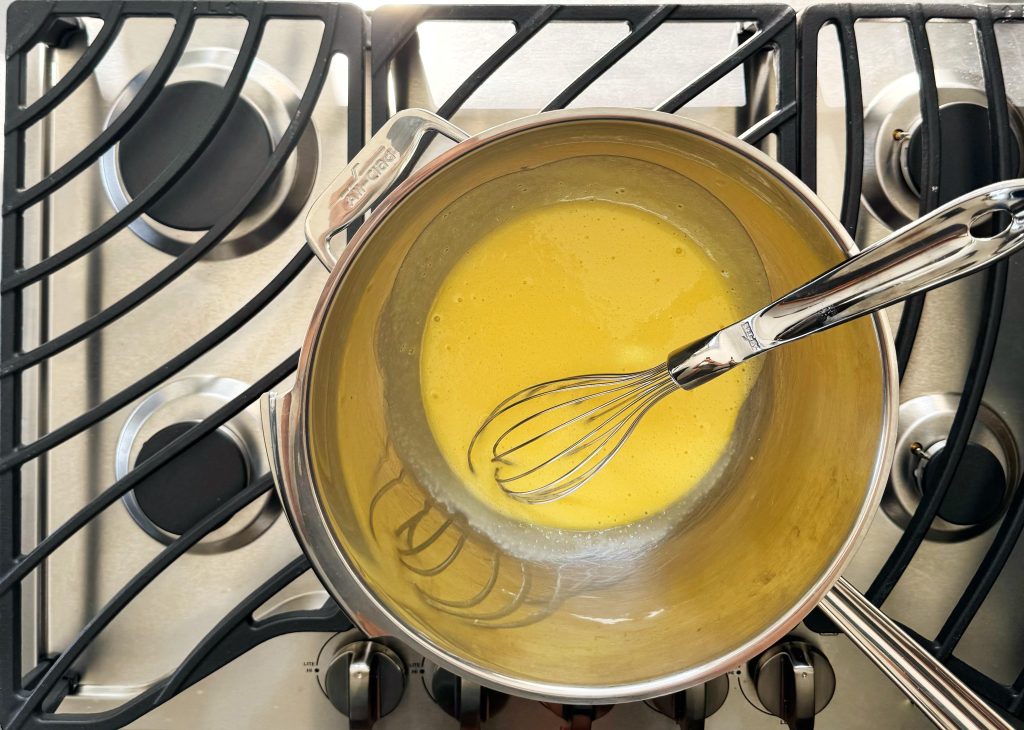
Mastering emulsion stability mechanics separates tentative amateur cooks from instinctual culinary masters who never fear a split hollandaise or broken vinaigrette. Almost every cook has endured that sinking moment when a velvety, golden sauce suddenly curds, weeping greasy yellow pools over the rim of a mixing bowl. It feels like an act of culinary betrayal, an inexplicable accident brought on by turning your back for half a second. Yet sauces do not curdle out of spite. They separate because the invisible microscopic boundaries holding incompatible fluids together have violently buckled under thermodynamic stress.
An emulsion is fundamentally an unnatural state of matter. In the physical universe, fat and water despise one another. Water molecules are aggressively polar, tightly clinging together through intense hydrogen bonds that exclude nonpolar lipid chains. When you force oil into water, you fight against the fundamental laws of entropy and surface tension. Left alone, the oil droplets will always collide, fuse, and form a distinct floating layer to minimize contact with their aqueous surroundings.
Creating a stable emulsion means declaring a temporary truce between these warring liquids. You are not dissolving the fat; you are mechanically shattering it into millions of microscopic spheres and trapping them inside an aqueous prison. When that suspension holds, the result is sheer velvet on the palate, reflecting light with an opaque, glossy sheen. When it fails, you are left with greasy liquid and grainy solids. By understanding the invisible architectural forces governing these suspensions, you can permanently eliminate sauce failures from your repertoire.
The thermodynamic war between oil and water in classic cooking
To grasp why culinary suspensions fail, you have to picture the energetic battlefield occurring at the liquid boundary. Every liquid possesses interfacial tension, an inward pull that compels droplets to form the smallest possible surface area, which is a perfect sphere. When billions of tiny oil droplets crowd together inside an acidic wine reduction or lemon juice base, they constantly bump into one another due to kinetic Brownian motion. If two naked oil droplets graze, their hydrophobic tails instantly coalesce into a single, larger droplet. This spontaneous fusion releases energy and reduces surface area, steadily driving the mixture toward complete thermodynamic collapse.
The culinary secret to defying this collapse lies in Stokes’ Law, which describes the settling velocity of suspended particles. The rate at which fat separates from liquid depends directly on three physical variables: droplet diameter, liquid viscosity, and the difference in density between the continuous and dispersed phases. Shrinking the fat droplets down to microscopic dimensions radically reduces their ability to rise and coalesce. Simultaneously, thickening the surrounding water phase turns that liquid into a dense, viscous obstacle course, mechanically preventing the droplets from colliding.
Whenever you whisk a pan sauce, whisking provides the violent shearing force needed to fragment the fat. But mechanical brute force is only half the battle. Without a dedicated chemical intermediary to cushion the impact between droplets, mechanical shearing simply delays an inevitable split. As demonstrated in classic Harvard University science and cooking public lecture research, successful sauces rely on surface-active agents that fundamentally alter the interfacial tension between opposing culinary phases.
The colloidal physics of kitchen suspensions and amphiphilic shields
Deep within the colloidal realm, emulsion stability mechanics depend entirely on creating a sustained thermodynamic truce between two mutually hostile substances. This miraculous truce is negotiated by surfactants, specifically amphiphilic molecules possessing a split personality. One end of the surfactant molecule is hydrophilic, seeking out water, while the opposite tail is lipophilic, craving fat. When introduced into a mixture of oil and water, these molecules spontaneously orient themselves along the borderline of every microscopic fat sphere.
Egg yolks serve as the culinary world’s most versatile surfactant reservoir because they are packed with lecithin, an exceptional phospholipid. When you whip raw yolk into warm clarified butter to create a classic béarnaise, lecithin molecules plunge their fatty tails directly into the butter droplets while anchoring their charged heads out into the vinegar reduction. This creates an electrostatic and steric barrier around every droplet. The exposed outer shells carry identical electrical charges, meaning whenever two butter droplets drift close to one another, they magnetically repel instead of fusing.
Milk proteins such as casein perform a similar protective function in traditional pan reductions, while the complex mucilage in prepared Dijon mustard blankets oil droplets in cold dressings. Even finely milled solid particles, such as the starch granules released from pasta water or ground black pepper, can nestle into the fluid interface to physically wedge droplets apart in a phenomenon known as Pickering stabilization. Regardless of the specific kitchen ingredient deployed, the objective remains identical: assemble a permanent molecular shield before the droplets have an opportunity to touch.
Four proven rules that keep your delicate emulsions completely unbreakable
Applying sound emulsion stability mechanics requires far less mysticism and significantly more attention to kinetic energy and volumetric boundaries. When professional chefs whip up emulsions on the line, they are not relying on intuition; they are executing a strict sequence of physical controls. Follow these four non-negotiable principles to ensure your sauces never fracture.
Control droplet dispersion speed during the critical initial baseline formation
The single most frequent mistake made during mayonnaise or hollandaise production happens within the first sixty seconds. If you dump a substantial volume of oil into your egg yolk base at the beginning, you overwhelm the system with excess fat before a continuous aqueous matrix can establish itself. The mechanical shear from your whisk ends up tearing large, unwieldy fat blobs that quickly link arms, trapping the water inside small pockets rather than the reverse.
You must introduce the fat drop by single drop while whisking with relentless vigor. This initial phase builds what food scientists call the seed emulsion. By forcing a minuscule amount of fat through extreme shear against a high concentration of surfactants, you generate billions of uniformly tiny starting droplets. Once this protective colloidal grid locks into place and the mixture turns thick and pale, the system can easily swallow larger streams of fat without risking structural failure.
Balance phase volume ratios to prevent catastrophic thermodynamic crowding
Every emulsion features two distinct components: the dispersed phase (the droplets) and the continuous phase (the liquid bath they float in). There is a hard geometric threshold for how tightly spheres can pack into a given volume. Once the dispersed oil droplets occupy roughly seventy-four percent of the total sauce volume, they become packed shoulder-to-shoulder like commuters in a jammed subway car. Understanding emulsion stability mechanics allows you to troubleshoot this impending disaster before the mixture separates entirely.
As you add more oil, the droplets begin distorting against one another, dramatically spiking the sauce’s viscosity until the emulsion becomes rigid. If you push beyond this threshold without adding more water, the continuous phase runs out of room to insulate the droplets. The tight spheres pop, fuse, and instantly flip the sauce inside out, converting your luscious emulsion into greasy clarified fat littered with curdled egg flecks. Whenever an emulsion begins looking uncomfortably thick, dull, or greasy along the edges of the whisk, immediately beat in a tablespoon of warm water, cream, or lemon juice to restore the continuous phase volume.
Manage the kinetic temperature window with clinical precision
Heat acts as both the engine and the assassin of emulsified butter sauces. For warm sauces like hollandaise, béarnaise, or beurre blanc, temperature governs the physical state of the fat and the viability of the protein stabilizers. Butter fat must remain above thirty-two degrees Celsius to stay liquid; let the sauce cool below this point, and the butter begins to crystallize into hard needles that puncture the delicate surfactant membranes, causing immediate separation.
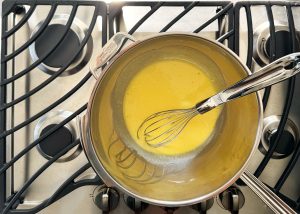
Conversely, pushing the temperature past sixty-five degrees Celsius triggers the rapid, irreversible denaturation of egg yolk proteins. Instead of flexing as supple protective coats around the butter droplets, the proteins violently knot together into tight, scrambled curds, expelling both fat and moisture. Keep your working pan within the ideal thermal corridor between fifty-two and sixty degrees Celsius. Use a heavy-bottomed saucier to buffer heat spikes, and never let the base of your bowl touch boiling water directly.
Deploy secondary stabilizers to create structural steric hindrance
Relying on a single surfactant creates a fragile single point of failure in a frantic kitchen. Master cooks build resilience into their sauces by layering secondary structural stabilizers that manipulate viscosity and steric hindrance. Adding a modest spoonful of Dijon mustard to a vinaigrette introduces both plant mucilage and microscopic seed fragments, multiplying stability tenfold compared to oil and vinegar alone.
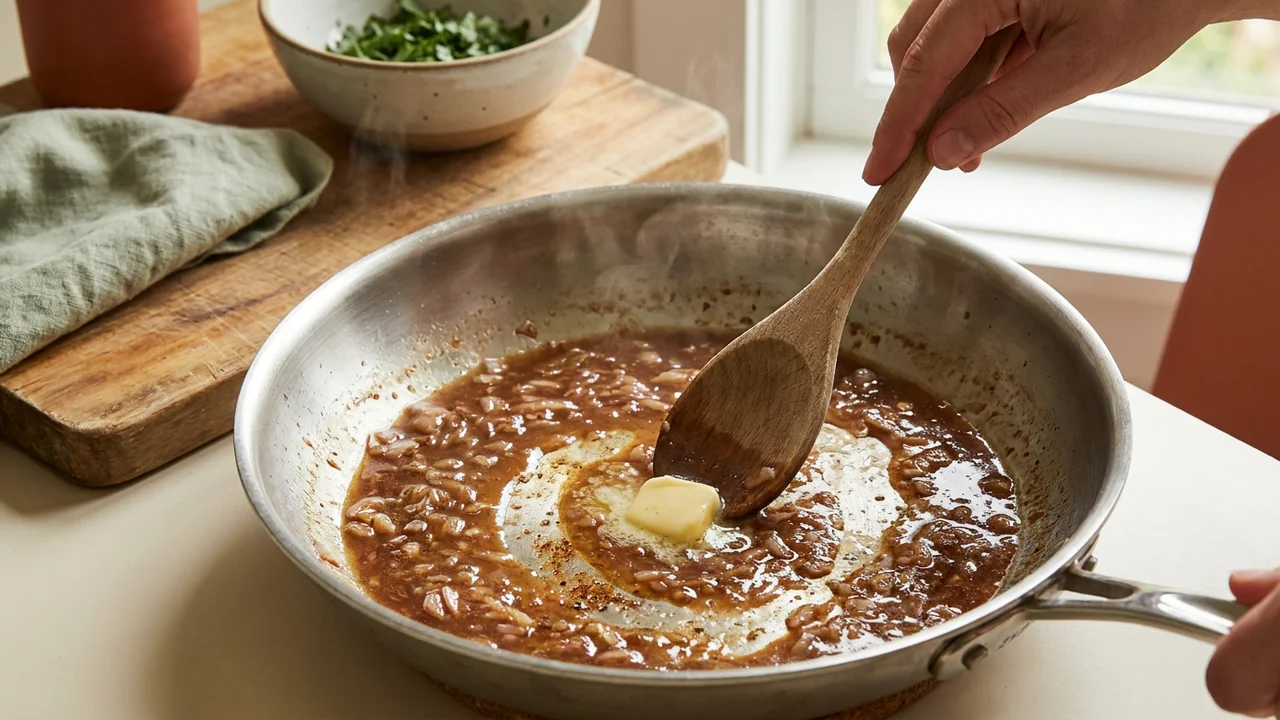
In hot pan sauces, incorporating a rich, gelatin-laden bone stock provides an elastic protein web that drastically thickens the continuous water phase, raising the kinetic barrier against droplet collisions. Cold butter swirled into a well-reduced stock forms a glossy beurre pané precisely because the gelatin physically prevents the melting fat droplets from merging. Starch slurries, reduction glazes, and fruit pectins all operate through this identical protective mechanism, offering a reliable safety margin against thermal and mechanical errors.
Diagnosing and reversing sudden sauce fractures before total collapse
When home cooks neglect fundamental emulsion stability mechanics, a smooth sauce will undergo rapid phase inversion. Fortunately, a split sauce is not chemically ruined; the constituent parts are entirely intact, merely rearranged in an undesirable spatial architecture. Catching a fracture early requires watching for subtle sensory cues. Before a sauce completely separates into oil and liquid, it often develops a dull, oily sheen across the surface, pulls away cleanly from the sides of the bowl, or exhibits faint beading around the whisk tines.
If you spot these early warnings, stop adding oil instantly. Splash a single tablespoon of boiling water or cold water (depending on whether the sauce is warm hollandaise or cold mayonnaise) directly into the fracture line and whisk furiously from the center outward. The fresh moisture restores the continuous phase, giving suffocated droplets breathing room to re-suspend.
When confronting systemic breakdowns under intense pressure, understanding structural design flaws is essential. Just as dissecting how the NFL Overtime Rules Face 3 Major Strategic Flaws After Back-To-Back Primetime Thrillers uncovers the risks of brittle sudden death mechanics, culinary mechanics reveal that rigid recipes break when cooks fail to adjust to shifting kinetic conditions. If a sauce has totally collapsed into an oily swamp, you must execute a structural reset. Place a fresh tablespoon of water or a single fresh egg yolk into a clean bowl, whisk it into a frothy base, and slowly whisk the broken sauce back into this new foundation, treating the fractured liquid exactly like pure oil.
Culinary microstructure mastery across daily pan sauces and dressings
By internalizing emulsion stability mechanics, you no longer rely on rigid recipes or panic when heat shifts unexpectedly. The exact same colloidal laws that preserve a velvety béarnaise apply when you mount butter into an acidic reduction for a restaurant-caliber pan sauce, or when you emulsify starchy pasta water with pecorino cheese for an authentic cacio e pepe without stringy clumps.
Great cooking is ultimately the deliberate manipulation of physical microstructure. When you recognize that an emulsion is a living suspension of millions of crowded droplets fighting against thermodynamic laws, your hands adjust naturally. You whisk with calculated shearing intent, you monitor temperature corridors instinctively, and you balance phase volumes with absolute confidence. Emulsions cease to be a fragile kitchen gamble and become what they were always meant to be: one of the most reliable and exquisite textures in gastronomy.