Emulsion Stability Mechanics and 4 Proven Rules to Defeat Broken Sauces Forever
A broken sauce is not bad luck; it is a predictable failure of interfacial physics. Discover how manipulating droplet shear, thermal corridors, and surface tension transforms volatile kitchen emulsions into unbreakable culinary gold.
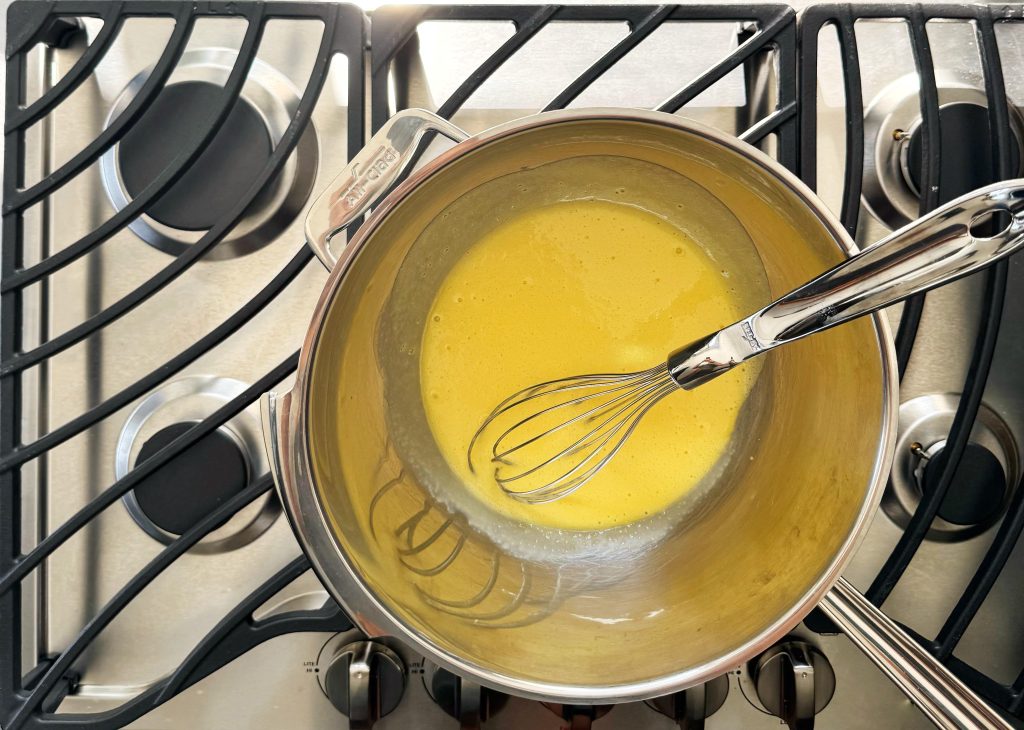
Mastering emulsion stability mechanics separates erratic amateur cooks from unflappable professionals who can summon velvet pan sauces at will under intense kitchen pressure. Every cook has witnessed the tragedy firsthand. You stand over a saucepan watching a golden ribbon of hollandaise, a glossy mayonnaise, or a glossy pan reduction suddenly fracture into an unappetizing pool of greasy yellow fat floating atop watery, curdled sludge. The instinct is to blame bad luck, an impatient burner, or an unruly whisk. The reality is far more clinical. Cooking sauces are strictly governed by thermodynamics, surface chemistry, and fluid dynamics.
An emulsion is fundamentally an unnatural peace treaty between two mortal enemies. Lipids and water refuse to associate willingly because water molecules prefer bonding with one another through tight hydrogen networks, energetically ostracizing nonpolar fat chains. When you force them into suspension, you are fighting against the relentless pull of entropy. Understanding how to structure, protect, and maintain that fragile equilibrium elevates sauce-making from anxious guesswork into a reliable, repeatable craft.
The Microscopic War Between Polar Water and Hydrophobic Fat
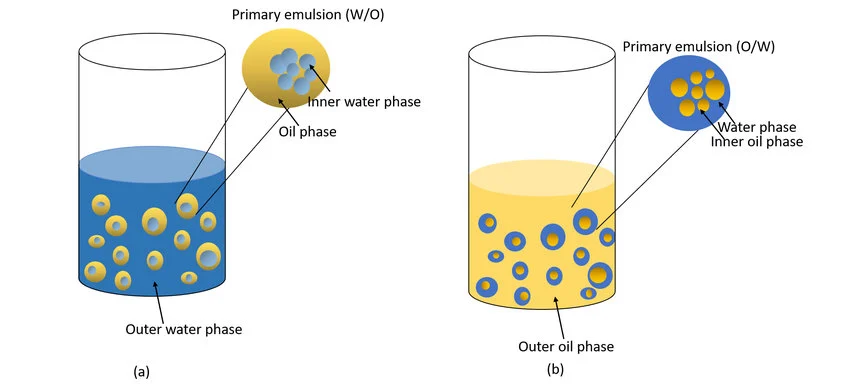
At the microscopic scale, every emulsion consists of two warring parties: the continuous phase and the dispersed phase. In an oil-in-water emulsion like mayonnaise, hollandaise, or a classic pan velouté, water acts as the continuous sea while billions of microscopic fat droplets float suspended throughout the liquid medium. Because water molecules are intensely polar, they pull together with tremendous force, creating interfacial surface tension. The oil droplets, fundamentally nonpolar and hydrophobic, are shoved together to minimize their contact area with water.
Left entirely to their own devices, suspended oil droplets inevitably collide, coalesce into larger globules, and float upward to form an unbroken layer of grease. The core of emulsion stability mechanics lies in overcoming interfacial tension by deploying amphiphilic molecules known as surfactants or emulsifiers. These biochemical mediators possess a split personality: a hydrophilic head that anchors securely into water, and a lipophilic tail that embeds itself directly inside the oil droplet.
Egg yolks provide the quintessential culinary surfactant in the form of lecithin, alongside a potent array of low-density lipoproteins. When you introduce mechanical energy into the mixture, these lipoproteins coat the newly sheared oil droplets like microscopic armor plating. The hydrophilic heads project outward into the water phase, generating negative electrostatic charges. Because identical charges repel, the coated oil droplets bounce off one another upon impact rather than fusing together into greasy clumps.
Proteins from dairy, mustard mucilage, garlic saponins, and gelatin peptides perform comparable stabilizing duties in various preparations. A classic French vinaigrette relies on the complex polysaccharides and proteins inside Dijon mustard to prevent instantaneous oil separation. A rich beef pan sauce relies on denatured gelatin extracted from collagenous bones to provide the viscosity cushion that keeps swirling butter droplets locked in place.
The Exact Thermodynamic Thresholds That Trigger Catastrophic Separation
Sauces do not break out of malice; they break because specific physical tolerances are violated. Anyone studying emulsion stability mechanics quickly realizes that broken sauces do not fail by accident, but along four predictable mechanical collapse pathways known as creaming, flocculation, Ostwald ripening, and coalescence.
Creaming occurs when the dispersed fat droplets, being less dense than the surrounding water, slowly drift to the surface under gravitational pull. Flocculation happens when the droplets gather into loose clusters without immediately merging their internal cores. Ostwald ripening describes the thermodynamic migration where smaller droplets dissolve across the aqueous phase to feed larger droplets, driven by differences in Laplace pressure. Coalescence represents the ultimate point of no return: the protective surfactant film ruptures completely, the droplets fuse into continuous masses, and the sauce catastrophically splits.
Thermal abuse remains the most frequent instigator of coalescence in warm emulsified sauces. Consider hollandaise or béarnaise. Egg yolk proteins act as surfactants only as long as their peptide chains remain flexible and intact. When temperatures climb above 65°C (149°F), proteins like vitellin unfold aggressively and cross-link into rigid, insoluble networks. Instead of shielding the butterfat droplets, the proteins squeeze out water and form gritty curds, leaving the liberated butterfat to collect on the surface. Conversely, allowing a warm butter emulsion to drop below 40°C (104°F) causes butterfat to partially crystallize. These sharp lipid crystals physically pierce the delicate surfactant membranes of neighboring droplets, triggering sudden structural failure upon the slightest mechanical disturbance.
The subtle peril of structural collapse is not unique to culinary physics. When systems operate near extreme tension thresholds without adequate buffering, small oversights rapidly cascade into systemic disasters. In regulatory frameworks and institutional finance, for instance, early warning signals frequently go unheeded until catastrophic vulnerabilities spill open, as seen when Fraud Whistleblowers Face 4 Major Risks Under Trump Cash Bounty Plan while navigating precarious structural volatility. In a saucepan, as in high-stakes governance, maintaining structural equilibrium requires respecting hard operational thresholds before internal stress levels rip the matrix apart.
Four Proven Mechanical Rules to Lock Sauces in Permanent Equilibrium
Achieving total command over pan sauces, dressings, and emulsified reductions does not require laboratory equipment. It requires respecting the thermodynamic boundaries of the continuous phase. Translating emulsion stability mechanics into repeatable muscle memory requires four non-negotiable physical rules.
Establish the Continuous Phase Matrix Before Introducing a Single Droplet of Fat
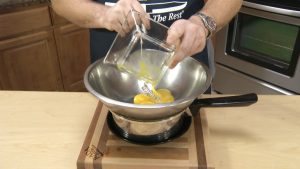
The cardinal error in emulsion preparation is dumping oil or butter into a dry or fat-heavy pan. An oil-in-water emulsion cannot form unless an adequate volume of continuous aqueous fluid is already present to accept and disperse the incoming lipids. In practical terms, this means your egg yolk, vinegar reduction, stock, or lemon juice must be thoroughly whisked together before adding even a teaspoon of butter or oil.
Water molecules must fully hydrate the surfactant proteins before those proteins can properly align at droplet interfaces. If you attempt to whisk a cold knob of butter into a pan that contains only rendered pan fat and dry fond, the butter will simply melt into continuous oil, sealing the sauce’s doom. Always ensure at least two to three tablespoons of water-based liquid are bubbling and active in the pan base, fully dissolving all surface proteins, before introducing your fat source.
Apply Progressive Micro Shear Forces to Shrink Dispersed Droplet Diameters
Shear force is the physical tearing motion that fractures large oil globs into microscopic spheres. According to fluid dynamics principles explored in Harvard University Science and Cooking educational resources, the rate at which oil droplets separate is directly proportional to the square of their radius. If you cut the average diameter of your fat droplets in half, you reduce their tendency to separate by a factor of four. Shrink them to sub-micron dimensions, and Brownian motion alone will keep them suspended indefinitely.
Achieving this level of dispersion requires progressive introduction. The first additions of oil or melted butter must enter drop by drop under violent agitation. Each droplet must be stretched, distorted, and broken apart by mechanical shear before the next wave arrives. Pouring in an unchecked stream floods the continuous phase with excess oil, causing un-sheared fat droplets to contact one another and form continuous lipid lakes before the surfactant molecules have time to coat them. This physical phenomenon governs emulsion stability mechanics by increasing interfacial surface area exponentially at the exact moment the surfactant is most available to coat it.
Govern Phase Volume Ratios Through Calculated Viscosity Buffers
There is a mathematical limit to how many spheres can fit into a given volume before they are forced into physical contact. In physical chemistry, this theoretical maximum packing fraction sits at roughly 74 percent dispersed phase volume. Once oil constitutes more than roughly three-quarters of your total sauce volume, the droplets are packed so tightly against one another that they warp from spheres into polyhedral cells, placing extreme mechanical strain on the thin aqueous walls separating them.
When a mayonnaise or hollandaise turns thick, glassy, and resists the whisk, it has arrived at this danger zone. If you add more oil at this juncture, the sauce will break instantly because there is literally no physical room left for water to separate the droplets. The solution is simple but counterintuitive: add a few drops of water, lemon juice, or stock. This instantly thins the continuous phase, restores the distance between lipid spheres, and resets your capacity to emulsify additional fat without risking collapse.
Maintain the Goldilocks Thermal Band Between Solidification and Protein Coagulation
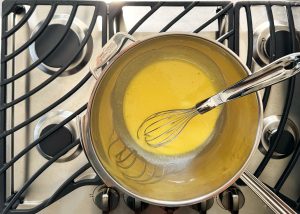
Warm emulsified sauces demand a strict operational temperature band between 48°C and 58°C (118°F to 136°F). This window keeps butterfat completely liquid while sitting comfortably below the denaturation point of yolk vitellin and dairy albumins. Working inside this corridor guarantees optimal fluidity for vigorous whisking while protecting surfactant proteins from thermal shock.
Professional sauciers monitor this window through tactile feedback. If the side of your saucepan feels too hot to hold your bare palm against comfortably for several seconds, you are rapidly approaching 60°C and must pull the pan off the heat immediately. If the pan feels merely lukewarm, the fat is beginning to crystallize, which drastically increases viscosity and invites phase separation. Move the pan back and forth over a gentle pilot flame or maintain a disciplined water bath to hold the sauce securely within its sweet spot.
Emergency Resurrection Mechanics When a Sauce Fractures in Real Time
Even seasoned culinary veterans occasionally misjudge a flare-up or rush an oil pour. When a sauce breaks, throwing it into the waste bin is an admission of defeat based on a misunderstanding of physics. Because the underlying components—lipids, water, and surfactants—remain completely intact, the failure is purely spatial. The phases have separated, but they can be systematically reassembled.
If a sauce breaks due to rapid fat saturation, immediately stop adding fat. Whisk a single tablespoon of boiling water vigorously into a clean, warm bowl, then slowly incorporate the broken mixture whisk by whisk. The sudden infusion of continuous water re-establishes the aqueous matrix, allowing the whisk’s mechanical shear to capture the separated fat droplets one by one and pull them back into alignment.
If the emulsion broke due to severe overheating and the proteins have begun to coagulate, boiling water alone will not restore stability because the surfactant proteins have lost their functional flexibility. In this scenario, crack a fresh, room-temperature egg yolk into a clean bowl, whisk it with a teaspoon of acidic water or lemon juice to hydrate the native lecithin, and treat your broken sauce as raw oil. Whisk the broken mixture into the fresh yolk base drop by drop. The unblemished surfactant army in the new yolk will encase the old fat globules, producing an emulsion that is often glossier and more stable than the original attempt. Understanding practical emulsion stability mechanics provides an infallible roadmap for real-time recovery, ensuring no pan reduction or dressing is ever truly lost.
Elevating Everyday Kitchen Craft Beyond Blind Recipe Followership
Culinary freedom begins the moment you stop following recipes as arbitrary rituals and start viewing them as applied physical systems. A recipe telling you to whisk butter into a pan reduction over low heat is not imparting magic; it is instructing you to build an oil-in-water suspension buffered by extracted collagen, low shear thresholds, and precise thermal control.
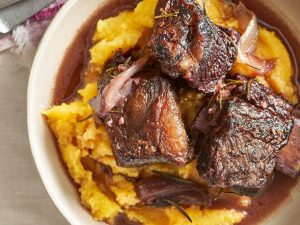
When you glaze roasted vegetables with emulsified pan drippings, whip an aioli by hand using mortar and pestle shear, or swirl cold butter into a sharp white wine reduction to achieve a glistening beurre blanc, you are directly manipulating surface tension and phase volume. The kitchen stops being a minefield of unpredictable mishaps and becomes an arena of conscious craft, grounded in real emulsion stability mechanics rather than superstition. Once you command the microscopic forces holding fat and water together, perfect texture ceases to be a lucky accident and becomes your baseline standard.