Cast iron seasoning mechanics and 4 proven rules to forge indestructible pans
Raw cast iron is full of jagged microscopic crevices waiting to seize your food and rust. Mastering the science of lipid polymerization transforms porous metal into an indestructible, glass-slick culinary heirloom.
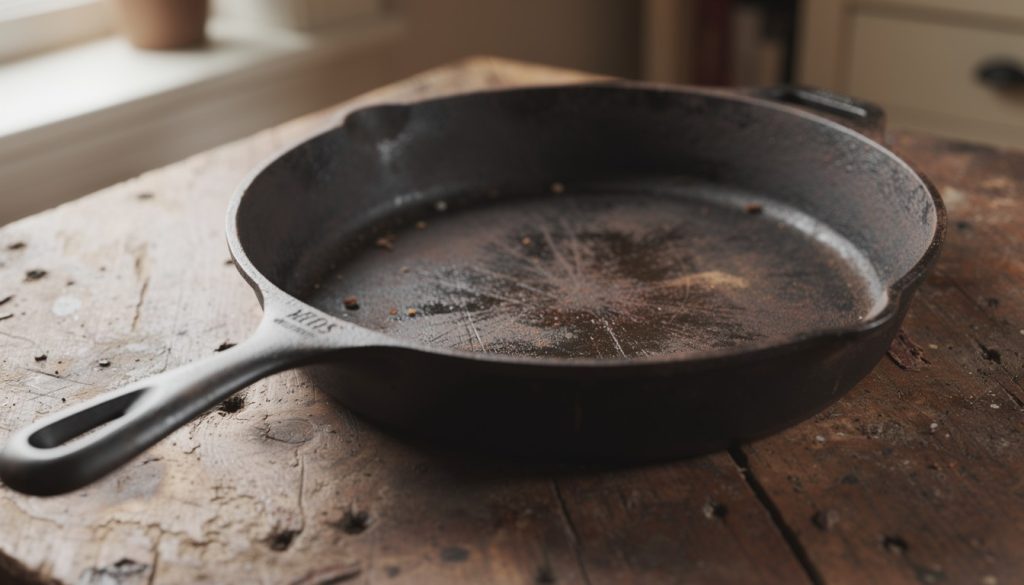
Mastering cast iron seasoning mechanics transforms an ordinary skillet from a sticky, rusting slab of metal into an indestructible nonstick culinary workhorse. For generations, home cooks have treated skillet maintenance like dark alchemy, relying on passed-down superstitions, campfire folklore, and cryptic warnings about moisture. In truth, building a glassy patina requires zero folklore and pure applied chemistry. The jet-black coating that defines high-performing iron is not dried oil, nor is it a simple layer of trapped grease. It is an engineered polymer network chemically anchored directly to the metallic crystal structure.
Cast iron is not naturally smooth. Straight out of foundry sand molds, grey iron presents a rough, porous face eager to react with atmospheric oxygen. Drop a raw protein into an unseasoned pan, and moisture flash-evaporates, vacuuming meat fibers into microscopic fissures where they form aggressive covalent bonds with bare iron atoms. The steak tears, the pan oxidizes, and clean-up becomes a miserable scrub session. Seasoning provides the molecular armor that prevents this kitchen disaster by converting liquid unsaturated fats into a solid, impenetrable, semi-crystalline film.
The microscopic reality of raw iron and molecular bonding
Place a raw cast iron pan under an electron microscope, and the illusion of solid metal vanishes instantly. What appears smooth to the fingertip is actually a chaotic landscape of jagged peaks, micro-cavities, crevices, and graphite flakes suspended in an iron matrix. This tortuous topography is cast iron’s greatest liability when bare, but its greatest asset once cured. The porosity creates immense surface area, providing microscopic anchor points that hold protective coatings in place.
When cooking on unseasoned metal, heat expands these pores, pulling in moisture, sugars, and liquid proteins. Free iron ions actively catalyze oxidative reactions, binding food stubbornly to the pan. When you zoom into unseasoned iron under a scanning electron microscope, you witness why cast iron seasoning mechanics are essential for culinary performance. Without a molecular buffer, every sear turns into an unwanted chemical union between meal and metal.
The mechanical bond formed between seasoned oil and metal is known as mechanical interlocking. Liquid oil slips into the microscopic valleys and crags through capillary action. When thermal energy triggers polymerization, that liquid hardens inside the crags. The hardened plasticized fat cannot simply be rubbed off because it is mechanically intertwined with the crystalline iron itself. Instead of sliding over a flat surface, the polymer locks into thousands of microscopic iron undercuts.
The thermodynamic chemistry behind lipid polymerization
The transition from runny vegetable fat to an obsidian-colored nonstick shield is governed by lipid auto-oxidation, free radical propagation, and thermal crosslinking. When fats are subjected to sustained heat in the presence of atmospheric oxygen, their molecular architecture destabilizes. Triglyceride molecules break down, cleaving off fatty acid chains and releasing free radicals.
According to academic research on lipid auto-oxidation and unsaturated fatty acid crosslinking, high temperatures cause vulnerable double bonds in fatty acids to open up and bind with adjacent carbon molecules. Instead of individual fatty acid tails slipping past one another as a liquid, they join into vast, three-dimensional, crosslinked polymeric chains. This natural synthesis produces a durable bioplastic practically identical to linoleum or cured oil paint.
At the same time, prolonged thermal exposure induces partial pyrolysis. Thermal degradation drives off volatile gases, moisture, and hydrogen, leaving behind pure elemental carbon embedded directly within the polymer matrix. That carbon is what gives a seasoned skillet its lustrous black finish, immense hardness, and thermal endurance. Just as computational researchers realized when analyzing how Google DeepMind Minecraft AI Agents Claim Major Win In 27 Costly Hours through relentless iterative problem solving rather than brute luck, building an unyielding surface on cast iron demands structured, repeatable execution rather than blind guesswork.
Cast iron seasoning mechanics and 4 proven rules for a flawless finish
Engineering a durable nonstick surface at home requires strict control over your chosen lipid, layer thickness, thermal application, and cooling cycles. Cutting corners or relying on outdated kitchen myths yields tacky pans that flake at high temperatures. Follow these four foundational rules to harness the chemistry correctly.
Rule 1 Choose drying oils with high polyunsaturated fatty acids
Not all fats possess the chemical capacity to polymerize effectively. Saturated fats like beef tallow, lard, butter, and unrefined coconut oil contain single carbon bonds packed tightly with hydrogen atoms. Because they lack reactive double bonds, saturated fats resist thermal crosslinking. While traditional frontier cooks used lard out of necessity, saturated fats yield soft, greasy films that dissolve rapidly during everyday cooking.
Polyunsaturated fats, on the other hand, feature multiple double carbon bonds along their fatty acid chains. When heated, these double bonds snap open, eagerly crosslinking with neighboring molecules to build tough, dry plastics. Grapeseed oil, soybean oil, and sunflower oil are prime candidates for seasoning because they boast massive concentrations of linoleic and oleic acids alongside elevated smoke points. Grapeseed oil has become the modern culinary benchmark, offering superior durability, minimal odor during curing, and a smooth glassy finish that resists brittle cracking.
Rule 2 Apply microscopic layers to avoid sticky gummy pooling
The most devastating mistake home cooks make is pouring oil into the skillet like batter into a cake mold. When an oil layer is too thick, the exterior skin polymerizes upon contact with oven air while the liquid trapped underneath is starved of oxygen. The result is a gummy, amber, mottled mess that never dries, attracts dirt, and flakes off in unsightly sheets the moment you heat the pan on the stove.
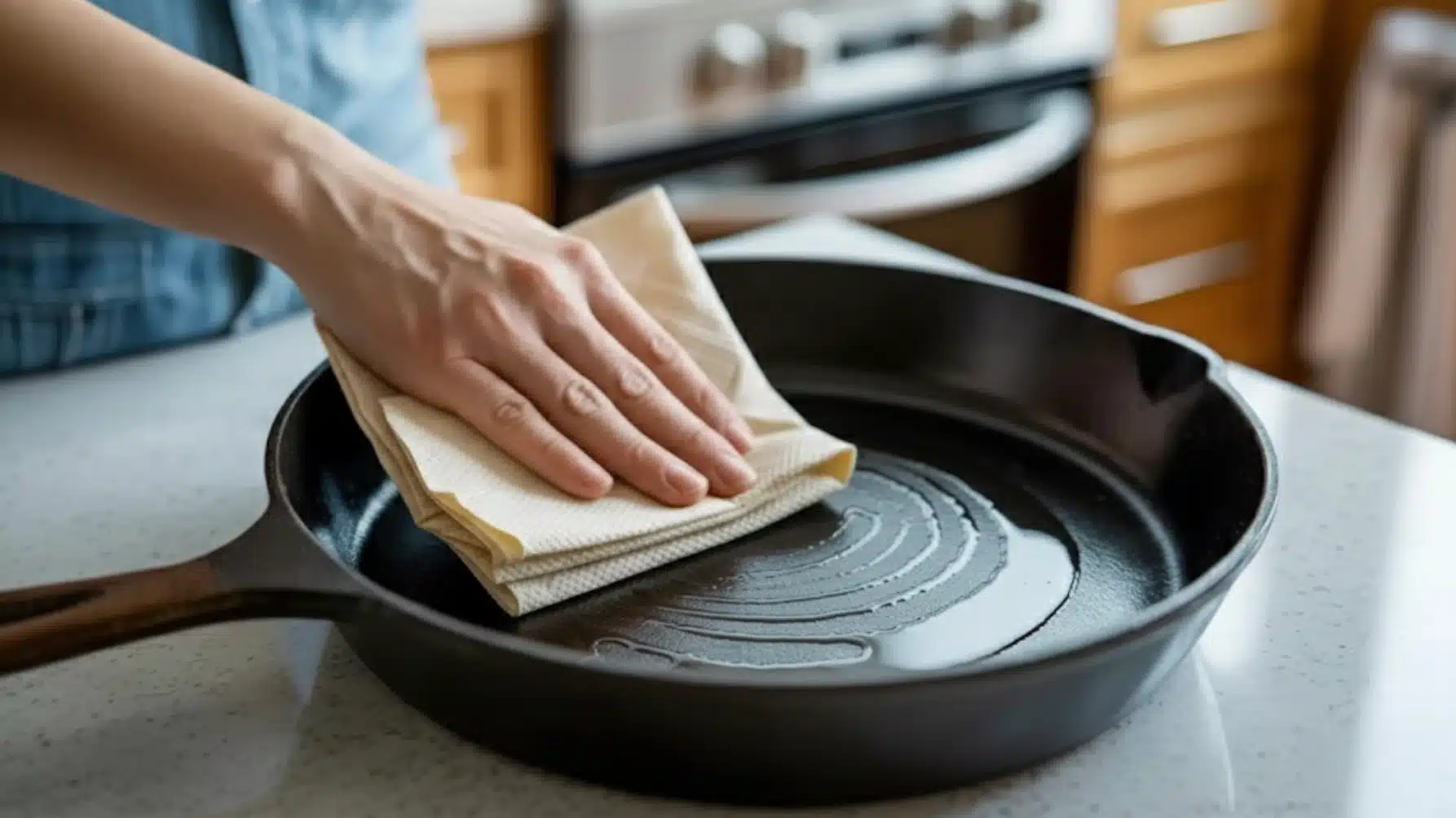
Polymerization requires uniform oxygen exposure across the entire film. Pour less than a teaspoon of oil into a warm skillet, rub it thoroughly into every square millimeter of the cooking surface, handle, and exterior base, and then immediately grab a dry, clean lint-free cloth. Wipe the pan aggressively, as if you spilled the oil by accident and are desperately trying to remove every trace of it. What remains is a microscopic layer only molecules deep. This application rate highlights the foundational truth of cast iron seasoning mechanics, where thinner is always superior to thicker. Building five paper-thin coats yields a surface ten times stronger than one heavy application.
Rule 3 Push past the smoke point to induce free radical crosslinking
Curing cannot take place at lukewarm temperatures. In order to drive lipid oxidation, decompose the triglycerides, and generate the reactive free radicals required for crosslinking, the ambient temperature must reach and exceed the lipid smoke point by 25 to 50 degrees Fahrenheit.
If you are utilizing grapeseed oil with an established smoke point around 425 degrees Fahrenheit (218 degrees Celsius), your oven must run at 475 degrees Fahrenheit (246 degrees Celsius) for a full sixty minutes. That faint, hazy smoke wafting from the oven vent is visual proof of volatile fractions boiling away, leaving only dense, heat-resistant carbonized polymers locked into the pan. If you bake below the smoke point, the oil will remain partially unreacted, sticky to the touch, and vulnerable to washing right off.
Rule 4 Cool slowly in ambient heat to prevent crystal microfractures
Thermal dynamics do not end when the timer chimes. Metal and organic polymers expand and contract at noticeably different rates when exposed to sudden temperature swings. Pulling a scorching 475-degree skillet out into a chilly kitchen induces immediate thermal contraction shock. This abrupt temperature drop can generate invisible microfractures along the boundary where the fresh polymer clings to the iron grain.
Once the hour of baking concludes, shut off the oven and walk away. Leave the oven door closed and let the cookware cool naturally over two to three hours until it reaches room temperature. Slow, gradual ambient cooling allows the molecular matrix to settle, relieves internal physical tension between the metal substrate and the seasoning film, and maximizes long-term adhesion.
Debunking modern dish soap myths and everyday care mistakes
The terrifying warning that a single drop of dish soap will ruin a seasoned skillet is a stubborn culinary relic of the early twentieth century. Historic household soaps were made by mixing animal fats with pure lye (sodium hydroxide). Unreacted lye is a ferocious caustic base capable of chemically saponifying crosslinked polymers, dissolving seasoning layers straight back to grey iron within seconds.
Modern commercial dish soaps are not traditional lye soaps at all. They are gentle synthetic detergents utilizing biodegradable surfactants designed to lower water surface tension and suspend soft, unpolymerized cooking grease. Modern culinary education often overlooks basic cast iron seasoning mechanics, leading cooks to baby their cookware unnecessarily. A fully cured polymer matrix is chemically inert and completely insoluble in mild dish detergent. You can wash your skillet with warm water, mild dish soap, and a soft sponge without inflicting the slightest damage on your patina.
The real killers of cast iron are moisture, oxygen, and prolonged soaking. Submerging a skillet in a sink full of soapy water gives moisture ample time to creep through microscopic voids in the polymer, causing rust bloom beneath the seasoning that jacks the coating off the metal. Running a skillet through a modern dishwasher is even worse, exposing it to extreme heat, steam saturation, and aggressive alkaline wash powders that will shred even decades-old seasoning within a single wash cycle.
Restoring stripped pans and troubleshooting carbon buildup
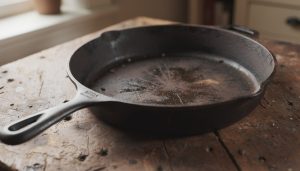
Even if an heirloom skillet looks ruined beneath thick layers of crumbly black crud or bright orange surface rust, the underlying iron remains virtually indestructible. Most cooks mistake thick carbon buildup for seasoning. Seasoning is a smooth, paper-thin, glassy amber-to-black polymer. Carbon buildup is charred, crusty, rough food residue that burned onto the surface because the pan was not cleaned properly between uses. Carbon buildup is brittle, traps trapped moisture, and will inevitably flake off into your food.
To eliminate carbon crust, scrub the dry pan with coarse kosher salt and a few drops of neutral oil, using the salt as a mechanical abrasive. For heavier deposits, a stainless steel chainmail scrubber safely knocks away charred crust without gouging the iron underneath. If orange rust has formed, a thirty-minute bath in equal parts cold water and white vinegar dissolves the oxidized iron. Follow this immediately with a thorough wash, dry the pan over low heat on the stovetop, and start building new layers using your high-heat drying oil.
A complete reset demonstrates the true durability of cast iron seasoning mechanics, proving that real cast iron can almost always be resurrected. Once you command fundamental cast iron seasoning mechanics, you eliminate the anxiety of cooking with bare metal forever. Your skillet ceases to be a finicky, high-maintenance chore and becomes an unmatched kitchen tool, searing meats at ferocious heat, sliding fried eggs effortlessly across the surface, and outlasting every synthetic nonstick pan ever manufactured.