Culinary emulsion mechanics and 4 proven rules to conquer broken sauces
Few kitchen failures feel as sudden or humiliating as a velvety sauce breaking into a greasy pool of oil. Understanding the physics of molecular suspension turns kitchen catastrophes into effortless culinary mastery.
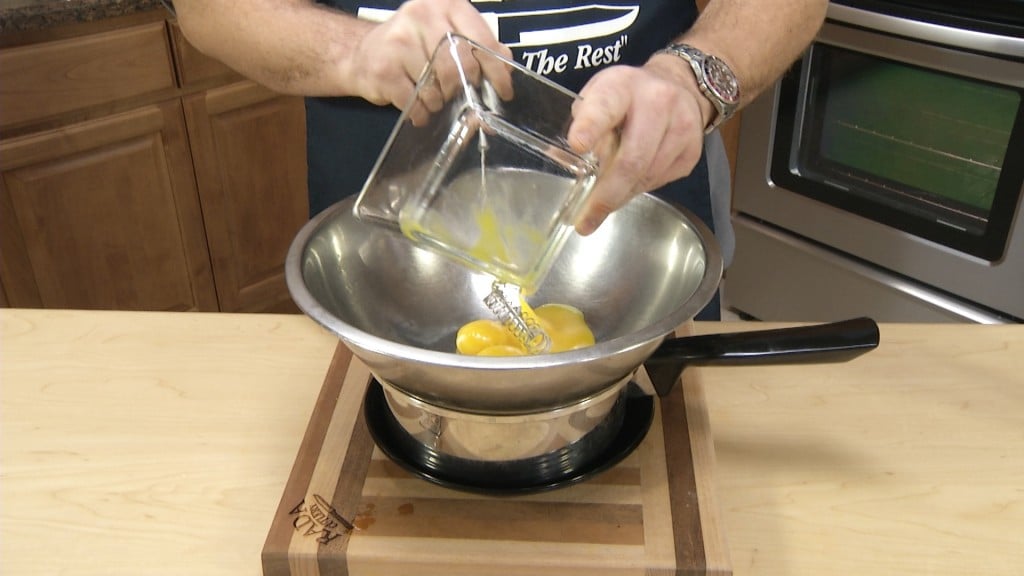
Understanding culinary emulsion mechanics separates confident cooks from those who watch their hollandaise split into greasy, ruined disasters. There is a precise, terrifying moment every home cook recognizes. You stand over a warm stainless bowl or a sputtering skillet, whisking furiously. For three minutes, the mixture looks like liquid silk, thick and glossy enough to coat the back of a spoon. Then, without warning, the sheen vanishes. The smooth body collapses into a curdled, yellow slush floating in a slick moat of clarified butter. It feels like betrayal, but it is actually just physics reasserting itself.
Sauces do not break out of malice. They break because liquids that despise each other were forced into an unnatural marriage without sufficient structural reinforcement. When you force oil and water together, you are working against the fundamental laws of thermodynamics. Without an intuitive grasp of how droplets behave at the microscopic level, every béarnaise, mayonnaise, and pan reduction remains a gamble.
The invisible physical war between oil and water
At its core, the science of culinary emulsion mechanics is a constant war against thermodynamic equilibrium. Water molecules are intensely polar. They cling to one another through tight hydrogen bonds, forming a dense, cohesive community. Fat molecules, whether derived from rendered duck fat, golden olive oil, or melted dairy butter, are non-polar hydrocarbons. They want nothing to do with water. When dumped into the same vessel, water molecules pull together so tightly that they squeeze the fat molecules out, forcing them to coalesce and rise to the surface.
To create an emulsion, you must physically tear that incoming fat into billions of microscopic droplets and suspend them throughout the water. In culinary terminology, the water functions as the continuous phase, while the oil serves as the dispersed phase. The more finely you shatter those fat droplets, the more viscous and luxurious the sauce feels on the human palate. When millions of tiny spheres crowd together in a liquid medium, they bump against one another, creating friction that resists flow. That friction is what transforms runny liquid yolk and fluid melted butter into a towering, spoonable ribbon.
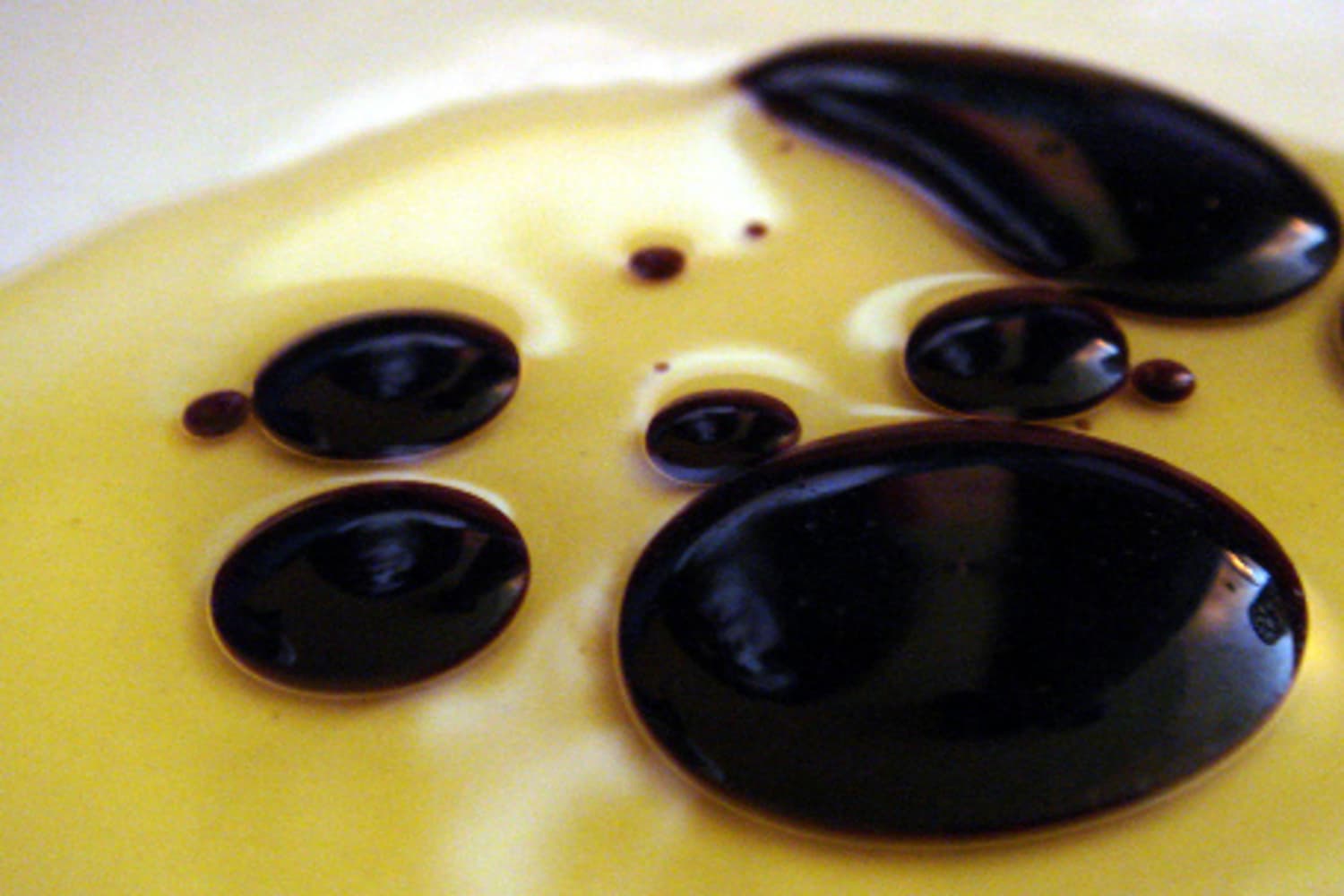
Yet those droplets are perpetually searching for an excuse to merge. Every tiny sphere possesses surface energy, and nature despises high surface energy. Left to their own devices, tiny droplets will collide, fuse into larger droplets, and eventually reconstitute a floating slick of yellow grease. To prevent this inevitable collapse, cooks rely on surfactants, commonly called emulsifiers. These molecules possess a split personality. One end is hydrophilic, meaning it loves water, while the opposite end is lipophilic, meaning it clings to fat. Research documented by the Harvard University Science and Cooking program demonstrates how these amphiphilic molecules coat the exterior of every dispersed oil droplet, creating a molecular shield that prevents them from fusing upon contact.
Why traditional culinary wisdom fails under real kitchen heat
When amateur cooks ignore fundamental culinary emulsion mechanics, they almost always blame their tools rather than physics. Old-school recipe cards frequently urge cooks to add a splash of cold water or whisk faster when a sauce begins to look dull. Unfortunately, frantic whisking alone cannot compensate for a broken thermal envelope or an exhausted continuous phase. Whisking faster only adds kinetic energy, which generates additional friction and heat, accelerating the very collapse you are trying to prevent.
The greatest point of confusion lies in the role of egg yolks. Culinary lore treats egg yolks as pure emulsifiers, but a yolk is actually an emulsion itself, comprised of roughly fifty percent water, thirty percent fat, and sixteen percent protein. The true heroic surfactant inside an egg yolk is lecithin, a phospholipid accompanied by low-density lipoproteins. When you overheat an egg yolk beyond 158 degrees Fahrenheit, those coiled protein strands denature and form rigid, irreversible cross-linked bonds. Instead of coating fat droplets flexibly, the proteins clamp together into rubbery curds, squeezing out the trapped butterfat in a catastrophic process known as syneresis.
Conversely, cold temperatures present an equally lethal hazard to dairy-based emulsions. Butterfat solidifies around 60 degrees Fahrenheit. If your butter cools too rapidly while being incorporated into an emulsion, the droplets harden into crystalline wax. The rigid fat crystals pierce the delicate surfactant films surrounding neighboring droplets, causing the entire structural web to rupture instantly. Successful sauce making is not an exercise in brute wrist strength. It is an exercise in environmental boundary management.
Four proven principles that guarantee unbreakable kitchen emulsions
Navigating the fragile threshold between fluid suspension and greasy separation requires systematic process control. By mastering four non-negotiable physical rules, you can produce bulletproof emulsions that hold their gloss through chaotic service and recover instantly if pushed to the brink.
Establish a continuous liquid baseline before introducing fat
The single most common operational error in sauce preparation is pouring fat into an empty or liquid-starved bowl. An emulsion requires a hospitable continuous medium before a single droplet of fat can be successfully suspended. If you drop melted butter directly onto raw yolks without adequate initial hydration, the fat volume instantly overwhelms the available water molecules. The mixture enters phase inversion, where the fat becomes the continuous medium and traps microscopic pockets of water, producing a greasy paste rather than a light sauce.
Always whisk a tablespoon of water, lemon juice, wine reduction, or vinegar into your yolks or mustard base before introducing fat. This initial reservoir provides the physical room needed for incoming oil droplets to disperse freely. As a reliable metric, the continuous phase must represent at least one-third of the initial volume during the opening seconds of emulsification. Give your fat droplets somewhere to swim, or they will swallow the sauce whole.
Control temperature boundaries to protect sensitive protein surfactants
This delicate thermal window showcases culinary emulsion mechanics at its most temperamental. For warm egg-based sauces like hollandaise, béarnaise, and choron, the ideal operational corridor sits strictly between 120 and 145 degrees Fahrenheit. Below 120 degrees, butter begins to crystallize, losing its liquid compliance. Above 150 degrees, egg proteins begin tightening into scrambled curds, stripping the surfactant barrier away from the lipid droplets.
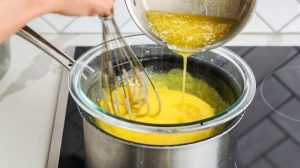
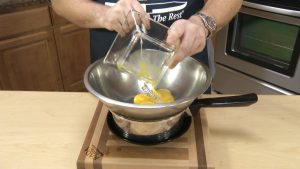
Ditch the anxiety-inducing double boiler if it causes your pan to overheat. Work over direct, gentle heat on an induction burner or keep a damp towel beside your stove. If the bottom of the pan feels too hot to touch with bare knuckles, pull it off the heat immediately. Regulating temperature by moving the pan on and off the burner allows you to preserve the elasticity of the yolk proteins while keeping the butter thoroughly molten.
Apply mechanical shear to shatter droplets into microscopic suspension
Shear force forms the mechanical engine driving culinary emulsion mechanics forward. Simply stirring oil and vinegar in a circle does not create an emulsion; it merely pushes large oil globules around in a whirlpool. To build an enduring suspension, you must subject the liquid to intense shear force, which stretches round oil globules into elongated cylinders until they snap into thousands of microscopic spheres.
A balloon whisk accomplishes this through the rapid spacing of its thin stainless wires, slicing through the mixture at varied velocities. An immersion blender takes this concept to its technological zenith, spinning blades at ten thousand revolutions per minute to shear fat down to sub-micron dimensions within seconds. Smaller droplets mean greater aggregate surface area, higher viscosity, and vastly superior shelf stability. If your vinaigrettes separate within ten minutes of sitting on the dining table, your droplets were simply too large when you stopped mixing.
Rescue a separating matrix with immediate thermodynamic intervention
Even seasoned professional cooks occasionally push an emulsion past its tipping point. The secret to kitchen mastery is recognizing that a broken sauce is not dead; its components have simply reorganized into an undesirable thermodynamic state. Because the oil droplets and water molecules are still physically present, they can be reassembled if you restore the correct volumetric balance.
The moment you detect a dull, oily ring forming along the rim of your bowl, stop pouring fat immediately. Add a single teaspoon of boiling water or cold cream, depending on the sauce type, and whisk vigorously in the center of the bowl until a smooth, shiny vortex reappears. If the break has progressed to full separation, start fresh in a clean bowl with a teaspoon of water and a dab of Dijon mustard or fresh yolk. Slowly drizzle the broken mixture into this new continuous base exactly as if it were fresh oil. Within ninety seconds, the entire failed preparation will be pulled back into a glossy, pristine suspension.
Applying structural balance to high-stakes kitchen prep
Grasping these intricate culinary emulsion mechanics allows a line cook to remain composed when a sauce begins to haze or separate. In professional environments, maintaining stability across high-pressure variables requires constant systemic calibration. In the same way institutional leadership must balance volatile competing interests—an operational reality examined in depth when Roger Goodell faces 4 crucial crossroads reshaping the modern sports landscape—a professional chef must balance temperature, friction, and fluid volume to keep delicate matrices from catastrophic failure.
Consider the humble pan sauce made after searing a thick cut of meat. The dark, caramelized sugars and proteins stuck to the bottom of the pan—the fond—contain natural gelatin and soluble proteins. When you deglaze that pan with wine or stock and reduce it, you are concentrating those natural stabilizers. Whisking cold, cubed butter into that simmering reduction at the very end relies on identical physics. The cold butter melts gradually, allowing its dairy solids and moisture to emulsify the fat into the rich reduction without scorching. Take the pan off the flame, drop the butter in small pieces, and swirl the skillet continuously. The result is a glossy, restaurant-caliber pan sauce built purely on physical balance rather than added starch thickeners.
From nervous measuring to intuitive culinary mastery
Cooking transforms from a stressful sequence of rigid instructions into pure creative freedom the moment you comprehend the underlying physics of your ingredients. When a sauce breaks, amateur cooks panic because they believe they made a moral mistake or failed an arbitrary recipe test. In reality, the liquid phase simply dropped below the critical volume needed to keep billions of lipid droplets separated, or the temperature crossed a biological threshold that seized your surfactants.
Once you master culinary emulsion mechanics, sauces cease to be unpredictable gambles and become reliable building blocks of great dining. You begin to read the surface texture of a vinaigrette before pouring it over greens. You spot the subtle loss of satin gloss in a hollandaise before the butter separates, correcting the flaw with a single drop of liquid before anyone at the table notices. Kitchen confidence is not born from luck; it is forged by understanding the invisible forces at play inside the pan.