Emulsification mechanics and 4 proven rules that rescue disastrous broken sauces
Few kitchen failures feel as heartbreaking as watching a luscious sauce split into an oily, curdled mess. By understanding the microscopic physics of liquid suspensions, you can build permanent culinary stability.
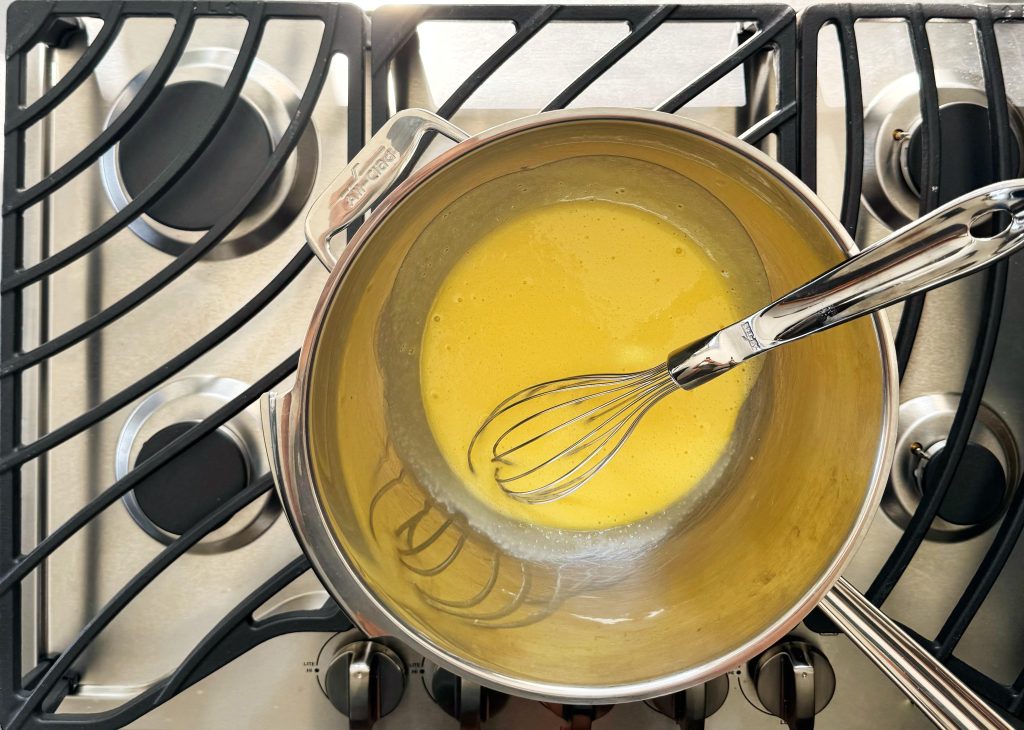
Understanding emulsification mechanics is the ultimate dividing line between a velvety, luxurious sauce and a greasy, curdled culinary disaster. Every cook has stood over a pan at some point, watching in silent horror as a glossy pan sauce or delicate hollandaise abruptly fractures into slick pools of floating yellow oil and grainy sediment. It feels erratic. It feels like bad luck or culinary spite. Yet food never behaves unpredictably; it merely follows the unyielding laws of thermodynamics and surface chemistry.
When you force water and fat to live together in peace, you are demanding an unnatural truce. Water molecules are intensely polar, clinging to one another with stubborn hydrogen bonds while pushing nonpolar lipid molecules away. Left alone, oil and water will inevitably retreat to their respective corners. Turning that chemical standoff into a silky, light-refracting emulsion requires deliberate physical intervention. Once you master the hidden physics operating at the liquid interface, broken sauces cease to be mysterious tragedies and become completely preventable events.
The microscopic physics behind culinary liquid harmony
At its core, any emulsion is a colloid where tiny droplets of one liquid hang suspended throughout another liquid. In culinary applications, you almost always deal with an oil-in-water matrix. The water functions as the continuous phase, forming a fluid highway system. The fat—whether clarified butter, olive oil, or rendered animal drippings—serves as the dispersed phase, shattered into billions of microscopic globes floating within that watery network.
When you dissect emulsification mechanics at the microscopic scale, the real hero is surface area. If you pour one hundred milliliters of oil into a bowl, it forms a single puddle with minimal contact area against the air and container. If you shred that same volume of oil into microscopic spheres measuring five to ten micrometers across, you expand its collective surface area by a factor of thousands. Water molecules must stretch, bend, and weave around this immense swarm of micro-droplets.
That dramatic expansion of surface area creates an energetic penalty called interfacial tension. The system wants to shed energy. The quickest way for oil droplets to lower their surface energy is to smash into each other, merge, and reform big, lazy pools of fat. Preventing that collision cascade requires surfactants. Surfactants are amphiphilic molecules possessing a split personality: one end loves water (hydrophilic), while the other end craves lipids (lipophilic). By coating the boundary layer of every suspended droplet, surfactants form an invisible shield that prevents oil droplets from touching each other, as detailed in foundational colloidal suspension chemistry published by LibreTexts.
The catastrophic molecular collapse of culinary suspensions
Sauces do not fail out of nowhere; they fail when specific kinetic or chemical thresholds are breached. Most kitchen failures happen because cooks misunderstand how emulsification mechanics react to sudden temperature fluctuations, volume crowding, and evaporation. The moment your continuous phase loses the ability to keep the dispersed phase isolated, the structural architecture implodes.
The first structural hazard is droplet packing density. In a standard oil-in-water suspension, water must surround each lipid droplet with a thin liquid cushion. If you continually add fat without adding sufficient water, the droplets get squeezed tightly against one another like marbles crammed into a jar. Once fat occupies roughly seventy-four percent of the sauce’s total volume, the system reaches the random close-packing limit. The droplets deform, press against each other, rupture their surfactant barriers, and instantly coalesce into a broken pool of grease.
Thermal shock presents an equally lethal threat. Heat supplies kinetic energy, making molecules vibrate faster. In a warm emulsion like béarnaise, gentle warmth keeps the butterfat liquid and pliable. However, push the temperature past sixty-two degrees Celsius, and the egg yolk proteins serving as your primary surfactant begin to denature irreversibly. Instead of flexible shields cradling droplets, the proteins unravel, cross-link into tight rubbery knots, and squeeze water out of the suspension. Without protective surfactants and free water, the entire sauce shatters into oily liquid and scrambled flakes.
The foundational pillars of unbreakable liquid stability
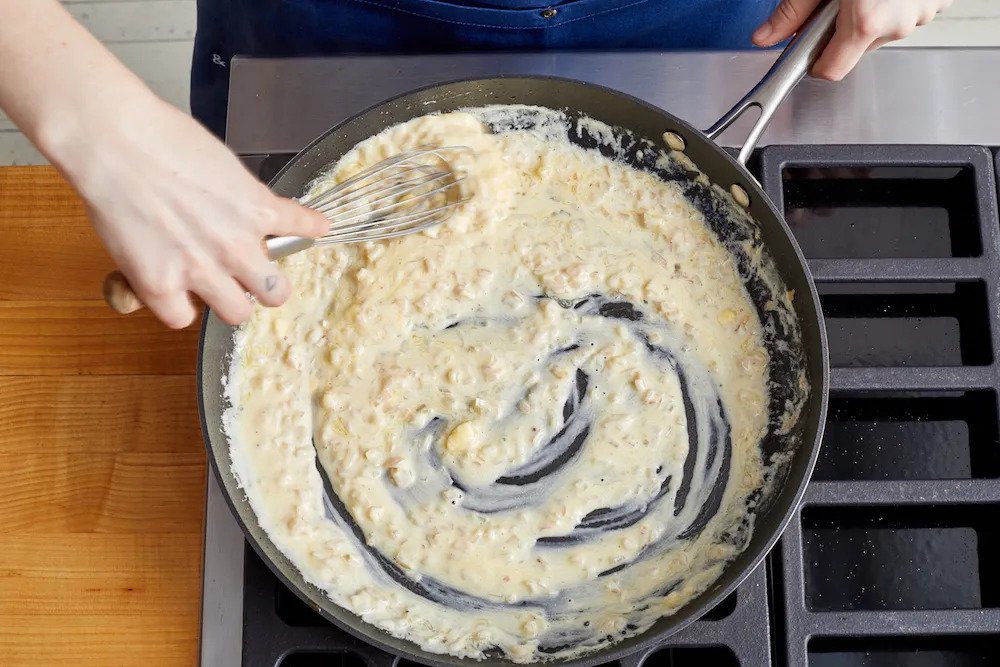
Building an emulsion that can withstand the rigors of service does not require synthetic gums or industrial homogenizers. Professional cooks build resilience by engineering the underlying liquid architecture correctly from the first second of preparation. Respecting these four core rules of emulsification mechanics guarantees your sauces hold their glossy texture from the cutting board to the dining table.
Calibrate the continuous phase volume before adding a single drop of fat
The earliest misstep in sauce preparation occurs before the whisk even touches the bowl. Many cooks dump yolks, acid, and a generous splash of butter together, hoping brute force will marry them. That approach overwhelms the continuous phase before it ever establishes a stable foundation. You must construct a generous reservoir of water-based liquid first.
Whether using lemon juice, vinegar reduction, stock, or plain water, the continuous phase needs enough initial volume to provide open swimming lanes for incoming fat droplets. A single egg yolk contains roughly fifty percent water, which can comfortably suspend nearly two hundred milliliters of fat if properly thinned. However, starting with an extra tablespoon of water or acid gives you an immense safety margin. It expands the spacing between droplet boundaries, lowering the internal friction and dramatically reducing the chance of premature coalescence during the precarious initial stages of mixing.
Control thermal thresholds to preserve fragile surfactant protein structures
Temperature dictates the physical phase of your fats and the structural integrity of your emulsifiers. Butterfat solidifies below thirty-two degrees Celsius and turns volatile above sixty-five degrees Celsius. Your operating window must keep fat liquid without cooking the protective proteins that coat it.
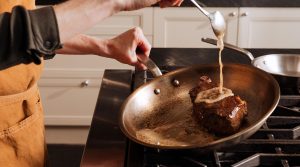
For warm butter sauces, maintain an internal temperature between forty-nine and fifty-seven degrees Celsius. In this sweet spot, egg proteins remain supple and active, forming pliable films over the butter droplets without coagulating. When mounting pan sauces with cold butter—a technique known as monter au beurre—remove the pan completely from high heat. The residual warmth of the simmering reduction melts the cold butter gently, allowing the native milk solids and casein proteins in the butter to act as built-in surfactants. Boiling the pan violently while adding butter evaporates the essential water phase instantly, burning the proteins and triggering a catastrophic split.
Apply violent kinetic shear to maximize interfacial droplet surface area
A gentle stir will never create an emulsion. Droplet subdivision requires genuine kinetic force. The smaller you break the fat droplets, the more viscous, glossy, and stable the sauce becomes. This phenomenon occurs because tiny droplets resist movement through liquid far more effectively than large ones, creating the luxurious sensory thickness we associate with great sauces.
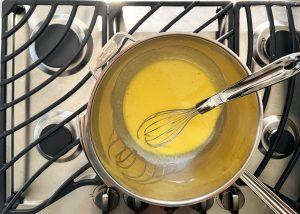
Here, the core principle of emulsification mechanics relies on sheer kinetic energy to overcome surface tension. Using a balloon whisk with dense, flexible wires generates significant shear rates by forcing the liquid through narrow spatial corridors at high speed. An immersion blender takes this to an entirely different dimension, spinning at over ten thousand revolutions per minute to shear fat into uniform microscopic particles within seconds. When adding oil or melted butter, introduce it in a hair-thin, threadlike trickle directly into the vortex. Feeding fat slowly ensures every droplet gets sheared into micro-particles before the next wave arrives.
Introduce dual surfactants to construct resilient steric barriers
Relying on a single surfactant creates a fragile system. If that single molecule encounters adverse heat, salinity, or acidity, your defense line collapses. Stacking different surfactant types creates steric hindrance—a layered mechanical barricade that physically blocks droplets from approaching close enough to fuse.
Egg yolk provides lecithin, a phospholipid that locks onto droplet surfaces with remarkable tenacity. Pairing lecithin with the complex plant mucilage found in prepared mustard or the protein matrix of garlic creates an impenetrable defensive alliance. Mustard contains natural polysaccharides that coat droplets while simultaneously thickening the continuous water phase. By increasing the viscosity of the surrounding water, mustard dramatically slows down droplet motion. Droplets that move slowly collide less frequently, giving you an emulsion that remains stable for hours rather than minutes.
The emergency triage toolkit for recovering completely broken mixtures
Even seasoned kitchen veterans encounter the sudden fracture of an emulsion when heat spikes or oil pours a fraction too quickly. The worst reaction is tossing the separated ingredients into the trash. The fat, water, and proteins are still inside your bowl; they have merely fallen out of structural alignment.
Mastering culinary physics requires the same precise spatial calibration seen in elite athletic mechanics; just as studying baseball curveball mechanics and 4 proven rules to throw devastating unhittable breaks reveals how fluid boundary layers and rotation dictate movement, liquid suspensions obey uncompromising fluid dynamics where tiny adjustments in angle and sheer force govern the entire system.
To resurrect a split sauce, step away from the heat source immediately. Take a clean bowl and introduce one tablespoon of lukewarm water or fresh egg yolk. This re-establishes an uncompromised continuous phase with abundant free water. Whisk that fresh liquid vigorously, then take your broken, greasy mixture and treat it as raw fat. Drizzle the split sauce drop by drop into the fresh base while applying heavy kinetic shear.
As you whisk, the fresh water and uncoagulated surfactants capture the loose fat, breaking it back down into micro-droplets. Within sixty seconds, the slick grease vanishes, absorbed back into a cohesive, velvety matrix. Applying sound emulsification mechanics lets you resurrect even a completely separated hollandaise, saving expensive ingredients and preserving your culinary sanity under high-pressure kitchen conditions.
Practical culinary wisdom for enduring kitchen mastery
Cooking is often romanticized as pure intuition, an instinct guided solely by taste and flair. Yet real culinary freedom begins when you grasp the physical and chemical principles governing your tools and ingredients. When you stop guessing how liquids interact and start visualizing the microscopic droplets colliding inside your pan, you move from tentative recipe-following to effortless technical command.
An emulsion is not a delicate, temperamental miracle waiting to break at the slightest draft. It is an engineered suspension that thrives when given sufficient water, controlled heat, adequate shear, and protective surfactants. Treat the mechanics with the respect physics demands, and you will never fear a broken sauce again.