Cast iron seasoning mechanics and 4 proven rules to build indestructible nonstick skillets
Uncover the molecular science behind fat polymerization and learn how to forge an indestructible nonstick patina on raw iron. Stop relying on greasy folklore and master true skillet chemistry.
Mastering cast iron seasoning mechanics is the single greatest skill separating frustrated home cooks from lifelong culinary devotion. Walk into an antique shop or a countryside kitchen, and you will inevitably discover an heirloom skillet boasting a deep, obsidian sheen. An egg dropped onto that burnished surface slides effortlessly, gliding like wet ice across glass without clinging or tearing. Most cooks attribute this slick performance to decades of sentimental family use, believing that endless waves of bacon grease somehow magically saturate the iron over time. That romantic notion is culinary folklore.
What appears to be smooth, polished stone is actually an engineered polymer coating fused chemically to bare gray metal. Raw iron fresh out of a sand foundry mold is a landscape of microscopic chaos. It contains jagged crags, deep fissures, and open crystalline pores hungry to bind with the proteins and starches in your dinner. Unraveling the science behind this physical transformation turns skillet upkeep from a chore into a predictable, repeatable chemical process.
The molecular reality of fat polymerization and metal bonding
Cast iron is an alloy that behaves quite differently from modern clad stainless steel or forged carbon sheets. When liquid iron cools inside casting molds, carbon clusters into irregular graphite flakes. These microscopic pockets leave behind thousands of tiny subterranean caves across the skillet floor. When you place a piece of raw poultry or cold beef into an untreated hot skillet, the proteins rapidly unfold under thermal stress. Those denatured proteins reach downward into the exposed pores of the iron, forming tough covalent bonds with the metal atoms. The meat essentially welds itself to the pan.
A resilient nonstick patina solves this mechanical entrapment through radical chemical reconstruction. Seasoning is not grease, nor is it a pool of melted fat. True seasoning is a hard, dry polymer matrix created when unsaturated fatty acids undergo simultaneous thermal oxidation and free-radical cross-linking. When unsaturated oil reaches its smoke point, fragile double carbon bonds snap open. These highly reactive molecular fragments seek out adjacent fatty acid molecules, binding together into expansive, rigid, three-dimensional chains.
Because this reaction happens in direct contact with hot metal, the newly forged polymer anchors itself firmly inside the granular pores of the casting. Iron serves as a potent natural catalyst, speeding up oxidation and anchoring the polymer mesh directly to the substrate. A properly executed cast iron seasoning mechanics framework transforms a porous, food-trapping mineral into a hydrophobic barrier that repels water and prevents chemical bonding with food proteins.
Why traditional oil advice ruins cookware surfaces
Generations of kitchen advice have circulated well-meaning recommendations that quietly wreck skillet finishes. The most ubiquitous misconception tells cooks to build their nonstick base by simply frying pounds of fatty breakfast meats. Commercial bacon fat consists primarily of saturated lipids, added sugars, moisture, and curing salts. Saturated fats lack the open chemical bonds required for aggressive cross-linking, which causes them to carbonize sluggishly. Meanwhile, the rendered sugars bake into sticky brown varnish, trapping crud in the pores instead of building an impenetrable, glassy laminate. When cooks misunderstand cast iron seasoning mechanics, they reach for whatever oil bottle sits closest to the stove without considering molecular structure.
Another common misstep stems from the internet trend of applying raw flaxseed oil. Because flaxseed possesses an exceptionally high iodine value, it polymerizes into an ultra-hard, glassy sheet with remarkable speed. However, extreme hardness without elasticity breeds brittle vulnerability. As a skillet expands and contracts under intense stove burner temperatures, rigid flaxseed coatings fail to flex alongside the expanding metal underneath. Much like how analysts watch volatility unfold when Dow Today Slips as 4 Critical Forces Reshape Market Divergence, home cooks panic when sudden thermal shifts disrupt an otherwise stable thermodynamic system. The over-hardened flaxseed film fractures microscopically, eventually peeling away in large black flakes.
Four essential principles for bulletproof seasoning layers
Applying cast iron seasoning mechanics to your daily kitchen routine requires abandoning guesswork in favor of precise chemistry. Creating a resilient, glass-slick surface is a controlled manufacturing process you can execute reliably in any home oven.
Strip micro-residues down to bare iron before starting
A resilient polymer network cannot anchor to iron if an intermediary layer of carbon, oxidized grease, or factory wax sits in the way. If your pan currently sports an uneven, gummy, or flaking face, applying fresh coats over the wreckage only compounds the structural instability. Stripping the pan down to raw, dull gray iron provides the ultimate clean slate. A basic sodium hydroxide solution or a heavy application of lye-based oven cleaner breaks down organic resin bonds without etching the iron itself. Once the metal is bare, rinse thoroughly with cold water, scrub away loose particles with fine steel wool, and dry the iron immediately over low stove heat to prevent flash rust from forming before your protective lipids arrive.
Apply microscopic monolayers rather than visible liquid pools
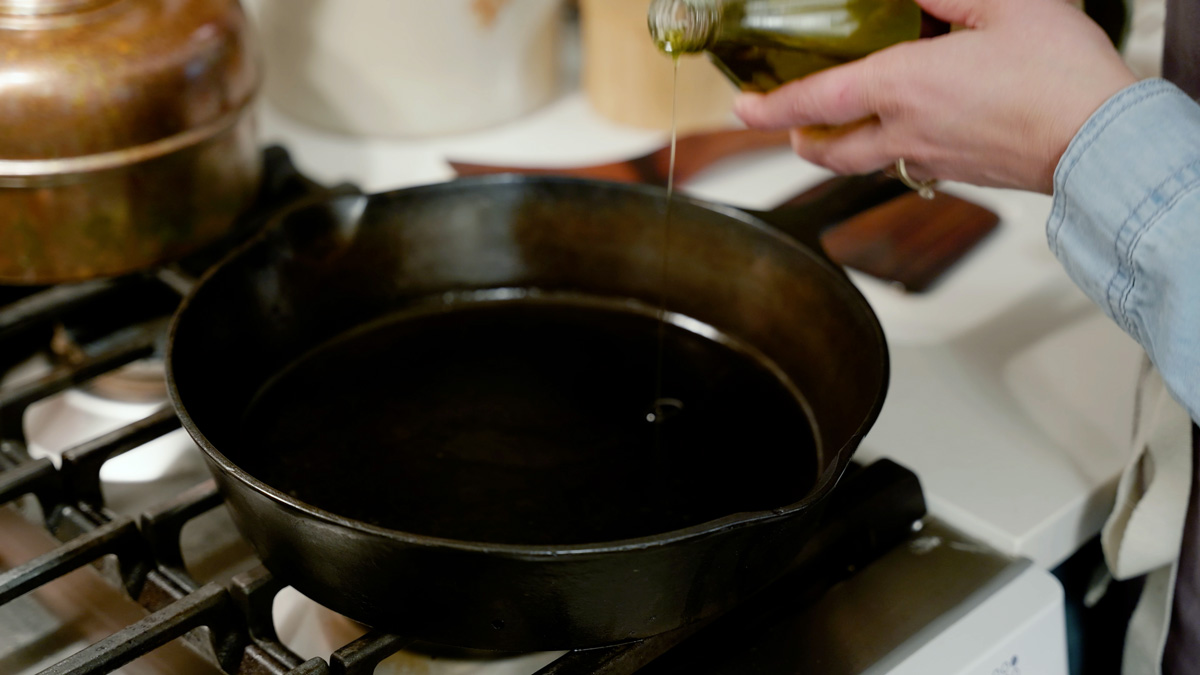
The single most destructive mistake in skillet seasoning is excess volume. Pouring oil into the pan and wiping it around with a paper towel leaves behind a puddle that looks thin to the human eye but represents a towering ocean to microscopic iron pores. As the skillet heats in the oven, surface tension pulls that liquid puddle into thousands of concentrated beads. Instead of a uniform polymer film, you produce raised, amber-colored dots of sticky, half-cured grease that instantly scrape off under a spatula. The correct approach requires aggressive buffing. Pour a half-teaspoon of oil into the iron, distribute it across every edge, and then take a clean, dry shop cloth and wipe the metal down until it appears completely dry. What remains is a microscopic monolayer, just a few molecules thick, which directly aligns with core cast iron seasoning mechanics, ensuring the metal accepts the fat at a molecular level without bubbling or sagging.
Drive temperatures past the oil smoke point into full polymerization
Polymerization does not occur efficiently at gentle cooking temperatures. Baking oil below its smoke threshold yields soft, gummy residues that smell rancid within days. To shatter the lipid bonds and initiate free-radical cross-linking, the ambient temperature must exceed the oil smoke threshold by roughly twenty to forty degrees Fahrenheit. For neutral culinary oils with balanced polyunsaturated profiles, such as refined grapeseed or high-oleic canola, your oven must reach between 450 and 480 degrees Fahrenheit. At this threshold, volatile organic compounds flash off into the air, while the dense carbon backbone binds into a smooth, hydrophobic sheet. Keeping the pan upside down on the center oven rack ensures maximum, even radiant exposure across the entire cooking basin.
Cure through thermal cycles to build cross-linked lattice depth
A single cured layer of oil creates a protective skin against rust, but it lacks the physical mass required to withstand the scraping of stainless spatulas or the searing of rough crusts. Durability is a function of multi-layered lamination. Once the oven timer expires after an hour of high-heat baking, shut off the power and leave the skillet inside the closed oven until it returns to room temperature. This gradual cooling phase relieves internal micro-stresses within the newly formed polymer network. Repeating this application, baking, and cooling cycle three or four times laminates several distinct monolayers together. The subsequent coats anchor to the polymer lattice beneath them, assembling a dense, nonstick composite that rivals modern synthetic coatings.
Routine maintenance habits that protect the polymer matrix
Once you cultivate a hardened polymer foundation, day-to-day maintenance is remarkably straightforward. An enduring kitchen myth claims that washing cast iron with standard dish soap will immediately dissolve your hard-won seasoning. This warning dates back to the nineteenth century, when pioneer soaps contained unreacted lye that easily stripped animal fats and weakened polymer chains. Modern commercial dish detergents rely on mild surfactants formulated specifically to encapsulate loose surface oils without damaging cross-linked carbon polymers. Thorough American Chemical Society analysis of cast iron surface chemistry demonstrates that fully cross-linked polymer matrices remain impervious to non-lye surfactants.
Water, rather than soap, is the quiet enemy of iron cookware. Setting a freshly washed skillet on a dish rack invites residual moisture to seep beneath microscopic gaps in the polymer veneer, rapidly generating orange iron oxide rust. Always dry your skillet immediately on a stovetop burner over gentle heat until all visible water evaporates. While the pan remains warm to the touch, spread a micro-droplet of oil over the cooking basin using a cotton rag, buffing until the metal looks matte rather than glistening. Sustaining a pan over generations is simply an ongoing preservation of cast iron seasoning mechanics.
Diagnosing and rehabilitating damaged skillet finishes
Even a seasoned kitchen veteran occasionally encounters finish failures. A sudden splash of acidic white wine, an extended simmer with crushed heirloom tomatoes, or an accidental overnight soak in soapy water can dull an otherwise immaculate pan. Reading the diagnostic signs on the cooking face tells you exactly what stage of rehabilitation the metal requires.
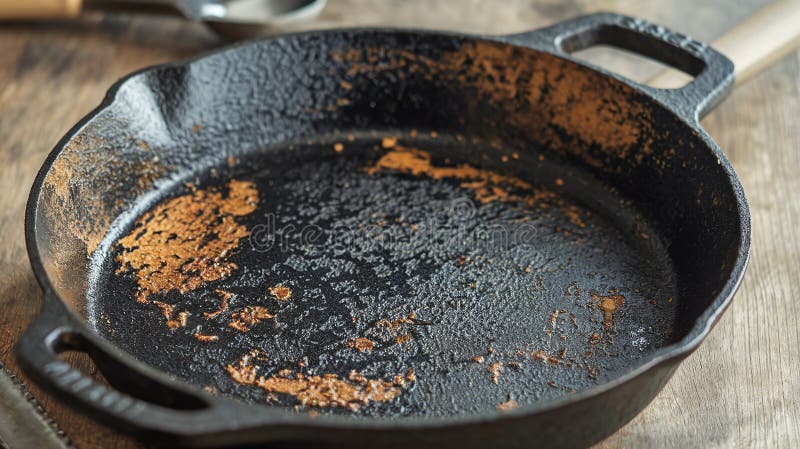
If the skillet feels sticky, tacky, or gummy to the touch, excess oil was applied or the curing temperature failed to cross the polymerization boundary. You can resolve this issue without stripping the iron simply by placing the dry skillet upside down in an oven cranked to 475 degrees Fahrenheit for sixty minutes, forcing the sluggish lipids to finalize their cross-linking sequence. If the surface produces crusty black flakes in your morning eggs, you are dealing with burnt food carbon rather than true polymer degradation. Scour the basin aggressively with coarse kosher salt and a dry towel, or use a stainless steel chainmail scrubber to shear away the brittle carbon deposits until the slick, uniform base reemerges. Rebuilding a ruined pan is a testament to how forgiving cast iron seasoning mechanics can be when you reset the baseline.