Emulsion sauce mechanics and 4 proven rules to stop catastrophic kitchen breaks
A broken hollandaise or greasy pan sauce can ruin hours of careful culinary prep in seconds. Discover the molecular physics of fluid dispersion and the practical techniques that guarantee glossy stability every time.
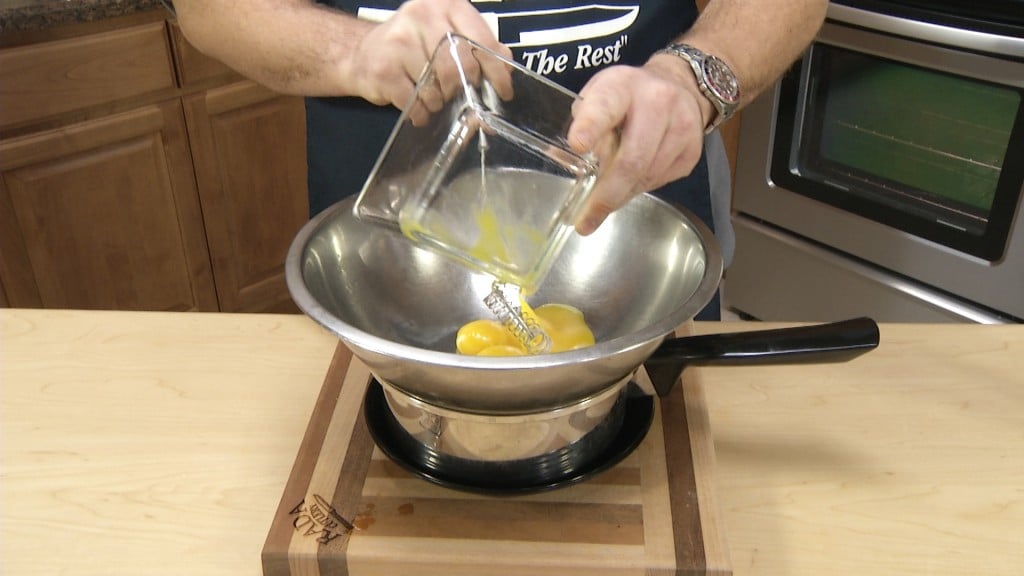
Mastering emulsion sauce mechanics will transform a hesitant cook into an instinctive chef capable of spinning butter, oil, and water into velvety liquid gold. We have all stood over a skillet watching in silent horror as an immaculate, glossy glaze suddenly degenerates into a greasy pool of curdled fat and murky puddle. The pan sizzles, the kitchen clock ticks, and panic sets in. Home cooks often chalk this failure up to bad luck, faulty recipes, or erratic burner heat. Yet sauces do not misbehave out of spite. They follow unbending physical principles that govern how immiscible liquids behave when forced into close quarters.
Understanding these culinary dynamics shifts your perspective from blind recipe-following to deliberate physical manipulation. A sauce is not merely a combination of flavors. It is a precarious architectural suspension where billions of microscopic fat droplets float trapped inside a web of water, acids, and surfactant molecules. When you control the thermodynamic forces inside the pan, luxurious texture stops being an accident and becomes an absolute certainty.
The Invisible Battle Between Water and Fat in Your Pan
At the atomic scale, oil and water are natural adversaries. Water molecules are intensely polar, binding to one another through tight hydrogen networks that exclude non-polar fatty acids. Dump vegetable oil into vinegar, and the oil floats to the top to minimize surface contact with the water beneath. Surface tension acts as an invisible barrier, compelling the oil droplets to coalesce into the largest possible shapes to minimize their overall energy state.
When you dig into emulsion sauce mechanics, you quickly discover that liquids hate each other when their electric charges disagree. To coax them into a unified, silky texture, you must overcome interfacial tension. This requires two distinct components that work in tandem: mechanical shear and an amphiphilic mediator. Mechanical shear breaks the bulk fat into billions of microscopic droplets, dramatically increasing its collective surface area. The mediator, known to food scientists as an emulsifier or surfactant, possesses a split molecular personality. One end of the molecule is hydrophilic, latching onto water, while the opposite tail is lipophilic, anchoring firmly into fat.
As you vigorously beat an egg yolk into warm butter or whisk a Dijon vinaigrette, these surfactant molecules migrate to the boundary between oil and water. They wrap around each suspended fat globule like a protective coating. The hydrophilic heads point outward into the surrounding liquid, creating an electrostatic shield that repels neighboring droplets. As long as those droplets remain tiny and physically isolated, the mixture behaves as a single, thick, cohesive liquid that catches the light and clings effortlessly to a spoon.
Why Traditional Sauces Collapse Without Warning
The heartbreaking reality of emulsion sauce mechanics is that every vinaigrette, hollandaise, or pan sauce is living on borrowed time. Emulsions are thermodynamically unstable systems. Left entirely to their own devices, every emulsion on Earth will eventually separate back into its constituent layers. Your goal at the stove is simply to build an architecture stable enough to survive through the meal.
Collapse happens through four sequential phases: creaming, flocculation, coalescence, and phase inversion. Creaming occurs when lower-density fat droplets drift upward under the influence of gravity. Flocculation follows when droplets clump together while retaining their individual shapes. Coalescence is the fatal turning point where the protective surfactant barrier ruptures, allowing touching droplets to fuse into larger, visible oil globules. Once coalescence gains momentum, complete phase inversion occurs. The water loses its grip as the continuous phase, and the fat takes over, reducing your glossy creation to a fractured, greasy mess.
Heat is the most common catalyst for this ruin. In egg-based emulsions like béarnaise or sabayon, excessive heat rapidly denatures the proteins in the yolk. Rather than maintaining their flexible protective film around fat globules, the proteins form rigid, tangled clumps, squeezing trapped water out like water from a dry sponge. Conversely, insufficient warmth causes clarified butter to crystallize, piercing surfactant barriers and unleashing liquid fat. Even excessive evaporation can trigger catastrophe by drying up the continuous water base until the fat droplets have nowhere left to float.
Four Proven Rules to Master Culinary Emulsions Without Fear
Respecting the underlying emulsion sauce mechanics allows you to manipulate temperature, friction, and molecular barriers with effortless precision. These four fundamental practices transform emulsion stability from a game of chance into repeatable, predictable science.
Calibrate Your Kinetic Energy and Initial Droplet Size
The stability of any dispersion hinges directly on the radius of its suspended droplets. According to physical colloid principles documented in American Chemical Society research on emulsion stability, smaller droplets drastically lower the rate of separation and increase perceived viscosity. In practical kitchen terms, this means the first thirty seconds of sauce creation determine its lifespan.
When beginning an emulsion, add your fat drop by drop while applying the highest possible shearing force. A balloon whisk whipped in a rapid side-to-side motion creates far more kinetic shear than a passive circular stir. By introducing the fat in minuscule quantities at the start, you force the surfactant molecules to saturate every new droplet instantly. Once a dense, stable nucleus forms, you can gradually increase the pouring stream to a steady ribbon. If you pour a cup of warm butter into egg yolks all at once, no amount of frantic whisking can shear that overwhelming volume down before massive coalescence takes hold.
Control the Thermal Threshold to Preserve Fragile Surfactants
Temperature dictates the flexibility and binding capacity of culinary proteins. For warm egg-based emulsions, the functional working window is remarkably narrow, hovering between 55 degrees Celsius and 62 degrees Celsius. Below this threshold, animal fats solidify and sluggish molecules fail to disperse evenly. Above 65 degrees Celsius, the proteins permanently denature and curdle into scrambled fragments.
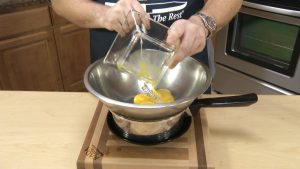
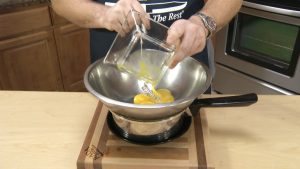
Maintain this delicate balance by working over a gentle water bath where the bowl never touches the simmering water directly. The steam provides steady, diffused heat that warms the liquid without scorching the bottom of your vessel. Keep a small dish of cold water or an ice cube nearby. If you notice the sauce beginning to look slightly matte, stringy, or steaming aggressively, pull the bowl off the heat immediately and whisk in a few drops of cold liquid to drop the core temperature before the protein bonds lock irreversibly.
Maintain the Volume Balance of the Continuous Phase
An emulsion can only contain a finite amount of dispersed fat before it simply runs out of room. In an oil-in-water emulsion, the water constitutes the continuous phase that envelops everything else. If the volume of fat exceeds roughly three to four times the volume of water, the tightly packed droplets begin pressing directly against each other, bursting their protective skins through sheer physical pressure.
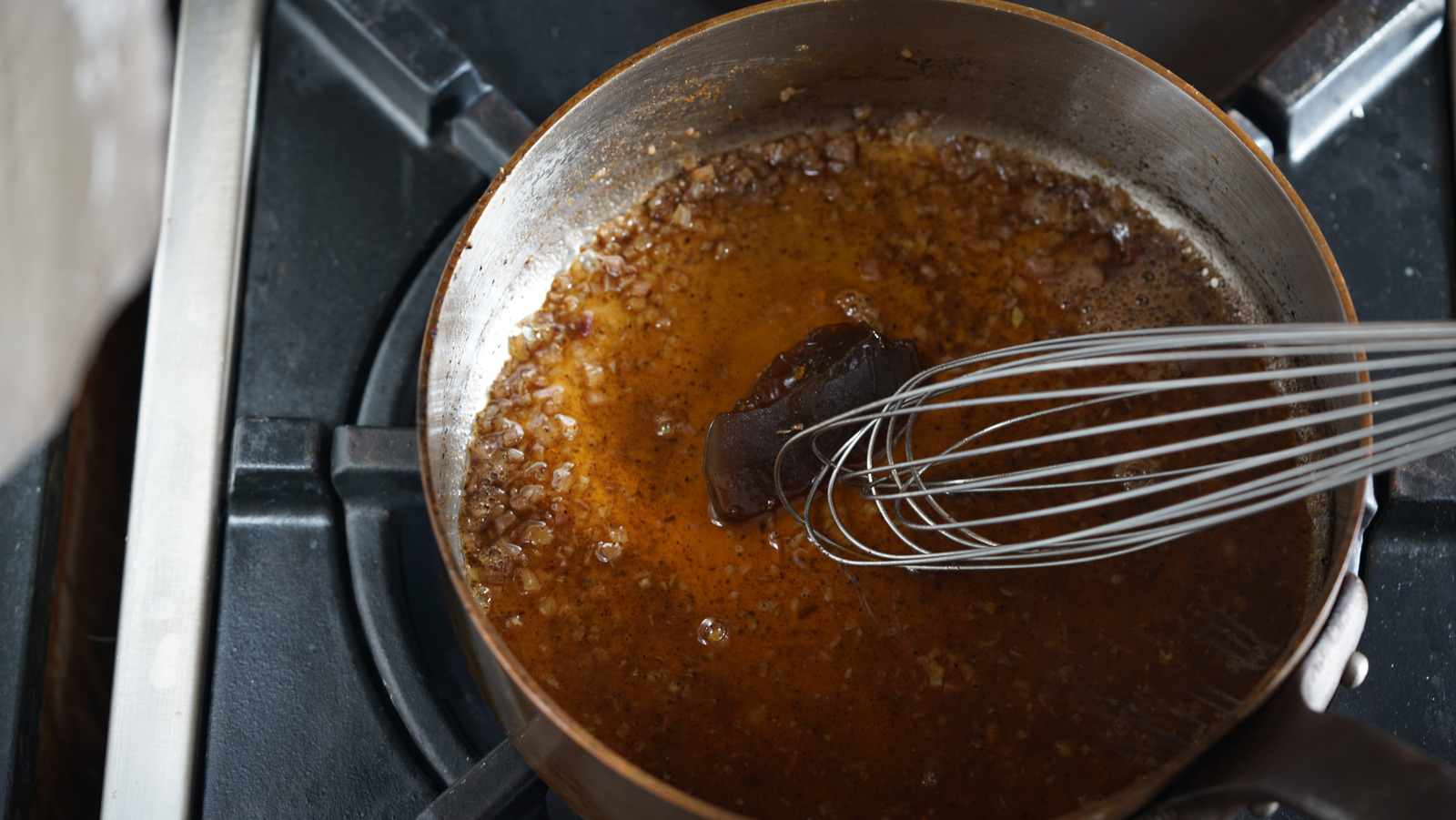
Much like how meat brining mechanics and 4 proven rules to prevent dry ruined roasts rely on osmotic fluid pressure, emulsion sauce mechanics demand adequate continuous moisture to keep suspended fat droplets isolated from one another. As pan sauces reduce over an active flame, liquid continually escapes as steam. If your reduction becomes too dense and begins weeping fat at the edges, do not panic. Simply whisk in a tablespoon of cold stock, wine, or water. Restoring the volume of the continuous phase gives overcrowded fat droplets room to maneuver, immediately restoring a silky sheen.
Deploy Amphiphilic Stabilizers Before Phase Inversion Strikes
Professional line cooks rarely rely on egg yolks alone when building complex sauces under pressure. They enlist functional allies that enhance viscosity and strengthen surface barriers. Mustard is perhaps the most versatile culinary stabilizer available. It contains natural mucilage, a complex polysaccharide that physically thickens liquid, alongside active surface-active compounds that coat oil droplets.
Cold butter cubes can also act as self-emulsifying stabilizers through the technique known as monter au beurre. Cold butter is not pure fat. It is itself an emulsion containing roughly sixteen to eighteen percent water and milk solids. When swirled into a hot pan reduction off the flame, the melting butter gradually releases its own tiny water droplets along with natural dairy surfactants. This gentle mechanical dispersion thickens the sauce without shocking the delicate liquid structure.
How to Rescue a Broken Sauce Before Dinner Is Ruined
When your sauce suddenly curdles or splits into an unsightly puddle of grease, understanding emulsion sauce mechanics provides an immediate roadmap to recovery. A broken sauce is not ruined food; it is merely an unorganized mixture of perfectly good ingredients waiting for mechanical reordering.
The simplest rescue starts with a clean bowl and a single tablespoon of warm water. Place the warm water in the bowl and begin vigorously whisking while slowly dribbling the broken sauce into it, exactly as if the broken sauce were fresh oil. The fresh water re-establishes a clean continuous phase. As the broken mixture enters under heavy agitation, its suspended fat is forced back into microscopic dispersion. Within sixty seconds, the entire batch usually binds back into an impeccable, glossy cream.
If the sauce broke due to severe egg curdling, an auxiliary surfactant is required. Whisk an entirely fresh egg yolk with a splash of lemon juice in a clean bowl until pale and frothy. Slowly whisk your broken sauce into the fresh yolk. The new surplus of intact lecithin molecules quickly encapsulates the loose fat droplets, pulling the emulsion back from the brink of disaster with zero loss in flavor or velvety mouthfeel.
The Lifelong Freedom of Intuitive Sauce Crafting
Cooking becomes infinitely more relaxing when you no longer fear the physical transformations happening inside your cookware. A glossy sauce is not an act of culinary mysticism reserved for high-end restaurants. It is an approachable triumph of kinetic energy, thermal regulation, and colloid physics.
Once emulsion sauce mechanics become second nature, recipe cards fade into obsolescence because your eyes, nose, and whisk tell you everything you need to know. You will recognize the subtle dulling of a sauce on the verge of overheating, the sudden thinning that signals a shortage of water, and the exact moment when mechanical shearing has locked fat and liquid into harmony. Step up to the stove, manage your molecular boundaries, and create sauces that hold their silky perfection from the first swirl to the final bite.