Culinary Emulsion Mechanics Reveal 4 Proven Secrets to Craft Flawless Velvety Sauces
Discover the physical laws governing fat and water to create rich pan sauces, glossy hollandaise, and stable dressings that never split. Learn how microscopic shearing, surfactant chemistry, and phase ratios guarantee silky perfection every time you cook.
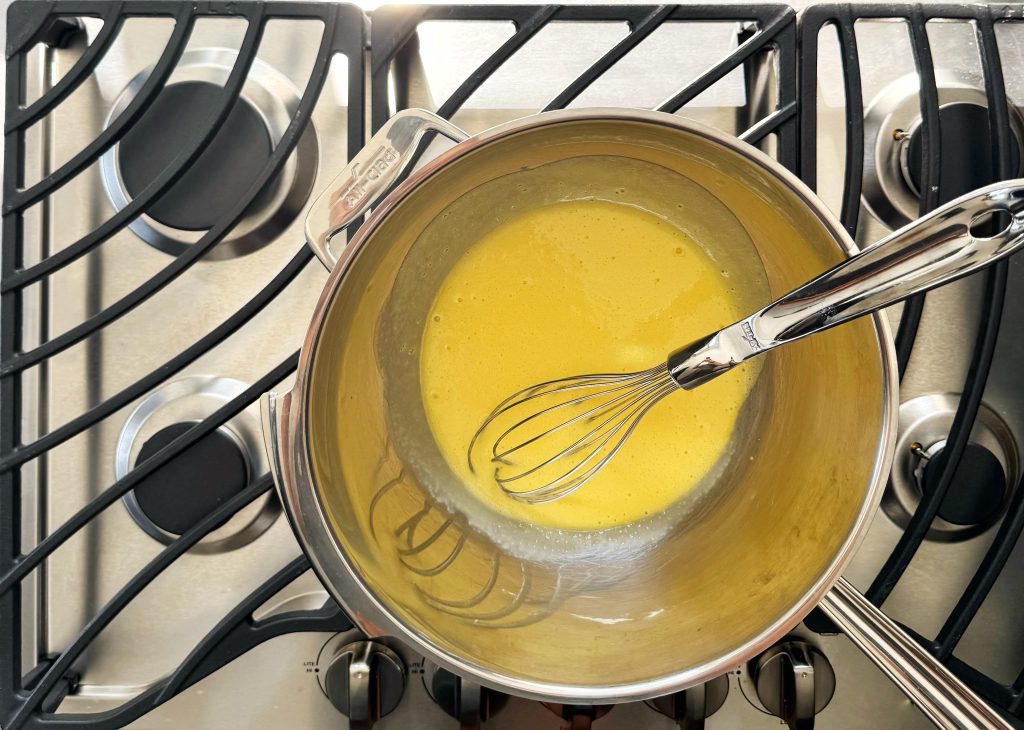
Mastering culinary emulsion mechanics unlocks the secret to transforming ordinary pan drippings and stubborn fats into silky, restaurant-quality sauces that never separate. Every cook knows the sudden sinking feeling of watching a glossy hollandaise curdle into a grainy pool of clarified butter, or seeing an energetic vinaigrette split into slick oil puddles within thirty seconds of whisking. The instinct is often to blame bad luck, an uncooperative stove, or a faulty recipe. In truth, creating an emulsion is not an act of culinary mysticism. It is an exact physical negotiation between two sworn chemical adversaries: water and fat.
Liquid fat and water molecules fundamentally resist one another. Water molecules are strongly polar, bound tightly together by hydrogen bonds that create an intensely cohesive liquid network. Lipids, by contrast, are nonpolar hydrocarbons that slip past each other without forming charged attractions. Pour olive oil into water, and the water molecules pull each other closer, squeezing the hydrophobic fat droplets out of their network until the oil floats on top in a defeated layer. Bridging that molecular chasm requires far more than brute muscle with a wire whisk; it demands an understanding of how interfacial tension operates in the pan.
The Molecular Warfare Between Water and Lipid Droplets
When you analyze culinary emulsion mechanics on a microscopic plane, every sauce resolves into two distinct realities: the continuous phase and the dispersed phase. In an oil-in-water emulsion like mayonnaise, hollandaise, or pan gravies, water serves as the continuous phase. It forms the fluid ocean through which billions of microscopic oil droplets must travel. If those droplets remain macroscopic, buoyancy wins, dragging them upward into an unsightly slick. The cook's objective is to shatter the fat into tiny spheres so diminutive that Brownian motion and liquid viscosity overcome gravity.
Mechanical force alone, however, is insufficient. Shaking oil and vinegar violently inside a glass jar shatters the oil into droplets, but within minutes, those droplets collide, merge through a process called coalescence, and re-establish their original boundary lines. This collapse occurs because creating new surface area between oil and water requires thermodynamic work against interfacial tension. Water seeks the lowest energy state, which always means minimizing contact with fat. According to foundational Harvard University Science and Cooking research, keeping droplets suspended indefinitely requires introducing an amphiphilic molecule: a molecular mediator possessing one end that loves water and another that anchors itself firmly into fat.
Four Proven Principles That Determine Emulsion Stability
Building an enduring emulsion does not rely on frantic wrist movement or blind adherence to ingredient quantities. Instead, stability hinges on four fundamental physical mechanisms that dictate how lipids scatter and remain suspended inside a water-based matrix.
Metering the Initial Dispersed Phase with Precision
The foundational rule of culinary emulsion mechanics dictates that you cannot rush the initial droplet dispersion. When you pour fat into your water base, the existing water must completely surround every single droplet. If you dump a cup of melted butter into warm egg yolks all at once, the volume of oil instantly overwhelms the meager water phase. The lipid droplets collide with one another far faster than they can encounter the water, merging into a continuous sheet of grease that suffocates the sauce before it begins.
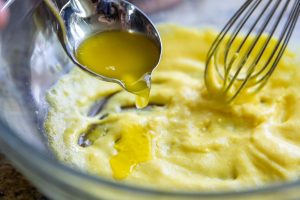
During the first critical ninety seconds, fat must enter the bowl in a microscopic trickle, almost drop by single drop. Each drop must be shredded into dispersed microscopic spheres before the next arrival enters the fray. Only after a robust population of droplets is established, multiplying the viscosity of the base, can you increase the stream of oil to a steady thread. Pacing the introduction respects the physical geometry of surface area generation.
Deploying Natural Amphiphilic Surfactants to Lower Surface Tension
Without a surfactant to coat the outer perimeter of each lipid sphere, even the finest mechanical shearing cannot stop eventual coalescence. Surfactants are microscopic shields. In egg yolks, the hero is lecithin, a phospholipid accompanied by low-density lipoproteins. Lecithin features a hydrophilic phosphate head that bonds enthusiastically with water molecules, while its long fatty-acid tails burrow deeply into the interior of the lipid droplet.
Once coated in lecithin, the droplets carry negative electrical charges on their exteriors. When two coated droplets drift near each other inside the sauce, their like charges repel, forcing them apart like identical magnetic poles. Egg yolks are the most famous source, but culinary surfactants exist throughout the pantry. The mucilage in ground mustard seeds, the soluble gelatin proteins in reduced bone broth, and the caseins found in dairy milk all function as structural stabilizers that prevent droplets from merging.
Regulating Kinetic Energy and Shearing Force
A critical aspect of culinary emulsion mechanics lies in the application of mechanical shearing force. Simply stirring a spoon in circles creates laminar flow, which gently guides fat droplets past each other without breaking them apart. Real emulsification demands turbulent shear stress—the violent tearing action generated by the narrow wires of a balloon whisk, the high-speed vortices of an immersion blender, or the friction of a mortar and pestle.
The smaller you can slice those lipid droplets, the more stable your sauce becomes. An immersion blender spinning at ten thousand revolutions per minute generates such intense shearing force that it pulverizes oil into droplets measuring mere micrometers across. Because smaller droplets feature exponentially higher total surface area relative to their volume, they become tightly packed into the continuous phase, dramatically increasing the sauce's thickness and resistance to separation.
Managing Viscosity Thresholds and Phase Ratios
There is a geometric limit to how much oil an emulsion can hold. In a typical oil-in-water sauce, the dispersed fat droplets pack together like oranges in a crate. As you add more oil, the spheres squeeze tighter, distorting from perfect globes into polyhedrons. This crowding creates the luxurious, spoon-coating thickness associated with classic mayonnaise. However, if the volume of dispersed fat exceeds roughly seventy-five to eighty percent of the total volume, the droplets literally run out of room.
At this tipping point, known as phase inversion, the sauce will violently invert into a greasy water-in-oil emulsion or collapse into oily separation. If your sauce begins to look stiff, dull, or oily around the edges of the whisk, the continuous water phase is running dry. Introducing a splash of water, lemon juice, or vinegar instantly replenishes the continuous ocean, creating fresh breathing room between the crowded droplets and restoring stability.
Why Sauces Break and How Structural Diagnostics Save Them
Even seasoned cooks occasionally watch a sauce split into greasy chaos. Most kitchen catastrophes happen when cooks disregard culinary emulsion mechanics during rapid temperature changes. Emulsions are delicate thermodynamic systems. Excessive heat denatures the surfactant proteins in an egg yolk, causing them to coagulate into solid curdles that shed their protective coating and release the trapped butter. Conversely, extreme cold solidifies butter fats, creating rigid crystals that pierce droplet boundaries and induce structural collapse.
Diagnosing the precise nature of the failure tells you exactly how to salvage it without throwing ingredients into the bin. Much like how understanding the biological levers explored in Sourdough Fermentation Mechanics Reveal 4 Proven Secrets to Master Magnificent Bread unlocks structural control over gluten networks, diagnosing a broken sauce requires dissecting the thermodynamic conditions that destabilized your colloidal suspension.
If a sauce splits from lack of water, a tablespoon of boiling water whisked vigorously into the oily mass can re-establish the continuous phase in seconds. If the protein matrix has completely collapsed from thermal shock, you must rebuild the suspension from scratch. Place a fresh egg yolk or a teaspoon of Dijon mustard in a clean bowl with a teaspoon of water, whisk until frothy, and slowly incorporate the broken sauce as if it were fresh oil. The new surfactant reservoir will recapture the escaped droplets and restore velvety cohesion.
Everyday Applications From Pan Gloss to Stable Vinaigrettes
The principles of fluid dispersion are not reserved solely for elaborate French mother sauces. Consider the classic restaurant technique of mounting a pan sauce with cold butter, known classically as monter au beurre. After searing meat, deglazing the fond with wine or stock leaves a rich, water-dense reduction. Whisking in cubes of refrigerator-cold butter off the direct heat slowly melts the milkfat while simultaneously releasing the natural milk solids and water trapped within the butter. The cold temperature prevents premature separation, allowing the residual gelatin and water in the stock to engulf the melting fat, yielding a glossy, mirror-like finish.
Similarly, everyday salad dressings gain immense longevity through intentional formulation. Whisking simple oil and vinegar produces a temporary suspension that fractures before the bowl reaches the dining table. Integrating a teaspoon of Dijon mustard or honey introduces natural polysaccharides and proteins that anchor the droplets in place. Professional sauce stations depend entirely on culinary emulsion mechanics to maintain texture under intense service demands, relying on measured temperatures, precise ratios, and dependable surfactant anchors.
When culinary emulsion mechanics become an intuitive framework rather than a list of recipes, your confidence at the stove fundamentally transforms. You no longer dread the finicky nature of a hollandaise or wonder why your pan sauces leave greasy rings on the plate. By mastering the microscopic dance between fat, water, and mechanical energy, you gain total mastery over texture, mouthfeel, and culinary execution.