Bond duration mechanics reveal 4 proven rules to shield fixed income returns
Maturity dates tell you when a bond finishes, but duration reveals how it survives the journey. Discover how fixed income sensitivity transforms paper losses into strategic wealth.

Mastering bond duration mechanics provides the ultimate competitive advantage for investors who want absolute clarity over their fixed income capital. Most market participants treat debt securities like glorified savings accounts with delayed exit gates. They examine the face value, check the coupon yield, glance at the stated maturity date, and assume the trajectory between purchase and redemption remains predictable. That assumption shatters the moment benchmark interest rates shift by a single percentage point, dragging portfolio balances into disorienting declines.
Fixed income contracts are dynamic pricing engines rather than static promises. Every cash flow delivered across the lifespan of a security carries a time value that fluctuates against prevailing market conditions. When you dismiss these mathematical underpinnings, you surrender your capital to economic crosscurrents. Understanding the subtle leverage embedded in time-weighted cash flows transforms what looks like passive yield collection into an active preservation fortress.
The hidden fulcrum behind every fixed income portfolio
To grasp how debt instruments react under pressure, you must abandon the comfort of nominal maturity dates. A ten-year government note does not expose you to ten years of interest rate risk in a uniform, linear fashion. Cash arrives incrementally through periodic coupon distributions, meaning a measurable fraction of your initial outlay returns long before the final principal repayment clears.
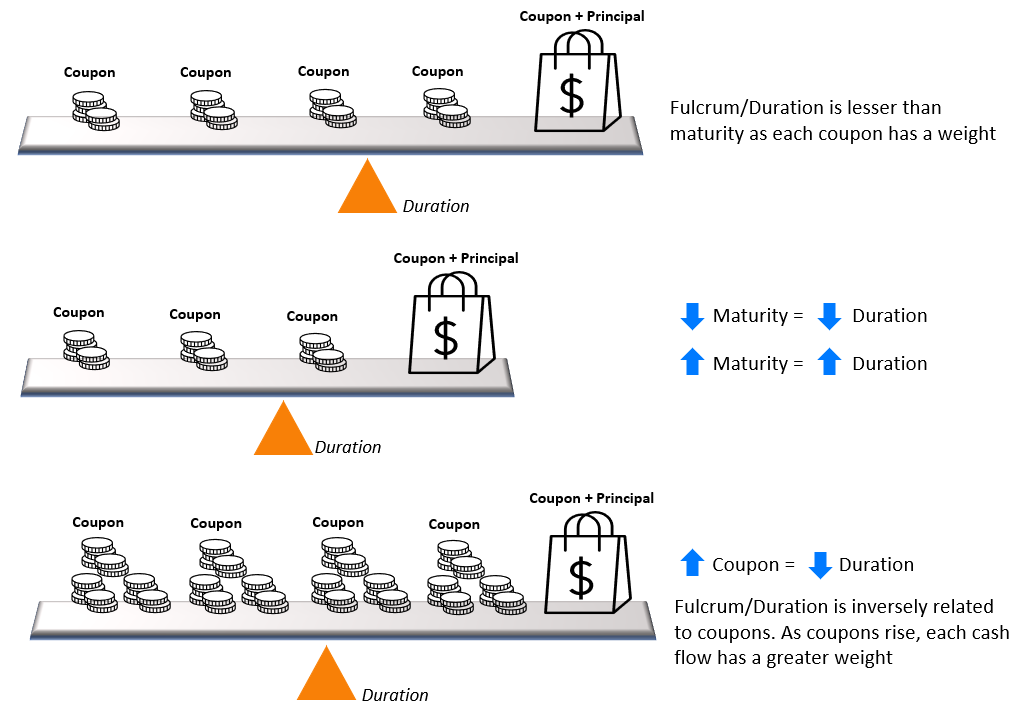
When you analyze bond duration mechanics, you quickly discover that bond maturity represents only half the equation. The genuine measure of risk lies in how quickly those future streams repay the current purchase price. If interest rates rise across the broader economy, newly issued paper offers richer yields, causing existing bonds with lower coupons to trade at steep discounts. The magnitude of that downward price revision is not arbitrary. It corresponds directly to duration, which functions as the fulcrum balancing the see-saw between market yields and market prices.
Savvy institutional allocators do not evaluate risk through calendar years alone. They measure sensitivity using standardized units of percentage price movement. By evaluating the weighted timing of every incoming coupon alongside principal recovery, professional desks forecast balance sheet adjustments before economic reports hit the public wire. For deeper institutional standards on calculating these price movements, the CFA Institute fixed income risk analysis illustrates how structural sensitivity dictates global debt performance.
Why maturity dates deceive everyday bond investors
Retail portfolios frequently suffer catastrophic drawdowns during tightening cycles because allocators confuse maturity with exposure. Imagine two distinct instruments, each possessing an identical maturity horizon of ten years. The first instrument pays an annual coupon of seven percent, while the second offers a modest coupon of two percent. A casual observer assumes both carry identical vulnerabilities to shifting interest rates.
That assumption represents a dangerous portfolio error. The instrument paying seven percent returns substantial liquidity into your hands every twelve months. Those robust cash disbursements can be reinvested immediately into higher-yielding opportunities, effectively insulating your overall wealth from prolonged devaluation. Conversely, the instrument paying two percent locks the lion’s share of its total economic benefit into the final repayment date a decade away. Its present value gets hammered violently when market rates climb, because you are stuck waiting years for meager cash flows.
Just as kitchen physics dictates that rushing heat burns the exterior while leaving the center raw—an exact parallel explored in our breakdown of how pan searing mechanics reveal 4 proven secrets to flawless crusts—managing a fixed income allocation without understanding yield curve friction leads to unforced portfolio destruction. Speed, structural balance, and patience cannot be decoupled from mathematical realities.
Four core laws governing how duration dictates your portfolio resilience
Navigating the debt markets requires moving past conceptual definitions and engaging with the operational laws that govern asset prices. These four principles dictate how duration behaves under real-world pressures.
Macaulay duration measures the true arrival time of your capital
Under classical bond duration mechanics, Macaulay duration solves this exact conundrum by discounting every individual interest payment and the ultimate principal sum back to present value terms. Each discounted payment is then multiplied by the time remaining until receipt, before the entire sequence is divided by the prevailing market price of the bond.
The resulting figure is expressed in years, but it represents temporal center of gravity rather than calendar maturity. A zero-coupon note, which delivers no cash whatsoever until maturity, carries a Macaulay duration precisely equal to its lifespan. The moment you introduce interim coupons, that duration contracts. High-coupon instruments drag the center of gravity closer to the present, minimizing the duration metric and providing an operational cushion against volatile yield shifts.
Modified duration calculates the exact mathematical price shock
While Macaulay duration provides the temporal anchor, portfolio survival depends on immediate price implications. This is where modified duration steps in. By dividing Macaulay duration by one plus the yield to maturity per payment period, investors establish a direct link between interest rate adjustments and portfolio valuations.
The rule is straightforward and unforgiving. For every one percent move in market yields, a bond’s price will fluctuate in the opposite direction by approximately its modified duration figure. A portfolio showing a modified duration of eight years will lose roughly eight percent of its asset value if yields rise by one hundred basis points. Conversely, that same portfolio gains eight percent if yields drop by an identical margin. This metric removes guesswork, translating abstract yield curve changes into exact monetary gains or losses.
Convexity serves as the structural shield against aggressive rate spikes
Duration assumes that the relationship between yields and bond prices follows a straight line. In reality, that relationship forms a curved path known as convexity. This non-linear asymmetry is the crown jewel of bond duration mechanics, proving that fixed income mathematics harbors built-in defenses for educated allocators.
When yields tumble, bond prices climb faster than linear duration forecasts. When yields surge, bond prices fall more slowly than pure duration estimates indicate. Convexity represents this beneficial curvature. Instruments with high positive convexity offer superior preservation during aggressive monetary tightening and enhanced upside when capital costs retreat. Seeking out positive convexity is how seasoned treasurers construct asymmetric defensive postures that withstand macroeconomic surprises.
Cash flow timing balances the scale against unexpected inflation
Inflation erodes purchasing power, but its most venomous impact strikes the timing of debt reimbursements. When living costs surge, distant cash flows suffer double damage from elevated interest rates and diluted currency value. Shortening duration through accelerated coupon distribution limits this exposure.
By prioritizing instruments that front-load their distributions, investors continuously liberate dry powder. Reinvesting that cash into climbing short-term instruments converts rising rate environments into wealth-building engines. You stop being a passive victim of inflation and become an active compounder of higher returns.
Strategic portfolio calibration across different economic seasons
Implementing these bond duration mechanics within a real portfolio requires ruthless discipline rather than speculative forecasting. Constructing a resilient fixed income allocation means matching the duration profile of your assets to the structural liabilities you expect to fund.
A classic operational framework utilizes barbell strategies to capture the best of two extremes. By concentrating capital in ultra-short paper paired with targeted long-term issues, an investor secures high immediate liquidity alongside extended yield capture. The short leg provides rapid reinvestment optionality as central banks move, while the long leg captures dramatic capital appreciation if the economic cycle weakens and yields plunge.
Alternatively, laddered architectures spread maturities evenly across a defined spectrum, such as one through ten years. Every twelve months, a tranche matures and returns principal. That capital is automatically redeployed at the longest end of the ladder, steadily refreshing the portfolio’s effective duration without exposing the entire balance sheet to sudden timing mistakes. This structural cadence eliminates the temptation to predict macroeconomic trends, replacing human bias with mechanical reliability.
Mastering the mathematics of fixed income longevity
A mature appreciation for bond duration mechanics transforms how an allocator perceives market volatility. Price drops in fixed income allocations are not permanent capital losses unless an investor is forced to liquidate early due to mismanaged liquidity or panic.
When you align the duration of your assets with your true investment horizon, price swings caused by shifting interest rates become temporary accounting artifacts. Over the full holding period, higher reinvestment yields from ongoing coupon disbursements eventually offset and exceed short-term capital declines. Ultimately, mastering bond duration mechanics allows capital allocators to stop fearing rate shifts and start exploiting structural pricing inefficiencies with unwavering confidence.