Basketball shooting biomechanics reveal 4 proven rules to build an unshakeable jump shot
Discover how kinetic sequencing, optimal release angles, and energy transfer turn a streaky jump shot into an automatic weapon. Learn the biomechanical adjustments that protect your form against late-game fatigue.
Mastering basketball shooting biomechanics is the single most transformative shift an athlete can make to eliminate cold streaks and build pure consistency. Every gym houses dedicated players who hoist hundreds of jumpers daily, yet their shooting percentages stagnate when defensive pressure rises. This gym-rat paradox stems from a fundamental error: volume without mechanical efficiency merely reinforces dysfunction. Repeating an unstable motor pattern a thousand times does not build mastery; it hardwires bad habits into your central nervous system.
A pure jump shot is neither luck nor vague muscle memory built on gut feel. It is applied physics, functional anatomy, and neuromuscular timing operating in unison. The human body is a multi-segmented kinetic chain—an interconnected sequence of levers built to generate, transfer, and release mechanical energy. When each link in that chain fires in chronological harmony, shooting feels effortless. When energy leaks through misaligned joints or hitch-filled release timing, accuracy evaporates. Elevating your scoring ability requires looking past generic shooting tips to dissect the kinetic laws that dictate ball flight.
The Hidden Physics Behind Every Pure Swish
Basketball is an unforgiving game of millimeter margins. A regulation rim measures 18 inches in diameter, while an official ball measures roughly 9.4 inches. If a ball dropped into the hoop from a completely vertical 90-degree descent, it would enjoy the full 18 inches of clearance. The instant an athlete shoots from distance, however, that vertical angle becomes impossible.
When researchers map out basketball shooting biomechanics in laboratory settings with three-dimensional motion capture, they observe that ball flight is determined entirely by three parameters: release speed, launch angle, and backspin rate. A shot launched on a flat trajectory of 35 degrees compresses the rim opening into a razor-thin oval window of barely 10.3 inches, leaving less than an inch of margin on either side.
Conversely, an optimal launch angle between 45 and 52 degrees expands the effective target window to over 12.7 inches. That steeper arc dramatically elevates entry probability and softens collisions against the back iron. Furthermore, imparting consistent backspin of two to three revolutions per second stabilizes the ball in flight via the Magnus effect. When that backspinning sphere contacts the rim, friction cancels forward velocity, killing the rebound energy and causing the ball to tumble softly into the net.
Why Traditional Form Drills Sabotage Natural Movement
Rethinking basketball shooting biomechanics requires dismantling dogmatic coaching clichés that treat the human skeleton like an immovable metal bracket. For decades, traditional instructors barked identical demands: square your ten toes to the basket, lock your shooting arm into a rigid ninety-degree L-shape, and jump as high as possible before releasing at the apex. While well-intentioned, these rigid cues contradict basic human kinesiology.
Every human skeleton features distinct anatomical variations. Humeral torsion, shoulder socket depth, carrying angles at the elbow, and thoracic mobility differ dramatically from player to player. Forcing an athlete with a wide carrying angle to square their feet flush against the rim creates immediate tension across the anterior deltoid and rotator cuff. To escape that impingement, the shooter instinctively kicks their elbow outward or tilts their head off-target.
Fluid mechanics emerge from natural skeletal alignment, not robotic symmetry. Elite shooters regularly turn their feet ten to twenty degrees away from their shooting hand. This subtle stance sweep clears the shooting hip, releases tension across the neck, and stacks the shooting shoulder, elbow, wrist, and dominant eye onto a single vertical plane. Forcing an artificial ninety-degree elbow freeze similarly ruins the dynamic elastic recoil required for effortless shooting range.
Four Proven Biomechanical Anchors of an Unshakeable Jump Shot
A true mastery of basketball shooting biomechanics breaks down the movement into four non-negotiable structural anchors. These phases do not function as isolated events; they form an unbroken wave of energy generated from the hardwood and released through the fingertips.
Ground Force Generation and Triple Extension
Power does not originate in the wrist or shoulder; it begins with court interaction. Efficient shooters produce vertical momentum through rapid triple flexion followed by explosive triple extension through the ankles, knees, and hips. When the balls of your feet drive downward, the floor returns an equal and opposite force upward through the skeleton. Any pause or forward knee collapse bleeds this ground force before it reaches the torso. Loading the hips like a compressed spring establishes a grounded center of gravity, allowing the glutes and quadriceps to initiate the kinetic impulse that propels the shot.
The Kinetic Dip and Fluid Energy Routing
A stubborn myth in player development advises shooters to catch the ball high and keep it high. Yet elite perimeter marksmen consistently dip the ball toward their waist upon catching it. This kinetic dip is a vital synchronization tool. As the hips and knees hinge downward, the hands descend in harmony. When the legs drive upward, the ball ascends along an unbroken path close to the body, capitalizing on the muscular stretch-shortening cycle. Eliminating the dip transforms a rhythmic energy wave into an arm-heavy push.
The Set Point and Visual Target Alignment
As the ball ascends above the chest, it arrives at the set point—the brief transitional hub where the shooting hand settles underneath the leather. Placing the ball directly in front of the eyes blinds the shooter to the rim during key targeting fractions of a second. Positioning it too far behind the head creates a catapult motion that flattens trajectory. The ideal set point positions the ball slightly above the dominant eyebrow with an early wrist cock, forming a stable shelf beneath the ball while keeping the elbow comfortably seated along the scapular plane.
The Release Window and Clean Decoupling
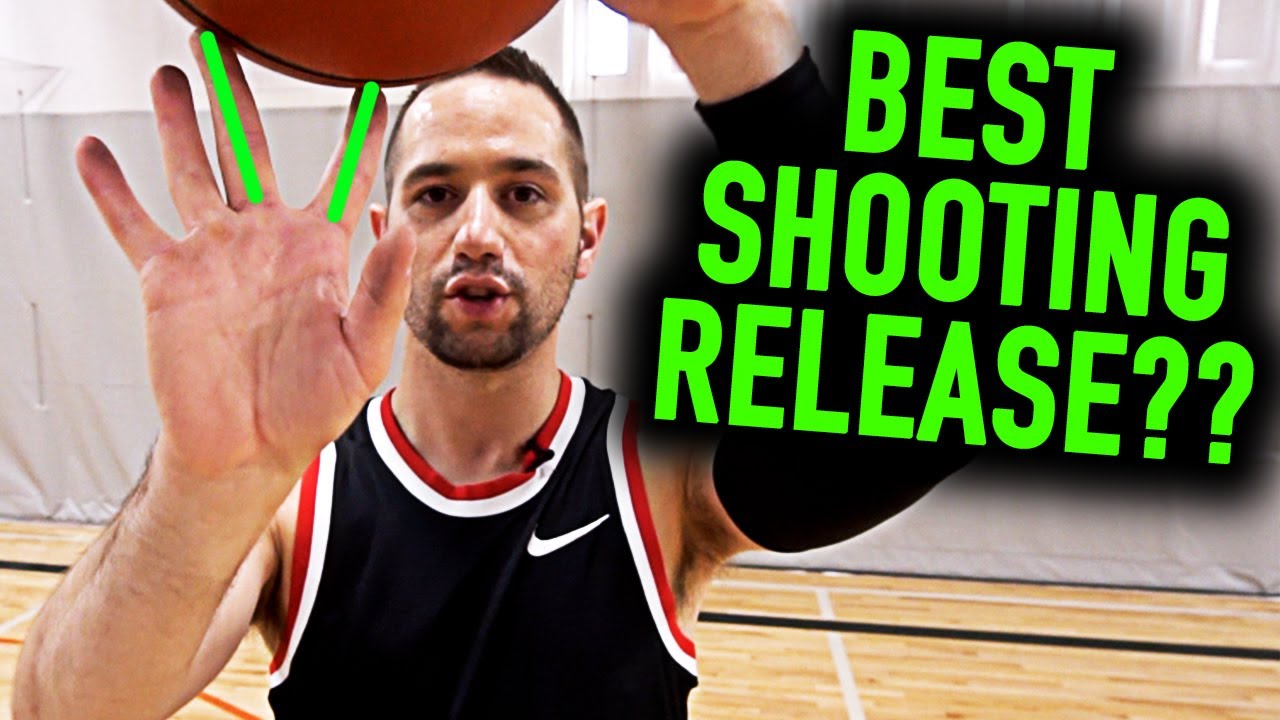
The kinetic sequence culminates in a release window lasting less than 0.05 seconds. As the jump shot reaches its vertical release height, upward energy travels through the shoulder, accelerates into elbow extension, and snaps through the wrist like a bullwhip. During this flash, the non-shooting guide hand must cleanly decouple. Its sole job is stabilizing the ball during the ascent; it must never push or flick. Final contact belongs exclusively to the index and middle finger pads, imparting pure vertical backspin.
How Late Game Fatigue Destroys Movement Patterns
The ultimate validation of shooting mechanics does not happen in an empty gym. It occurs late in high-stakes competition when heart rates spike and leg muscles fatigue. When an athlete understands basketball shooting biomechanics, they recognize that fatigue does not strike the fingertips first; it erodes the lower-body power engine.
As fatigue builds in the quadriceps and calves, ground reaction force drops noticeably. Unable to generate normal elevation, tired shooters instinctively compensate by dropping their set point toward the chest and pushing with their shoulders. This flattens the launch angle and shortens ball flight, producing heavy misses off the front rim.
Elite ball handlers and playmakers must master these same energy transfers when attacking off the dribble, an athletic reality showcased when examining how Jordin Canada Drives 3 Crucial Tactics Powering the Atlanta Dream WNBA Finals Surge through relentless downhill pressure and controlled pull-up elevation. Maintaining kinetic integrity under exhaustion requires deep technical discipline. According to a peer-reviewed kinetic chain analysis in basketball shooting, elite shooters protect their release angles by preserving consistent upper-body sequencing even when jump height declines, making slight adjustments in arm velocity rather than compromising structural posture.
Practical Diagnostics to Audit and Rebuild Your Kinetic Chain
Fixing an inconsistent jumper requires diagnosing movement patterns rather than staring at the net. Implementing an honest diagnostic of your personal basketball shooting biomechanics requires looking past the net and examining joint angles. Makes can occasionally mask poor mechanics, while flawless kinetic releases sometimes roll off the rim.
Begin your audit using slow-motion video captured from both profile and front angles. Record twenty jump shots from intermediate distance and analyze the footage for three critical markers: Does the upward path of the ball synchronize smoothly with leg extension? Does the guide hand decouple without thumb flicking? Does the shooting elbow stay aligned within your natural scapular plane?
Strip away distance to correct movement faults. Position yourself three feet from the rim and execute one-handed shots with your guide hand held behind your back. This isolates the shooting arm, immediately highlighting any balance flaws, improper wrist extension, or lateral drift. Once you produce fifteen consecutive swishes with clean high arc, step backward progressively while reintroducing the natural kinetic dip. By committing to these foundational principles of basketball shooting biomechanics, shooters transform inconsistent flurries into cold, repeatable muscle memory that survives any defensive pressure.