Emulsion stability mechanics and 4 proven rules that prevent broken sauces
Mastering the fragile balance between oil and water requires more than rapid whisking; it demands an understanding of interfacial tension and droplet physics. Discover the four proven rules that keep culinary suspensions velvety and stable under intense kitchen heat.
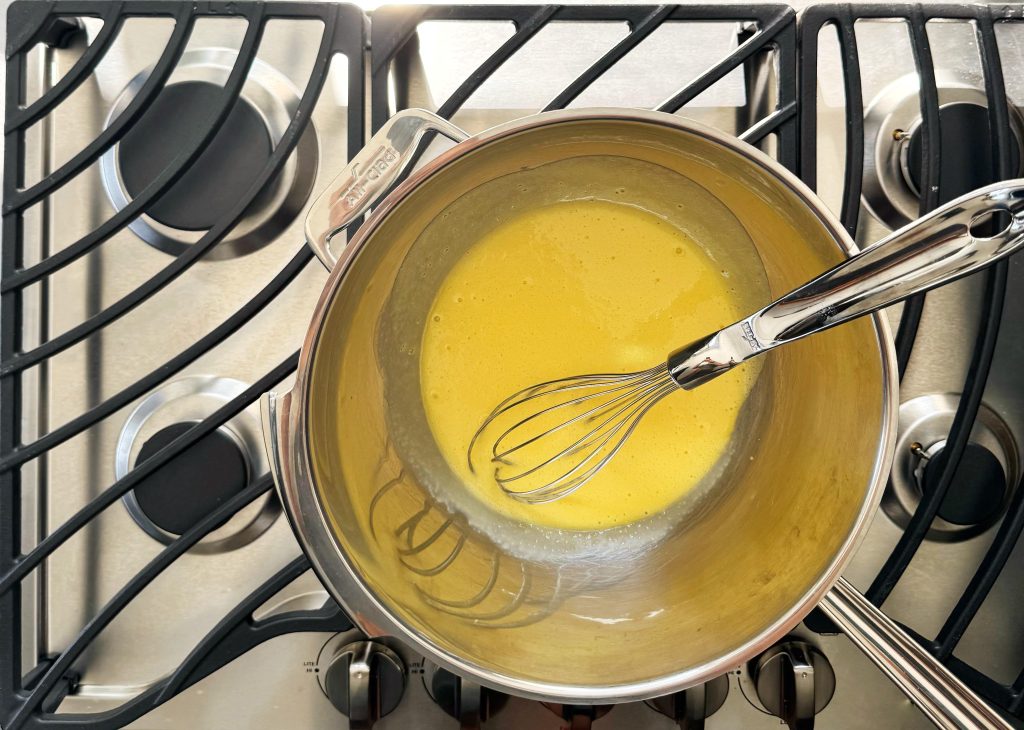
Mastering emulsion stability mechanics separates amateur pan drippings from velvety hollandaise, glossed pan reductions, and silken mayonnaise that never weeps oil onto the plate. Few kitchen disasters feel as abrupt as an emulsion splitting. One moment you are whisking a fragrant golden ribbon of butter and egg yolk; the next, the mixture collapses into a curdled, watery clump floating in yellow grease. This sudden breakdown rarely stems from bad luck. Instead, it represents an inevitable thermodynamic defeat where microscopic forces overpower mechanical effort.
Sauces are not gentle solutions where ingredients dissolve into each other harmoniously. They are colloidal battlegrounds. Understanding how to force two hostile liquids into a unified suspension transforms your command of the stovetop, turning panic-inducing kitchen tasks into predictable physical routines.
The Hidden Physics of Combining Oil and Water
A rigorous examination of emulsion stability mechanics reveals that every whisk stroke battles fundamental thermodynamics. Water molecules are intensely polar. They link together through powerful hydrogen bonds, clustering tightly like magnetic marbles. Lipids, whether rendered animal fat, olive oil, or clarified butter, consist of nonpolar triglyceride chains that cannot participate in this hydrogen-bonding network.
When you force oil and water together without intervention, the water molecules aggressively bond to one another, squeezing nonpolar lipid molecules out of their communal matrix. Scientists define this phenomenon as the hydrophobic effect. Left alone, the system seeks its lowest energetic state by minimizing contact area between the two immiscible fluids. The lipid droplets coalesce into larger globules until two distinct, separated layers form. According to classic American Chemical Society food emulsion studies, interfacial tension creates a severe energetic barrier that simple manual agitation cannot permanently overcome.
To produce an emulsion, you must shatter the bulk oil into trillions of microscopic spheres and disperse them through the continuous water phase. Each time a droplet fractures into smaller units, its total surface area expands exponentially. With that expanded surface area comes elevated interfacial energy. Without a stabilizing mechanism to counteract this surface tension, the dispersed droplets will inevitably collide, merge, and trigger complete separation.
Molecular Surfactants and the Energy Barrier of Coalescence
Mechanical force alone can break oil into fine droplets, but it cannot prevent them from fusing upon contact. That preservation task falls squarely on surface-active agents known as surfactants or emulsifiers. Within the broader study of emulsion stability mechanics, amphiphilic molecules such as lecithin, casein, and mucilage serve as non-negotiable molecular shields.
An amphiphilic molecule possesses a split personality. One end exhibits strong hydrophilic polarity, enthusiastically bonding with water, while the opposite tail consists of a lipophilic hydrocarbon chain that embeds directly into the oil droplet. When introduced into a sheared mixture, these molecules immediately rush to the liquid-liquid boundary, coating every lipid droplet in a protective molecular envelope.
This surfactant shield stabilizes the sauce through two complementary defenses. First, it introduces steric hindrance. The bulky protein chains or phospholipid heads protruding outward physically block neighboring oil droplets from approaching close enough to touch. Second, these outward-facing groups often carry matching electrical charges, generating electrostatic repulsion. When two suspended droplets drift near each other, like charges repel, bouncing them apart before their lipid cores can fuse. If you understand these structural dynamics, you can accurately manipulate viscosity, shear, and temperature to keep delicate sauces stable under pressure.
Four Proven Principles for Building Unbreakable Emulsions
Moving from abstract physical chemistry to confident cooking requires translating molecular principles into precise kitchen habits. Whether constructing an intensely thick garlic aioli or mounting a pan sauce with cold butter, four physical laws dictate whether your suspension holds firm or disintegrates.
Control the Dispersed Phase Rate to Avoid Rapid Inversion
To govern emulsion stability mechanics on a practical cooktop, fat must never enter the mixing vessel faster than the mechanical implement can shear it into microscopic droplets. The most perilous moment occurs at the very beginning of the process. If you introduce a heavy stream of oil into a base of egg yolk and acid, the sheer volume of lipid overwhelms the minimal water phase. Rather than forming oil droplets inside a continuous water bath, the liquids suffer catastrophic phase inversion, forming water droplets trapped in an ocean of grease.
A reliable emulsion begins with a stable seed suspension. Add the lipid drop by drop while agitating continuously until the mixture visibly thickens and turns opaque. This optical shift signals that you have created an immense network of micro-droplets that refract light. Once this initial matrix forms, the existing droplets actively assist in shearing newly added oil, allowing you to gradually increase the pouring speed into a steady, controlled stream.
Calibrate Temperature Windows to Protect Surfactant Integrity
Heat alters viscosity, kinetic energy, and molecular geometry. In warm butter emulsions like béarnaise and hollandaise, temperature serves as both creator and destroyer. If the sauce drops below roughly 45°C (113°F), saturated milk fats begin to solidify into rigid, jagged crystals. These crystalline fats pierce the delicate surfactant membranes surrounding adjacent droplets, triggering rapid coalescence and leaving a greasy film.
Conversely, excessive heat destroys emulsions through protein denaturization. The primary surfactants in egg yolks—vitellin and livetin proteins—unravel under heat, exposing reactive sites that form tight, irreversible peptide networks. If your pan crosses 68°C (155°F), these proteins cross-link so aggressively that they contract, expelling water through syneresis and leaving grainy scrambled eggs swimming in clarified butterfat. Keeping your pan within a temperate band between 50°C and 62°C (122°F to 144°F) preserves surfactant flexibility while keeping lipids fully liquid.
Maximize Mechanical Shear to Shrink Droplet Diameter
Droplet size directly governs how long an emulsion will survive on the plate. Under Stokes’ Law of sedimentation, the velocity at which suspended particles rise or settle is proportional to the square of their radius. Large oil droplets possess significant buoyancy; they float upward rapidly, congregating at the surface in a process known as creaming. Microscopic droplets, on the other hand, remain buffeted by surrounding water molecules through Brownian motion, resisting gravitational separation indefinitely.
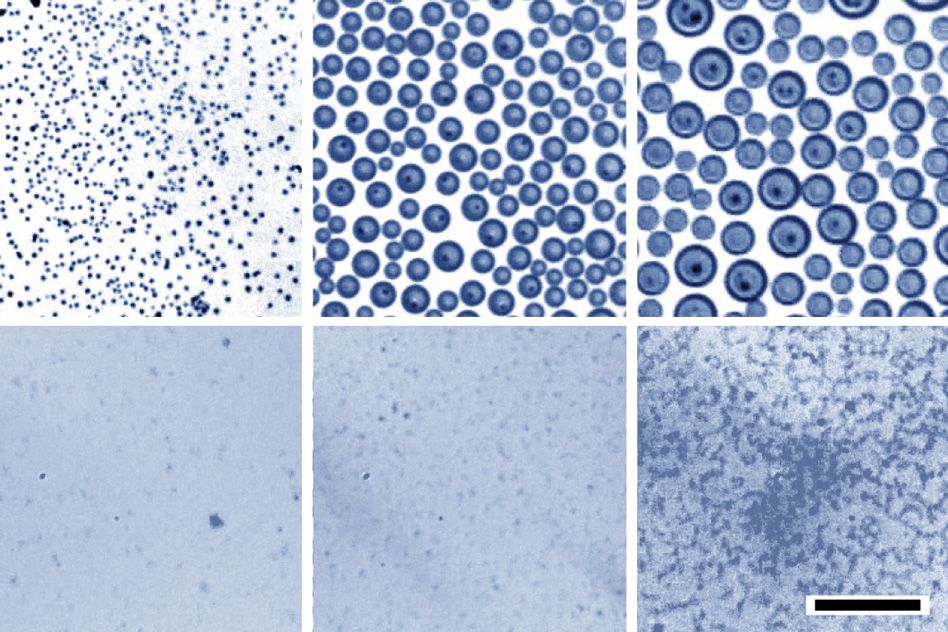
Traditional balloon whisks yield droplet diameters between 10 and 50 micrometers through wrist-driven shear. A high-speed immersion blender spinning at thousands of revolutions per minute shears those same lipids into sub-micron droplets with vastly greater surface area. Smaller droplets produce a significantly more stable matrix, a firmer mouthfeel, and a glossy, opaque appearance that holds its structure for hours without separating.
Balance Volume Fractions to Sustain Viscous Drag
An emulsion gains its luxurious thickness through the geometric crowding of its dispersed particles. When oil droplets occupy between 60% and 74% of the total liquid volume, they physically press against one another. To move, each droplet must deform and slide past its neighbors, generating substantial internal friction that human palates perceive as silkiness.
However, when the internal phase exceeds the random close-packing limit of spheres (roughly 74%), the continuous water layer between droplets thins down to a few nanometers. At this critical juncture, even a minor kinetic shock causes the continuous film to rupture, prompting total sauce failure. Maintaining stability requires keeping enough continuous water present to lubricate droplet movement. Just as analyzing Order book mechanics and 4 proven rules that prevent costly trading slippage requires tracking how liquidity micro-imbalances trigger cascading system failures, culinary cooks must recognize when their continuous phase is running dangerously dry.
Diagnosing and Rescuing a Broken Suspension
When kitchen conditions falter, understanding emulsion stability mechanics ensures that culinary collapse is never permanent. Sauces rarely break without early warning signs. Before a complete collapse occurs, the sauce often loses its sheen, exhibiting a dull, greasy surface texture or shedding microscopic beads of clear fat around the rim of the bowl. This state indicates that interfacial tension is overtaking your surfactant barrier.
If you catch this destabilization early, rescue is remarkably simple. Whisk in a tablespoon of cold or room-temperature water immediately. By replenishing the continuous phase, you widen the gaps between crowded lipid droplets, dropping the internal volume fraction back below the danger threshold. The sauce quickly recovers its velvety gloss.
If the emulsion has completely separated into oil and curdled solids, aggressive re-whisking alone will achieve nothing because the continuous matrix has disappeared. To salvage the ingredients, establish a fresh continuous phase in a clean bowl using a single tablespoon of water, lemon juice, or an egg yolk. Begin whisking that fresh base vigorously, then re-introduce the broken, separated sauce drop by drop, treating it exactly like raw oil. The new pool of surfactants will encapsulate the fractured lipid droplets, rebuilding a rock-solid suspension without wasting a single gram of butter.
The Lasting Mastery of Culinary Equilibrium
A cook who follows recipes blindly treats broken sauces as unpredictable curses of bad timing or poor equipment. A cook who understands physical forces sees an emulsion for what it truly is: a dynamic system operating under strict mechanical constraints. Every adjustment in whisking speed, pouring rate, and pan temperature directly influences how molecules position themselves at the boundary between two stubborn fluids.
Ultimately, emulsion stability mechanics transforms unpredictable pan magic into an exacting, reliable kitchen science. When you respect the energetic requirements of phase dispersion, balance your volume fractions, and safeguard your molecular surfactants, your sauces reward you with breathtaking texture, luminous sheen, and unflinching structural stability.