Emulsion sauce mechanics and 4 proven rules that prevent tragic kitchen disasters
A broken hollandaise or split vinaigrette is never bad luck; it is fluid dynamics in action. Unpack the chemistry of culinary suspensions to create silky, indestructible sauces every time you cook.
Mastering emulsion sauce mechanics separates panicked amateur cooks from confident culinary artisans who can rescue any sauce on the fly. We have all stood over a saucepan, watching in horror as a satin-smooth hollandaise suddenly collapses into an oily, curdled swamp right before dinner. The instinct is often to blame bad luck, an inaccurate stove knob, or an impatient wrist. In truth, a broken sauce is never random. It is an unyielding, predictable demonstration of fluid dynamics and surface chemistry answering the fundamental laws of physics.
When fat meets water, nature prefers separation. Left to their own devices, hydrophobic lipid molecules cling to one another while hydrophilic water molecules form tight hydrogen bonds, pushing the oil outward into isolated pools. Forcing these stubborn adversaries into a harmonious, spoon-coating partnership requires understanding the physical forces at play. Once you see a sauce not as a fragile recipe but as an engineered colloidal suspension, the fear of splitting evaporates entirely.
The microscopic tug of war behind every velvety sauce
Every classic sauce you admire, from a velvety béarnaise and garlicky aioli to a delicate pan deglaze finished with chilled butter, exists in a state of physical defiance. They are colloidal suspensions, specifically liquid-in-liquid emulsions. Trillions of microscopic fat droplets stay suspended throughout a surrounding water base without coalescing into greasy puddles on the plate.
Looking closely at emulsion sauce mechanics reveals an ongoing tug-of-war between polar and nonpolar molecules. Water molecules are intensely polar, acting like miniature magnets that pull toward each other with fierce surface tension. Oil molecules, composed of long nonpolar hydrocarbon chains, cannot participate in this electrical attraction. When you simply shake oil and water together in a glass jar, the oil fragments into brief, chaotic bubbles, but the immense surface tension of the water rapidly expels them, forcing the oil droplets to fuse back together into a single slick film.
To keep these droplets apart, a cook must manipulate two distinct phases known as the continuous phase and the dispersed phase. The continuous phase is the liquid matrix that surrounds everything, usually an acidic water solution such as lemon juice, wine vinegar, or reduced stock. The dispersed phase consists of the countless fragmented oil or butterfat droplets suspended within that matrix. If the dispersed droplets touch and merge, the sauce breaks. If they remain tiny and isolated, trapped in the web of the continuous phase, the sauce retains a rich, velvety texture that rolls across the tongue like liquid silk.
Why oil and water refuse to cooperate without molecular diplomacy
Brute physical whisking can temporarily scatter oil droplets, but it cannot keep them apart for longer than a few fleeting minutes. This is where chemical diplomats, known scientifically as surfactants or emulsifiers, enter the equation. Without an emulsifier, thermodynamic reality will always favor phase separation because a coalesced pool of oil requires far less interfacial energy than millions of separate droplets floating through liquid.
Understanding the real genius behind emulsion sauce mechanics lies in surfactant chemistry, specifically molecules like lecithin found in egg yolks. Lecithin is an amphiphilic molecule. One end of its molecular structure is lipophilic, meaning it bonds eagerly with fat, while the opposing end is hydrophilic, craving direct contact with water. When introduced into the mixture, these molecules immediately rush to the boundary between the oil droplets and the water base.
The lipophilic tails embed themselves deep inside the fat droplets, while the hydrophilic heads stick outward into the surrounding water. This orientation creates an electrostatic and steric barrier around every single droplet. Because the outer surfaces of these newly coated droplets now share identical electrical charges, they physically repel one another instead of fusing upon collision. Egg yolk is the undisputed king of kitchen emulsifiers, but natural surfactants also reside in the mucilage of prepared mustard, the pulverized fibers of garlic in traditional Spanish allioli, and the milk proteins present in cold butter.
Four proven rules that guarantee indestructible emulsions every time
Transforming raw ingredients into a stable suspension does not require culinary sorcery. Applying sound emulsion sauce mechanics transforms temperamental reductions into stable, glossy textures that withstand the dinner rush without flinching. Follow these four structural directives to guarantee stability in every pan.
Establish a secure continuous phase before introducing oil droplets
The most frequent mistake cooks make occurs in the opening five seconds of preparation. If you pour fat into an empty bowl or dump oil onto whole egg yolks before creating a fluid water base, failure is nearly certain. Emulsification requires a welcoming aquatic environment where fat droplets can find room to disperse. A single egg yolk contains approximately fifty percent water, but that moisture is tightly bound to proteins.
Before a single drop of warm butter or oil enters the bowl, you must dilute the yolk with a small splash of liquid. A tablespoon of water, lemon juice, or reduced vinegar loosens the dense yolk matrix and expands the volume of the continuous phase. Whisk this base until it froths and pales. This preparatory step creates a spacious liquid reservoir, ensuring that the incoming fat droplets are immediately surrounded by water rather than crashing into neighboring lipid molecules.
Manage temperature boundaries to protect sensitive protein matrices
Heat accelerates molecular movement, lowering the viscosity of fats and making them easier to shatter into fine droplets. However, excessive heat destroys the very proteins that keep the emulsion alive. When preparing warm emulsions like hollandaise or béarnaise, your working window is razor-thin, typically hovering between 120°F and 145°F (49°C to 63°C).
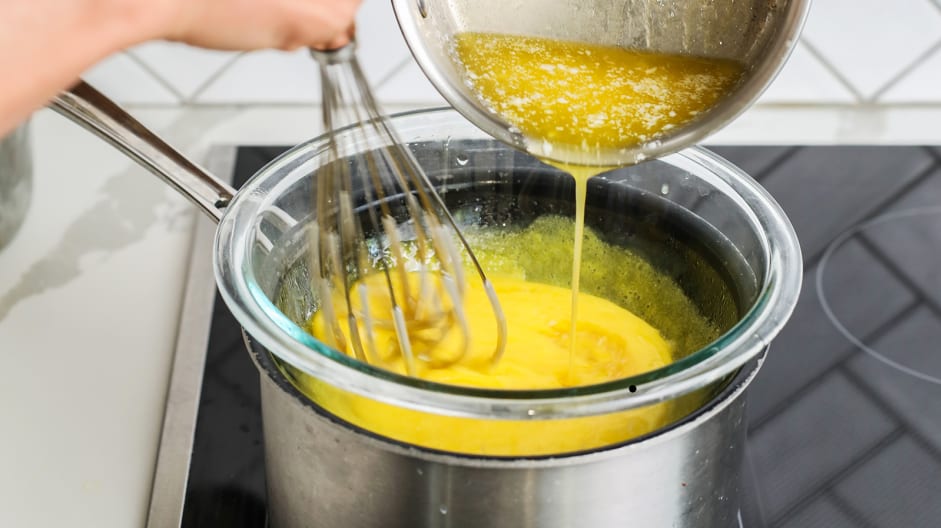
Push the pan beyond 150°F (65°C), and the egg proteins begin to unfold, denature, and cross-link into rigid coagulated knots. This thermal curdling squeezes water out of the protein network, instantly starving the continuous phase and releasing the fat in an oily tide. Conversely, if your butter is too cold, the saturated fats crystallize into solid platelets that shred the surfactant film. In this delicate balance, respecting temperature limits is critical because emulsion sauce mechanics break down when thermal agitation overwhelms interfacial tension. Maintain gentle, indirect heat through a bain-marie or pull the pan off the burner regularly to calibrate temperature by feel.
Apply mechanical shear to shatter fat into microscopic spheres
Surface tension fights aggressively against droplet division. Overcoming that resistance requires mechanical energy, known in physics as shear force. The size of your oil droplets dictates both the stability and the mouthfeel of your sauce; the smaller the droplets, the thicker and more stable the emulsion becomes.
A gentle stir with a wooden spoon simply pushes oil slicks around the pan without imparting enough kinetic energy to break them up. You need violent shearing action. A balloon whisk with numerous thin, flexible wires chops through the mixture, slicing large fat globules into microscopic spheres. When starting an emulsion, whisk in tight, rapid figures-of-eight or back-and-forth strokes rather than lazy circles. For absolute bulletproof stability, an immersion blender provides astronomical shear rates, generating millions of uniform micro-droplets in seconds through cavitation and high-speed blade vortexes.
Respect the volumetric tipping point to prevent phase inversion
There is a mathematical limit to how much oil a given volume of water can hold. In fluid mechanics, this is known as maximum packing fraction. If you imagine fat droplets as tiny spheres packed tightly inside a jar, there comes a point where the spheres touch on all sides, leaving no room for the continuous water phase between them. In culinary systems, this catastrophic threshold occurs when oil occupies more than roughly seventy-five to eighty percent of the sauce’s total volume.
When you push beyond this ratio without adding more water, phase inversion occurs. The sauce abruptly flips inside-out: the oil becomes the continuous phase, and water becomes trapped droplets. Visually, the sauce goes from a creamy, stiff ribbons into a greasy, curdled sludge in the blink of an eye. Whenever your mayonnaise or hollandaise begins to look excessively stiff, oily, or unyielding, whisk in a teaspoon of warm water immediately. This replenishes the continuous phase, spreads the droplets apart, and prevents structural collapse.
How to resurrect broken mixtures before dinner is ruined
Even seasoned restaurant veterans experience an occasional split sauce when working during an intense dinner rush. The fatal mistake is tossing the broken disaster into the trash. Because an emulsion is a physical mixture rather than an irreversible chemical reaction (assuming you have not scrambled the egg proteins into solid curds), every broken sauce can be rebuilt completely.
When cooks diagnose why a sauce splits, returning to basic emulsion sauce mechanics exposes whether the issue was phase ratio or droplet shear. To resurrect a shattered hollandaise or mayonnaise, grab a clean bowl. Add one teaspoon of warm water or an extra egg yolk to establish a brand-new, healthy continuous phase. Now, treat your broken sauce not as ruined food, but simply as your fat source.
Begin whisking your fresh base vigorously while dripping the broken mixture into it drop by drop. The fresh surfactant and abundant water immediately capture the incoming oil-and-water mixture, re-shearing the fat into microscopic droplets. As the emulsion catches and gains body, you can increase the pouring speed to a steady, thin stream. Within two minutes, what was once a greasy mess re-emerges as a gleaming, perfectly suspended sauce with even greater stability than before. For deeper technical reference on how interfacial boundaries behave under stress, consult Exploratorium food science laboratory guides detailing colloidal kitchen physics.
The lifelong kitchen instinct of permanent sauce control
Cooking with absolute confidence comes down to recognizing the physical state of your ingredients at any given second. Much like how observers notice how AAPL stock surges as 4 major signals defy the tech market rout through disciplined structural balance, a stable emulsion relies on fundamental laws rather than pure luck. When you stop crossing your fingers and start observing droplet dispersion, temperature thresholds, and phase ratios, the kitchen stops feeling like an unpredictable gamble.
A silky pan sauce whisked with cold butter cubes at the very end of cooking—known in classic French technique as monter au beurre—relies on these identical physical laws. The natural milk solids and small water content inside the cold butter provide just enough continuous phase and emulsifiers to suspend the melting butterfat into the savory pan reduction. Internalizing these fundamental emulsion sauce mechanics guarantees that every pan sauce, mayonnaise, or béarnaise reaches velvety perfection without fear. You no longer follow recipes blindly; you command the physics of the pan.