Sourdough fermentation mechanics and 4 proven rules that create extraordinary wild crumb
Transform dense sourdough boules into airy, blistered artisan loaves by mastering the microscopic kinetics, gas expansion dynamics, and enzymatic realities of wild dough.
Mastering sourdough fermentation mechanics transforms simple flour and water into an aerated, blistered, deeply flavorful loaf of artisan bread. Many bakers spend months wrestling with heavy boules, sticky dough that puddles across the counter, or erratic pockets of giant holes trapped inside gummy crumb. They blame their flour, curse their ovens, or chase expensive Dutch ovens in search of salvation. Yet the real secret never lives in the cast iron. It lives inside the dynamic microbial metropolis operating beneath the surface of the mixing bowl.
Wild dough is not an inanimate baking batter that yields to rigid clock timers. It is a living, breathing thermodynamic engine driven by billions of wild yeasts and bacteria working in an intricate biochemical dance. When you learn to decipher what these microorganisms consume, how they alter the physical elasticity of gluten, and how temperature dictates their output, the guesswork evaporates. In its place emerges repeatable control over every loaf you bake.
The microscopic ecosystem driving every wild starter
A sourdough culture is fundamentally an act of peaceful ecological coexistence. While commercial bakeries rely on isolated, laboratory-selected monocultures of fast-acting yeast, a wild starter harnesses two distinct classes of microorganisms: wild yeasts and lactic acid bacteria. The dominant yeast species in stable starters is rarely the commercial strain. Instead, strains such as Kazachstania exigua and wild Saccharomyces cerevisiae take root, thriving in acidic environments that would paralyze conventional baker yeast.
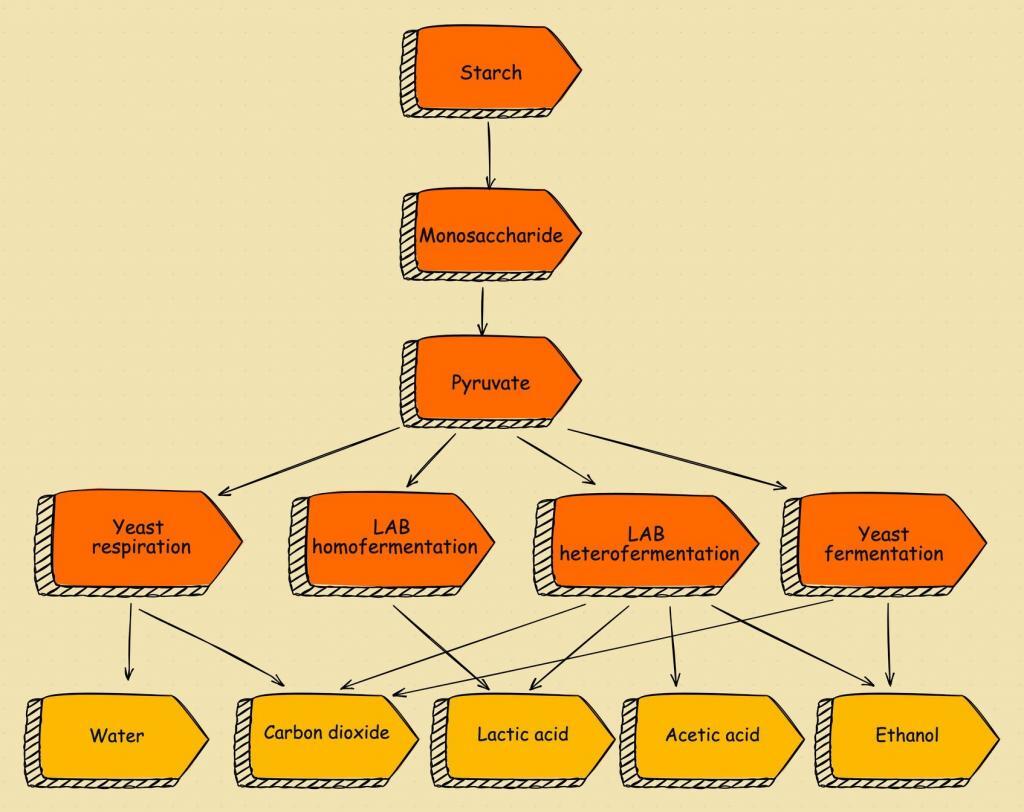
Alongside these resilient yeasts live lactic acid bacteria, predominantly members of the genus Fructilactobacillus, particularly Fructilactobacillus sanfranciscensis. What makes this pairing remarkably robust is metabolic resource partitioning. The bacteria consume maltose using the enzyme maltose phosphorylase, leaving glucose and other simpler sugars untouched. The wild yeasts, incapable of metabolizing maltose, consume the remaining simple sugars without competing with their bacterial hosts. According to peer-reviewed research published by the American Society for Microbiology, this cooperative metabolic adaptation ensures starter stability across thousands of feeding cycles and varying ambient conditions.
Understanding sourdough fermentation mechanics requires peering past romanticized bakery folklore into the rigorous world of biochemistry. As the bacteria metabolize their share of carbohydrates, they discharge organic acids into the dough matrix. Lactic acid contributes a mild, dairy-like sweetness, while acetic acid provides a sharper, vinegary punch. This drop in dough pH from an initial 5.8 down to roughly 3.8 fundamentally transforms the physical behavior of the bread dough, altering enzyme activity and gluten structural stability.
Thermodynamics and enzymatic activity inside the dough matrix
The moment water hydrates milled grain, an enzymatic cascade begins. Naturally occurring enzymes locked within the grain endosperm awaken. Alpha-amylase and beta-amylase immediately begin dismantling damaged starch granules, converting complex starches into maltose and glucose. These simpler sugars serve as the primary fuel source for your wild microbial colony. Without robust enzymatic liquefaction of starch, your starter organisms would quickly starve in a desert of inaccessible carbohydrates.
Simultaneously, proteolytic enzymes known as proteases begin breaking peptide bonds within the developing gluten matrix. Gluten is composed of two primary proteins: gliadin, which provides extensibility and stretch, and glutenin, which provides elasticity and tensile strength. Protease activity gently softens this protein network, allowing the dough to relax and expand under internal gas pressure. However, protease activity is a double-edged sword. If the dough spends too long at elevated temperatures or experiences extreme acid accumulation, excessive proteolysis will liquefy the gluten network, causing the dough to lose its shape and puddle uncontrollably.
Every baker must balance this biochemical structural breakdown against physical gas retention. Just as managing unstable liquid structures in cooking demands precision, as seen when exploring how Emulsion sauce mechanics and 4 proven rules that prevent disastrous kitchen breaks govern delicate sauces, wild dough requires a delicate thermodynamic balance between gluten degradation and gas generation to avoid structural collapse.
Sourdough fermentation mechanics and 4 proven rules that transform dense loaves into airy masterpieces
Achieving an open, lacy crumb with tall vertical spring requires translating micro-level biochemical knowledge into tactile baking adjustments. The following four rules dismantle the common points of failure that produce dense, sour bricks.
Manage dough temperature to balance bacterial lactic acid against wild yeast vitality
When bakers dissect sourdough fermentation mechanics, they quickly realize that dough temperature acts as the master throttle of the entire microbial ecosystem. Yeast cells and lactic acid bacteria respond to heat along vastly different biological curves. Wild yeast flourishes within a moderate thermal window between 24°C and 26°C (75°F to 78°F). In this range, yeasts produce carbon dioxide gas swiftly without outstripping the dough structural development.
Lactic acid bacteria, by contrast, thrive in warmer environments between 28°C and 32°C (82°F to 90°F). When bulk fermentation runs hot, bacterial acid production accelerates rapidly, creating massive amounts of lactic acid and triggering premature protease degradation before the yeast has produced sufficient carbon dioxide. Conversely, holding dough below 18°C (64°F) dramatically slows yeast gas production while encouraging the slow generation of pungent acetic acid. Professional bakers calculate their Desired Dough Temperature by adjusting water temperature against flour temperature, ambient kitchen temperature, and the physical friction of mixing, locking in their target temperature from the very first turn of the dough.
Track volumetric expansion and bubble geometry rather than rigid kitchen timers
One of the most persistent errors in home bread making is following recipes that instruct you to ferment for four hours. Microbial activity varies dramatically based on ambient microbial load, grain mineral ash content, and water pH. A fermentation that takes four hours on a humid summer afternoon might take nine hours in a dry, chilly winter kitchen. Clock watching inevitably leads to under-fermentation or structural exhaustion.
Read the physical signs written directly into the dough. Look for convex doming across the upper surface where the dough meets the container walls, signifying positive upward gas pressure. Inspect the transparent base of your container for a network of aerated micro-bubbles that transition from small, pin-prick voids into distinct, spongy aerations. The dough should feel buoyant, airy, and gently responsive when shaken. For standard white flour loaves, bulk fermentation should generally conclude when the dough expands by roughly 30 to 50 percent, leaving sufficient unconsumed starch reserves to power the explosive expansion of oven spring.
Calibrate flour hydration to match the enzymatic degradation rate of your grain
Internet baking culture often fetishizes hyper-hydration doughs exceeding 85 percent water. For white roller-milled flours with modest protein strength, excessive water saturates the protein strands, separating the gluten chains so drastically that they cannot form durable cross-linked disulfide bonds. The trapped water pools into capillary voids, weakening the dough walls and causing structural flattening.
Grains with high mineral content, such as stone-ground whole wheat or dark rye, naturally demand higher hydration because their bran and germ particles absorb vast quantities of water. However, these whole grains also introduce high levels of native enzymes that accelerate fermentation and gluten breakdown. When working with refined bread flours, keeping hydration between 72 and 75 percent maintains optimal tension between gluten elasticity and dough extensibility. Only increase hydration once your shaping technique and grain choice provide the tensile strength required to lock that excess moisture into a resilient matrix.
Execute gentle tensile folds during bulk rest to reinforce gluten walls against acidic collapse
Dough is not a static sponge; it is a dynamic polymer suspension that requires physical alignment. Because sourdough starters continuously acidify the dough, the lowering pH gradually introduces positive charges to protein side chains, increasing electrostatic repulsion between gluten strands. Left alone, this repulsion leads to a lax, slack dough structure.
This structural tension represents the physical counterweight within sourdough fermentation mechanics, working in tandem with continuous enzymatic digestion. By executing periodic stretch-and-folds or gentle coil folds during the first half of bulk fermentation, you manually orient the tangled glutenin molecules into organized, parallel planes. This mechanical realignment creates a taut skin with high surface tension. Handle the dough with flat, wet palms, stretching the mass upward just until you feel resistance without tearing the delicate sheet. These folds trap the tiny gas pockets created during initial mixing, transforming isolated voids into a unified honeycomb structure.
Diagnosing structural collapse and over-acidification before baking
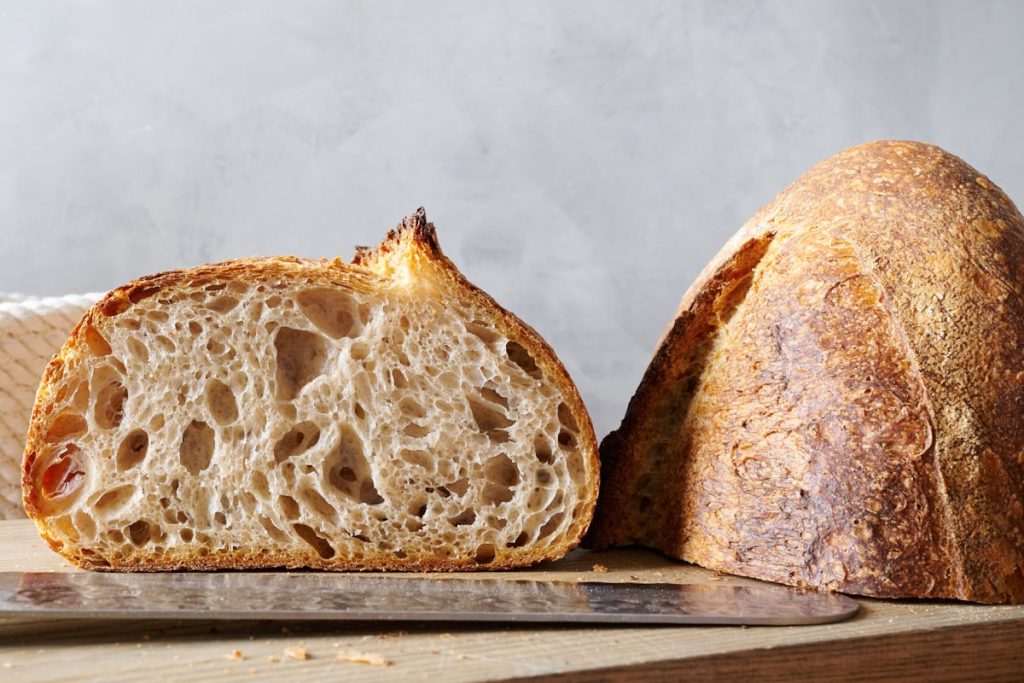
Failing to respect sourdough fermentation mechanics often produces the classic fool’s crumb, where cavernous top voids hover above a dense, gummy base. Novice bakers often celebrate these giant holes as evidence of an open crumb, but this appearance actually reveals significant under-fermentation. When dough is shaped and baked before the wild yeast has distributed microscopic gas nuclei evenly throughout the mass, steam concentrates into a few weak fissures during baking, blasting open massive tunnels while the dense, un-aerated mass beneath sets into rubber.
At the opposite extreme lies over-fermentation. In this scenario, excessive microbial acid degrades the gluten mesh beyond repair. As the pH plunges below 3.8, the glutenin strands lose all structural memory and snap under tension. The dough feels soupy, tears during the simplest preshaping attempts, and spreads flat as a pancake when tipped out of its proofing basket. If an over-fermented loaf enters the oven, it produces zero vertical lift, setting into a pale, sour, crumbly loaf with a dull, blisterless crust. Catching fermentation at its peak viscoelastic plateau ensures the gluten retains the structural elasticity needed to catch expanding steam without rupturing.
Tasting the legacy of patient fermentation
When an artisan loaf enters a blisteringly hot oven, the mechanical choreography reaches its peak. Within the first ten minutes, trapped carbon dioxide expands according to fundamental gas laws, while water converts into volatile steam. Starch granules along the exterior gelatinize, forming a thin, glossy film that traps this internal expansion until the loaf blossoms along the score mark. Maillard reactions between liberated amino acids and simple sugars paint the crust in deep mahogany tones, yielding rich aromas of toasted hazelnut, malt, and caramelized grain.
Once you internalize sourdough fermentation mechanics, you stop following arbitrary clock timers and start reading the living dough directly. You recognize how a drafty kitchen shifts fermentation velocity, how different stone-milled flours alter enzymatic appetite, and how subtle fold adjustments preserve structural tension. Baking ceases to be a nerve-wracking gamble and becomes an intuitive craft anchored in timeless biological science. Every slice of airy, open crumb becomes a testament to the mastery of this microscopic world.