Margin trading mechanics and 4 costly errors that destroy leveraged portfolios
Borrowed capital can amplify market gains, but sudden margin contractions can liquidate an entire account within minutes. Understanding the exact arithmetic of leverage separates enduring investors from sudden balance sheet casualties.
Mastering margin trading mechanics separates speculative gamblers from seasoned operators who understand how borrowed leverage actually functions under extreme market pressure. While leverage promises to accelerate wealth accumulation, it fundamentally distorts portfolio risk profiles by introducing non-linear downside exposure. A ten percent decline in an unleveraged equity portfolio represents an uncomfortable drawdown, but that same decline inside an aggressive margin structure can permanently wipe out underlying equity. When retail and institutional market participants borrow money against their holdings, they enter a contractual arrangement that hands ultimate liquidation authority to the broker. Survival requires stripping away romantic notions of purchasing power and confronting the ruthless engineering behind collateral ratios, borrowing friction, and liquidity dry-ups.
The hidden physics of borrowed capital and balance sheet hypothecation
At its fundamental core, margin trading mechanics operate as a secured lending arrangement where an investor deposits cash or eligible securities as collateral to finance additional asset purchases. This is not merely clicking a button to double your buying power. When an account opens a margin facility, the brokerage extends credit backed by the equity value of the pledged assets. The broker maintains a senior claim on every share sitting in the portfolio. Through hypothecation and rehypothecation agreements buried within standard brokerage disclosures, the firm often retains the contractual right to lend those exact securities to other institutional traders, including short sellers seeking borrow inventory.
Just as audio engineers assemble synthetic soundscapes to construct an illusion of physical presence—a craft explored in Foley sound design mechanics and 4 proven rules that create stunning cinematic realism—brokerage trading screens frequently project an illusion of purchasing power that obscures the underlying debt architecture. You see a consolidated cash balance, but underneath the interface lies a volatile, floating-rate balance sheet loan that resets daily.
The financing rate tied to this loan fluctuates based on prevailing benchmark central bank interest rates combined with broker-dealer tier markups. When broad monetary policy tightens, the cost of carrying debit balances surges. This turns static positions into negative-yield liabilities that constantly erode net asset value even if nominal asset prices remain flat. Furthermore, brokers assign specific risk weightings, commonly known as haircuts, to different asset classes. Blue-chip equities might require standard collateral coverage, while volatile small caps or high-beta growth stocks command prohibitive requirements or receive zero collateral credit entirely.
How broker collateral thresholds trigger catastrophic liquidation cascades
The mathematical reality of margin trading mechanics becomes brutally transparent when asset prices diverge from an investor’s directional thesis. Regulatory frameworks, such as FINRA Rule 4210 margin requirements and risk governance, dictate minimum baseline equity ratios, but individual brokerage firms regularly impose house requirements that are substantially more restrictive. Understanding these thresholds requires knowing the exact boundary where an investor loses operational control over their balance sheet.
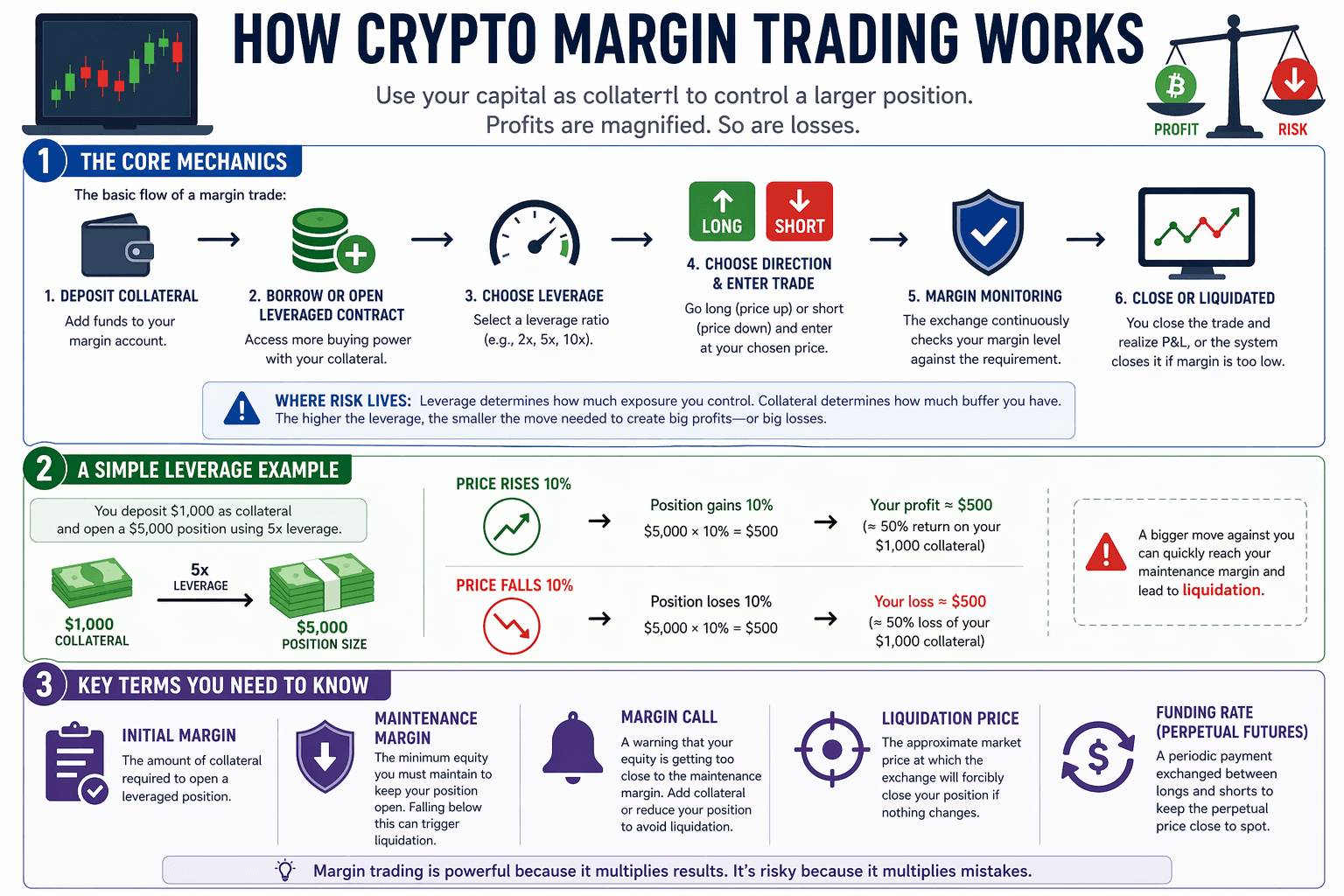
Consider an account operating with initial margin rules requiring fifty percent equity at purchase, backed by a twenty-five percent statutory maintenance margin requirement. If you deposit ten thousand dollars in cash and purchase twenty thousand dollars of equity securities, your starting equity ratio stands at fifty percent. However, as the market price drops, the debit balance of ten thousand dollars remains entirely static while portfolio equity absorbs one hundred percent of the dollar loss. If the portfolio value drops to thirteen thousand three hundred and thirty-three dollars, your remaining equity of three thousand three hundred and thirty-three dollars represents exactly twenty-five percent of the total value. A single cent decline below that threshold breaches maintenance territory.
When a breach occurs, the popular belief that brokers will politely issue a notification and provide days to wire additional funds is an expensive myth. Broker customer agreements grant risk algorithms the legal authority to liquidate assets immediately without prior client notification. When widespread market panic strikes, algorithmic risk systems do not seek optimal execution prices. They dump collateral at prevailing market bids to make the lending broker whole, frequently locking in bottom-of-the-market losses and leaving the account holder with depleted capital or an uncollectible deficit balance.
Four devastating traps that accelerate margin portfolio collapse
Analyzing historical market drawdowns reveals how flawed interpretations of margin trading mechanics regularly transform manageable corrections into catastrophic portfolio liquidations. Investors often treat leverage as an extension of standard long-term investing, failing to recognize that borrowed capital enforces an unforgiving chronological deadline on every position. The following four operational errors consistently dismantle leveraged accounts.
Overestimating equity buffers during systemic volatility clusters
Traders routinely calculate their margin headroom under conditions of normal market distribution, assuming that a thirty or forty percent market decline is an statistical impossibility over short horizons. This error stems from relying on static Gaussian distribution models rather than acknowledging the fat-tailed reality of financial panics. In a systemic liquidity shock, correlations across uncorrelated asset classes rapidly converge toward one. Equities, corporate credit, and commodities frequently plummet simultaneously as institutions raise cash to cover obligations elsewhere. An equity buffer that appeared generous during tranquil market regimes evaporates overnight, turning what should have been a temporary unrealized drawdown into a terminal liquidation event.
Ignoring compound interest drag and benchmark funding spreads
When investors fail to factor borrowing cost volatility into their margin trading mechanics, the portfolio suffers from what quantitative analysts term negative carry bleed. Brokerage margin rates are rarely fixed. They float atop prime or benchmark interbank lending rates, often carrying punitive spreads between two and eight percent depending on portfolio size. If an account holds five hundred thousand dollars in long equities supported by two hundred and fifty thousand dollars in margin debt at an eight percent annual rate, the investor must generate twenty thousand dollars in pure gains each year simply to break even on financing costs. Over extended consolidation phases, this constant interest drag strips away portfolio equity, steadily marching the account toward maintenance threshold triggers even without downward price movement.
Concentrating debt into illiquid or high haircut securities
Pledging thin, volatile assets as margin collateral invites sudden risk recalculations from broker risk desks. While high-momentum equities appear attractive during bull markets, clearinghouses and brokerage firms continuously adjust their collateral haircuts based on market depth and historical volatility. If a single stock represents sixty percent of a margin portfolio and experiences a sudden drop in trading volume or earnings volatility, the broker can unilaterally raise the maintenance requirement from thirty percent to seventy percent overnight. This administrative change instantly creates a massive margin deficit, forcing forced liquidation of the position into a shallow bid pool, sparking catastrophic slippage.
Failing to anticipate intraday maintenance margin expansions
Many active market participants track their balances based on end-of-day statements without monitoring intraday margin mechanics. During geopolitical shocks, macroeconomic data releases, or central bank announcements, clearing brokers regularly invoke emergency risk protocols by doubling or tripling intraday margin requirements to protect the clearing firm from systemic clearing failures. An account that maintained an adequate cushion at the market open can find itself severely under-margined at mid-day simply because the broker widened its protective risk parameters. Automatic liquidation algorithms execute trades instantaneously to eliminate the firm’s balance sheet exposure, completely disregarding the trader’s intended time horizon.
Institutional risk controls to insulate capital from market shocks
Institutional risk desks implement strict protocols around margin trading mechanics to prevent rogue drawdowns from triggering automated dealer liquidations. Surviving sustained volatility demands adopting identical structural safeguards rather than relying on emotional discipline during market panics. The cornerstone of professional leverage management begins with establishing an absolute ceiling on debt utilization that sits well below regulatory minimums.
Instead of borrowing the maximum allowable limit under statutory rules, prudent portfolio managers cap margin utilization at twenty to thirty percent of eligible equity. This conservative threshold ensures the underlying assets must experience an extraordinary, unprecedented drawdown before breaching broker maintenance triggers. Furthermore, sophisticated operators maintain segregated, unencumbered cash reserves at external institutions. Keeping cash inside the same brokerage account where margin debt exists often leads to it being absorbed by shifting collateral algorithms during stress events. True liquidity reserves must sit entirely outside the hypothecated framework to serve as deployable capital when market disconnections emerge.
Dynamic hedging functions as another crucial insulation layer. Portfolio managers rarely accept unhedged delta risk when operating with borrowed money. By allocating a fractional percentage of total capital toward long volatility structures, out-of-the-money index put options, or inverse futures contracts, an investor can manufacture an automatic liquidity infusion precisely when asset collateral values crater. The cash payout generated by compensatory derivatives offsets the collapsing equity value of the collateral, stabilizing the margin ratio without requiring the forced sale of long-term assets at depressed valuations.
The disciplined path to managing portfolio debt without ruin
Ultimately, respecting margin trading mechanics requires treating borrowed purchasing power not as a wealth multiplier, but as a high-friction financial derivative. Debt introduces an existential operational risk that fundamental stock-picking skill cannot overcome. A sound investment thesis backed by excellent business fundamentals means nothing if an arbitrary margin call liquidates the position forty-eight hours before the market recognizes its intrinsic worth.
Every leveraged market participant must construct an objective liquidation hierarchy long before market distress arrives. You must know precisely which securities will be voluntarily pruned first if collateral coverage contracts, eliminating the paralysis of panic-driven decision-making. Leverage rewards mathematical precision, unemotional balance sheet auditing, and humble acknowledgment of tail risk. When managed with unyielding defensive discipline, borrowed capital serves as an efficient transactional tool, but when approached with complacency, the mechanics of margin debt will invariably extract an irreversible financial toll.