Meat brining mechanics and 4 proven rules that guarantee remarkably juicy roasts
Tough, dry meat is rarely an accident of the oven; it is a failure of cellular hydration. Discover how dissolved salt ions alter muscle proteins to lock in savory juices forever.
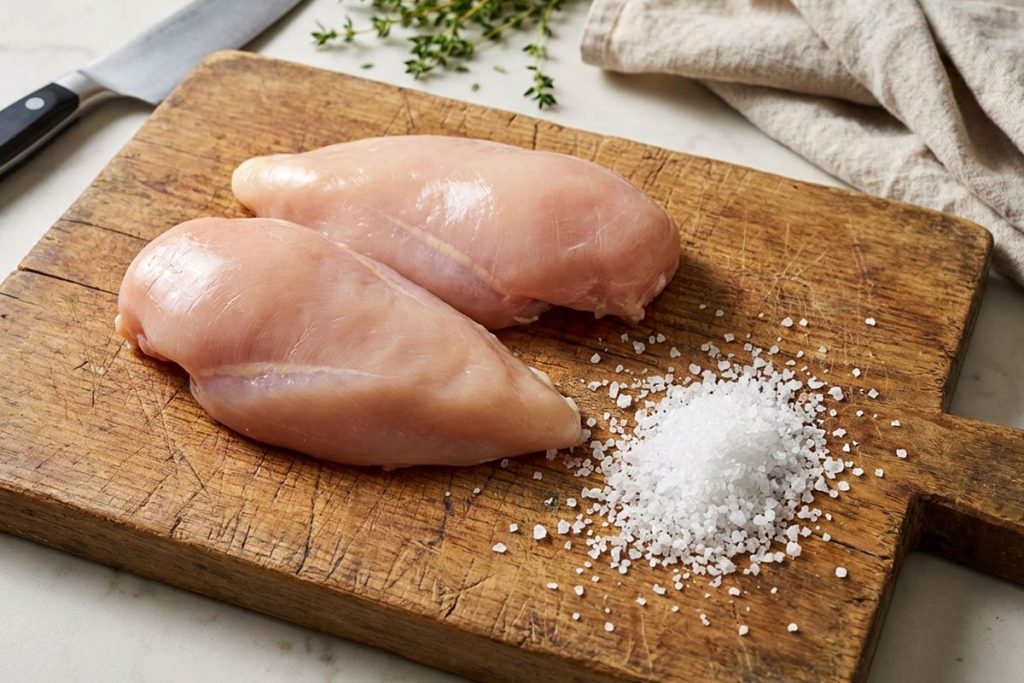
Mastering meat brining mechanics separates dry, leathery roasts from succulent culinary triumphs that carve like softened butter. Every cook has endured the heartbreak of pulling a golden Thanksgiving turkey or a thick pork loin from the oven, only to find the interior chalky and stripped of moisture. We instinctively blame the heat, cursing our oven thermometers or a five-minute delay in checking the meat. The true culprit, however, sits much deeper within the cellular architecture of raw animal muscle. Without the proper biochemical intervention before cooking begins, heat relentlessly wrings moisture out of protein fibers like water from a twisted washcloth.
Understanding meat brining mechanics requires looking beneath the pink surface into the microscopic bundle of myofilaments that make up raw flesh. Animal muscle consists of roughly seventy-five percent water, bundled neatly inside long, tubular muscle cells surrounded by protective protein sheaths. The bulk of that water does not float around loosely. It remains trapped by capillary forces within the tight lattice formed by structural proteins, predominantly actin and myosin. When thermal energy hits these proteins during roasting or grilling, they begin to denature, uncoiling from their stable native structures and coagulating into dense, tangled knots. As these knots tighten, the physical space between protein filaments shrinks dramatically, squeezing trapped moisture out into the roasting pan where it evaporates into thin air.
The microscopic tug of war inside raw muscle tissue
Lean cuts such as turkey breast, chicken cutlets, and center-cut pork chops suffer the most from this thermal contraction. Unlike beef chuck or pork shoulder, these lean cuts lack heavy deposits of intramuscular marbling and gelatin-rich connective tissues that can lubricate contracting fibers. When lean muscle hits temperatures above sixty degrees Celsius, the myosin filaments tighten their grip, followed shortly by the contraction of actin filaments around sixty-six degrees Celsius. At this critical threshold, untreated meat can lose nearly twenty to thirty percent of its total starting weight entirely in expelled water.
This is where physical chemistry becomes the cook’s most potent ally. Introducing common salt, sodium chloride, fundamentally restructures this thermal trap. When salt dissolves across the moist exterior of raw meat, it dissociates into positively charged sodium ions and negatively charged chloride ions. These tiny charged particles are small enough to slip through the cellular matrix of the meat. As they migrate inward, they initiate an extraordinary biochemical transformation that alters both the charge balance and the physical geometry of the meat’s structural proteins.
How dissolved ions rewrite the laws of culinary moisture
For decades, popular kitchen lore claimed that brining works through basic osmosis, pulling water inward across cell walls. In truth, culinary biochemists who study meat brining mechanics discovered that simple osmosis tells only half the story. If osmosis were the primary mechanism, water would initially rush out of the meat toward a salty liquid bath, leaving the cells dehydrated. The real magic stems from electrical charges and protein solubility. Chloride ions possess a strong negative charge that readily binds to the positively charged amino acid groups lining the myosin filaments. As chloride ions accumulate along the protein strands, adjacent filaments suddenly carry identical negative electrical charges.
Basic physics dictates that like charges repel. The densely packed protein filaments, which once sat crammed against each other, suddenly push apart. This microscopic expansion creates physical voids within the protein matrix, dramatically expanding its capacity to hold water. Simultaneously, the salt ions disrupt the cross-linking bonds that hold the myofibrils rigid. The ends of the filaments partially dissolve and untangle, forming a delicate, water-binding gel. When heat subsequently hits this altered matrix, the loosened proteins cannot contract into the tight, moisture-wringing knots characteristic of untreated meat. The meat retains up to ten percent more of its native weight after roasting, translating directly to unparalleled juiciness on the carving board.
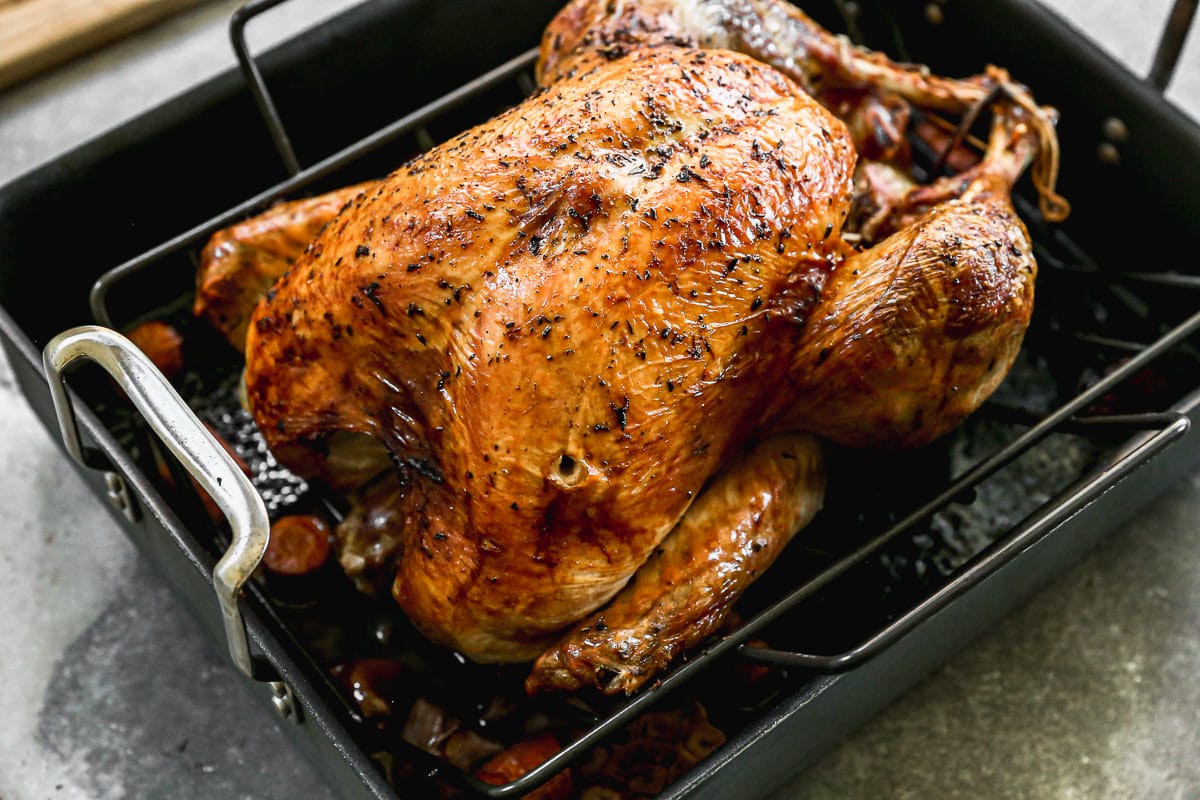
Four proven rules that optimize every home brining session
Applying meat brining mechanics successfully in a home kitchen requires abandoning guesswork in favor of predictable physical laws. You do not need commercial laboratory equipment to harness cellular hydration, but you must respect the kinetics of salt diffusion and fluid equilibrium.
Calibrate salt concentration by total weight rather than liquid volume
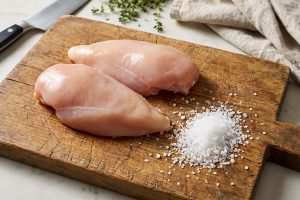
Traditional wet brining recipes frequently call for arbitrary ratios such as one cup of kosher salt per gallon of water. This approach is notoriously unreliable because different salt brands vary wildly in crystal size and density; a cup of Morton kosher salt contains nearly twice the sodium chloride of a cup of Diamond Crystal kosher salt. Modern culinary science resolves this problem through equilibrium brining. Weigh your raw cut of meat, add the exact weight of water required to submerge it, and calculate one to one-and-a-half percent of that combined mass in pure salt. By measuring total weight rather than volume, you establish a finite, predictable ceiling for sodium absorption. The meat reaches absolute equilibrium with the surrounding liquid and can never become excessively salty, even if left submerged overnight.
Allow adequate diffusion time for deep cellular penetration
Salt ions do not race through dense muscle tissue; they creep forward millimeter by millimeter according to Fick’s laws of diffusion. Surface salting an hour before cooking will certainly season the outer few millimeters and enhance exterior browning, but it leaves deep muscle fibers completely unchanged. Much like how studying sprint acceleration mechanics and 4 proven rules that produce blistering speed reveals that force production matters far more than frantic foot speed, salt penetration depends entirely on steady concentration gradients rather than hasty surface exposure. For a typical chicken breast, complete penetration requires roughly two to four hours. A thick bone-in pork roast demands twelve to eighteen hours, while a whole twelve-kilogram holiday turkey necessitates a full twenty-four to forty-eight hours of steady refrigerated resting to ensure that ions reach the center bone.
Prioritize dry brining over wet submersion for crisp poultry skin
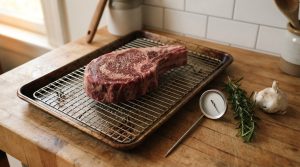
Modern advocates of meat brining mechanics frequently point out that submerged poultry absorbs excessive liquid, often up to ten percent extra plain water. While that extra water ensures extreme juiciness, it wreaks havoc on poultry skin. Water trapped within dermal layers must boil off entirely before the skin can exceed one hundred degrees Celsius to begin browning. By dry brining—sprinkling one percent of the meat’s weight in salt directly onto the dry exterior and resting it uncovered on an elevated wire rack in the refrigerator—you harness natural moisture without waterlogging the skin. The salt initially draws a droplet of water out via osmotic pressure, dissolves in that bead to form a hyper-concentrated brine, and then diffuses back into the deep interior. The circulating cold air of the refrigerator dehydrates the surface skin to parchment-like thinness, guaranteeing shatteringly crisp crackling while the interior meat stays thoroughly saturated.
Factor in ambient temperature to preserve protein integrity
Brining must always occur strictly between zero and four degrees Celsius. Warm environments not only invite rapid microbial proliferation but also alter the rate at which proteins denature. If meat sits in a salty solution at room temperature, enzymatic breakdown accelerates unchecked, degrading the outer muscle layers into an unappealing, mushy paste before the core receives sufficient sodium ions. Cold temperatures keep the muscle filaments taut and structurally sound while the chloride ions steadily perform their electrostatic loosening. Keep your brining vessel buried deep inside the refrigerator rather than sitting on a door shelf where temperatures fluctuate whenever the fridge opens.
The real science separating wet brining from surface salting
Home cooks frequently debate whether submerging a cut in seasoned water offers any real advantage over dry salting. The answer lies in the interaction between aromatic flavor molecules and cell membranes. Salt ions are tiny; they penetrate muscle with relative ease. Aromatic compounds from bay leaves, peppercorns, garlic, and citrus peels, however, consist of large organic molecules that are completely incapable of passing through intact muscle tissue. When you make an elaborate, heavily spiced wet brine, virtually none of those complex flavor compounds penetrate past the first millimeter of meat. You expend significant energy boiling, cooling, and seasoning gallons of water only to discard the fragrant aromatics down the drain.
Furthermore, wet brining inevitably dilutes pure poultry or pork flavor. The water taken up during submersion is tasteless moisture. When you bite into wet-brined meat, the initial sensation is undeniably juicy, but sensory evaluations documented in Exploratorium science of meat cooking research demonstrate that tasters consistently rate dry-brined meats as possessing a deeper, richer, and far more concentrated savory profile. Dry brining preserves the animal’s natural cell sap while restructuring protein bonds to hold onto existing rich juices. Wet brining remains useful primarily for lean, thin cuts like shrimp or thin pork cutlets that spend only thirty minutes in liquid, or for commercial processing where extra water weight yields higher financial returns.
Mastering kitchen heat management after the salt work is done
Even the most meticulous execution of meat brining mechanics can be undone by careless oven management. Brining raises the moisture threshold of animal proteins, effectively widening your margin of culinary error, but it cannot defy the laws of extreme heat. If you blast a brined roast past seventy-five degrees Celsius internal temperature, the structural proteins will eventually collapse and squeeze out their bound moisture regardless of how many chloride ions are present.
Treat brining as one half of a unified cooking system. Pair proper salting with low-temperature cooking, such as reverse-searing or gentle roasting at one hundred and twenty degrees Celsius. Gentle convective heat brings the interior up to the target temperature gradually, allowing proteins to settle into their relaxed, water-holding configuration without violent thermal shock. When the core reaches the desired doneness, remove the meat from the heat and allow carryover cooking to conclude naturally. Because the salt has dissolved the rigid filament cross-links, resting brined meat allows free water to re-distribute evenly across the muscle bundle. As the roast cools slightly, internal pressure drops, the protein gel stabilizes, and every droplet of savory, seasoned liquid remains locked securely inside where it belongs.