Emulsion sauce mechanics and 4 proven rules that eliminate disastrous broken sauces
A broken sauce feels like sudden culinary betrayal, but liquid chemistry obeys strict physical laws. Here is how fat, water, and mechanical shear interact to create velvety stability every single time.
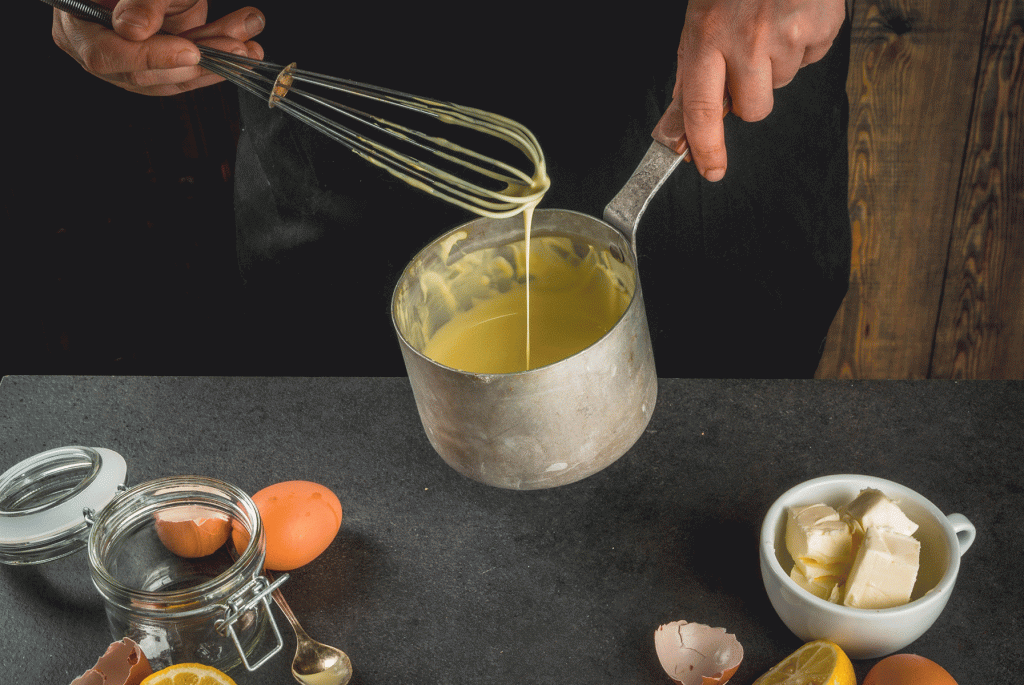
Understanding emulsion sauce mechanics changes everything you know about what happens inside a saucepan. Few kitchen failures deliver the gut-punch disappointment of an emulsion that suddenly collapses into an oily, curdled slick. You stand over a saucepan watching velvety hollandaise or glossy pan gravy disintegrate into greasy yellow liquid floating atop grainy sludge. Most home cooks blame bad luck, an inaccurate burner knob, or a momentary distraction. In reality, the sauce did not fail out of spite. It failed because it reached a predictable thermodynamic breaking point.
Sauces like mayonnaise, beurre blanc, aioli, and classic pan pan-reductions are not single liquids. They are colloidal suspensions consisting of two mortal chemical enemies: water and fat. Under normal circumstances, thermodynamic equilibrium demands that oil molecules cluster together to minimize contact with polar water molecules. Forcing these hostile substances into a harmonious, creamy liquid requires energy, mechanical division, and precise molecular scaffolding.
The invisible colloidal warfare happening inside your skillet
The heart of emulsion sauce mechanics lies in thermodynamic hostility. Water molecules are polar dipoles held tightly together by strong hydrogen bonds. Lipids, whether derived from rendered animal fat, olive oil, or clarified butter, are nonpolar hydrocarbons. Drop olive oil into warm water, and the water molecules pull tightly toward one another, physically squeezing the oil droplets aside. The oil floats to the surface because coalescing into a single uniform sheet requires far less energy than remaining scattered throughout the aqueous phase.
To produce an emulsion, you must actively fight this thermodynamic imperative. Culinary emulsions come in two basic formats: oil-in-water or water-in-oil. In nearly all savory kitchen applications, from pan gravies to classic French mother sauces, cooks construct an oil-in-water emulsion. The water, stock, wine, or vinegar serves as the continuous phase, meaning it forms the liquid matrix. The lipid acts as the dispersed phase, shattered into billions of microscopic droplets trapped within that matrix.
When the dispersed droplets are sheared down to diameters smaller than five to ten microns, their surface area increases exponentially. At this microscopic scale, the physical drag of the surrounding liquid counteracts gravity and buoyancy. The sauce turns opaque and thickens because these crowded droplets physically bump against each other, impeding the flow of liquid. If you understand this molecular battle, you stop guessing and start manipulating the physics of your skillet deliberately.
The physics of droplet dispersion and mechanical shear
When studying emulsion sauce mechanics on a kinetic level, you realize that passive mixing is completely useless. Merely stirring melted butter into warm vinegar with a wooden spoon creates an unstable mixture that separates within fifteen seconds. What transforms loose fats and liquids into a stable culinary colloid is mechanical shear stress.
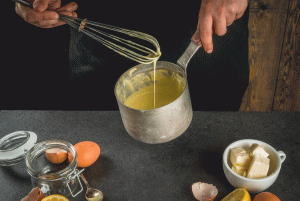
Shear force occurs when adjacent layers of fluid move at different speeds. As the fine tines of a balloon whisk or the spinning blades of an immersion blender tear through the mixture, they produce velocity gradients. The liquid near the whisk wire moves violently, while the surrounding liquid resists. This shearing force pulls spherical fat globules into elongated cylinders until surface tension destabilizes them, causing them to snap into tinier spheres. The more kinetic energy you transfer into the sauce during the initial blending phase, the smaller those droplets become.
Smaller droplets mean a exponentially higher surface-area-to-volume ratio. This dramatic expansion of surface area requires surrounding water molecules and emulsifying agents to coat each droplet immediately. If droplet creation outpaces the availability of emulsifiers or continuous liquid, the bare fat surfaces collide and instantly fuse. This catastrophic fusion process, known to food scientists as coalescence, is the structural origin of every broken sauce.
Four foundational mechanics that guarantee silky and stable sauces
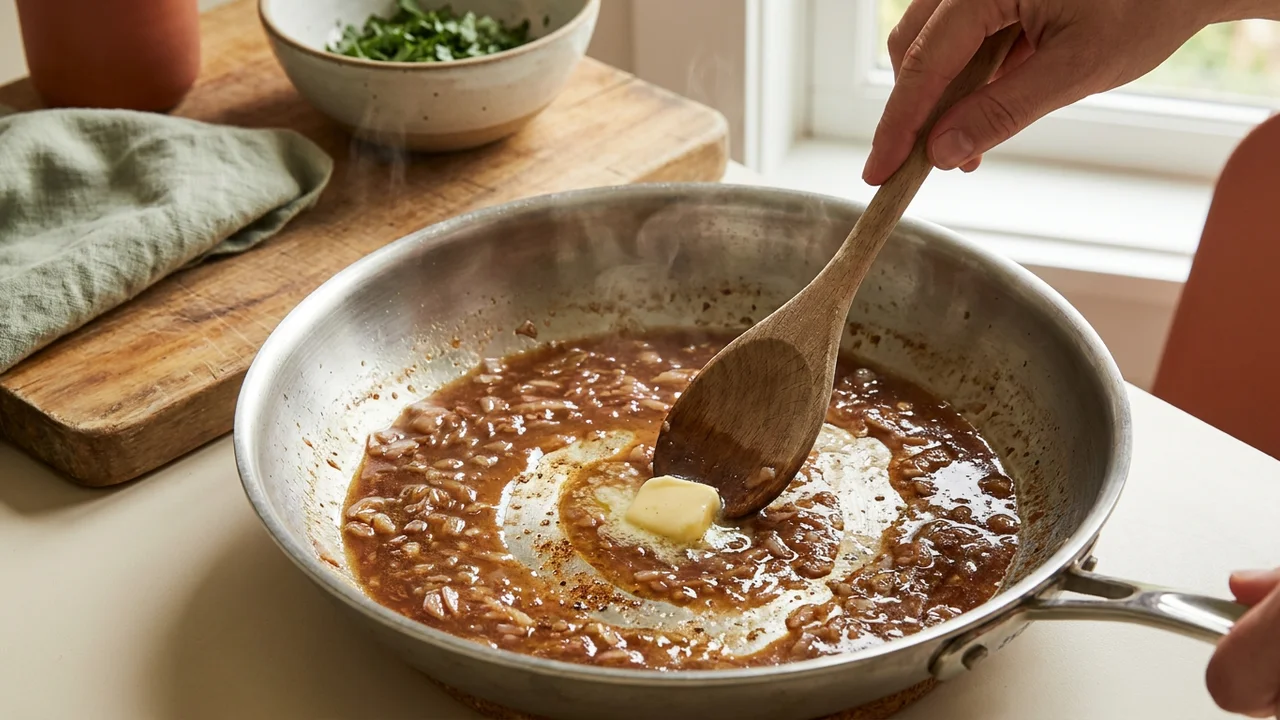
These four operational principles demystify everyday emulsion sauce mechanics into repeatable culinary science. By mastering how continuous volumes, shear inputs, thermal corridors, and surfactant molecules interact, you eliminate panic from your cooking repertoire.
Rule 1 Respect the critical volume threshold of the continuous phase
A frequent error occurs before heat is even applied: attempting to disperse a massive volume of oil into an inadequate reservoir of water. Every emulsion has a strict packing limit. In physical chemistry, spherical droplets packed together into a rigid lattice reach maximum close-packing density at roughly seventy-four percent of the total volume. If fat exceeds this critical volume fraction without sufficient continuous liquid to separate the droplets, the structure undergoes phase inversion.
Phase inversion flips the emulsion on its head. Suddenly, the oil becomes the continuous medium, and the water coalesces into microscopic droplets. When this happens during the preparation of a pan sauce or mayonnaise, the entire structure shatters into an unappealing, greasy puddle. To maintain structural integrity, your continuous aqueous phase must account for at least twenty to thirty percent of the final volume. If you plan to incorporate one cup of butter into a pan reduction, you need at least two to three tablespoons of flavorful liquid, such as reduced wine or fortified stock, acting as your continuous reservoir.
Rule 2 Match shear velocity to liquid viscosity
Applying kinetic energy requires tactical pacing rather than brute strength. At the start of an emulsion, when only a few drops of fat sit in the aqueous base, the viscosity of the liquid is very low. Low-viscosity liquids cannot transmit shear stress effectively because they offer almost no internal friction. If you dump a cup of melted butter into a thin reduction all at once, your whisk merely sloshes liquid around without shearing the fat.
You must introduce the dispersed phase drop by drop while whisking at maximum velocity. Each droplet must be fully shredded and coated before the next arrives. Just as athletic performance relies on kinetic chains and sequential force transfer—an idea explored in our guide on tennis serve mechanics and 4 proven rules that unleash effortless power—building an emulsion requires synchronized physical exertion where wrist leverage, whisk cadence, and kinetic energy shear fat droplets into microscopic suspension. As more droplets enter the continuous phase, the sauce thickens. Once that internal resistance builds, the higher viscosity helps tear subsequent fat additions apart, allowing you to pour in a steady, thin stream.
Rule 3 Manage the tight thermal safety corridor
Temperature sensitivity is where emulsion sauce mechanics frequently penalize uncalibrated heat control. Temperature alters the viscosity of liquids, the rigidity of interfacial molecular films, and the physical state of the dispersed fat. In butter-based sauces like hollandaise, béarnaise, and beurre blanc, stability exists only within an unforgiving thermal corridor between 120 and 145 degrees Fahrenheit.
If the pan drops below 110 degrees, the saturated fatty acids in butter begin to crystallize. Sharp fat crystals pierce the delicate interfacial membranes protecting the droplets, causing rapid coalescence once the sauce warms back up. Conversely, if your pan temperature climbs above 155 degrees, egg yolk proteins or dairy milk solids denature irreversibly. When these proteins contract and coagulate, they squeeze out trapped water through syneresis, leaving the fats free to separate. Controlling heat requires moving the pan on and off the flame rhythmically while relying on pan thermal mass rather than direct heat spikes.
Rule 4 Deploy amphiphilic molecular anchors at the right moment
Mechanical shear breaks fat into tiny droplets, but mechanical force alone cannot keep them apart permanently. Without an interfacial stabilizer, surface energy will eventually cause the droplets to merge. This is where surfactants and amphiphilic molecules step into the molecular architecture. An amphiphilic molecule features a dual chemical personality: a hydrophilic head that bonds with water and a hydrophobic tail that buries itself into fat.
Lecithin found in egg yolks is the culinary world's premier surfactant, but it is far from the only tool available. The mucilage in prepared mustard, the gelatin extracted from slow-simmered connective tissue, the casein proteins in dairy, and the polysaccharidic starches in garlic all function as structural stabilizers. When introduced to the continuous phase prior to fat addition, these molecules orient themselves at the boundary layer between oil and water. They create an electrostatic and steric barrier that prevents fat droplets from fusing, even when they collide during agitation.
How to diagnose and resurrect a split emulsion before service
Troubleshooting is an inescapable rite of passage when putting emulsion sauce mechanics to the test under real kitchen conditions. When an emulsion splits, your senses immediately signal the failure: the surface loses its satin sheen, tiny beads of fat accumulate at the pan rim, and the body thins out abruptly. Panicking cooks often throw the pan into the sink, assuming the ingredients are ruined. In truth, the chemical components are still present and intact; they have simply disorganized.
Diagnosing the failure mode dictates the repair. If the sauce separated due to evaporative water loss, the remedy is deceptively simple. Take the pan off the heat, add a single tablespoon of cool water or stock, and whisk vigorously. Reintroducing water instantly restores the necessary volume fraction of the continuous phase, giving the crowded fat droplets room to re-suspend.
If the sauce broke because of thermal shock or excessive fat loading, you must establish a fresh continuous phase in a clean pan. Add a teaspoon of warm water, stock, or a fresh egg yolk to the new vessel. Take your broken, separated mixture and treat it as raw fat. Whisking continuously, dribble the broken sauce into the fresh base drop by drop. The newly available surfactants and base volume immediately re-emulsify the shattered components, saving your sauce without altering its core flavor profile.
The sensory rewards of total emulsion mastery
Internalizing true emulsion sauce mechanics gives you instinctual mastery over every sauce, vinaigrette, and pan reduction you will ever cook. As detailed in the Exploratorium science of culinary sauces and emulsions, texture is not merely a tactile backdrop; it is an active flavor delivery system. When fats remain trapped in microscopic spheres, they coat the tongue evenly, releasing volatile aromatic compounds gradually rather than overwhelming the palate in a single greasy wash.
Great cooking rarely depends on exotic ingredients or mysterious kitchen folklore. It depends on understanding the basic physical laws governing how matter behaves under heat and mechanical force. When you pick up a whisk, you are orchestrating a controlled colloidal reaction. Respect the continuous phase, calibrate your shear, protect your thermal boundary, and leverage your molecular stabilizers. Once those mechanics become second nature, a broken sauce becomes an impossibility.