Emulsion sauce mechanics and 4 proven rules that prevent disastrous kitchen breaks
A broken sauce feels like sudden kitchen betrayal, but culinary stability is governed by exact physics rather than luck. Unpack the thermodynamic rules and molecular behaviors that guarantee a silky, permanent emulsion every time.
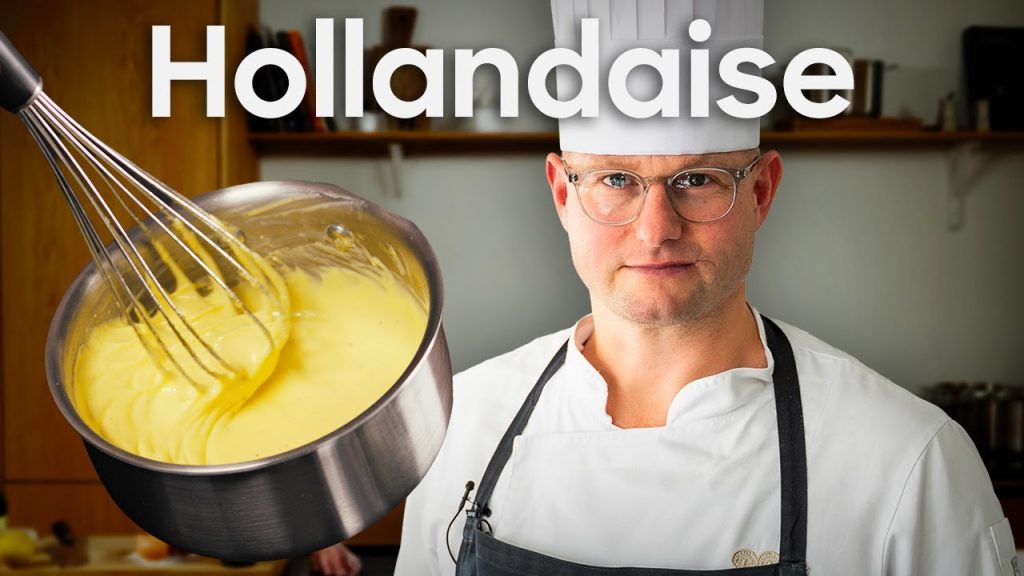
Understanding emulsion sauce mechanics separates timid line cooks who dread curdled hollandaise from confident culinary masters who command glossy, velvety pan sauces at will. Few kitchen failures deliver the gut-punch humiliation of a broken sauce. You watch an opulent, satiny ribbon suddenly shear into a curdled, greasy lake of separated fat and cloudy liquid. Most home cooks chalk this catastrophe up to bad luck, humidity, or a momentary lapse in whisking speed. The truth is far more liberating. Liquid mixtures do not misbehave out of spite. They obey unyielding laws of fluid dynamics, molecular chemistry, and thermodynamic energy.
An emulsion is fundamentally an unnatural peace treaty brokered between two sworn chemical enemies: water and lipid fats. Under ordinary conditions, water molecules cling tightly to one another through strong hydrogen bonds, effortlessly squeezing nonpolar fat molecules out of their cluster. Forcing these reluctant antagonists into an intimate, stable suspension requires more than sheer wrist endurance. It demands an appreciation of interfacial tension, surfactant packing, and kinetic shear.
The Physics of Suspended Chaos Between Water and Oil
At its core, the study of emulsion sauce mechanics reveals an ongoing battle against basic physical thermodynamics. When you pour oil into water, the system seeks its lowest possible energy state. Because contact between hydrophobic oil molecules and hydrophilic water molecules requires energy to sustain, the liquids minimize their surface area by separating into two distinct layers. Creating a sauce requires doing mechanical work against this natural tendency, forcing the oil to shatter into billions of microscopic droplets suspended throughout the water phase.
In culinary terminology, the water or acid base represents the continuous phase, while the fat serves as the dispersed phase. As long as those fat droplets remain microscopic and physically isolated from one another, light refracts through the matrix to produce an opaque, satiny appearance. The liquid takes on a rich, viscous body because the tightly packed spheres bump against one another, impeding the natural flow of the liquid. The moment these suspended spheres collide with enough kinetic energy to merge, a process known as coalescence begins. A few merged droplets rapidly snowball into catastrophic phase separation, leaving you with an unappetizing puddle of melted grease.
The stability of this fragile suspension rests on droplet size. Smaller droplets mean greater total surface area, which requires more structural stabilization but yields a vastly more durable sauce. Coarse whisking produces droplets measuring roughly fifty micrometers across, creating a loose mixture on the brink of collapse. Intense shear forces from an immersion blender or a high-velocity wire whip can reduce those droplets to less than two micrometers. According to foundational Institute of Food Technologists food science research, reducing droplet diameter dramatically slows the rate of gravitational separation, turning an otherwise volatile mixture into an enduring architectural marvel.
The Molecular Mediators That Hold Liquids Together
Mechanical force alone cannot keep oil droplets apart indefinitely. Left to their own devices, even the finest micro-droplets eventually bump, merge, and separate. This is where emulsion sauce mechanics depend entirely on amphiphilic molecules—compounds possessing dual affinities. These molecules feature a water-soluble polar head and a fat-soluble hydrocarbon tail. They act as molecular bridges, positioning themselves at the delicate boundary where oil meets water.
In classical saucemaking, egg yolks serve as the ultimate treasure trove of natural emulsifiers. The most famous player is lecithin, a phospholipid whose charged phosphate head submerges happily into the surrounding water while its fatty acid tails anchor deep inside the oil droplet. Yet lecithin does not work alone. Vitellin and other low-density lipoproteins within the yolk unfold at the interface, forming a resilient, viscoelastic blanket around each fat sphere. This mechanical cushion generates electrostatic repulsion, physically batting away neighboring droplets whenever Brownian motion pushes them together.
Other traditional kitchen staples rely on alternate molecular mediators. In a classic vinaigrette, the mucilage and complex polysaccharides in prepared mustard create steric hindrance, physically blocking oil droplets from touching. In a delicate beurre blanc, milk proteins—specifically caseins—act as the stabilizing shield that prevents melted butter fat from consolidating. Understanding which mediator you are relying upon determines the precise boundaries of temperature, salinity, and acidity your sauce can tolerate before structural collapse becomes inevitable.
Essential Rules for Bulletproof Emulsion Stability
When you master practical emulsion sauce mechanics, you stop treating sauce making as an unpredictable gamble and approach it as controlled structural engineering. Whether you are whipping a batch of garlicky aioli by hand or building an ephemeral pan sauce over an open flame, the same kinetic and thermal principles dictate the outcome. Committing four foundational rules to memory will protect your creations from sudden disaster.
Master the Dispersed Phase Introduction Rate
The earliest moments of building an emulsion are the most dangerous. Novice cooks often pour oil or clarified butter too quickly into their base, overwhelming the continuous phase before a stable suspension can form. When free fat floods the bowl faster than the existing surfactant can coat it, the oil droplets pool together instantly, triggering immediate inversion where water becomes trapped within fat instead of the reverse.
Begin by introducing your fat drop by single drop. Whisk vigorously after each tiny addition until the fat vanishes completely into the liquid matrix. This meticulous start establishes billions of tiny nucleation sites. Once you observe the mixture thickening noticeably and shifting to a pale, glossy sheen, the emulsion has successfully taken root. At this stage, you can gradually increase the pour to a steady, pencil-thin stream, confident that the existing droplet architecture will absorb and divide the incoming fat with ease.
Regulate Thermal Thresholds to Protect Protein Bridges
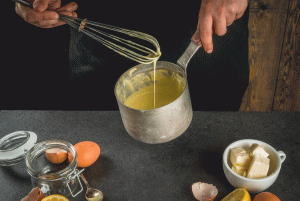
Temperature dictates both the fluidity of fats and the physical integrity of protein emulsifiers. In warm sauces like hollandaise or béarnaise, heat is a double-edged sword. Warmth softens butter into a liquid state and encourages egg yolk proteins to unfold and coat oil droplets. However, push the temperature past sixty-five degrees Celsius, and those delicate yolk proteins undergo irreversible thermal coagulation. Instead of forming an elastic film at the liquid boundary, they clump into firm curds of cooked egg, dropping the fat from their grip.
Conversely, cold temperatures present their own hidden traps. If the butter fat in a pan sauce drops below its solidifying threshold around twenty-eight degrees Celsius, the fat crystals seize, puncturing the delicate surfactant envelope and expelling the continuous phase. Just as reading high-stakes political momentum demands recognizing subtle undercurrents before an outcome is locked—much like examining how Michelle Tafoya Faces 4 Crucial Shifts in a Tight Minnesota Senate Clash illustrates the danger of ignoring environmental volatility—a saucier must heed the early warning signs of thermal fatigue before an emulsion shatters beyond repair. Keep your sauce comfortably warm to the touch, hovering between fifty and fifty-eight degrees Celsius, where proteins remain pliable and fats stay fluid.
Maintain Sufficient Continuous Phase Volume
A fundamental blind spot in emulsion sauce mechanics is ignoring the sheer volume of the continuous phase relative to the fat. It seems counterintuitive, but adding more oil actually makes an emulsion thicker, while adding water thins it out. As you pack more microscopic oil spheres into the bowl, they crowd so tightly against one another that the sauce loses mobility. If the volume of the dispersed fat exceeds roughly eighty percent of the total volume, there is simply not enough water left to coat the spaces between spheres.
When an emulsion becomes excessively stiff, tacky, or dull in appearance, it is crying out for hydration. Starving the continuous phase leads directly to catastrophic phase inversion. The remedy is simple: whisk in a tablespoon of warm water, lemon juice, or flavorful stock the moment your sauce begins to look unyielding or oily around the rim. Restoring the aqueous reservoir instantly relaxes the crowded spheres, lowering interfacial tension and granting the matrix the capacity to absorb substantially more fat.
Apply High Shear Kinetic Energy from the First Drop
Stirring is not the same as shearing. A gentle, circular paddle motion merely moves oil globules around the bowl in lazy orbits without tearing them apart. To create microscopic droplets that resist coalescence, you must generate intense elongational shear. This occurs when adjacent layers of liquid travel at radically different velocities, physically stretching an oil droplet until it snaps into tiny spheres.
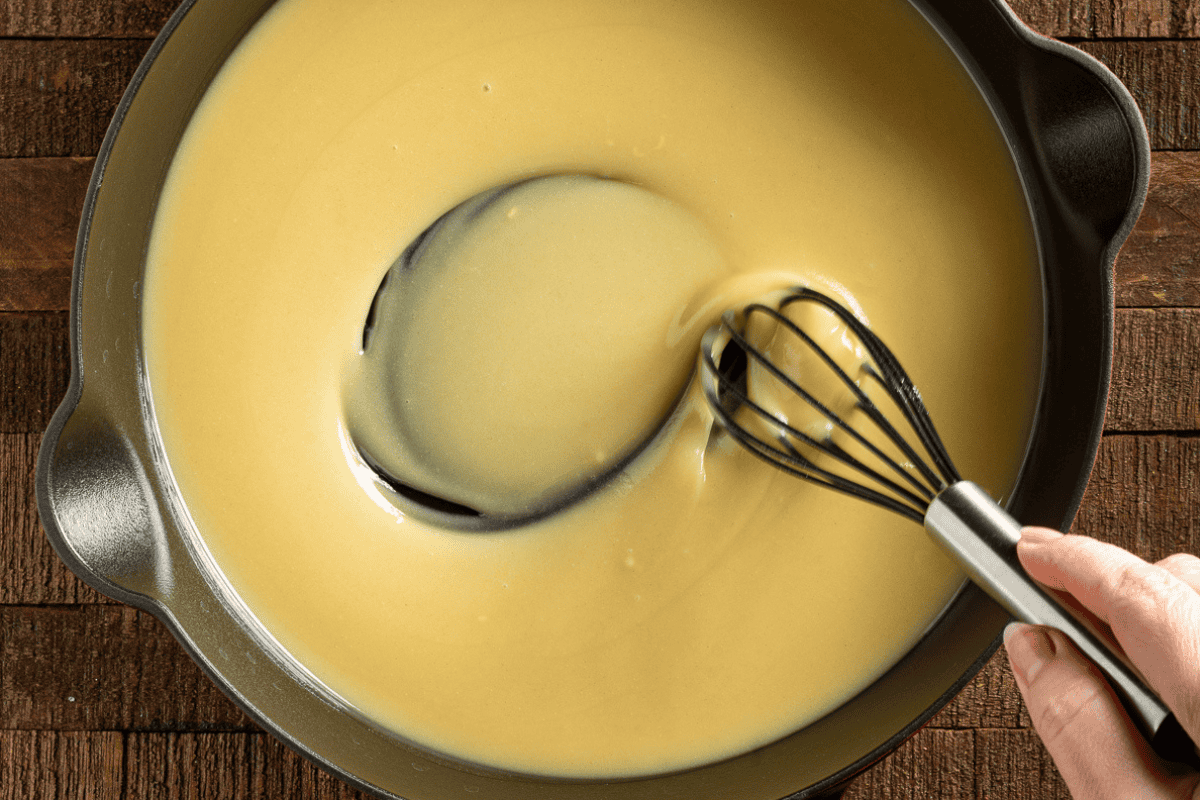
When using a wire balloon whisk, use a rapid side-to-side snapping motion across the widest diameter of the bowl rather than a circular swirl. This forces the liquid through the narrow wire tines at maximum velocity, generating the turbulent shear necessary to smash oil droplets apart. If you choose mechanical assistance like an immersion blender or food processor, position the spinning blade directly at the interface where the liquids meet. The vortex pulls the oil through microscopic tolerances at thousands of revolutions per minute, establishing an ultra-fine, velvety matrix in seconds.
Diagnosing and Rescuing a Collapsing Culinary Matrix
Even seasoned culinary professionals occasionally push an emulsion past its breaking point. The secret to kitchen confidence lies in recognizing the warning signs before total collapse occurs. Long before an emulsion fully splits, it communicates distress. It loses its satiny, light-refracting sheen and takes on a greasy, semi-translucent cast. A greasy film starts sweating around the edges of the bowl, and the rhythmic drag on your whisk changes from a supple, velvety resistance to a loose, watery slide.
When a sauce begins to separate, applying fundamental emulsion sauce mechanics provides an immediate roadmap to salvation rather than panic. Stop adding fat immediately. If the sauce has broken due to dehydration or excessive crowding of droplets, whisking in a single tablespoon of boiling water can instantly reconstitute the continuous phase, coaxing the separated fat back into suspension through rapid thermal and kinetic re-shearing.
If the emulsion has completely inverted into a curdled mess of grease and water, a mechanical reset is required. Place a single fresh egg yolk or a teaspoon of Dijon mustard into a clean, warm bowl alongside a splash of water. Begin whisking vigorously while treating your broken sauce as if it were pure oil. Drizzle the broken mixture into the new base drop by drop. The fresh surfactants and pristine continuous phase will capture the liberated fat droplets, systematically rebuilding a silky, indestructible suspension from the ruins of the failed attempt.
Professional Habits That Cultivate Silky Textural Mastery
Achieving legendary consistency across sauces comes down to building sensory awareness and respecting your workspace ergonomics. Stabilize your mixing bowl on the countertop using a damp kitchen towel rolled into a tight donut ring. This frees both hands—one to control the steady, microscopic flow of fat, and the other to drive continuous, high-amplitude shear with the whisk. Without a steady bowl, your whisking stroke degrades into erratic, low-energy splashing that invites instability.
Pay close attention to auditory and tactile feedback while you cook. An emulsion nearing its optimal balance hums with a distinct, wet slapping sound as the whisk cuts through the dense suspension. The drag against your arm should feel cushioned and elastic, signaling that billions of micro-spheres are densely packed without suffocating the aqueous foundation. Internalizing these emulsion sauce mechanics transforms muscle memory into an instinctive dialogue with heat, liquid, and shear force, guaranteeing that every sauce you bring to the table arrives silky, luxurious, and completely unbroken.