Pan sauce mechanics and 4 proven rules that prevent greasy separated sauces
Transform scorched skillet drippings into restaurant-caliber velvet glaze by mastering culinary emulsion physics. Discover how thermal control, gelatin concentration, and mechanical shear eliminate separated, greasy pan sauces forever.
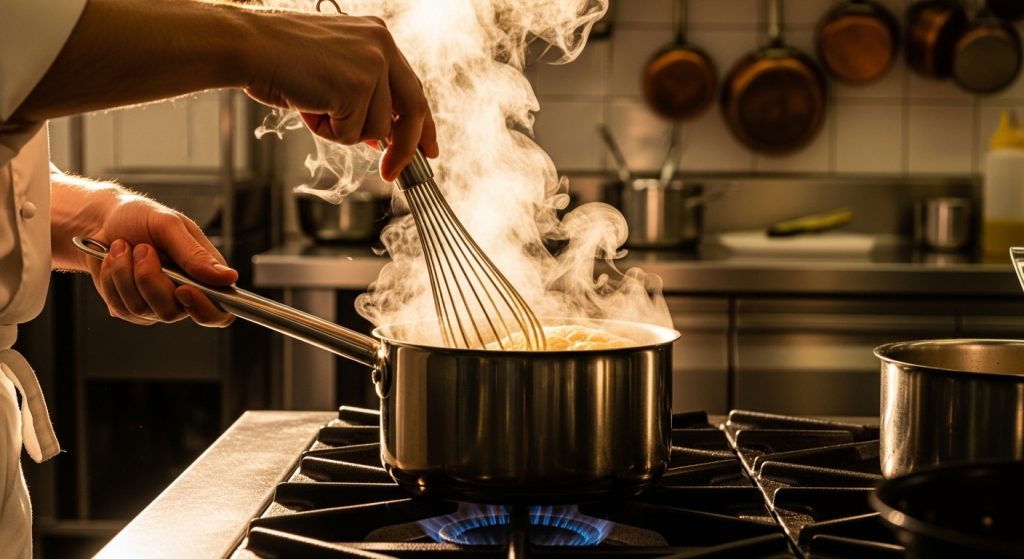
Mastering pan sauce mechanics requires understanding that you are not simply mixing ingredients, you are engineering a high-stakes kinetic emulsion inside hot metal. You sear a dry-brined steak, a duck breast, or a heritage pork chop until it develops an amber crust, transfer the protein to a warm cutting board, and gaze into the skillet. What remains is a landscape of dark, flavorful sediment cemented to the steel, bathed in a shimmering puddle of rendered fat. Too many cooks panic at this junction, either drowning the pan in cold wine while the heat screams, or allowing loose fat to boil into a separated, unappetizing slick. That disappointment is entirely preventable once you decode the underlying molecular choreography.
A great pan sauce is neither an accident nor an obscure craft reserved for Michelin-starred sauciers. It is an exercise in colloidal chemistry. By leveraging thermal shock, controlling the ratio of aqueous to lipid phases, and deploying collagen proteins as structural scaffolds, you can reliably produce a mirror-glazed sauce with a luxurious mouthfeel in less than four minutes. The journey begins by looking past the surface grease and examining what is happening at the metal interface.
The microscopic battle between water fat and gelatin
The dark crust clinging to your cookware is known culinarily as the fond, derived from the French word for foundation. As proteins and carbohydrates in the meat endure searing temperatures between 280°F and 330°F, non-enzymatic browning processes create hundreds of novel flavor compounds. Carbonyl groups from reducing sugars react with amino acids in a cascade of rearrangement reactions, synthesizing savory aromas that do not exist in raw meat. Deeply unpacking pan sauce mechanics reveals that the fond stuck to stainless steel is a goldmine of flavor precursors waiting for thermal extraction.
The dilemma lies in the hostile relationship between water and fat. Lipids are nonpolar molecules, held together by hydrophobic interactions that naturally force them to cluster together and minimize surface contact with polar liquids. Pouring stock or wine into an oily pan will never spontaneously yield a unified sauce. Left to their own devices, water molecules form tight hydrogen bonds with each other, aggressively expelling the oil droplets to create two separate, unappealing layers.
To overcome this natural thermodynamic repulsion, you require a structural intermediary. That mediator is gelatin, the denatured product of triple-helix collagen found in well-crafted bone stocks. Gelatin molecules are long, coiled peptides rich in proline and glycine. When dispersed in hot water, these flexible chains increase the liquid phase viscosity. This mechanical thickness acts as a physical buffer, dramatically slowing the rate at which suspended fat droplets can collide, fuse, and separate. Without sufficient gelatin or an alternative hydrocolloid, your liquid lacks the structural strength to suspend even a thimble of melted butter.
Why extreme thermal energy shatters an emulsion before it can form
Culinary emulsions are kinetic systems in constant motion. Surface tension continually drives microscopic fat spheres toward coalescence. The only force opposing this collapse is the energy barrier provided by viscosity and surface-active proteins. When an amateur cook dumps cold butter into a pan bubbling furiously over a high burner, they inadvertently provide excess thermal energy that overwhelms the stabilizing forces within seconds.
Butter is not a monolithic block of fat. It is an inverted emulsion consisting of roughly 80 to 82 percent milk fat suspended alongside 16 to 18 percent water, stabilized by natural phospholipids and casein proteins. When cold butter encounters extreme heat, its delicate internal water evaporates instantaneously into steam. The natural protein membranes denature and fall apart, freeing the milk fat to merge into a continuous yellow slick. Once free fat dominates the system, the emulsion undergoes a catastrophic phase inversion.
When structural safeguards vanish, systems fail uniformly. Just as a modern economy destabilizes when a Bank Fraud Surge Triggers 4 Critical Alerts from Federal Probes to Global Treaties because underlying transaction protocols disintegrated, a delicate sauce ruptures when thermal volatility overpowers molecular stabilization. This dynamic highlights a central pillar of pan sauce mechanics, where temperature control dictates structural survival.
Four proven rules that guarantee a glossy stable pan sauce
Executing an immaculate pan sauce demands strict adherence to physical boundaries rather than rigid ingredient measurements. By honoring the physics of extraction, reduction, temperature management, and kinetic shear, you can produce a flawless pan sauce with whatever liquids and aromatics you have on hand.
Deglaze only after discarding scorched free fat
The fond stuck to the bottom of your pan contains water-soluble and alcohol-soluble flavor compounds, but the liquid oil floating above it contains almost none. Lingering rendered cooking oil adds dead volume, diluting your sauce and dramatically increasing the risk of greasy separation. Tip your pan over a heatproof bowl and pour off virtually all the loose, clear fat, retaining only the sticky, browned glaze and a microscopic sheen of oil.
Return the pan to medium-high heat and introduce your deglazing liquid, whether dry vermouth, white wine, cider, or aromatic stock. The dramatic temperature gradient between the hot metal and the cold liquid triggers steam cavitation. As the liquid boils aggressively, violent micro-bubbles physically dislodge the denatured proteins from the microscopic pores of the stainless steel. Use a flat-edged wooden spatula to systematically scrape every square millimeter of the metal floor until the skillet gleams clean and the liquid takes on an opaque, amber hue.
Reduce your stock until gelatin concentrates into syrup
Once your deglazing liquid has reduced by three-quarters, cook off the harsh, raw ethanol notes and pour in a rich, gelatin-laden bone broth. At this stage, amateur cooks often make the mistake of adding butter immediately. If your aqueous phase is too dilute, the spatial distance between gelatin peptides is too vast to provide adequate viscosity. You must reduce the liquid until water evaporation drives the gelatin concentration up to roughly 3 to 5 percent by weight.
Watch the surface bubbles carefully. Initially, the bubbles burst rapidly and noisily, behaving like boiling water. As water leaves the pan, the bubbles become smaller, tighter, and burst with a lazy, rhythmic cadence. Dip a metal spoon into the liquid and pull your index finger across the back. The sauce should hold a sharp, clean line without running. Here, practical pan sauce mechanics shifts from chemical extraction to physical rheology.
Cut the flame entirely before mounting cold butter
The classical French technique known as monter au beurre is routinely ruined by leaving the skillet over active flame. To incorporate butter without stripping its protective milk solids, the ambient liquid temperature must remain between 125°F and 140°F (52°C to 60°C). Pull the skillet completely off the heat source or shift it to a dormant back burner for thirty seconds before introducing the fat.
Always use unsalted butter straight from the refrigerator, cut into small, uniform cubes. Cold butter absorbs thermal energy as it transitions from a crystalline solid to a liquid, naturally chilling the surrounding sauce down into the safe emulsion zone. Modern pan sauce mechanics teaches that butter is not merely a flavor finish but a pre-formed emulsion held together by fragile phospholipid envelopes. Adding it cold ensures that these phospholipid envelopes disperse slowly throughout the sauce before the fat globules have an opportunity to merge.
Introduce physical shear force with continuous skillet swirling
Dropping butter cubes into warm liquid and letting them melt quietly produces a film of melted fat on top of your stock. To engineer an emulsion, you must supply mechanical shear force to break down large fat globules into microscopic droplets smaller than five micrometers in diameter.
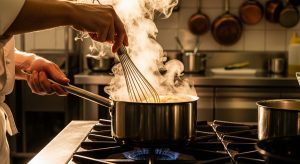
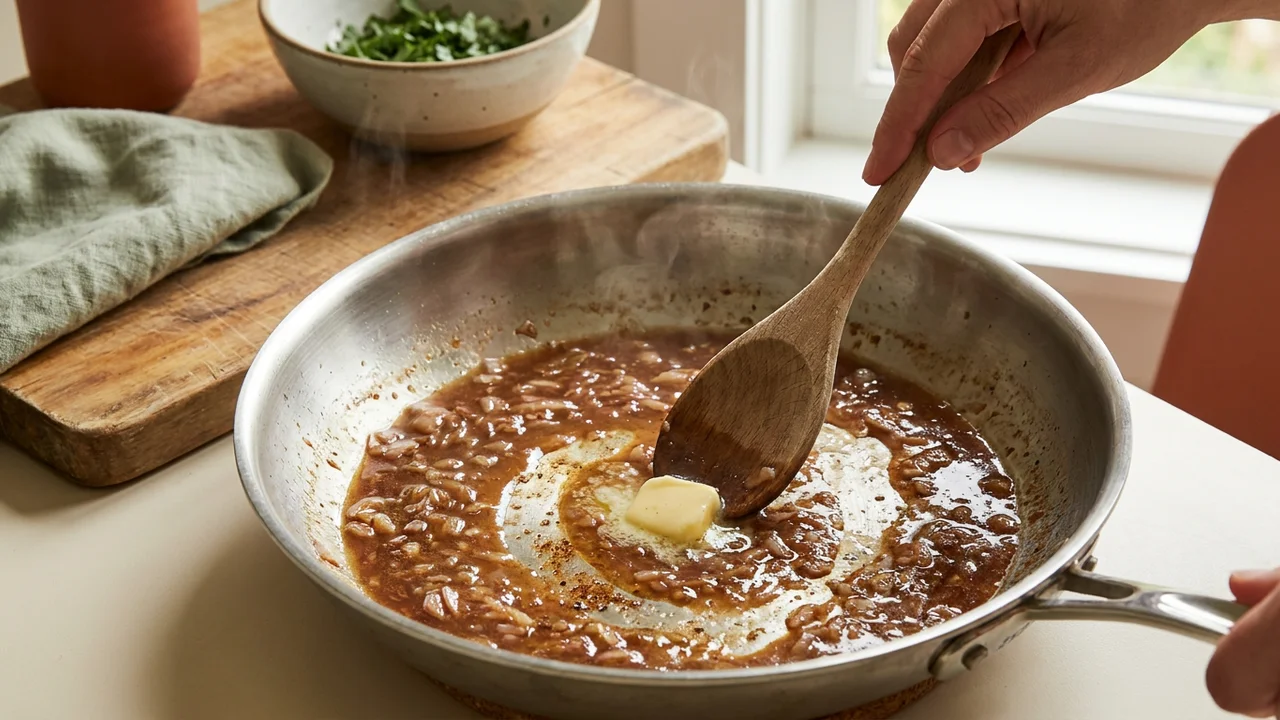
The moment the cold butter cubes hit the warm reduction, initiate an aggressive circular swirling motion with the skillet while simultaneously working with a wire whisk. The friction of the liquid against the sloping curved walls of the pan creates a high-shear vortex. This kinetic agitation pulverizes the melting butter into billions of tiny droplets. Suspended within the viscous gelatin matrix, these micro-droplets refract light uniformly, turning a dark, translucent broth into an opaque, satin glaze that clings gracefully to a spoon.
The emergency triage toolkit for broken pan sauces
Even seasoned culinary veterans occasionally misjudge the thermal mass of a heavy cast-iron or tri-ply pan, resulting in a sudden break where clear yellow grease pools around dark, curdled specks. When an emulsion shatters, dumping it down the sink is an unnecessary waste of expensive ingredients and hours of searing flavor.
Because broken pan sauces almost always fail due to dehydration where the water-to-fat ratio skews too far toward oil, the primary corrective agent is cold moisture. Pull the pan entirely off the stove, add two teaspoons of cold tap water or unreduced stock, and whisk furiously. The cold liquid immediately drops the system below the destabilization threshold while restoring the continuous aqueous phase, allowing the dispersed fat droplets to re-anchor themselves.
If physical agitation and cold water fail to realign the sauce, deploy a biochemical bridge. Whisk in a half-teaspoon of cold Dijon mustard or a splash of heavy cream. Mustard seeds contain natural mucilaginous polysaccharides that dramatically elevate aqueous viscosity, while heavy cream brings an army of pre-homogenized casein micelles and lecithin that readily envelop wayward fat globules. According to American Chemical Society analysis of pan sauce chemistry, these natural emulsifying agents lower interfacial tension between immiscible phases, pulling severed sauces back into cohesive harmony within seconds. When you grasp pan sauce mechanics at the molecular level, a broken sauce is never a lost cause, but merely an emulsion in need of corrective surface-active agents.
Developing the culinary instincts of a professional saucier
Executing an extraordinary sauce does not require measuring cups or laboratory thermometers at the stove. It requires tuning your senses to the shifting physical states inside the skillet. Listen to the audible pitch of the pan change from the sharp, violent hiss of deglazing steam to the quiet, muted murmur of concentrated gelatin. Observe the visual texture of the surface as the glossy, mirror-like sheen appears, signaling that the fat has been successfully dispersed throughout the reduction.
Balance the final emulsion with a measured drop of high-acid liquid, such as fresh lemon juice, sherry vinegar, or minced shallots macerated in wine. Acid cuts through the heavy coat of milk fat on the tongue, refreshing the palate and accentuating the deep umami notes extracted from the fond. Ultimately, intuitive pan sauce mechanics transforms a routine weeknight sear into an effortless masterclass in culinary physics.