Running economy mechanics and 4 proven rules that build unstoppable aerobic speed
Elite endurance athletes do not simply possess larger engines; they waste far less fuel per stride. By mastering elastic recoil and horizontal force transfer, runners can unlock unprecedented speed without increasing cardiovascular strain.

Mastering running economy mechanics separates athletes who crumble under late-race fatigue from competitors who float across the pavement with relentless momentum. For decades, traditional coaching dogma treated oxygen consumption like a simple fuel tank problem. If an athlete wanted to run faster, conventional wisdom dictated that they merely had to expand their aerobic capacity. Yet every weekend at local road races and elite world majors alike, runners with staggering aerobic test scores find themselves outpaced by lighter, crisper competitors who appear barely to be working. The difference lies not in the size of the biological engine, but in the efficiency of the chassis transferring power to the road.
Locomotion is an ongoing negotiation between gravitational pull, structural resistance, and biological tissue. When you watch an accomplished distance runner drift through a sub-five-minute mile, you are not observing sheer muscular exertion. You are watching a tuned biological spring that stores, redirects, and releases kinetic energy with minimal metabolic tax. Understanding how to refine this mechanical conversation transforms training from an exhausting slog into a precise craft.
The Hidden Physics Behind Metabolic Efficiency on Foot
Running economy represents the steady-state oxygen cost required to maintain a given submaximal running velocity. In physiological terms, if two runners share an identical maximum oxygen uptake, the runner who consumes fewer milliliters of oxygen per kilogram of body weight at race pace will almost always reach the finish line first. Long before cardiovascular exhaustion sets in, the subtle architecture of running economy mechanics dictates how much oxygen each stride actually consumes.
Human bipedal running relies heavily on what physicists term the spring-mass model. In this dynamic framework, the entire lower extremity operates as a compliant mechanical spring topped by the body’s center of mass. When your foot strikes the ground, the system compresses, absorbing external impact forces. As the body travels over the stance leg, that compressed biological spring rebounds, hurling the center of mass back into the flight phase. Muscles do not need to contract actively through every millimeter of propulsion if tendons and connective tissues store and return that mechanical energy passively. When tissues execute this cycle cleanly, the cardiovascular system is spared from generating costly metabolic force.
Why Raw Aerobic Capacity Fails Without Mechanical Conservation
Aerobic capacity, measured as VO2 max, merely establishes the upper boundary of what an endurance athlete could theoretically accomplish if every ounce of cellular fuel translated into forward motion. However, raw aerobic ceiling without mechanical efficiency resembles dropping a high-horsepower racing engine into a car with misaligned axles and deflated tires. The engine roars, fuel burns at an alarming rate, but much of that tremendous energy dissipates as friction and heat before ever rotating the drive wheels.
Coaches frequently obsess over maximal oxygen uptake while neglecting running economy mechanics, leaving massive kinetic gains on the table. Every unnecessary centimeter of vertical bouncing, every foot strike that plants too far ahead of the hips, and every rotational twist through the torso represents wasted metabolic currency. That wasted energy must be continuously financed by burning glycogen and demanding elevated heart rates. Over the course of forty thousand strides in a single marathon, even microscopic mechanical inefficiencies accumulate into catastrophic late-stage deceleration. Decades of biomechanical studies published by the National Institutes of Health confirm that movement economy correlates far more tightly with distance running performance among homogeneous elite fields than aerobic capacity alone.
Four Proven Principles That Elevate Stride Efficiency
Transforming running economy mechanics requires moving past generic cues and addressing the physical springs governing human locomotion. By systematically recalibrating how structural tissues interact with the ground, runners learn to preserve momentum rather than fight against it with brute muscular force.
Harnessing Elastic Recoil Through the Achilles Spring
The human Achilles tendon and plantar aponeurosis are biological masterpieces engineered specifically for energy recycling. Unlike muscle fibers, which burn adenosine triphosphate every time they contract, dense connective tissue stores mechanical deformation energy like an industrial coil spring. During the initial ground contact phase, the Achilles tendon stretches under body weight, capturing impact energy through a process known as hysteresis reduction. In elite distance runners, this passive tendon spring accounts for up to fifty percent of the total mechanical work delivered during push-off.
Developing this elastic capacity requires high-rate tendon stiffness rather than extreme muscular flexibility. A tendon that is excessively lax or loose deforms slowly and leaks kinetic energy as ambient heat. Conversely, a tendon with optimal structural stiffness snaps back immediately, flinging the runner forward during terminal stance without requiring significant metabolic effort from the gastrocnemius or soleus muscles.
Eliminating Braking Forces by Landing Under the Center of Mass
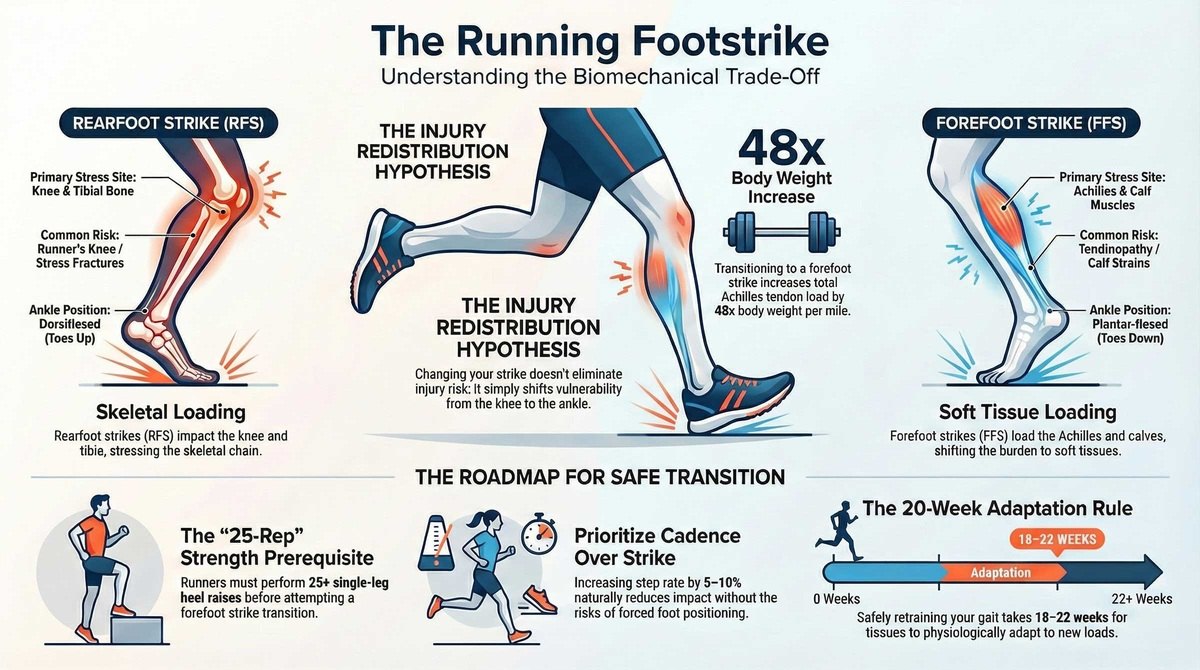
Few mechanical habits destroy momentum faster than overstriding. When a runner reaches forward with the lead foot in an attempt to buy artificial stride length, the heel contacts the ground significantly ahead of the center of mass. This creates an immediate collision force directed backward into the tibia, hip, and lumbar spine. Overstriding creates a catastrophic braking force, which directly degrades running economy mechanics by converting horizontal momentum into jarring vertical spikes.
Efficient runners ensure that foot strike occurs directly underneath a neutral, forward-traveling pelvis. Instead of reaching forward with an open knee angle, the lower leg should actively swing backward just prior to touchdown. This subtle retracting action synchronizes the foot’s velocity with the ground beneath it, transforming ground impact from a harsh collision into a fluid continuation of forward momentum.
Optimizing Cadence to Suppress Destructive Muscle Oscillations
Every time a foot slams into the asphalt, impact shock waves travel upward through the skeletal frame, causing non-contractile soft tissues to wobble violently. These rapid wobbles, known as muscle tissue oscillations, force the surrounding motor units to perform isometric contractions purely to stabilize the limb and protect bones from microscopic damage. That involuntary stabilizing effort siphons oxygen that could otherwise drive horizontal forward speed.
Increasing stride frequency to an individualized sweet spot—typically between 175 and 185 steps per minute for most adults—shortens both ground contact time and aerial flight time. Shorter flight trajectories dramatically reduce vertical displacement, preventing the body from dropping violently into the ground from excessive heights. Less downward drop translates directly into reduced impact forces, eliminating the metabolic tax of stabilizing loose muscular oscillations with every foot strike.
Neuromuscular Calibration Through Explosive Heavy Resistance
Long-distance athletes historically avoided the weight room out of an unfounded fear of bulking up. Modern sport science demonstrates the exact opposite: lifting near-maximal loads builds dense neural recruitment pathways without necessarily adding unwanted muscle cross-sectional area. Much like how an orchestrator arranges recurring musical themes—as explored in our breakdown of film score leitmotif mechanics and 4 proven rules that evoke unforgettable emotional resonance—the neuromuscular system relies on structured rhythmic patterns to automate motor unit recruitment under extreme fatigue.
When an athlete performs heavy, low-repetition squats, deadlifts, and loaded calf raises, the central nervous system learns to fire high-threshold motor units simultaneously. This neuromuscular coordination enhances rate of force development. When the foot subsequently meets the ground during a run, muscle spindles stiffen faster, allowing the runner to produce equivalent ground reaction forces in significantly fewer milliseconds. The less time spent stuck to the ground, the less metabolic fuel consumed per mile.
Diagnostic Flaws That Secretly Waste Kinetic Energy
Identifying inefficiencies requires objective mechanical observation rather than relying solely on subjective feel. When assessing running economy mechanics, sports scientists watch for energetic leaks that bleed forward velocity into unwanted rotational torque. One of the most prevalent culprits is excessive pelvic drop, often driven by weak gluteus medius musculature. When the hip drops excessively on the swing leg side, the stance leg must work twice as hard to maintain balance, turning what should be a pure sagittal-plane forward glide into a chaotic side-to-side wobble.
Another common leakage point occurs within the upper body carriage. Arms that cross aggressively over the body’s midline force the thoracic spine to twist defensively to keep the head pointing straight. This rotational counter-torque introduces horizontal shearing forces that work directly against linear speed. Keeping the arm swing tracking along the direction of travel preserves angular momentum, allowing the lower body springs to rebound cleanly along a straight path.
Structuring Workouts to Rewire Locomotor Coordination Over Time
Sustained mastery of running economy mechanics is never built overnight through random mileage increases. Motor patterns consolidate only when biological tissues are repeatedly exposed to precise stress while the central nervous system remains fresh. Incorporating short, steep hill sprints measuring eight to ten seconds with full recovery teaches the brain to recruit maximal motor units without generating crippling lactic acid accumulation. These brief, explosive uphill bursts force knees into dynamic flexion and demand an upright, forward-tilted posture that naturally mirrors ideal flat-ground mechanics.
Similarly, plyometric drills like low-amplitude pogo jumps, hurdle hops, and single-leg box drop landings teach the Achilles tendon complex to behave like an energetic coil. When paired with high-volume aerobic running conducted at truly conversational speeds, these targeted mechanical stimuli reshape connective tissue architecture over months and seasons. By treating every stride as a carefully orchestrated physics problem rather than an endurance battle, runners stop fighting the ground and start floating over it with effortless, repeatable precision.