Pan sauce emulsion mechanics and 4 proven rules that create unforgettable velvety depth
A broken pan sauce turns expensive seared meat into an oily disappointment. Discover how culinary physics, thermal drops, and mechanical shear turn simple fond into mirror-gloss perfection.
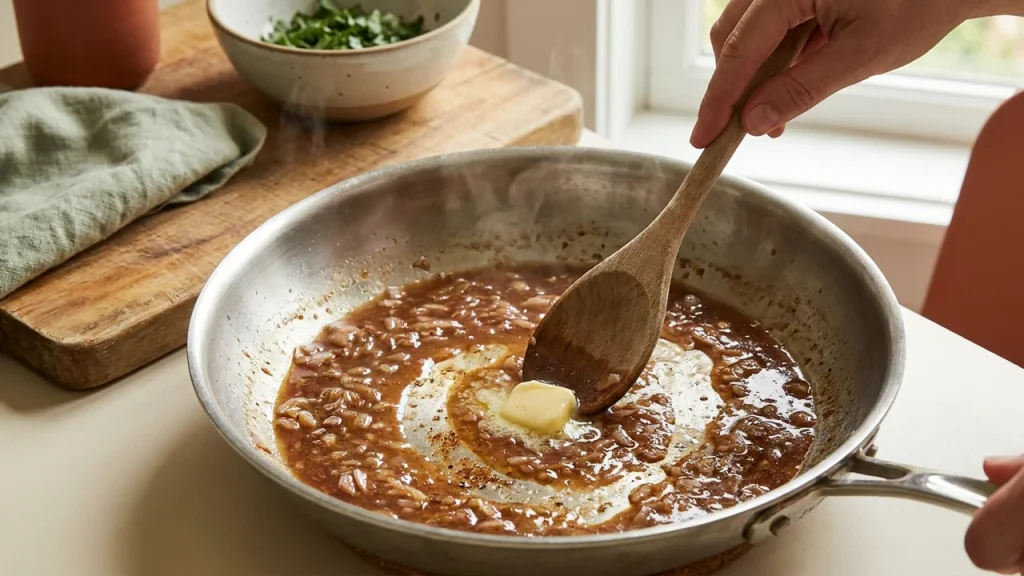
Understanding pan sauce emulsion mechanics separates home cooks scraping burnt pan debris from seasoned line cooks who spin fond into mirror-sheen liquid velvet. You pull a golden, seared duck breast or a thick ribeye from a screaming-hot stainless skillet, leaving behind a network of deeply caramelized drippings stuck fast to the metal. The instinct is simple: pour in some wine, scrape with a wooden spoon, toss in butter, and hope for luxurious pan gravy. Yet more often than not, the mixture splits into an uninviting greasy film floating atop a muddy, thin puddle.
The difference between a sauce that clings seductively to the back of a spoon and one that slides off in an oily slick is not luck. It comes down to fluid dynamics, surface tension, and the exact physical behavior of dispersed microscopic droplets suspended within an aqueous sea. Making an exceptional pan sauce is an exercise in applied colloid chemistry carried out in seconds over high heat.
Why everyday skillet pan juices break into greasy puddles
When you dissect pan sauce emulsion mechanics at the molecular tier, you discover that every pan sauce is fundamentally a thermodynamic gamble. Water and oil are natural enemies. Water molecules are polar and cling tightly to one another through hydrogen bonding, forming a dense electrostatic collective. Cooking oils and rendered animal fats are nonpolar triglycerides that cannot participate in that hydrogen bonding network. Left to their own devices, water molecules squeeze oil droplets out of the way to bond with each other, driving the lipid particles to coalesce and float to the surface.
The golden crust clinging to your skillet, known in classical kitchens as fond, consists of concentrated amino acids, denatured proteins, and browned sugars generated by the Maillard reaction. When you introduce a deglazing liquid like wine, stock, or fortified cider, the solvent dissolves those hydrophilic flavor compounds. However, that liquid also picks up stubborn, free-floating rendered animal fats. Because the pan liquid at this stage lacks sufficient emulsifying agents to bridge the gap between oil and water, simply reducing the liquid on high heat concentrates the tension. If you throw raw fat into that boiling aqueous reduction without a stabilizing bridge, thermal chaos forces the fats to separate completely.
The microscopic architecture of culinary binding agents
A stable emulsion is a kinetic truce. You are forcing tiny droplets of fat to stay suspended evenly throughout water without colliding, merging, and floating away. To pull this off, you need two structural elements: mechanical force to shatter the fat into microscopic spheres, and a surfactant or stabilizer to keep those spheres apart.
Surfactants are amphiphilic molecules possessing a split personality. One end of the molecule loves water, while the other end bonds with fat. When mixed into a liquid, these molecules coat each tiny fat droplet, positioning their hydrophobic tails inward into the oil and their hydrophilic heads outward toward the water. This effectively gives each fat droplet a polar force field that repels neighboring droplets. Investigations from the Harvard Science and Cooking research group demonstrate how physical boundary layers and suspended colloids determine the stability and flow of kitchen reductions. Without a protective boundary layer, thermodynamic entropy inevitably wins, collapsing the suspension back into distinct layers of grease and watery broth.
Mastering pan sauce emulsion mechanics through 4 proven rules
Constructing a flawless sauce right after searing meat does not require mysterious culinary wizardry. It requires honoring four strict, interconnected physical steps that force oil and water into an unbreakable union.
Build a rich gelatin foundation in the deglazing liquid
Before any finishing butter ever touches the pan, your aqueous phase must possess structural backbone. Water alone has very low viscosity, allowing dispersed fat droplets to drift freely, collide, and merge into large greasy pools. Adding gelatin changes everything. Gelatin consists of hydrolyzed collagen fragments that form a loose, microscopic mesh throughout warm liquid. This protein network creates viscous drag, effectively thickening the continuous water phase and locking fat droplets in place so they cannot crash into one another.
If you deglaze with plain store-bought stock or standard table wine, the liquid will lack the natural collagen found in traditional roasted veal or chicken bone broths. To solve this, always use rich homemade gelatinous stock or bloom a half-teaspoon of unflavored powdered gelatin directly into your deglazing liquid before pouring it into the skillet. As the liquid reduces, that concentrated gelatin creates the dense, shock-absorbing liquid matrix your emulsion needs to survive.
Control the thermal drop before mounting with cold fat
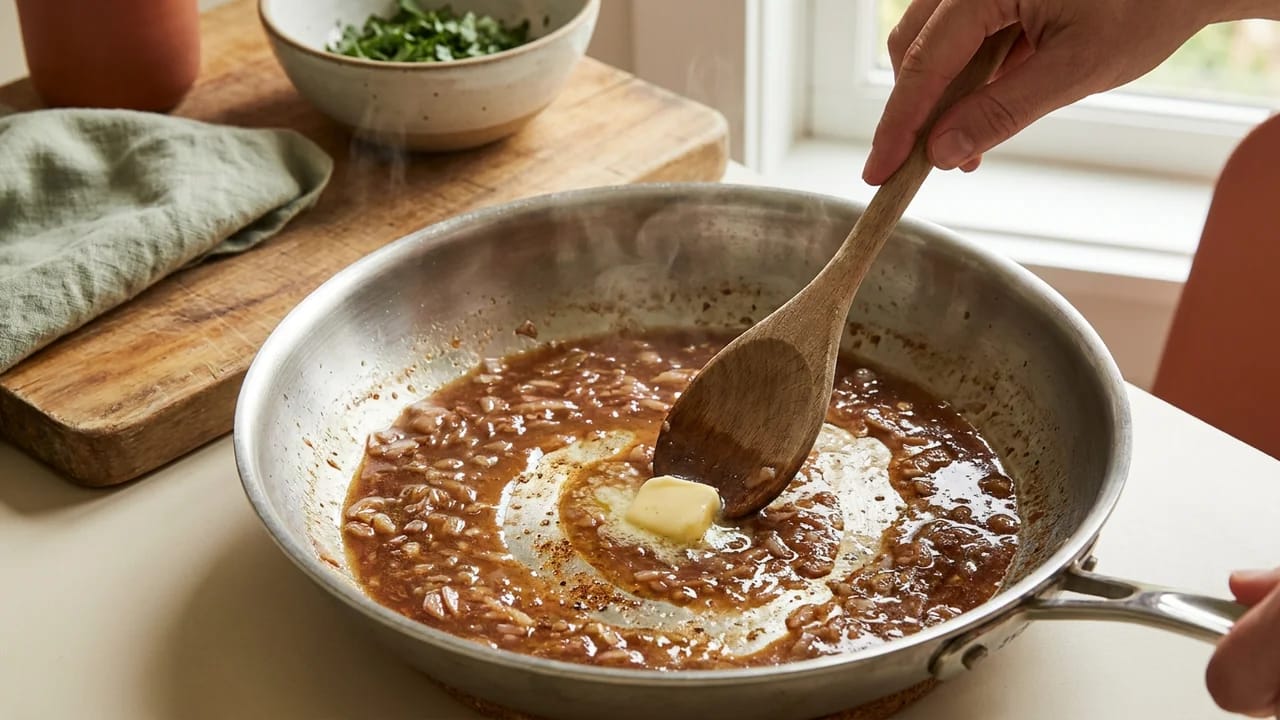
The classic French technique of finishing a sauce with butter is called monter au beurre, and it fails more often than any other step in home kitchens. The fatal mistake is adding butter while the pan is still violently boiling. Whole butter is already a fragile water-in-oil emulsion composed of roughly 80 percent milk fat, 16 to 18 percent water, and roughly 2 percent milk proteins. If butter is dropped into a boiling pan above 185 degrees Fahrenheit, the water inside it instantly flashes into steam, the delicate milk solids denature, and the fat clarifies into pure liquid oil.
This thermal sweet spot is where pan sauce emulsion mechanics thrive, preserving structural cohesion before the fats disintegrate into oily pools. Pull the skillet completely off the primary heat source and let the violent bubbling subside until the liquid settles to a gentle steam, right around 140 to 160 degrees Fahrenheit. Furthermore, the butter must be refrigerator-cold. Cold butter melts slowly from the outside inward, releasing its fat in small, manageable increments while its native milk proteins disperse into the sauce to act as immediate surface-active stabilizers.
Apply aggressive mechanical shear to shatter fat globules
Gentle stirring will never produce an emulsion. You cannot simply drop cold butter into warm stock and wait for it to melt into a sauce. You must supply vigorous mechanical shear to tear the melting lipid mass into billions of sub-micron droplets. Much like how foundational sprint acceleration mechanics and 4 proven rules that unlock explosive speed depend on generating sudden, explosive force against the ground to overcome stationary inertia, breaking butter fat down into microscopic spheres requires decisive kinetic energy.
As the cold butter hits the warm reduction, grab the skillet handle with one hand and a stiff wire whisk or wooden spoon with the other. Swirl the pan in rapid, circular motions over residual heat while whisking furiously. The friction of the whisk against the pan surface shears the melting fats into microscopic particles faster than they can coalesce. The pan swirl forces the liquid through a vortex, continuously dragging the continuous aqueous phase across the dispersed oil phase until the liquid transforms into an opaque, light-reflective glossy glaze.
Anchor surface tension with starch or natural phospholipids
Even with gelatin and mechanical shear, certain high-acid pan sauces like a sharp lemon piccata or a heavy red wine reduction fight stabilization. Acids weaken protein networks, making the mixture vulnerable to splitting. To counter this, introduce dedicated emulsifiers or starch molecules to anchor surface tension. A small dab of Dijon mustard introduces naturally occurring mucilage and lecithin from crushed mustard seeds, which instantly coat lipid droplets and prevent separation.
Mastering these pan sauce emulsion mechanics means recognizing that chemical bridges are just as critical as temperature control. Alternatively, you can incorporate a small bead of beurre manié, which is equal parts softened butter and raw flour kneaded together, or swirl in a drop of cold starch slurry. Starch granules swell rapidly in hot liquid, absorbing free water and physically obstructing fat droplets from finding each other. This gives you an unbreakable safety net that keeps the sauce glossy and stable even if it sits on a warm plate for ten minutes.
Diagnosing and salvaging a broken glossy glaze
When troubleshooting pan sauce emulsion mechanics in the middle of dinner service, immediate diagnosis is everything. A sauce breaks in two distinct ways: it either runs dry of water, or it suffered excessive heat. If your sauce suddenly turns into a clear, oily layer with grainy bits settled at the bottom, look at the edges of the pan. If the edges are dry, your continuous water phase has evaporated completely. Fat cannot disperse into a liquid that does not exist.
To fix an over-reduced, broken sauce, immediately take the pan off the burner. Whisk in a single tablespoon of cold water or cold stock. That small dose of liquid re-establishes the continuous aqueous phase, giving the separated fat droplets room to disperse once more. Whisk rapidly, and you will watch the greasy puddle miraculously snap back into a creamy, cohesive coating. If excessive heat broke the sauce and water alone will not pull it together, pull the pan off the heat, add an ice cube, and whisk with maximum speed. The ice rapidly drops the core temperature while shedding just enough cold liquid to allow the milk proteins to regroup.
The sensory alchemy of finishing food with proper friction
Once you internalize pan sauce emulsion mechanics as a dialogue between heat, shear force, and surface tension, cooking becomes instinctive. You stop measuring with teaspoons and start judging by light reflection, drag against the whisk, and viscosity on the metal pan floor. A truly emulsified pan sauce coats meat evenly because its surface tension matches the food it blankets. It does not pool off into the corners of the dish or leave an oily ring around your roasted vegetables.
The culinary magic lies entirely in mouthfeel. When fat is trapped in billions of microscopic droplets, it coats the tongue in a thin, continuous film that melts cleanly at body temperature. Instead of an overwhelming burst of direct grease followed by dry acid, the palate experiences a harmonious release of aromatics, savory glutamates, and gentle acidity all at once. That signature texture is not the product of heavy cream or artificial thickeners. It is the raw power of everyday kitchen physics harnessed correctly inside a simple stainless skillet.