Cast iron seasoning chemistry and 4 proven laws that forge indestructible slickness
Seasoning a skillet is not greasy folk magic; it is an exact sequence of thermal lipid cross-linking. Discover the precise molecular mechanics that turn raw porous iron into an indestructible, naturally slick heirloom.
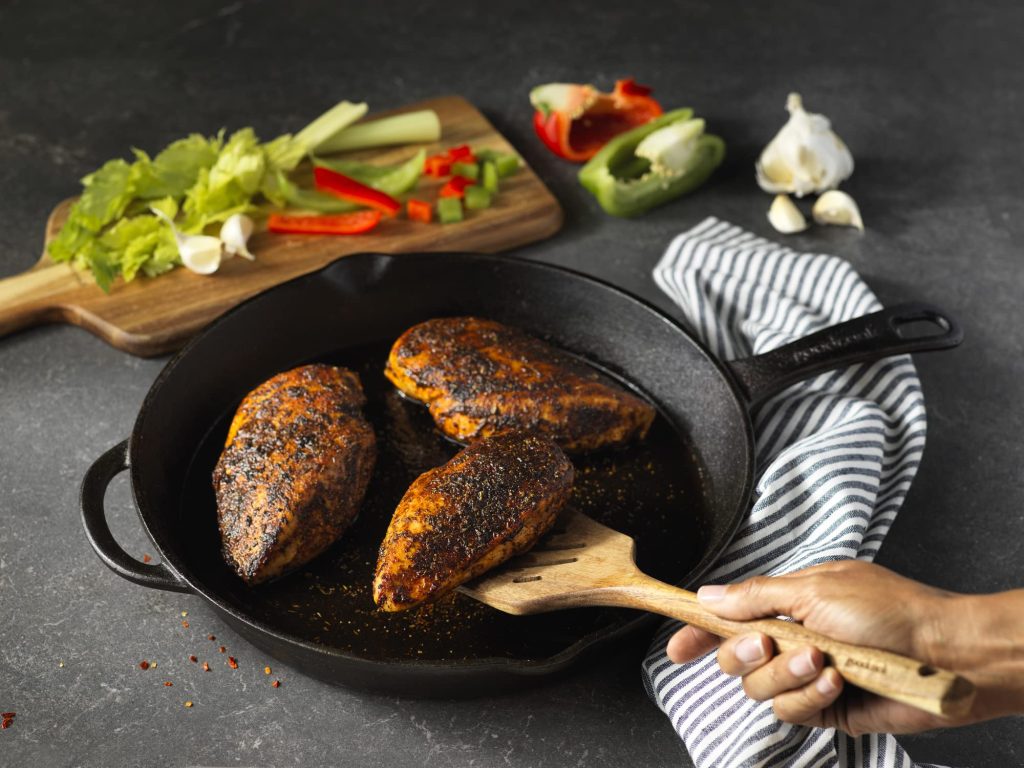
Understanding cast iron seasoning chemistry transforms a crude, porous slab of black metal into an heirloom nonstick skillet capable of sliding delicate eggs across its surface without resistance. Most home cooks approach seasoning as mystical kitchen folklore, indiscriminately smearing thick slabs of bacon lard over dirty pans and hoping for culinary miracles. What actually occurs on your stovetop or inside your oven is not the preservation of grease, but the deliberate engineering of a synthetic, cross-linked biopolymer fused directly to an oxidized crystalline metal matrix. When you comprehend the precise atomic transformations occurring under sustained heat, ruined surfaces, sticky coatings, and flaking carbon vanish entirely from your kitchen repertoire.
The Microscopic Reality of Raw Iron Porosity
Pick up a freshly cast, unseasoned skillet and run your fingertips across the cooking floor. What feels like a solid, continuous plane of metal is actually a chaotic topography of crags, pits, micro-fissures, and jagged peaks. Gray cast iron is an alloy containing roughly two to four percent carbon, alongside silicon and trace elements. During the cooling process at the foundry, excess carbon precipitates out into tiny crystalline flakes of graphite. When the mold is broken and the casting cools, these microscopic graphite pockets leave an intensely porous surface matrix.
Food sticks to hot raw metal because of two interrelated physical phenomena: mechanical interlocking and chemical bonding. As animal proteins or complex starches heat up, their molecular structures unfold and sink into these jagged microscopic valleys. Simultaneously, the exposed surface iron atoms, carrying vacant electron orbitals, form aggressive covalent bonds with sulfur and nitrogen atoms found within the food. Liquid water boils off, the protein contracts around the iron peaks like a clenched fist, and your delicate fish fillet or morning omelet fuses to the pan. To prevent this destruction, you must fill those micro-voids with an impermeable, nonreactive barrier that prevents physical snagging and blocks electron exchange.
Why Fat Polymerization Outperforms Modern Teflon Coatings
When you strip away culinary folklore, cast iron seasoning chemistry is fundamentally an exercise in radical-induced lipid polymerization. Unlike factory-applied polytetrafluoroethylene coatings that degrade, release volatile gases at high temperatures, and scratch off irreversibly under metal utensils, seasoned iron constructs an organic matrix that repairs itself every time you cook with hot fat. The seasoning layer is not liquid fat or hardened grease; it is a tough, insoluble plastic formed from oxidized triglycerides.
Liquid culinary oils consist of triglyceride molecules: a glycerol backbone bound to three fatty acid chains. When you subject these chains to extreme thermal energy in the presence of atmospheric oxygen, three distinct stages take place: autoxidation, thermal decomposition, and free-radical cross-linking. Oxygen attacks the carbon-carbon double bonds in the fatty acid chains, forming unstable hydroperoxides. As these peroxides disintegrate, they spawn reactive free radicals that seek stability by bonding with neighboring fatty acid molecules. Rather than existing as loose, independent slip-planes of oil, the molecules knit together into an immense, interlocking three-dimensional macro-network known as an oxypolymer.
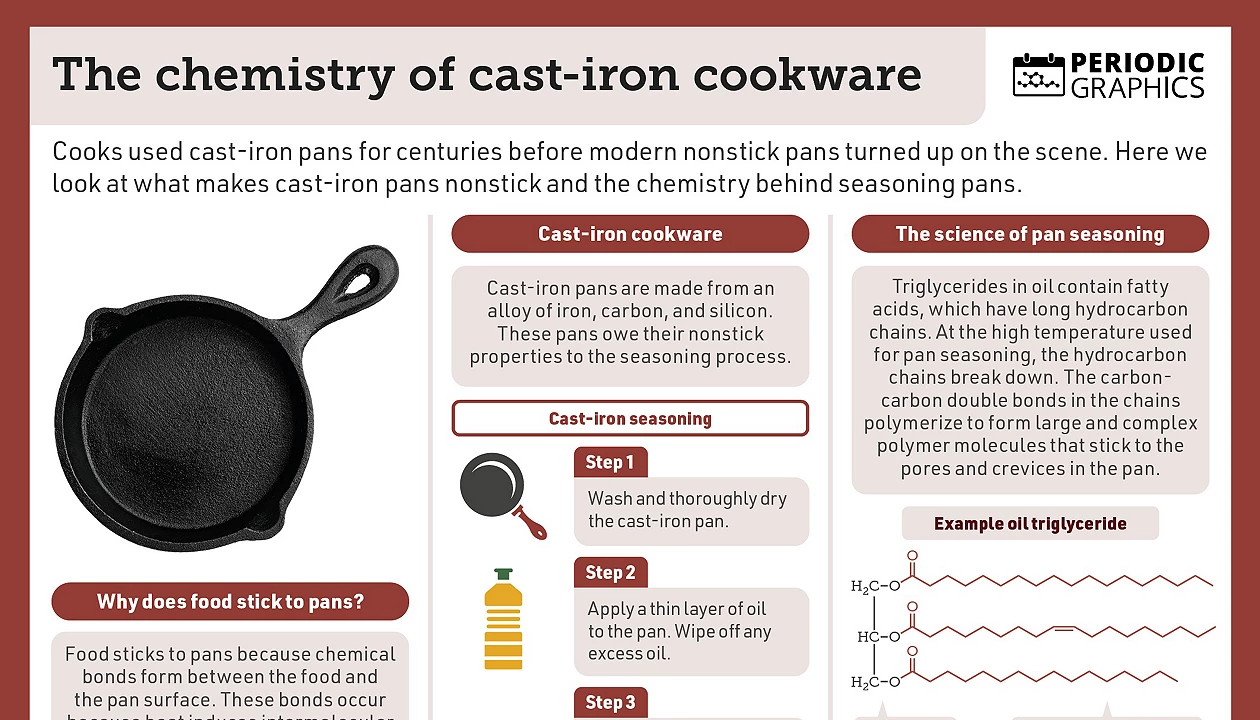
Four Proven Thermodynamic Laws That Forge Bulletproof Seasoning
Achieving a mirror-smooth, resilient surface requires moving past haphazard guesswork and adhering strictly to thermodynamic realities. Building a resilient polymer demands specific molecular inputs and temperatures that force chemical restructuring without charring the material into brittle soot.
Select Triglycerides Rich in Polyunsaturated Fatty Acids
Mastering cast iron seasoning chemistry requires discarding grandmother’s advice about slathering thick layers of bacon grease across cold metal. Animal fats such as lard, beef tallow, and butter consist predominantly of saturated and monounsaturated fatty acids. Saturated fats lack carbon-carbon double bonds entirely, meaning their carbon atoms are completely saturated with hydrogen. Without those double bonds, there are no reactive sites for oxygen to attack, meaning the fat resists radical cross-linking and instead melts, smokes, and bakes into a greasy, crumbly film.
To create a durable coating, you need drying or semi-drying oils rich in polyunsaturated fats, specifically linoleic and alpha-linolenic acids. Oils like refined grapeseed, sunflower, or authentic food-grade flaxseed feature fatty acid chains with multiple points of unsaturation. According to American Chemical Society research on lipid polymerization, these unsaturated sites readily donate hydrogen atoms under thermal stress, triggering the explosive cascade of cross-links necessary to build a durable, glassy polymer rather than a soft, sticky residue.
Apply Molecular Monolayers Rather Than Thick Puddles
The baseline mechanism of cast iron seasoning chemistry relies on heat driving off volatile compounds while unsaturated double bonds open up. However, this radical reaction requires direct contact with atmospheric oxygen. If you pour oil into the pan and leave a visible slick or pool, oxygen cannot diffuse downward through the thick liquid layer. Heat will partially oxidize the bottom while boiling the top, yielding a gummy, amber skin that wrinkles, traps raw oil beneath, and easily scrapes away under the edge of a spatula.
The secret to structural durability is building a succession of microscopic monolayers. Pour a half-teaspoon of oil into the iron, spread it across every square millimeter, and then take a clean, dry lint-free cloth and buff the iron vigorously as if you made an awful mistake and are trying to wipe away every trace of grease. The pan should look completely matte and dry to the naked eye. The infinitesimal film remaining trapped within the microscopic crevices is more than sufficient. Because this layer is only molecules thick, atmospheric oxygen permeates it completely, guaranteeing full, uniform cross-linking from the base iron outward.
Cross the Free Fatty Acid Smoke Threshold Intentionally
Many cooks panic the moment wisps of blue smoke drift from their skillet, instinctively turning down the burner. That hesitation halts polymerization in its tracks. A fat cannot cross-link into a rigid matrix while maintaining its original chemical stability. You must supply enough kinetic energy to break the ester linkages and fracture the hydrocarbon chains, which manifests visibly as the oil reaches its smoke point.
Passing the smoke point generates free radicals and releases volatile aldehydes, acrolein, and short-chain organic acids. This thermal degradation is the necessary precursor to synthetic restructuring. By pushing the temperature roughly twenty to thirty degrees Fahrenheit beyond the smoke point of your chosen oil, you trigger the radical propagation phase. The fatty acids strip down, link together, and polymerize into an insoluble solid before they have time to combust completely into black elemental carbon.
Bake Beyond Smoke Points to Complete Covalent Cross Linking
In the broader framework of cast iron seasoning chemistry, temperature control dictates whether you produce a glassy matrix or a flake-prone char. Baking the cookware at 450 to 500 degrees Fahrenheit for a full hour allows the nascent polymer to undergo extensive lateral cross-linking. As the chains knit together horizontally and vertically, the film shrinks slightly, pulling itself taut against the microscopic ridges of the iron floor.
Furthermore, this sustained heat causes the base layer of the polymer to react directly with iron oxides on the surface of the pan, forming organometallic bonds. This anchoring mechanism ensures the slick film behaves as an intrinsic metallurgical skin rather than a delicate coat of paint. Once the hour concludes, never shock the pan by pulling it into cool room air. Turn off the oven and let the metal contract gradually over several hours, preventing thermal stress fractures within the newly created polymer grid.
The Great Dish Soap Myth and Iron Maintenance Realities
A persistent, dogmatic myth insists that washing a cast iron skillet with dish soap instantly strips away years of careful seasoning. This belief originates from the nineteenth and early twentieth centuries, when household soap was manufactured by boiling rendered animal fat with unmeasured, aggressive lye—pure sodium hydroxide. Free lye is an alkaline brute that attacks esters and dissolves organic bonds through rapid saponification, shredding raw grease and delicate polymers alike.
Modern dish detergents, however, are not lye soaps. They are mild liquid surfactants, typically sodium laureth sulfate or similar synthetic molecules, designed to bind water-repellent oils to polar water molecules so loose surface fats wash away. A fully polymerized, cross-linked seasoning layer is no longer an oil; it is an insoluble, chemically resistant thermoset plastic. Gentle dishwashing liquid cannot dissolve covalent hydrocarbon bonds any more than it can melt a hard plastic bowl.
Kitchen panic often mirrors financial behavioral traps. Just as unmanaged early drawdowns decimate a portfolio, as explored in the analysis of Sequence of Returns Risk and 4 Proven Shields That Avert Devastating Wealth Erosion, early missteps in skillet care create compounding structural degradation that ruins an otherwise resilient foundation. When cooks refuse to wash their pans properly out of irrational fear, burnt carbonized food accumulates on top of the seasoning. This soot creates a false layer of black grime that eventually flakes off in jagged chunks, taking the delicate polymer beneath it down with it. Once you honor real cast iron seasoning chemistry, you will never fear washing your skillet with a drop of gentle dish soap.
Rescuing Damaged Metal Without Starting from Scratch
When a pan begins flaking or develops a rough, crusty texture, you are rarely seeing failed seasoning; you are seeing built-up, unpolymerized carbon. Food sugars, burnt proteins, and ancient layers of grease that were never properly cross-linked bake into charred carbon scales. Because this soot lacks molecular bonding, moisture creeps underneath, rusting the underlying iron and causing the black crust to detach into dinner plates.
You do not need to grind the pan down to bare silver with power tools unless rust has pitted the iron severely. A vigorous scrubbing with coarse kosher salt and a few drops of water, or the controlled abrasion of a stainless steel chainmail scrubber, strips away brittle carbon scales while leaving the chemically bound polymer untouched. If moisture does attack the metal and creates orange iron oxide rust, an acid soak in equal parts white vinegar and water dissolves the rust in under thirty minutes. Neutralize the acid immediately with a baking soda rinse, dry the iron over a hot burner, and immediately apply a microscopic monolayer of polyunsaturated oil to initiate the repair cycle.
The Lifelong Payoff of Scientific Pan Metallurgy
A properly seasoned skillet is a living, adaptive tool that improves with age. Every time you sear a ribeye, sauté aromatics in olive oil, or roast root vegetables at high heat, microscopic droplets of fat undergo micro-polymerization, filling fresh wear scratches and adding another microscopic terrace to the protective armor. You do not need to pamper the pan or obsess over esoteric maintenance rituals. Treat it with thermal respect, keep it free of carbonized soot, dry it thoroughly over heat after every wash, and let basic thermodynamics do the heavy lifting.
Looking at your skillet through the lens of cast iron seasoning chemistry turns cooking into an effortless dance between heat, fat, and metallurgy. The pan stops being a temperamental, high-maintenance relic of the pioneer trail and becomes an indestructible, ultra-efficient kitchen weapon. By replacing superstitious kitchen habits with sound molecular principles, your cookware will deliver restaurant-grade sears, effortless releases, and indestructible durability for generations to come.