JJ McCarthy Giants Debut Exposes 3 Major Problems in Landover
J.J. McCarthy finally made his appearance in Big Blue colors against Washington, but an isolated cameo and disjointed play-calling left more questions than answers. Here is the full breakdown of New York’s quarterback dynamic following the Week 5 clash.
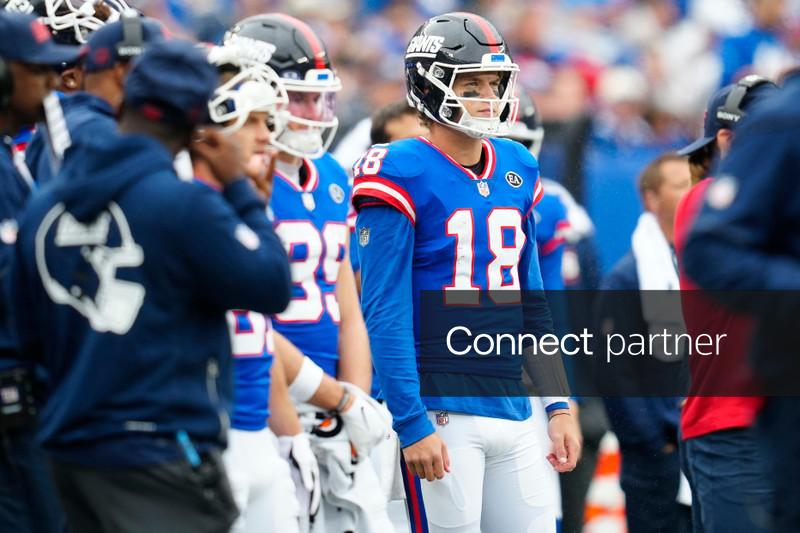
New York Giants quarterback J.J. McCarthy (18) is shown on the sideline, Sunday, October 4, 2026, in East Rutherford.
The much-anticipated JJ McCarthy Giants debut unfolded under strange circumstances in Landover on Sunday, leaving New York fans and analysts grappling with mixed signals about the franchise’s offensive hierarchy. Rather than heralding a bold new era under center, the brief appearance during Week 5 of the 2026 NFL season against the Washington Commanders served as a stark reminder of how complex in-season quarterback transitions can become. The team had generated immense intrigue after finalizing an ambitious late September trade to acquire the former Michigan national champion, yet his integration onto the field produced friction instead of fireworks.
As reported by USA Today, the trade completed in late September sent shockwaves through the NFC East, creating an immediate public expectation that Big Blue would accelerate the young passer into action. But when game day arrived in Landover, Maryland, head coach Brian Daboll and the offensive staff opted for an unconventional deployment strategy that caught observers completely off guard. Instead of handing McCarthy the keys or letting him run a dedicated two-minute drill, New York treated his introduction as an isolated wrinkle inside an offensive plan firmly commanded by veteran Jameis Winston.
Inside the Week 5 Surprise at Landover
Entering the divisional showdown against Washington, speculation ran rampant across sports media regarding how much playing time the new acquisition would see. Bolavip US highlighted the intense pre-game debate, questioning whether the Giants would hold McCarthy back while he learned the playbook or thrust him into a hostile road environment during a crucial division matchup. The answer arrived far earlier than anticipated, though in a manner few could have predicted.
NBC Sports reported that the coaching staff inserted McCarthy on the team’s very first offensive possession of the game. Coming off the bench just one play after Winston had moved the offense downfield, McCarthy jogged onto the turf to take an isolated snap before heading right back to the sideline. The sudden substitution disrupted the tempo of the opening drive, creating an awkward cadence that immediately raised eyebrows among commentators in the press box and fans watching at home.
Rather than establishing sustained offensive rhythm, that opening possession cameo exposed the operational difficulty of integrating an incoming quarterback mid-stream. When examining the initial JJ McCarthy Giants debut against an aggressive Washington defense, the play design lacked conviction. The defensive front for the Commanders showed zero confusion regarding the personnel shift, stacking the box and neutralizing the concept before it could develop into positive yardage.
The Play Calling Breakdown on Big Blue Possessions
Tactical execution requires synchronicity between the sideline and the huddle, and the afternoon in Landover offered little harmony for the newcomer. Yahoo Sports reported that while McCarthy received snaps during Week 5, the play-calling did him very few favors. The coaching staff dialed up disjointed packages that asked a newly acquired passer to execute situational responsibilities without the benefit of prior game-speed repetitions in New York’s primary system.
In modern professional sports, staging and perception often dictate narrative trajectory just as much as on-field mechanics. Much like how directors manipulate atmospheric tone through film color grading psychology and 4 proven rules that create unforgettable visual drama, the Giants attempted to construct a theatrical spark by flashing their new quarterback on screen, yet the raw execution instantly shattered the illusion. By shuttling McCarthy in for high-leverage situational moments rather than building a stable environment, the coaching staff placed an unnecessary spotlight on an unfinished transition.
The optics surrounding the JJ McCarthy Giants debut showed a sideline wrestling with offensive identity. Instead of giving McCarthy an extended series where he could read coverage, check out of bad looks, and build confidence with his wide receivers, the coaching staff relegated him to short-yardage and change-of-pace situations. Yahoo Sports noted that these limited packages felt forced, disrupting the offensive rhythm and exposing McCarthy to intense pass-rush pressure without clear secondary reads.
3 Crucial Realities Defining the Quarterback Room
Evaluating the immediate fallout from the JJ McCarthy Giants debut requires looking directly at the competitive environment inside the locker room, the compressed timeline of the trade, and the realities of NFL offensive chemistry.
Jameis Winston Firmly Controls the Offensive Reins
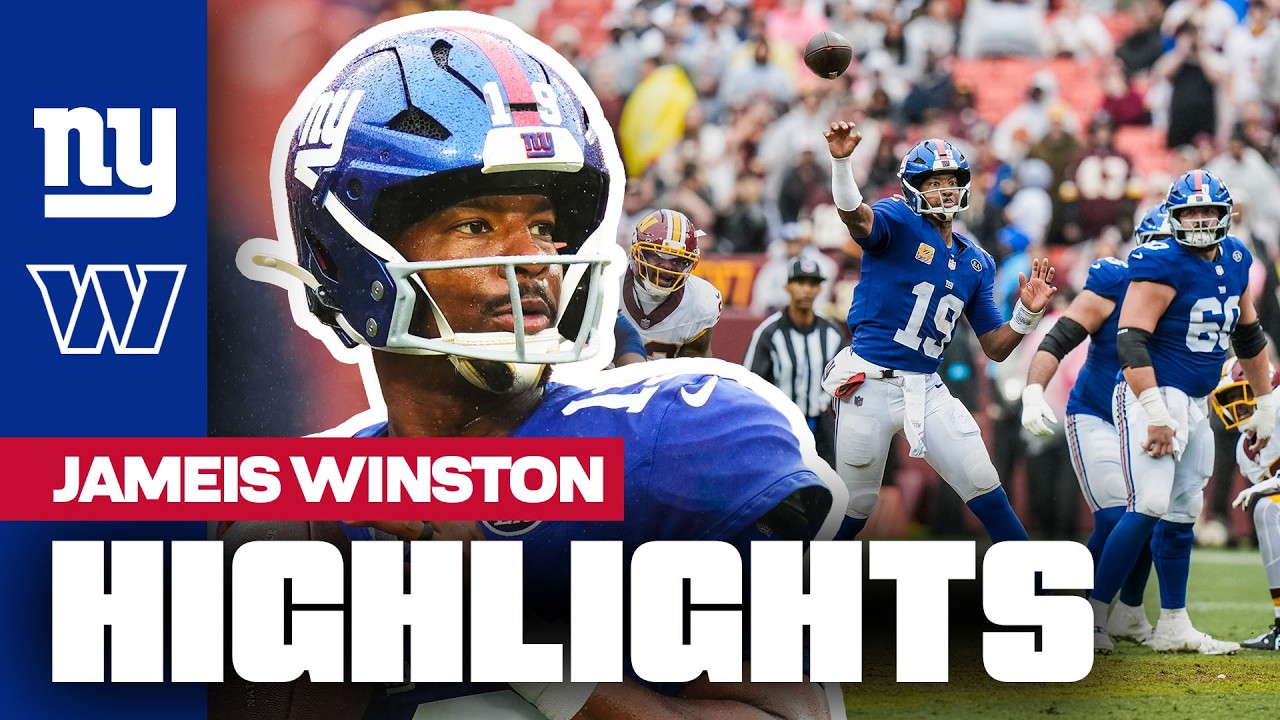
The primary barrier standing between McCarthy and meaningful playing time is the veteran currently starting under center. As reported by the New York Post, Jameis Winston shined against the Commanders, asserting total command of the huddle and executing the primary game plan with decisive swagger. Winston’s ability to distribute the football vertically and manage the offense in hostile territory has cemented his standing with the coaching staff, making any premature quarterback change virtually impossible.
The New York Post highlighted that McCarthy feels further away from taking over as the starting quarterback than ever before precisely because Winston performed with high efficiency. When a veteran starter is moving the chains and keeping the team competitive in NFC East play, an NFL coaching staff cannot justify benching production in favor of developmental upside. Winston’s firm grip on the starting job means McCarthy remains firmly entrenched in a secondary role for the foreseeable future.
Late September Trade Timeline Limits Playbook Command
NFL offenses are among the most intricate systems in professional sports, packed with layered audibles, protection adjustments, and sight adjustments. USA Today confirmed that the Giants acquired McCarthy in late September, giving the quarterback mere weeks to digest an entirely new terminology system and develop timing with unfamiliar pass catchers. Expecting any passer to master those nuances in a compressed window is unrealistic.
Because McCarthy arrived well after training camp and the preseason had concluded, his operational baseline is limited to scout team reps and classroom chalk-talk. When he entered the game in Landover, the offense visibly simplified its formations, giving Washington’s defensive coordinators an immediate cue on how to align. Until McCarthy achieves comprehensive mastery of Brian Daboll’s dense playbook, throwing him into live regular season action risks compromising both his confidence and the team’s operational efficiency.
Isolated Snaps Disrupt Natural Quarterback Rhythm
Quarterbacks rely heavily on drive flow, defensive reads over multiple downs, and footwork synchronization. Inserting a young quarterback for isolated snaps breaks that rhythm completely. As NBC Sports observed during McCarthy’s single-play appearance on the opening drive, bringing a passer cold off the bench to execute a single high-stress play rarely produces positive results.
Rather than accelerating his development, the JJ McCarthy Giants debut may have underscored the inherent pitfalls of two-quarterback rotation packages. Quarterbacks cannot establish their vision or test defensive coverage thresholds when they are utilized as part-time decoys. If the Giants intend to cultivate McCarthy into a legitimate long-term asset, they must provide him with full series rather than disjointed situational gimmicks that fail to test his actual passing ability.
Evaluating the Long Road Ahead for Big Blue
The aftermath of Week 5 leaves the New York front office and coaching staff at a strategic crossroads. Fans and media outlets who expected the late September trade to trigger an immediate passing of the torch now face the reality of a measured developmental timetable. As analysts process the JJ McCarthy Giants debut in Landover, the immediate verdict is clear, the starting job belongs to Jameis Winston until performance or physical necessity dictates otherwise.
For McCarthy, patience will be the defining requirement of the 2026 campaign. Moving from a blockbuster late-season trade directly onto the field created immense outside pressure, but the game against the Commanders demonstrated that development cannot be rushed through sporadic snaps. The Giants must decide whether keeping McCarthy active for limited gadget packages serves any real developmental purpose or merely serves as an unnecessary distraction for an offense finding its stride under Winston.
Ultimately, the JJ McCarthy Giants debut proved that timing and schematic cohesion matter far more than sheer pedigree. While Big Blue made an aggressive investment to bring the young quarterback to East Rutherford, the Landover outing made it abundantly clear that his journey to becoming New York’s full-time starter is going to take considerably more time than external hype suggested.