Kospi Slumps Below 6400 Points Amid 4 Critical Pressures Shaking Global Tech
South Korea’s equity benchmark plunged 3.65 percent below the 6,400 threshold on Monday as foreign institutional investors dumped shares amid artificial intelligence revenue fears. The rout extended Seoul’s losing streak to four consecutive sessions despite record earnings from domestic tech leaders.
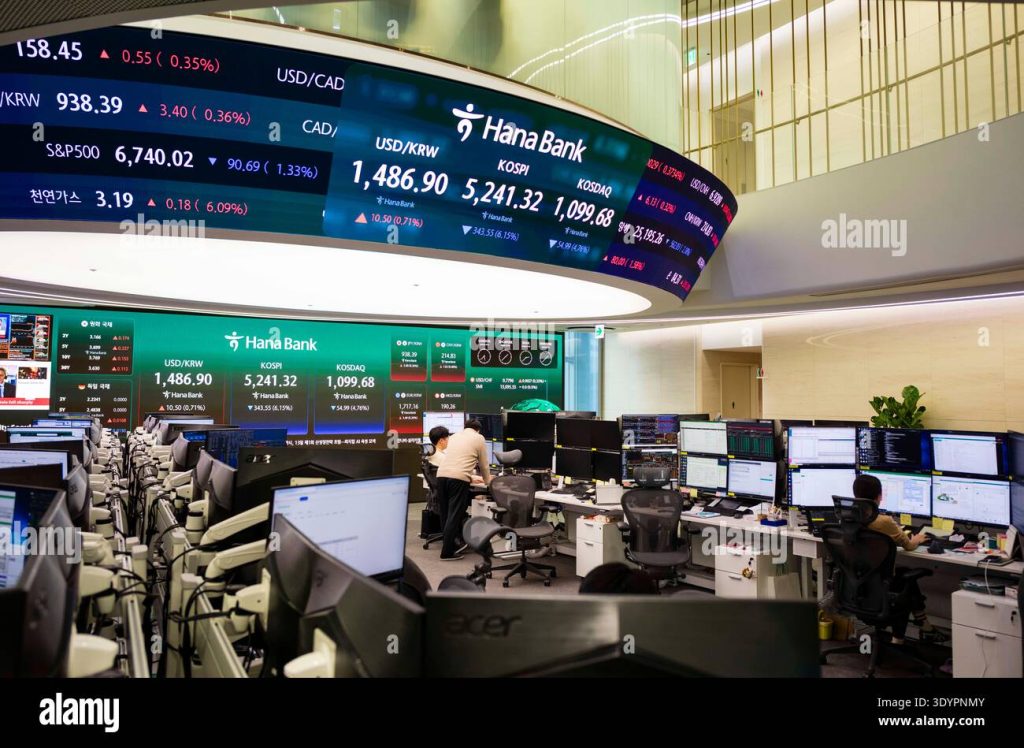
South Korea’s benchmark Kospi tumbled 3.65 percent on Monday, triggering widespread shockwaves across Asian financial markets as a relentless technology selloff intensified. The dramatic collapse caught retail and institutional market participants off guard, breaking through critical psychological support levels and pulling regional risk sentiment into negative territory. While international attention often gravitates toward Wall Street tech swings, the turbulence centered in Seoul reflects deeper structural realignments rippling through global supply chains.
A Sudden Freefall on the Seoul Trading Floor
Trading desks across the financial district of Yeouido confronted intense selling momentum from the opening bell on Monday, October 12. According to market data documented by TradingKey, South Korea’s premier equity gauge dropped sharply throughout the session, officially finishing at 6,384.25 points. The steep decline represented an absolute loss of 3.65 percent on the day, decisively breaking below the critical 6,400 benchmark that had served as an anchor for domestic market stability.
The downturn was neither an isolated blip nor an intraday flash panic. As reported by The Korea Times, the retreat extended losses across the Kospi to four consecutive sessions, marking an agonizing multi-day slide that erased substantial year-to-date market capitalization. The persistent selling erased cumulative gains across consumer, industrial, and technology sectors, leaving portfolio managers scrambling to hedge exposure against a deteriorating short-term technical backdrop.
What confounded many domestic retail investors was the glaring disconnect between headline corporate performance and equity market trajectory. Just days before the drop, domestic tech heavyweights had generated optimistic headlines with robust operational scorecards. The Korea Times observed that the steep selloff materialized directly in the face of record quarterly profitability announcements, highlighting that institutional market participants were no longer pricing equities on backward-looking financial figures.
Foreign Capital Exodus and the AI Valuation Chill
The primary driver behind the intraday rout was an aggressive, broad-based exit by international asset managers. Investigative coverage from Chosun Ilbo revealed that foreign investors logged a net sale of 566 billion won in domestic equities during Monday’s trading hours alone. This coordinated liquidation created insurmountable overhead supply, overwhelmingly absorbing local retail bids and exhausting domestic institutional buying power.
This persistent capital departure was corroborated by KED Global, which noted that sustained offshore offloading has deepened the ongoing chip selloff across the country. Offshore fund managers, navigating evolving risk mandates and adjusting their high-beta Asian holdings, rapidly trimmed allocations across Seoul’s semiconductor supply chain. Rather than rotating capital into defensive domestic utilities or dividend-yielding banking equities, foreign institutions moved liquidity outright into dollar-denominated reserves and Western sovereign bonds.
The selling was exacerbated by a complicated and fragmented international backdrop. An Associated Press report published by the Jacksonville Journal-Courier pointed out that Asian equity markets traded mixed on Monday, with regional traders parsing unpredictable macroeconomic headlines. Crude oil benchmarks slid by approximately $1.50 per barrel following public statements from U.S. President Donald Trump indicating plans for the United States to purchase diesel fuel from Russia. These shifting geopolitical undercurrents and shifting commodity prices generated cross-asset friction, tightening liquidity conditions just as offshore institutions accelerated their retreat from emerging and export-sensitive equity bourses.
4 Critical Pressures Driving the Semiconductor Meltdown
To understand why Seoul absorbed such an outsized blow while other Asian exchanges showed comparative resilience, analysts must dissect the precise intersection of corporate exposure, foreign flows, and macroeconomic head意见. Four distinct catalysts converged to trigger Monday’s market cascade.
Deepening AI Revenue Doubts Across Hardware Leaders
For more than eighteen months, global semiconductor equities enjoyed massive valuation premiums fueled by the anticipated explosion of artificial intelligence infrastructure spending. However, sentiment has pivoted from blind euphoria to rigorous scrutiny. As highlighted by Chosun Ilbo, international investors are increasingly questioning whether the monumental capital expenditure committed by global hyperscalers is yielding sustainable, monetization-backed enterprise revenue.
Because Seoul’s bourse is heavily weighted toward advanced memory producers, this existential question struck at the heart of domestic market capitalization. TradingKey recorded that industry cornerstones Samsung Electronics and SK Hynix each plunged by more than 4 percent during the session. These two hardware giants, which supply the high-bandwidth memory chips essential for running complex neural networks, faced severe valuation compression as Wall Street desks reconsidered the velocity of next-generation infrastructure orders.
Disconnect Between Record Corporate Earnings and Forward Guidance
Ordinarily, blockbuster earnings serve as an unshakeable bulwark against broader market drawdowns. That traditional logic failed completely on Monday. The Korea Times underscored that despite Samsung Electronics reporting historic, record-setting operating profits, investors responded by aggressively offloading shares. Market participants exhibited little interest in celebrating previous-quarter margins, focusing instead on warning signs of cyclical deceleration.
Equity analysts point to plateauing price growth in conventional memory segments, intensifying competition in foundry services, and inventory digestion cycles among enterprise buyers. When corporate balance sheets print stellar historical performance while forward outlooks suggest peak margin vulnerability, institutional capital routinely chooses to lock in profits. The subsequent selloff demonstrated that strong backward-looking balance sheets cannot insulate export stocks when cyclical anxieties take control.
Persistent Capital Outflows From Overseas Funds
The structural reliance of South Korea’s financial ecosystem on foreign capital flows became its most acute liability. Reporting from KED Global underscored that foreign selling has transformed from a transient tactical adjustment into a sustained trend. When international fund managers execute programmatic de-risking, foreign desks sell index baskets systematically rather than assessing individual firm fundamentals.
The 566 billion won single-day net outflow recorded by Chosun Ilbo represented an acute acceleration of this retreat. With foreign desks accounting for an outsized portion of daily liquidity, their departure left domestic market makers overwhelmed. Local retail traders, who had stepped in during earlier dips, were unable to absorb the volume of institutional sell tickets, turning what might have been a minor technical pullback into a multi-session capitulation event.
Geopolitical Volatility and Macro Commodity Shocks
Financial assets in export-dependent economies do not trade in a vacuum. The broader Asian trading session was buffeted by complex foreign policy and commodity dynamics, as detailed by the Jacksonville Journal-Courier. Announcements regarding unconventional energy trade dynamics involving the United States and Russia caused sudden fluctuations in energy futures, pulling oil prices down by roughly $1.50 per barrel.
While falling energy costs often provide relief to energy-importing economies, sudden policy unpredictability frequently prompts global macro funds to curb systemic risk exposure. When international investors face unquantifiable geopolitical crosswinds, emerging market equities and high-volatility technology bourses are routinely the first positions closed to preserve portfolio liquidity.
The Fragility of Tech Heavy Asian Exchanges
The severe downturn highlights an enduring vulnerability within South Korea’s capital market architecture. The domestic bourse features one of the highest sector concentration ratios in the developed world, with semiconductor fabrication and related electronics component manufacturers holding disproportionate mathematical weight over the headline index. When chip sentiment fractures globally, the broader domestic market lacks sufficient non-tech counterweights to stabilize index movements.
This structural concentration transforms the domestic equity market into a hyper-sensitive barometer for worldwide industrial appetite. Whenever consumer electronics demand cools in North America or cloud infrastructure buildouts pause in Western software centers, Yeouido feels the impact immediately. Financial market panics rarely occur in complete isolation; they build through subtle psychological cues long before an actual rout takes place. Much like the way master directors deploy Sound design in horror films and 4 proven techniques that craft genuine dread to unsettle viewers before a visible shock, trading floors absorb an accumulation of dissonant macro signals until sudden volatility shatters institutional complacency.
For global asset allocators, the selloff serves as an essential warning about systemic contagion across the Asian semiconductor corridor. As Taiwan, Japan, and South Korea jockey for position in the high-stakes supply chains powering artificial intelligence, their equity valuations remain inherently chained to the real-world commercial viability of generative software models developed thousands of miles away.
Strategic Realities for Global Tech Investors Moving Forward
Market observers now face the critical task of determining whether Monday’s sharp contraction marks the capitulation phase of a routine correction or the opening chapter of an extended cyclical downswing. The immediate technical focus remains firmly fixed on whether domestic buyers can mount a credible defense around the 6,380-point floor or whether continued selling will drag the index toward deeper multi-month support zones.
Corporate balance sheets will undergo unprecedented scrutiny in the weeks ahead. Investors will no longer reward companies purely for producing record unit shipments; institutional capital demands clear forward visibility regarding software adoption rates, enterprise monetization, and sustained hyperscaler capital budgets. If corporate management teams cannot provide definitive evidence that high-bandwidth memory demand will remain resilient through the coming fiscal quarters, risk premiums will remain elevated.
Restoring institutional stability across the Kospi will depend on whether upcoming hardware cycles validate the massive capital outlays pledged across the technology landscape. Until offshore capital stems its outflows and international demand signals provide verifiable clarity, trading across Seoul’s premier exchange is poised to remain turbulent, erratic, and acutely vulnerable to global macroeconomic shocks.