Emulsion sauce science and 4 proven rules that prevent catastrophic breaking
Few kitchen failures feel as devastating as a glossy sauce suddenly collapsing into a greasy puddle. Understanding the molecular physics behind liquid suspension ensures your sauces stay luxurious every single time.
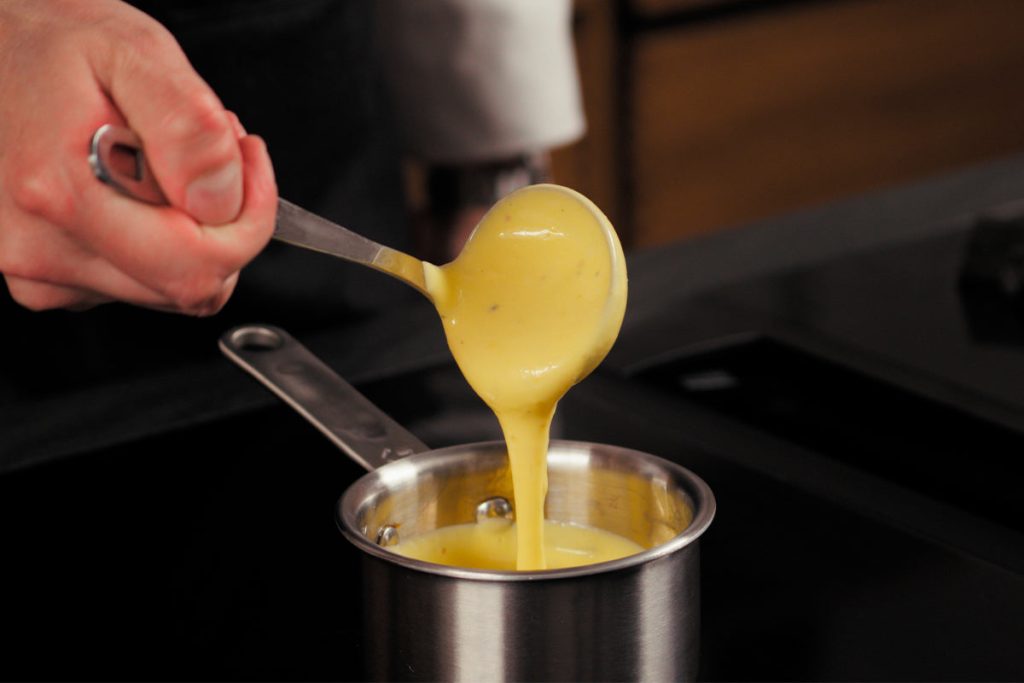
Mastering emulsion sauce science transforms fragile kitchen instincts into predictable, repeatable culinary excellence at the stove. Every cook eventually experiences the sudden horror of a glossy sauce breaking apart without warning. One second you are whisking a velvety hollandaise or mounting cold butter into a pan sauce reduction, and the next you are staring at a curdled, separated mess of yellow grease pooling above watery sediment. It feels erratic, like culinary witchcraft gone wrong, but it is actually strict physical chemistry playing out across microscopic droplet boundaries.
Great pan sauces, mayonnaise, and emulsified butter suspensions are neither fragile accidents nor genetic gifts passed down to lucky French sauciers. They are colloidal dispersions governed by thermodynamics, shearing mechanics, and surfactant chemistry. When you understand the forces pulling liquid droplets apart and the mechanical actions needed to bind them together, kitchen anxiety evaporates completely. You stop praying to the culinary gods and start manipulating droplet mechanics with total confidence.
The microscopic tug of war between water and fat
At its most elemental level, emulsion sauce science governs the kinetic standoff between two liquids that stubbornly refuse to mix. Water molecules are polar entities that cling tightly to one another through hydrogen bonds, forming a dense and cohesive network. Fat molecules, in stark contrast, are nonpolar triglycerides. Because nonpolar molecules cannot participate in hydrogen bonding, water actively squeezes them out, forcing oil droplets to gather together in order to minimize their exposed surface area. Left alone in a bowl, oil and water will inevitably separate into distinct strata to achieve the lowest possible thermodynamic energy state.
To overcome this natural separation, you must force one liquid to suspend inside the other as billions of microscopic spheres. In classic culinary sauces, water or wine serves as the continuous phase, meaning the uninterrupted sea of liquid that surrounds everything else. The melted butter, rendered duck fat, or neutral vegetable oil becomes the dispersed phase, chopped into trillions of tiny sub-micron droplets drifting through the watery matrix. Creating that suspension requires immense mechanical energy to overcome interfacial tension, the repulsive force operating at the boundary where fat meets water.
Without a mediator, those freshly shattered fat droplets simply collide and coalesce right back into pools of grease within seconds. This is where surfactants step onto the stage. Molecules like the lecithin found within egg yolks, the caseins tucked inside dairy butter, and the sinigrin compounds inside whole-grain mustard possess a dual nature. They have a hydrophilic head that burrows happily into water and a hydrophobic tail that anchors itself securely into fat. By coating the newly sheared droplets, these amphiphilic agents construct an invisible protective armor that prevents adjacent droplets from fusing together on contact.
The thermodynamic traps that cause sudden collapse
Sauces do not break because they are cursed; they break because one of three critical thermodynamic thresholds has been violated. The most frequent culprit is phase volume overload, a fancy scientific term for putting too much fat into too little water. A continuous liquid phase needs enough physical room to allow suspended spheres to glide past one another without grinding together. The theoretical ceiling for a standard sphere-packing suspension sits right around seventy-four percent dispersed fat. The moment your fat content eclipses that threshold, the microscopic oil droplets are pressed together so tightly that their protective surfactant shields rupture, causing catastrophic coalescence.
Thermal destruction is another unforgiving hazard that sabotages kitchen sauces. Heat speeds up the kinetic movement of water and fat molecules. If a hollandaise or béarnaise climbs past sixty-three degrees Celsius (one hundred forty-five degrees Fahrenheit), the egg yolk proteins providing surfactant stability begin to rapidly denature and coagulate into solid egg curd fragments. Once those proteins fold into rigid lumps, they abandon their posts at the fat-water interface, leaving trillions of butter droplets stranded without protection. The butter instantly slips away into greasy puddles, leaving behind gritty scrambled eggs swimming in clarified oil.
Conversely, plummeting temperatures trigger their own destructive cascade in butter-based sauces like beurre blanc. Butter contains roughly fifteen percent water naturally trapped alongside milk solids and saturated fats. When butter cools below roughly forty degrees Celsius (one hundred four degrees Fahrenheit), its saturated fat molecules begin to recrystallize into rigid lattices. These sharp crystalline structures pierce the fragile interfacial films that hold the emulsion together. This tipping point is precisely where the unforgiving physics of emulsion sauce science catches inattentive cooks off guard, turning a warm, satin pan glaze into a clumpy, curdled sludge before the plate even touches the dining room table.
Four fundamental laws that guarantee flawless kitchen emulsions
When translated into daily kitchen practice, emulsion sauce science boils down to controlling four mechanical levers. You do not need a degree in chemical engineering to command your pans, but you must respect the physical constraints under which liquids coexist. These four proven rules establish an unbreakable framework for any sauce you attempt, whether it is a weekday pan sauce, an aioli pounded in a stone mortar, or an airy sabayon.
Establish the continuous base before introducing the dispersed phase
Never pour fat into an empty bowl or dry pan and hope to blend moisture into it afterward. The continuous water phase must always exist first, establishing a hospitable landing zone where incoming oil can be shattered into suspension. When constructing a mayonnaise, this means whisking your egg yolk with a splash of water, lemon juice, or vinegar into a loose foam before a single drop of oil hits the mixing bowl. When reducing wine or stock for a classic pan sauce, you must leave enough concentrated liquid in the pan to receive the butter.
Attempting to reverse this sequence creates an inverted emulsion, where tiny droplets of water become trapped inside an overwhelming ocean of fat. While butter itself is technically a water-in-oil emulsion, sauce-making demands an oil-in-water suspension. If the water phase is too meager, the surfactant molecules become disoriented, unable to orient their hydrophilic heads correctly across the continuous boundary. If your pan looks dry or sticky before you begin whisking in butter, immediately add a tablespoon of stock, heavy cream, or warm water. You are actively laying down the architectural runway that supports the entire sauce.
Regulate shearing kinetic energy to shatter fat into microscopic droplets
Mechanical shear is the physical muscle that makes emulsion possible. Merely stirring oil into water with a spoon achieves nothing because the broad, lazy movement cannot overcome interfacial tension. You need intense shearing velocity, which tears large pools of liquid fat into microscopic particles measuring between one and ten microns in diameter. The smaller the droplet diameter, the longer the sauce will stay suspended against gravitational settling and spontaneous coalescence.
To maximize kinetic shear, choose your tools based on the viscosity of your mixture. A flexible balloon whisk provides rapid planetary movement across a wide surface area in a curved bowl, shearing liquids between the thin steel wires. For cold pan sauces, aggressive horizontal swirling of a heavy stainless steel skillet creates rotational friction against the pan walls, rapidly disintegrating cold butter. For stubborn or large-batch emulsions like aioli, immersion blenders provide astronomical shear speeds, generating thousands of revolutions per minute that pulverize fat into nano-droplets faster than thermal collapse can occur.
Maintain the thermal goldilocks zone between solidification and denaturation
Temperature control is the high-wire act of classic sauce craft. For egg-based warm emulsions like hollandaise, your working temperature band sits precisely between fifty and sixty degrees Celsius (one hundred twenty-two to one hundred forty degrees Fahrenheit). Below this window, the saturated butterfat thickens into solid grease, reducing the fluidity needed for droplets to deform and disperse. Above this window, egg proteins cross-link irrevocably, expelling water through syneresis and breaking the sauce into curdled grit.
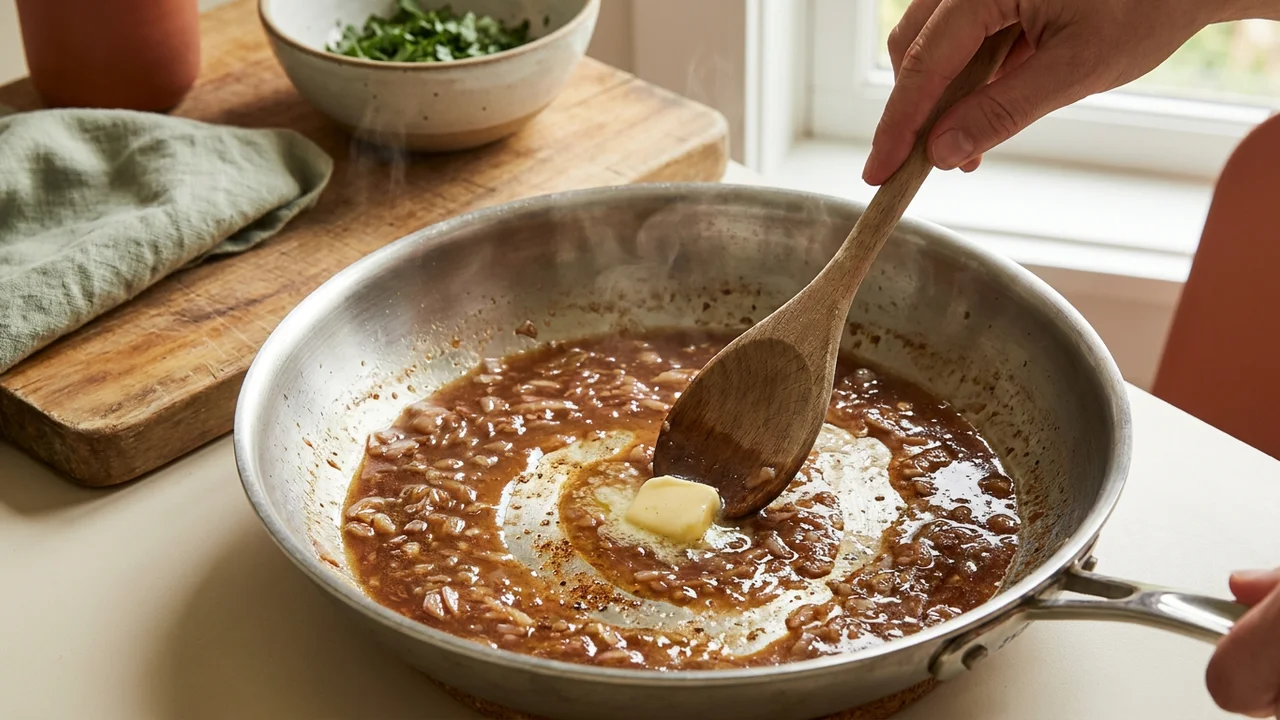
For pan sauces built on reduced stock, the secret lies in cold butter mounting, known traditionally as monter au beurre. Take cold, refrigerated cubes of butter and whisk them directly into a hot, simmering reduction that has been pulled off direct flame. As the cold butter slowly softens, the water and casein trapped inside it are released gradually alongside the fat. The cold temperature keeps the melting fat viscous enough to be drawn into small droplets before it liquefies completely. Boiling a pan sauce after mounting it with butter is the quickest way to ruin your work, as intense bubbling heat destabilizes the fragile casein network.
Introduce natural amphiphilic surfactants to reinforce interfacial films
While mechanical energy shatters fat, surfactants ensure those droplets stay separated forever. Water and oil alone cannot form a permanent emulsion no matter how aggressively you whisk. You must recruit reliable stabilizing molecules to coat the freshly created surfaces. Egg yolks are the most famous source thanks to high concentrations of lecithin and low-density lipoproteins, but modern kitchens draw on a far wider toolkit of natural stabilizing agents that bolster the American Chemical Society analysis of food emulsion interfaces.
Gelatin is the unsung hero of glossy restaurant pan sauces. Rich, homemade bone stocks packed with hydrolyzed collagen provide a dense physical network that thickens the water phase, dramatically slowing the rate at which oil droplets collide. Mustard contains complex mucilage polysaccharides that coat fat globules mechanically, acting as physical spacers between adjacent droplets. Savvy cooks lean into this aspect of emulsion sauce science by reinforcing fragile pans with mustard, garlic puree, or chilled butter scraps rich in casein, taking advantage of natural culinary chemistry by building an impenetrable layer of molecular shields.
Kitchen triage and the mechanics of rescuing a fractured sauce
When unexpected chaos erupts at the stove, inexperienced cooks panic, abandon the station, or toss good ingredients into the trash. It resembles the sudden scrambling in competitive arenas when unexpected emergencies derail a game plan, much like the intense speculation surrounding whether Is DJ Moore Playing Week 5 Bills Face 3 Major Setbacks Before Rams Clash forces coaches to rebuild offensive schematics overnight. In the kitchen, however, you do not need an entirely new roster; you only need fundamental mechanics to regain full control.
Instead of surrendering to panic, a grounded understanding of emulsion sauce science provides an immediate playbook for rapid resuscitation. A broken sauce simply means the dispersed fat has escaped its water cages. To rebuild it, you must reconstruct the continuous water phase in a fresh vessel and re-emulsify the escaped fat back into it. Take a clean bowl, add a single tablespoon of warm water or stock, and begin slowly whisking your broken, separated mixture into the fresh liquid drop by drop. The fresh water provides the open space needed for droplets to disperse without interference, coaxing the separated fat back into a stable colloidal state within sixty seconds.
If the sauce broke because it grew too hot and the egg proteins curled, mechanical whisking alone will not smooth out the solid curds. In that scenario, strain out the coarse egg fragments through a fine-mesh sieve, place a fresh raw egg yolk into a clean bowl with a teaspoon of water, and slowly beat the warm, strained butter mixture into the new yolk. The fresh, uncoagulated lecithin molecules in the new yolk will instantly wrap around the liberated butterfat, restoring the silky sheen of your sauce before anyone at the table notices an issue.
Elevating everyday cooking through pure mechanical fluency
Stepping away from recipe dogma transforms the way you move across the kitchen line. When you stop viewing sauces as delicate, capricious recipes that succeed only by luck, you unlock the ability to construct rich, balanced pan glazes out of whatever ingredients happen to be sitting in front of you. A simple splash of pasta cooking water, packed with gelatinized starches, combined with cold grated pecorino and black pepper creates a cacio e pepe that clings to noodles like liquid silk without ever separating into stringy clumps.
The exact same principles that keep a classic French hollandaise pristine apply when shaking a sharp vinaigrette in a mason jar or whipping up a quick pan glaze from seared pork drippings and apple cider. Ultimately, practicing reliable emulsion sauce science frees you from rigidly following recipe timers that know nothing about your stove. Once droplet mechanics and thermal boundaries become second nature, every sauce you pull from the fire will pour with velvet texture, incredible sheen, and unwavering stability.