Emulsion Stability in Sauces and 4 Proven Rules for Flawless Texture
Few kitchen failures sting quite like watching a glossy sauce split into a puddle of greasy liquid moments before plating. By mastering interfacial chemistry and thermodynamic control, you can guarantee silky consistency across every pan sauce, hollandaise, and vinaigrette you prepare.
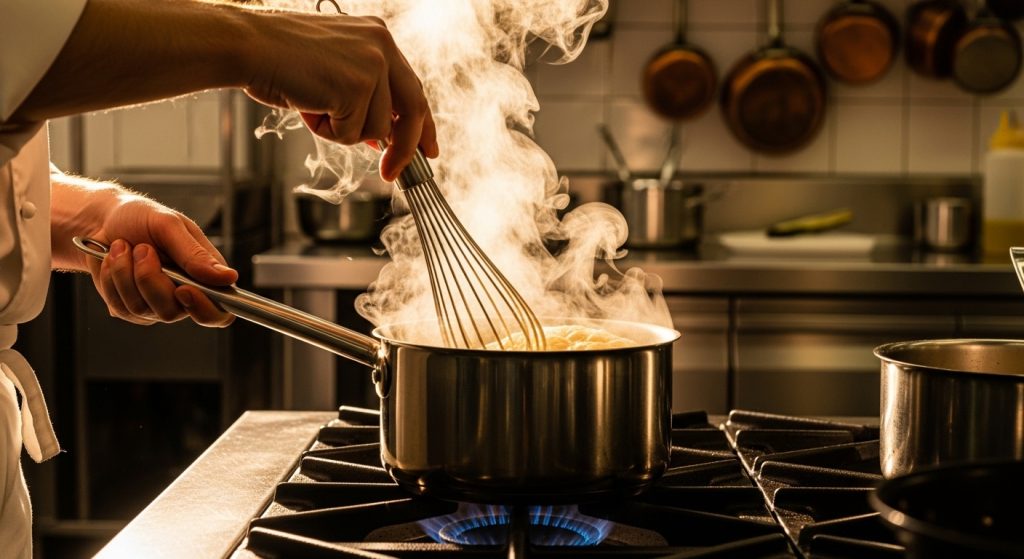
Achieving true emulsion stability in sauces separates an erratic home cook from a genuinely confident culinary craftsman at the stove. We have all stood over a skillet, spatula in hand, watching in disbelief as a satin-smooth pan glaze abruptly curdles into an oily puddle surrounding grainy curd fragments. It feels like an unpredictable betrayal by the ingredients, but food does not operate on mood. Cooking is thermodynamic physics disguised as art.
When you force oil and water to cohabitate, you are challenging fundamental molecular preferences. Left alone, water molecules cling to one another through tight hydrogen bonds, ruthlessly squeezing non-polar lipids outward to minimize interfacial contact area. Building a velvety reduction or an airy hollandaise requires manipulating these micro-scale dynamics so effectively that the ingredients have no choice but to stay suspended. Understanding how mechanical energy, molecular surfactants, and thermal ranges intersect turns sauce-making from a game of chance into a repeatable triumph.
The Molecular Tug of War Between Water and Fat
The underlying physics governing emulsion stability in sauces comes down to interfacial tension between two inherently immiscible liquids. In culinary preparations, one liquid acts as the continuous phase while the other serves as the dispersed phase. In typical gravies, veloutés, and butter-mounted reductions, water forms the continuous highway, carrying billions of microscopic lipid droplets suspended within its grid. In butter itself, the roles invert, trapping micro-droplets of water within a continuous matrix of solid fat crystals.
Creating an emulsion requires work. You must overcome the thermodynamic drive toward phase separation, formally known as interfacial free energy. Every time you whisk melted fat into reduced stock, you sheer large pools of oil into trillions of micro-globules. This process dramatically expands total surface area. Without stabilizing agents present at the boundaries of these droplets, Laplace pressure drives adjacent droplets to collide, merge, and rapidly collapse back into separated layers. Liquid fat seeks the lowest energy state possible, which is always a single, floating slick.
This is where amphiphilic molecules step into the ring. These chemical peacemakers possess a split personality: a hydrophilic head that craves water and a lipophilic tail that burrows eagerly into lipids. As your whisk tears fat apart, these molecules rush to coat each newborn droplet, orienting their lipid tails inward and projecting their water-loving heads outward into the liquid broth. This molecular shield creates steric and electrostatic repulsion, preventing adjacent fat spheres from fusing together when they inevitably bump into one another.
Why Traditional Kitchen Sauces Suddenly Split
Sauces do not break out of malice; they break because one of three critical physical boundaries was violated. Culinary schools often teach students that temperature swings directly dictate emulsion stability in sauces, yet cooks often ignore how rapidly phase separation accelerates once heat exceeds seventy degrees Celsius. Excess heat alters proteins and evaporates water, dismantling the delicate micro-scaffolding that holds fat droplets in place.
The most common culprit behind a shattered pan glaze is simple moisture starvation. As a reduction boils on high heat, water escapes into the kitchen air as vapor, while the fat content remains constant. When the volume ratio of fat to water exceeds roughly three to one, the continuous water phase physically lacks the volumetric surface area required to surround every fat particle. The droplets are crammed so tightly against one another that their protective surfactant barriers rupture, triggering an immediate and catastrophic oily collapse.
Mechanical neglect causes just as many casualties. Dumping two ounces of melted butter all at once into warm wine reduction overwhelms the whisk. Before the cook can shear the incoming lipid stream into micro-droplets, the fat pools together, saturates the local surfactant availability, and floats. Conversely, aggressive heat under egg-based sauces denatures the yolk proteins entirely, forming firm curd matrices that squeeze out moisture like a wrung sponge, a process known to food scientists as syneresis.
Four Proven Pillars That Guarantee Silky Sauces Every Time
Consistently executing rich, mirror-gloss sauces does not require professional kitchen machinery or commercial chemical stabilizers. It demands adherence to four core principles that govern how liquids interact under heat and movement.
The Hidden Power of Mechanical Shear and Droplet Size
When analyzing emulsion stability in sauces, lipid droplet diameter proves to be the ultimate decider of thermodynamic longevity. The smaller the droplet, the harder it is for buoyancy to pull that droplet upward toward the surface, an effect described mathematically by Stokes’ law. A lazy stir with a wooden spoon generates clumsy fat droplets measuring several hundred micrometers across. These clumsy blobs easily collide, merge, and float within minutes.
A fine-wire balloon whisk, or better yet, an immersion blender, introduces intense fluid shear stress. By tearing fat into droplets smaller than ten micrometers, you exponentially increase the viscosity of the liquid. The mixture thickens not because you added starch, but because trillions of microscopic spheres now jostle against one another, physically impeding fluid flow. If a sauce feels thin despite heavy butter content, your droplet size is simply too large.
Amphiphilic Emulsifiers That Anchor Your Sauce
Sufficient surfactant coverage is the bedrock of emulsion stability in sauces, preventing neighboring fat globules from coalescing into an oily slick. Pure fats and plain water will never form a durable bond through mechanical whipping alone; they require natural bonding agents to mediate the boundary. Fortunately, traditional culinary pantries are stacked with world-class natural surfactants.
Egg yolks contribute lecithin, a powerful phospholipid rich in phosphatidylcholine that forms exceptionally tough interfacial membranes. Cold whole butter brings its own built-in stabilizers in the form of milk fat globule membrane fragments and casein proteins. Dijon mustard provides natural mucilage polysaccharides that coat lipid boundaries while thickening the surrounding water. Even deeply roasted meat drippings carry hydrolyzed collagen in the form of rich gelatin, which creates a viscous elastic web that physically blocks fat droplets from sliding toward each other.
Precise Thermal Windows and Viscosity Management
Temperature dictates both molecular mobility and protein integrity. For butter-mounted pan sauces, known in classical French kitchens as monter au beurre, the optimal thermal sweet spot sits strictly between fifty-five and sixty-five degrees Celsius. Within this window, butter fat melts into a pliable liquid while its native milk proteins remain un-denatured, assisting the emulsification process seamlessly.
If you heat the pan past eighty degrees Celsius, the milk proteins scorch and coagulate, while water boils off vigorously, shattering the delicate balance. If the pan drops below forty-five degrees Celsius, butter fat begins to recrystallize into gritty, solid particles that give the tongue an unpleasantly greasy coating. Keeping a pan gently steaming rather than actively bubbling maintains the exact kinetic energy required for long-term suspension.
Phase Ratio Discipline and Continuous Hydration
The sequence in which you introduce ingredients determines whether an emulsion forms or instantly falls apart. You must always establish your continuous water-based phase first, complete with its natural stabilizers, before introducing the dispersed fat. Deglaze your pan with stock, wine, or vinegar, reduce the liquid to concentrate flavors, and ensure a visible puddle of liquid remains before a single drop of fat enters the pan.
Introduce lipids gradually, beginning with small amounts to confirm the initial droplets are fully suspended before increasing the pour rate. If the sauce begins to take on an oily sheen at the edges or appears ropey, it is sending an unmistakable warning signal that the continuous water phase is running dry. Whisking in a teaspoon of cool water or un-reduced stock instantly restores volumetric space, pulling the sauce back from the brink of total failure.
Emergency Resuscitation for Broken Culinary Sauces
Even seasoned culinary veterans occasionally misjudge heat or let an aggressive boil run thirty seconds too long. Troubleshooting failures requires diagnosing why emulsion stability in sauces collapsed under stress in the first place, rather than dumping the pan into the sink. In almost every scenario, a broken sauce can be resurrected in ninety seconds once you apply basic physical countermeasures.
If overheating caused the break, pull the pan off the burner immediately. The fastest emergency fix is thermal shock accompanied by mechanical agitation. Drizzle in a single tablespoon of ice-cold water, heavy cream, or an ice cube, then whisk with intense speed. The cold liquid lowers the temperature below the critical disruption threshold, while restoring the lost continuous phase volume, allowing fragmented droplets to recapture water molecules.
For more research on how interfacial shear and culinary thermodynamics operate under laboratory conditions, explore the Harvard University science and cooking lectures on culinary soft matter. The empirical data confirms what kitchen instincts have long suggested: physical phase ratios outweigh sheer ingredient volume every single time.
When high heat has permanently cooked egg yolks or scorched milk proteins, mechanical whisking alone cannot bridge the gap. You need fresh surfactants. In high-stakes environments, whether navigating volatile kitchen rushes or executing rigorous investigative reporting where practitioners apply Anonymous Source Verification and 4 Proven Safeguards That Prevent Catastrophic Media Blunders to prevent disastrous oversights, verifying underlying fundamentals before acting saves the day. In the kitchen, that means building an entirely new base before attempting to rescue the ruined fat.
Place a fresh egg yolk, a teaspoon of Dijon mustard, or a splash of gelatinous stock into a clean, warm bowl. Whisk it until smooth, then slowly drizzle the broken, oily liquid into this new anchor, exactly as if you were starting a mayonnaise from scratch. The fresh surfactant pool instantly captures the suspended fat, yielding a glossy, perfectly reconstituted sauce that tastes indistinguishable from an uninterrupted batch.
Developing the Intuitive Eye of the Master Saucier
Mastering emulsion stability in sauces ultimately frees you from strict recipe measurements, allowing tactile intuition to take over. You stop looking at timers and start reading visual cues reflected off the surface of the pan. A sauce that is balanced and mechanically sound displays a soft, satiny sheen rather than a reflective, mirror-like gloss of separated oil.
Pay close attention to how the liquid coats the back of a spoon, the classic test known as nappe. When an emulsion is tight, the sauce clings smoothly, parting cleanly when you drag your finger through the center without weeping clear liquid at the margins. Notice the resistance felt through the whisk wires: as micro-droplets proliferate, the liquid develops a buoyant, springy body that feels completely different from watery broths or gelatinous starch slurries.
Once you internalize the balance between dispersed lipids, continuous moisture, and stabilizing surfactants, the fear of curdled gravies and broken butter glazes evaporates. You control the temperature, meter the fat, and wield shear forces with intentional precision. The result is consistently rich, velvety sauces that elevate every meal you set upon the table.