
Distance Running Cadence and 4 Proven Rules That Build Extraordinary Endurance
Optimizing your stride frequency is the most powerful mechanical upgrade in endurance sports. Discover how calibrated turnover reduces impact shock and unlocks effortless speed.

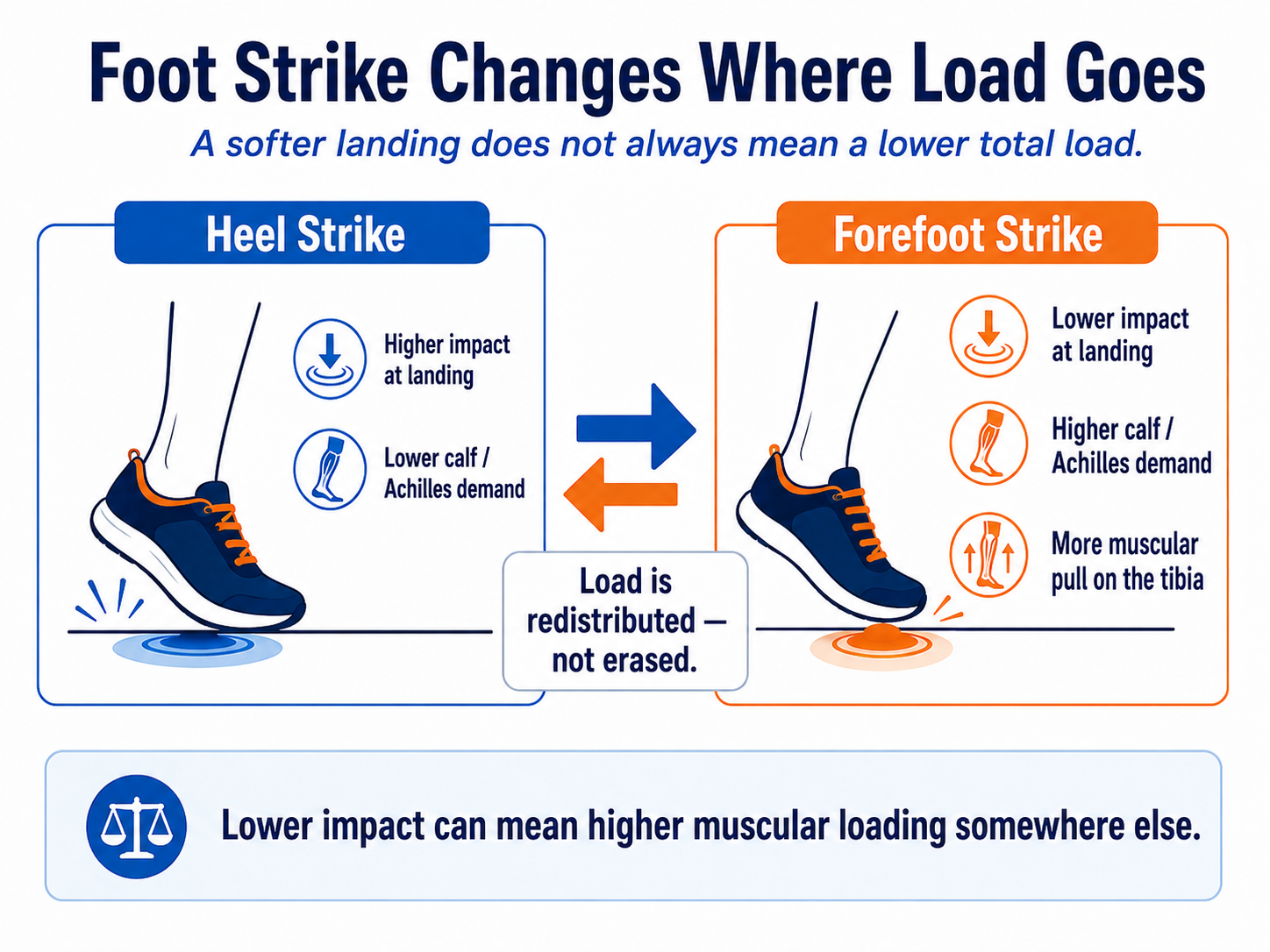
Mastering distance running cadence is the single most effective adjustment an endurance athlete can make to eliminate chronic joint impact and shatter race plateaus. Most recreational runners assume that running faster simply requires reaching further ahead with every single stride, flinging their lower legs forward in search of open road. This intuitive reflex is biomechanically disastrous. Every time your heel crashes into asphalt ahead of your center of mass, your skeleton absorbs a violent braking force that sends shockwaves directly into your patellar tendon, tibia, and hip socket.
Running speed is a simple mathematical product of stride length multiplied by stride frequency. Yet the physiological toll of those two variables is wildly unequal. While artificially lengthening your stride exponentially escalates impact forces and tissue damage, optimizing how rapidly your feet cycle beneath your pelvis transforms running from a series of jarring collisions into fluid, elastic locomotion. Understanding the physical principles governing this turnover separates runners who spend decades competing pain-free from those trapped in unending rehabilitation cycles.
The Physics of Stride Frequency and Ground Impact Forces
When an athlete modifies their distance running cadence, they fundamentally alter how kinetic energy travels up the lower kinetic chain. During human bipedal locomotion, the body functions remarkably like a tuned pogo stick, an engineering concept sports scientists refer to as the spring-mass model. Your leg serves as a compliant biological spring that compresses upon ground strike, stores mechanical energy within the Achilles tendon and plantar fascia, and subsequently releases that stored elastic energy to launch you into the next flight phase.
If your turnover rate is sluggish, your foot remains glued to the ground for too long. Extended ground contact time forces your leg muscles to contract eccentrically to stop your body from collapsing into the pavement. Instead of relying on the free, spring-loaded bounce provided by tendon recoil, your quadriceps and calves must actively burn glycogen to push your body weight back into the air. This mechanical drag burns through metabolic reserves prematurely while subjecting knees and lower back joints to severe vertical oscillations.
Every inch of excess vertical bounce represents wasted energy. Vertical oscillation measures how much your center of mass moves upward and downward during each stride cycle. Running is an exclusively horizontal sport; any biomechanical effort directed toward hoisting your torso into the sky does nothing to cross the finish line faster. Compact turnover keeps your pelvic trajectory flat, level, and gliding effortlessly forward across the ground.
Why the Universal 180 Steps per Minute Metric Fails Runners
For decades, conventional wisdom dictated that optimal distance running cadence sat immutably at 180 strides per minute for every human on Earth. This pervasive coaching dogma originated from observations made by exercise physiologist Jack Daniels during the 1984 Summer Olympics. Daniels noted that of the elite distance competitors he surveyed across various distances, virtually none took fewer than 180 steps per minute. What began as an insightful observational benchmark hardened over time into an unyielding, one-size-fits-all prescription.
The reality of human anatomy is far more nuanced than a single arbitrary number. A six-foot-four marathoner possessing elongated femoral levers operates with entirely different pendulum mechanics than a five-foot-two competitor. Limb length, tendon stiffness, foot strike geometry, and current running pace all dictate an individual’s mechanical sweet spot. Expecting an amateur jogging at an easy ten-minute-per-mile pace to churn their legs at 180 steps per minute often results in an unnaturally frantic, hyperactive shuffle that spikes cardiac output and degrades overall running economy.
Cadence is naturally speed-dependent. Elite distance athletes typically vary their turnover between 168 to 174 steps per minute during relaxed recovery miles, accelerating past 200 steps per minute when launching into an explosive finishing kick. The goal is never to force your body into a rigid mechanical straightjacket, but rather to discover the optimal turnover window that minimizes musculoskeletal loading at your target velocities.
Four Proven Cadence Adjustments That Build Extraordinary Endurance
Fine-tuning your distance running cadence requires an understanding of how lever arms, elastic recoil, and ground reaction timing interact under physical stress. Implementing small, systematic shifts protects connective tissues while cultivating sustainable, effortless race pace.
Calibrating Turnover Rate to Match Anatomical Limb Length
Your skeletal levers establish the baseline physics of your stride. Longer limbs possess greater rotational inertia, meaning it physically demands more metabolic energy to swing a long leg forward than a short one. Rather than obsessing over an arbitrary numerical target, calculate your baseline step rate across various training intensities. For taller athletes, a rhythm between 168 and 174 steps per minute during standard endurance runs may represent peak mechanical efficiency, whereas shorter athletes frequently thrive closer to 180 or 184 steps per minute. The objective is to eliminate sluggish overstriding without driving your turnover so artificially high that your heart rate spikes to support unnecessary limb oscillation.
Shortening Ground Contact Time Through Elastic Tendon Recoil
The fastest runners do not push against the ground with brute muscular effort; they rebound off it. Elite distance competitors typically spend less than 200 milliseconds in contact with the ground during each step, whereas recreational runners often linger for 250 milliseconds or more. To shorten this duration, visualize the road surface as glowing hot coals. The moment your midfoot kisses the pavement, engage your hip flexors and hamstring complex to pluck the foot upward. This rapid unweighting allows the Achilles tendon to act as a tensioned rubber band, snapping the lower leg forward through passive mechanical recoil rather than laborious muscular exertion.
Curbing Braking Forces by Landing Beneath the Center of Mass
By increasing distance running cadence by a modest five to eight percent, a runner naturally shifts the foot strike closer to their center of mass. When turnover is slow, the swinging foot swings forward like an uncontrolled pendulum, landing far ahead of the knee joint. This geometry locks the knee in an extended position, directing destructive ground impact forces directly into the patellofemoral cartilage. A subtle uptick in turnover prevents the lower leg from swinging past the knee before initial contact. As demonstrated in a landmark biomechanical analysis published in Medicine and Science in Sports and Exercise, subtle increases in step rate dramatically decrease energy absorption at both the knee and hip joints without demanding additional metabolic energy.
Progressive Metronome Drills for Neuromuscular Repatterning
Your central nervous system relies on deeply ingrained motor patterns that resist sudden changes. Attempting to overhaul your stride turnover overnight through willpower alone causes mental fatigue and erratic pacing. Instead, use an auditory metronome during short intervals of your training sessions. Set the beat five percent above your natural baseline step rate and synchronize your footfalls to the pulse for two-minute intervals, followed by three minutes of unprompted running. Over several weeks, these auditory cues rebuild the motor pathways governing your leg swing, transforming the adjusted cadence into a subconscious, effortless default.
Measuring Mechanical Efficiency Beyond Step Count
Evaluating distance running cadence in isolation misses the broader mechanical picture of how energy is conserved over two hours of continuous loading. A runner can easily hit a rapid turnover rate while exhibiting catastrophic form flaws, such as twisting their upper torso, swinging their arms across their sternum, or collapsing through their arches. True movement efficiency arises when rapid leg turnover synchronizes with quiet postural stability.
Auditory feedback provides an immediate window into running economy. Efficient runners move with an eerie, whisper-quiet softness across paved roads. If your footfalls sound like heavy wet slaps echoing against the concrete, your turnover rate is failing to absorb and recycle ground forces effectively. Just as sound design in horror films and 4 proven techniques that craft genuine dread rely on subtle acoustic nuance to trigger visceral physical responses, the acoustic feedback of your own stride signals whether your skeletal framework is working in harmony with gravity or waging a destructive war against it. Listening to the tempo and volume of your steps reveals far more about your biomechanics than looking at a wrist-worn monitor.
Modern wearable sensors also illuminate metrics such as duty factor and vertical ratio. Duty factor represents the percentage of each running stride during which your foot remains anchored to the pavement. High duty factors correlate directly with elevated fatigue rates and severe eccentric muscle wear. By keeping your vertical bounce below eight centimeters and shortening contact periods, you preserve glycogen reserves and safeguard fragile joint structures against overuse wear.
Sustaining Rhythmic Precision Over Long Distances
The truest test of mechanical discipline arrives during the final miles of a marathon or long progression run. When glycogen depletes and stabilizing muscles within the hips and core begin to weaken, human stride mechanics naturally regress toward protective survival mechanisms. Runners invariably slow their turnover, let their pelvis drop into anterior tilt, and begin lumbering with extended ground contact times.
Late-race breakdown occurs not because muscular strength vanishes overnight, but because neuromuscular fatigue erodes distance running cadence and forces the skeleton to absorb punishing ground shocks. When you feel exhaustion setting in, fighting to maintain your quick, light foot turnover is your primary defensive shield against catastrophic muscle damage. Shifting your mental focus from pace per mile to rhythm per minute preserves form when fatigue screams at you to collapse.
Building this resilience requires deliberate conditioning of the deep core stabilizers, including the transverse abdominis and gluteus medius. A robust muscular foundation prevents pelvic collapse, ensuring that every subtle increase in turnover translates directly into forward velocity rather than wasted lateral wobble. Treat cadence not as an arbitrary training statistic, but as the underlying pulse that orchestrates every stride, protects your musculoskeletal longevity, and unleashes your peak endurance potential.