Mortgage amortization mechanics expose 4 costly errors that crush household wealth
Most borrowers believe their monthly mortgage payments chip away at debt evenly from day one. Unraveling the hidden mathematics of loan schedules reveals why traditional repayment drains wealth and how to reclaim your balance sheet.

Mastering mortgage amortization mechanics is the single most critical step in preventing retail lenders from quietly siphoning your hard-earned wealth over thirty years. To the casual homebuyer, signing closing documents feels like crossing an emotional finish line. You receive a single, tidy monthly payment figure, assume the balance will melt away predictably, and settle into domestic life. Yet behind that stable monthly remittance sits an aggressive financial algorithm designed to extract the maximum possible interest before you ever build meaningful ownership in the property.
Debt is rarely linear, and the math governing residential real estate loans is intentionally counterintuitive. When you sign a standard thirty-year note, you enter an asymmetrical contract where the bank collects its profit upfront while you absorb nearly all market risk. To reclaim financial sovereignty, you must look directly at the underlying mechanics, understand how lenders engineer payment streams, and dismantle the common habits that keep families trapped in permanent debt cycles.
The Counterintuitive Mathematics Governing Amortization Schedules
When you break down mortgage amortization mechanics, the schedule is not a linear reduction of liability but an exponential curve weighted heavily in favor of the lender. An amortized installment loan utilizes a mathematical formula that fixes your total monthly payment across hundreds of billing cycles while constantly recalibrating the internal ratio of principal to interest. The word amortization itself originates from the Middle English and Old French term for killing off an obligation, but during the first decade of a traditional mortgage, the only thing being systematically extinguished is your free cash flow.
Consider the raw mechanics of an everyday scenario. A borrower secures a four hundred thousand dollar fixed-rate mortgage at an interest rate of six and a half percent over thirty years. The baseline monthly payment for principal and interest sits at roughly two thousand five hundred twenty-eight dollars. In the very first payment, an staggering two thousand one hundred sixty-six dollars goes straight to paying interest charges. A meager three hundred sixty-two dollars actually chips away at the principal balance. The borrower writes a substantial check, yet ninety-eight percent of the original balance remains completely untouched.
Lenders do not do this out of spite. It is the basic function of charging simple interest against a massive, outstanding principal balance. Because you owe the largest sum of capital on day one, the periodic interest assessment on that capital reaches its highest possible nominal value. As the principal drops, the interest charged in each consecutive cycle diminishes by a sliver, allowing a slightly larger sliver of your fixed payment to attack the principal. The progression resembles an agonizingly slow drip that takes decades to turn into an open spigot.
How the Amortization Curve Shifts Wealth Over Time
The foundational design of mortgage amortization mechanics dictates that interest is front-loaded entirely because the outstanding principal balance is at its absolute peak during the initial years. On a thirty-year fixed note at prevailing modern rates, you spend roughly twenty years paying more interest than principal in every single payment cycle. This structural delay creates what financial engineers call the amortization crossover point, the exact month where your payment finally allocates more money toward your personal equity than toward bank revenue.
On that four hundred thousand dollar loan, the borrower does not cross this mathematical tipping point until well into the nineteenth year. By year ten, the homeowner has faithfully transferred over three hundred thousand dollars to the loan servicer. Astonishingly, the unpaid balance still hovers near three hundred forty thousand dollars. If you decide to move, upgrade, or downsize after seven to ten years—which mirrors the statistical behavior of average homeowners—you have essentially operated as an expensive tenant for the lender, paying exorbitant rent disguised as homeownership.
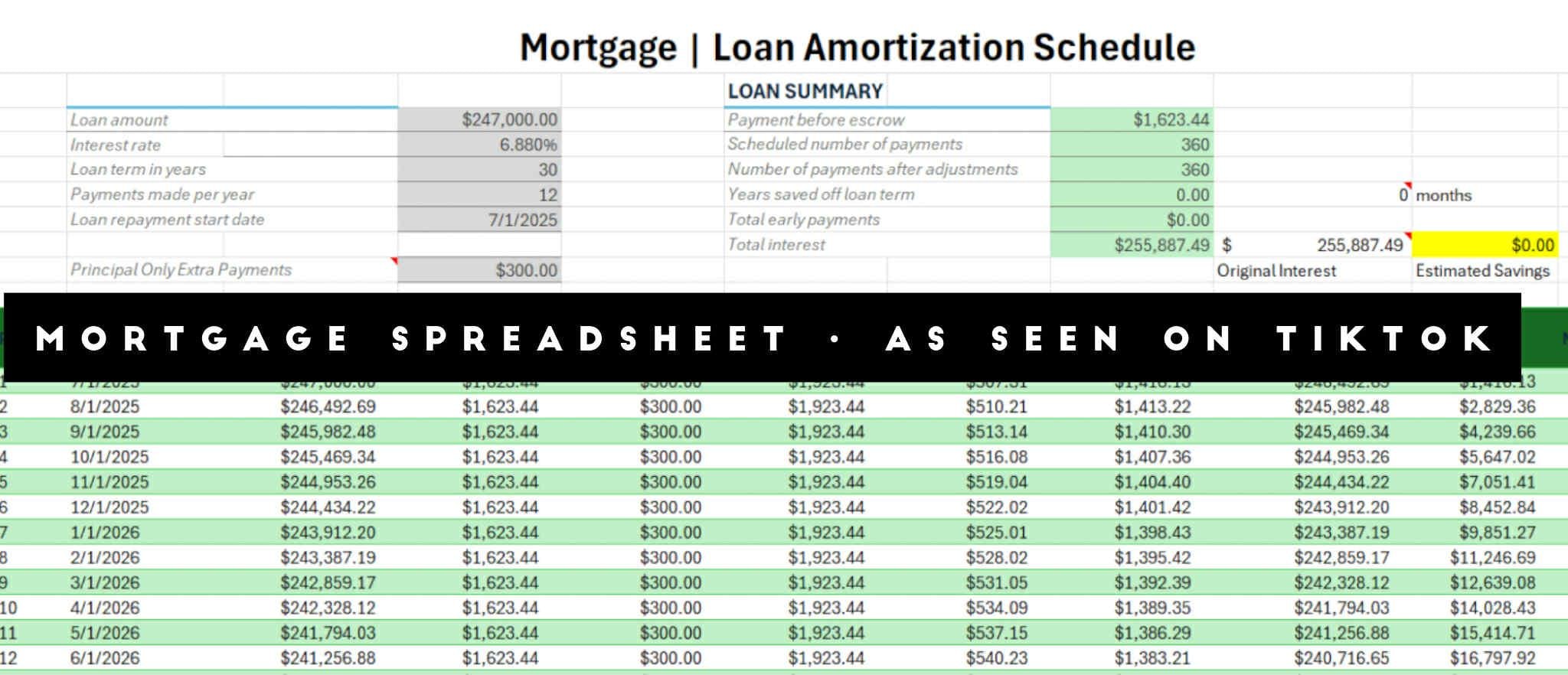
The Consumer Financial Protection Bureau guide on loan amortization structures underscores how crucial it is to examine the total lifetime cost of credit before committing to standard schedules. The dispassionate truth is that banks build their entire profitability model around residential mobility. Because lenders know typical families relocate or refinance every few years, they can repeatedly harvest the lucrative, interest-heavy front portion of an amortization table without ever letting the consumer reach the equity-heavy tail end.
Four Costly Amortization Mistakes That Bleed Homeowner Equity
Ignoring how mortgage amortization mechanics punish early loan resets leads many households into perpetual interest cycles. Borrowers routinely fall victim to standard banking practices and popular financial advice that sounds reasonable on the surface but proves mathematically catastrophic beneath the hood.
Resetting the Payment Clock with Premature Refinancing
The most pervasive trap in real estate involves refinancing a mortgage simply to lower a nominal interest rate by half a percent while restarting a thirty-year amortization clock. Imagine you have diligently serviced a loan for seven years. You have absorbed the most punitive interest payments and are finally entering the steep part of the equity accumulation curve. A loan officer calls with tempting news that mortgage rates have dropped slightly, offering a transaction that lowers your monthly payment by one hundred dollars.
What the loan officer rarely emphasizes is that resetting the clock back to month one completely wipes out your seven years of hard-won progress along the amortization curve. By extending the term back out to three hundred sixty months, you throw yourself back into the interest-dominant meat grinder. The total interest you pay over the combined life of both loans often eclipses the minor monthly cash savings by tens of thousands of dollars. Unless you refinance into a shorter term or maintain your previous higher payment amount, an interest rate reduction can easily morph into a massive wealth transfer from your pocket to the bank.
When market conditions shift, media outlets whip borrowers into a frenzy of speculative panic. Just as breaking news verification mechanics reveal 4 proven rules to stop dangerous deception, evaluating a refinancing proposal demands verifying the hard numbers rather than succumbing to emotional headlines or marketing promises of short-term relief.
Making Random Lump Sum Prepayments Without Principal Designation
Homeowners often believe that sending an extra check whenever they have spare cash will effortlessly dissolve their balance. Unfortunately, without explicit administrative instructions, loan servicing software frequently mishandles auxiliary capital. Many servicers automatically park unassigned payments into an unearned escrow holding account or categorize them as an advance payment on next month’s scheduled bill.
When a servicer applies extra cash as an early standard payment, they are pre-paying both future interest and future principal, completely negating the benefit of your prepayment. Mastering mortgage amortization mechanics requires recognizing that every dollar prepaid in year three carries quadruple the compounding punch of a dollar paid in year twenty-three, but only if that dollar is definitively coded as a principal-only curtailment. Every dollar that slashes current principal permanently kills off the interest that would have compounded on that dollar for the remaining life of the mortgage.
Ignoring the Silent Drag of Extended Forty Year Loan Terms
In response to home affordability crunches, financial institutions frequently promote extended loan horizons spanning forty years. While stretching a loan across four decades nominally reduces the monthly cash outflow, it dramatically distorts the underlying mathematics. The initial principal reduction grinds to a near-total halt.
In a forty-year amortization structure, virtually every cent paid during the first fifteen years serves purely as rent for the underlying debt. The borrower builds negligible equity through debt paydown, relying entirely on speculative market appreciation to gain net worth. If home prices stagnate or experience a cyclical contraction, borrowers on extended amortization structures face immediate negative equity because their scheduled payments did virtually nothing to create a financial buffer.
Failing to Leverage Strategic Amortization Recasting
A staggering percentage of homeowners have never heard of an amortization recast, leading them to pay thousands in unnecessary closing costs through refinancing. If you receive an inheritance, a business windfall, or liquidate a non-housing asset, dumping that lump sum into your mortgage reduces the total balance, but your servicer will still demand the exact same monthly payment amount the following month unless you request a recast.
An amortization recast allows you to make a significant principal reduction and pay a small administrative fee—typically a few hundred dollars—so the bank recomputes your remaining schedule over the existing term. Unlike refinancing, a recast does not change your interest rate, does not reset your remaining loan months back to thirty years, and does not require extensive underwriting appraisals. It simply realigns your monthly cash flow with your newly lowered principal balance, giving you breathing room while preserving your place on the curve.
Practical Countermeasures to Accelerate Equity Accumulation
Escaping the predatory physics of early loan amortization does not require winning a lottery or earning double your current salary. It requires altering the frequency and structure of your cash deployments. By altering the rhythm of your payments, you disrupt mortgage amortization mechanics to slice nearly half a decade off a conventional note.
The simplest and most elegant tactical countermeasure is the bi-weekly payment framework. Instead of remitting a single monthly payment twelve times per year, you divide your monthly payment in half and pay that figure every two weeks. Because there are fifty-two weeks in a year, you execute twenty-six half-payments, which equates to thirteen full monthly payments annually.
That single extra payment per year operates entirely as an unencumbered assault on the principal balance. Because it bypasses the interest filter, that thirteenth payment attacks the core debt when it is most vulnerable. On a standard thirty-year loan at modern interest rates, this painless shift alone shaves between four and six years off the total duration and saves seventy to one hundred thousand dollars in interest charges. You achieve these monumental balance sheet gains without altering your standard standard of living or budgeting habits.
The Psychological Shift from Debt Service to Asset Sovereignty
The modern retail banking apparatus is constructed around the philosophy of perpetual debt service. Mortgages are marketed as static monthly living costs alongside electric bills and grocery runs. When you view a mortgage merely as an inevitable utility expense, you surrender financial leverage to institutions that rely on your inertia for their quarterly earnings.
A home is simultaneously a shelter and a leveraged financial instrument. Treating it with mechanical rigor transforms how you prioritize capital. When you understand that early payments carry exponential value compared to late-stage payments, you stop viewing discretionary savings as inert cash and start viewing it as an instrument to extinguish high-cost amortized drag.
Ultimately, taking command of mortgage amortization mechanics shifts your family balance sheet from defensive debt survival to genuine wealth sovereignty. It allows you to build real equity rather than illusory paper gains, protects your household against real estate downturns, and ensures that when you make your monthly payment, you are building an enduring personal fortress rather than funding an institution’s profit ledger.