Bond Duration Mechanics and 4 Proven Rules That Prevent Devastating Portfolio Losses
Fixed income security is an illusion when rising interest rates crush bond prices. Discover how bond duration mechanics and 4 proven rules protect portfolios from catastrophic yield shocks.

Mastering bond duration mechanics transforms how an investor views fixed income, turning an opaque sea of yields into a precise physical engine. Many market participants equate safety with maturity dates, blithely assuming that holding a high-grade note guarantees capital protection simply because the issuer will honor its contractual obligations at redemption. This illusion evaporates the moment interest rates fluctuate across the broader economy. Duration is not merely an alternative expression of calendar time; it represents the fulcrum of financial sensitivity, dictating the exact percentage by which a portfolio’s market value will surge or plummet for every single point of interest rate movement. Without this metric, an allocator flies blind through monetary turbulence.
When central banks alter their benchmark targets or macro liquidity contracts, long-term bonds act less like predictable cash flows and more like leveraged equities. Fixed income assets do not move in lockstep, nor do their prices decay in a smooth linear arc. Understanding how duration works at a granular, mathematical level allows investors, treasurers, and analysts to construct robust balance sheets that withstand inflationary spikes and yield curve shifts. It separates passive spectators from deliberate allocators who understand that yield without duration analysis is simply an unhedged gamble.
Why Most Investors Misunderstand Fixed Income Volatility
Headlines and retail brokerages routinely describe government and corporate debt as the conservative ballast of a balanced portfolio. This framing breeds complacency. The average investor looks at an investment-grade bond and sees two primary parameters: coupon rate and maturity year. If a bond pays four percent annually and matures in twenty years, conventional wisdom suggests collecting regular interest distributions while waiting for the full principal to return at par. What this simplistic framework misses is the devastating impact of interim repricing.
A bond is an exchange of immediate capital for a rigid series of future cash flows. When macroeconomic conditions change and newly minted bonds offer higher yields, the existing fixed payments suddenly lose their competitive luster. To make the older bond appealing to new buyers, its secondary market price must fall until its effective return matches prevailing market conditions. The longer those fixed payments remain locked in the distant future, the harder the bond’s current trading value must crash to compensate for the rate difference.
When market participants ignore core bond duration mechanics, they confuse nominal security with capital preservation. A sovereign debt instrument carries virtually zero probability of default, yet a multi-percentage-point jump in yields can easily wipe out a third of its market value within months. Investors who panicked during historic yield surges did not suffer from credit defaults; they suffered from catastrophic duration exposure. Their portfolios were over-leveraged to interest rate sensitivity while masquerading as safe havens.
The Hidden Physics Behind Cash Flow Timing and Sensitivity
To tame this volatility, one must understand how cash flow distributions create a financial center of gravity. Frederick Macaulay introduced duration to solve a fundamental accounting problem: comparing two bonds with the same maturity date but completely different coupon structures. If Bond A pays an eight percent coupon over ten years while Bond B pays a two percent coupon over ten years, treating both instruments as ten-year risks is mathematically absurd.
Bond A delivers substantial cash flows early in its lifespan, returning a significant portion of the initial investment long before the final maturity date. Bond B hoards the vast majority of its total return for the final redemption payment. Macaulay duration quantifies this distinction by calculating the weighted average time until all expected cash flows are received, weighting each payment by its present value. A zero-coupon bond, which pays nothing until the final day, has a Macaulay duration exactly equal to its maturity. Every coupon payment pulled forward shifts the center of gravity closer to the present, shrinking duration and moderating sensitivity.
Diving deeper into bond duration mechanics reveals that cash flows received in year two carry radically different present-value implications than cash flows delivered in year twenty. Modified duration takes Macaulay’s foundation and adjusts it for the current yield to maturity, establishing a direct linear estimate of price sensitivity. If an aggregate portfolio possesses a modified duration of seven years, a one percent hike in benchmark yields drops the portfolio’s market value by approximately seven percent. Conversely, a one percent drop in yields boosts capital value by seven percent. This linear approximation offers a reliable first-order estimate, but real-world markets rarely behave in neat straight lines.
Four Proven Rules to Master Fixed Income Yield Cycles
Applying bond duration mechanics across shifting macroeconomic regimes demands operational rigor rather than speculative forecasting. By adhering to time-tested portfolio principles, allocators transform duration from an existential threat into an engineered tool for wealth preservation and capital growth.
Calculate Macaulay Duration to Unmask True Capital Recovery Timelines
Relying exclusively on calendar maturity guarantees a distorted view of liquidity and capital risk. Prudent fixed income management begins with mapping the cash-flow weighted time horizon across every individual holding. Investors must examine coupon frequency, payment magnitudes, and reinvestment assumptions to establish the true economic midpoint of the investment.
When market yields climb, low-coupon debt experiences far harsher price declines than high-coupon debt of identical maturity because the cash-flow fulcrum sits further out on the timeline. Calculating Macaulay duration allows allocators to see through the nominal maturity facade, pinpointing precisely when capital is returned and ready to be redeployed into higher-yielding opportunities. This metric strips away marketing narratives and exposes the raw economic duration embedded inside corporate credit structures and sovereign issues alike.
Exploit Convexity as a Dynamic Buffer Against Severe Rate Hikes
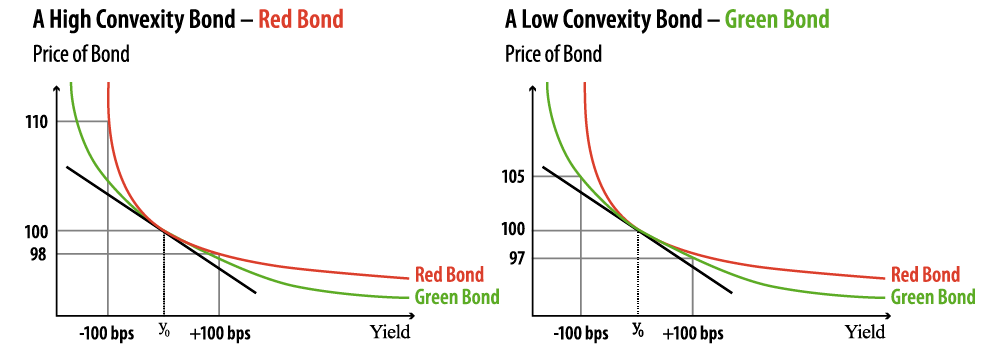
Modified duration assumes a straight-line relationship between price and yield, but the actual pricing function of an option-free bond curves upward. This natural curvature is known as convexity. When yields drop significantly, bond prices accelerate upward faster than a linear duration model predicts; when yields rise, prices decelerate downward, falling less than expected.
Convexity acts as the shock absorber within sound bond duration mechanics, curbing downside loss while magnifying upside gain. Investors should deliberately seek positive convexity by favoring non-callable issues over callable bonds or mortgage-backed securities, which often exhibit negative convexity. When yields drop on negative convexity assets, borrowers refinance, capping price appreciation and leaving investors exposed to heavy reinvestment risk. Demanding positive convexity guarantees that the portfolio’s duration naturally shortens during market crashes and lengthens during rallies, working automatically in your favor.
Align Asset Liability Horizons to Neutralize Interim Price Swings
Institutional balance sheets maintain solvency by strictly immunizing assets against future obligations. If an insurance firm, pension plan, or individual saver needs to disburse a specific sum in eight years, buying an eight-year maturity bond exposes the entity to reinvestment risk if rates drop, or price risk if forced to liquidate early.
True immunization requires matching the portfolio’s aggregate duration to the exact investment horizon. When duration equals the holding period, the price risk and reinvestment risk offset each other almost perfectly. If interest rates spike, the immediate drop in bond price is counterbalanced over time by the compounding effect of reinvesting coupons at higher prevailing yields. By aligning these time horizons, market fluctuations lose their destructive power, converting volatile debt holdings into a self-balancing cash-flow generation machine.
Construct Barbell and Bullet Structures to Counter Yield Curve Twists
The yield curve rarely moves in a parallel shift where short, medium, and long-term rates change by identical margins. Allocators must deploy deliberate portfolio architectures to exploit steepening, flattening, or inversions. The two primary strategies are bullet and barbell allocations.
A bullet portfolio concentrates duration around a specific intermediate maturity, capturing steady yield while dampening the violent volatility of the ultra-long curve. Conversely, a barbell strategy pairs ultra-short instruments with long-term bonds, completely bypassing intermediate maturities. The short-term paper provides dry powder and immediate liquidity to capture rising yields, while the long-term paper locks in superior duration that explodes in value during sudden recessions or aggressive rate cuts. Choosing between these structures provides the tactical flexibility necessary to navigate evolving macroeconomic environments without making reckless directional bets.
Operational Discipline and the Reality of Systematic Risk
Managing interest rate risk requires emotional detachment and structural preparation. When market cycles turn violent, illiquid secondary markets can widen bid-ask spreads, making portfolio adjustments painfully expensive. Allocators who fail to stress-test their duration exposure before yields move find themselves trapped in forced liquidation spirals, selling distressed assets to meet collateral calls or unexpected redemptions.
True financial mastery requires the same stubborn poise and multi-decade dedication celebrated when Angela Bassett inspires with 4 major triumphs across film and academia; elite practitioners reject instant gratification, refine their craft through turbulent environments, and let mathematical rigor do the heavy lifting. Fixed income is not a venue for speculative gambling or desperate yield-chasing. By grounding asset allocation in rigorous bond duration mechanics, treasurers and portfolio architects insulate their balance sheets from unforced errors. They accept that markets fluctuate, but they guarantee that the underlying mathematics of their portfolio remains tilted toward structural survivability. For those seeking deeper institutional methodologies, reviewing the CFA Institute analysis on fixed income risk and return reveals how professional risk managers model multi-variable curve shifts under extreme stress.
Building Structural Solvency Beyond Nominal Returns
Long-term wealth preservation is rarely about hitting speculative home runs; it is about eliminating systemic vulnerabilities before the storm hits. When cash flows are poorly mapped and maturity dates are confused with economic duration, a sudden swing in central bank policy can dismantle years of capital accumulation. Fixed income is the bedrock of institutional stability, but it demands respect for the physics of discounting.
Ultimately, honoring bond duration mechanics separates vulnerable balance sheets from resilient fortresses capable of thriving across generational credit cycles. By measuring cash-flow timing, leveraging positive convexity, immunizing liability schedules, and structuring portfolios against curve distortions, investors take complete control over their fixed income destiny. Volatility ceases to be a terrifying surprise and becomes an anticipated, measurable, and highly profitable component of an enduring financial engine.