Foley sound design mechanics reveal 4 proven secrets to craft immersive cinema
Behind every bone-chilling snap and intimate fabric rustle on screen lies a physical acoustic illusion. Discover the physical and psychoacoustic principles Foley artists use to bring cinematic storytelling to life.

Mastering Foley sound design mechanics unlocks the hidden sensory engine of modern cinema, proving that the sounds making our pulses quicken are rarely what they appear. When a character treads across fresh snow in an arctic thriller, you are not hearing frozen precipitation recorded on location. You are hearing an audio artist squeezing a pouch of cornstarch inside a soundproofed room while watching a monitor. When an action hero breaks an adversary’s arm, the sickening fracture does not come from bone, but from a stalk of celery snapped violently in front of a sensitive condenser microphone.
Film sets are notoriously hostile environments for pure sound. Directional shotgun microphones suspended on boom poles point directly at actors to capture clean, isolated dialogue while intentionally rejecting ambient reflections. The practical props handled on camera are frequently replaced with silent rubber or foam alternatives so that speech remains intelligible. Without post-production intervention, a completed film would present pristine voices floating across an eerie, lifeless void devoid of physical presence or weight.
The Hidden Architecture of Acoustic Deception
Sound operates as cinema’s subconscious narrative track. While visuals demand direct cognitive scrutiny, human hearing functions as an omnidirectional radar system evolved to assess spatial danger, material density, and physical proximity. If an audience member detects an unnatural visual artifact, they might forgive it as artistic license. If an audio cue fails to match physical weight or room acoustics, the brain instantly flags the scene as artificial.
This cognitive sensitivity forms the scientific foundation of Foley sound design mechanics. The human auditory system does not process reality photographically. Our ears do not register every frequency with equal weight, nor do they perceive loudness linearly across the spectrum. When actual physical events are recorded with documentary precision, they often sound thin, underwhelming, and surprisingly fake through stereo or surround loudspeakers.
Authentic footsteps on concrete, for example, typically produce a hollow, flat transient click that lacks narrative presence. A Foley artist reconstructs that footstep not by copying nature, but by engineering an acoustic caricature that fulfills what the human brain expects to hear. By combining heavy work boots, a specialized floor surface composed of aggregate stone, and precise heel-to-toe kinetic weight transfer, the sound designer creates an idealized acoustic event that feels undeniably genuine.
Inside the Curated Chaos of the Foley Pit
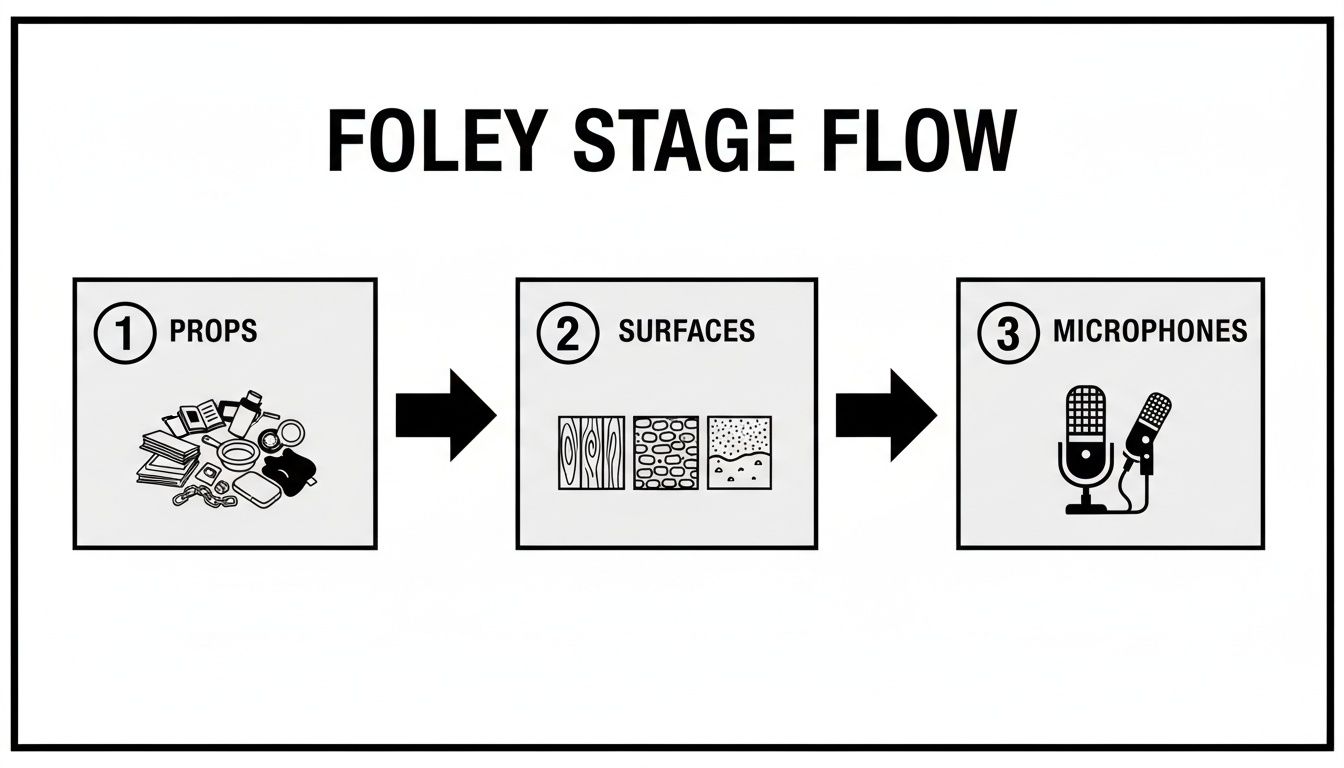
Step onto an elite scoring and audio production stage, and you will encounter an environment that resembles a theatrical salvage yard rather than a high-tech studio. Built into the floor are distinct recessed pits filled with varied textures, including crushed pea gravel, fine beach sand, weathered pine floorboards, paving flagstones, and marble tiles. Surrounding these pits are shelves crammed with seemingly random artifacts such as vintage telephone cords, rusted car door latches, antique roller skates, leather coats, and water tanks.
While synthetic sound libraries contain millions of pristine digital audio files, practical Foley sound design mechanics rely on bespoke physical materials because human movement is intrinsically non-linear. No two human footsteps sound identical. Walking across a room involves minor shifts in balance, momentum, shoe sole elasticity, and floorboard friction. Pre-recorded digital samples, when repeated across a continuous sequence, inevitably suffer from the unnatural repetition often dubbed the machine-gun effect.
A human Foley artist watches the actor on a projection monitor, holding identical materials and matching the visual performance frame for frame. They breathe with the actor, pause with the actor, and transfer their physical body weight to match the performer’s kinetic energy. This bodily empathy translates into acoustic micro-variations that digital algorithms struggle to replicate.
Four Fundamental Secrets That Bring Movie Audio to Life
The craft of post-production sound recording balances raw physical performance with acoustic engineering. Examining these four Foley sound design mechanics illustrates how auditory illusion functions at the highest levels of entertainment production.
Textural Exaggeration Over Literal Accuracy
The primary mandate of tactile audio is not literal documentation, but psychological resonance. Everyday objects routinely produce sounds that fail to convey their emotional impact on camera. A sharp switchblade opening in real life generates an underwhelming metallic tick. In cinematic storytelling, that switchblade requires a menacing, resonant slide followed by an emphatic, heavy latch click to communicate lethal danger.
Artists accomplish this by combining unrelated organic materials to synthesize complex textures. Snapping frozen romaine lettuce or thick celery ribs delivers the initial high-frequency transient of breaking cartilage, while twisting a soaked chamois cloth produces the wet, visceral low-frequency resonance required for impact scenes. Just as the physical balance in culinary emulsion mechanics reveal 4 proven secrets to craft flawless velvety sauces through thermal and kinetic control, Foley artists manipulate raw kitchen textures to engineer sound illusions that bypass conscious skepticism. Physical materials become an acoustic palette where density, moisture, and elasticity substitute for visual reality.
Micro-Temporal Sync and Human Imperfection
Amateur audio editors often make the mistake of snapping recorded transients perfectly to the exact video frame where an object makes contact. Counterintuitively, mathematical alignment produces an uncanny sensation where sounds feel detached from the screen. Light travels significantly faster than sound, and human sensory processing incorporates subtle temporal offsets when integrating visual and auditory stimuli.
Foley performers deliberately preserve natural human timing variations. In many sequences, slipping an audio event a single frame earlier or later shifts the perceived weight of the action. A punch sound placed half a frame before visual contact enhances perceived speed and kinetic aggression. Conversely, letting the low-frequency thud of a falling body land a fraction of a second after impact emphasizes inertia and devastating weight. This temporal flexibility remains an indispensable pillar of Foley sound design mechanics in action.
Resonant Mass and Velocity Modulation
A microphone cannot see how much an object weighs, but it instantly registers how physical mass changes an object’s resonant frequency. When an empty coffee mug is placed onto a wooden desk, it rings with a clear, high-pitched acoustic resonance. When a full ceramic mug makes contact, the liquid mass dampens the ceramic walls, dropping the pitch and shortening the decay time.
Master Foley artists manipulate resonant mass through precise hand placement and velocity control. When performing footwear tracks, the artist does not simply strike the ground. They articulate the sole, rolling through the strike to control contact area and frequency distribution. If a character carries emotional exhaustion or grief, the artist lets their heels drag slightly, introducing scraping friction that telegraphs melancholy without dialogue. Sound transmits emotional state through physical friction and acoustic damping.
Spatial Depth and Acoustic Frequency Rolloff
A sound recorded too close to a microphone sounds intimate and immediate, regardless of where the character stands within the camera frame. If an actor is framed in a wide establishing shot fifty feet away, a hyper-detailed, dry sound effect destroys the perspective of the shot. Sound naturally loses high-frequency energy as it travels through atmospheric air, while room reflections increase proportionally relative to direct sound.
Experienced recordists manage spatial perspective during tracking by combining direct spot microphones with ambient boundary microphones positioned far back in the room. By adjusting the physical balance between the direct acoustic signal and the room reflections, the Foley team mirrors the focal length of the camera lens. Sound captures three-dimensional depth when frequency response, air absorption, and spatial reverb match the visual field.
Why Digital Algorithms Cannot Replace Human Performance
With rapid advancements in computer processing, automated audio synthesis, and neural acoustic modeling, digital tools can generate surprisingly convincing sound waves. Software suites can analyze video frames and trigger digital footsteps across defined surfaces. Yet despite massive technological investment, the core tenets of Foley sound design mechanics remain stubbornly analog.
The human voice, body language, and auditory apparatus share deeply entwined biological roots. Modern Audio Engineering Society research on psychoacoustics demonstrates that human listeners detect subtle discrepancies in natural reverberation and transient dynamics far below conscious analytical thresholds. We instinctively sense the difference between a pre-packaged sound file triggered by a timecode marker and an embodied performance driven by a human artist reacting to dramatic tension.
A digital sample library offers perfection, but cinema thrives on expressive imperfection. A character running for their life does not run with uniform footstep intervals. Their cadence stumbles, their heel slips on wet asphalt, their heavy winter coat brushes against their ribs with ragged syncopation. Foley artists act as secondary physical performers, delivering expressive pantomime through acoustic vibrations that no algorithm can intuitively choreograph.
Listening to the World Through an Acoustic Lens
Once you comprehend how post-production sound is constructed, watching movies changes permanently. You begin to notice the delicate rustle of silk when an antagonist shifts in their chair, the dry crunch of leather boots on frozen soil, and the metallic ring of a brass doorknob turning in the dark. You realize that cinema is an elaborate acoustic tapestry where nearly every physical contact has been manually performed, recorded, sculpted, and mixed by hand.
The physical world is an infinite library of kinetic potential waiting to be struck, scraped, and rattled. Celebrating Foley sound design mechanics reminds us that cinema’s greatest illusions do not originate inside digital rendering farms, but inside darkened acoustic chambers where artists stomp in mud pits, snap vegetables, and breathe life into mute moving images.