Sprint acceleration biomechanics reveal 4 proven levers to unleash explosive speed
Explosive speed is determined in the opening twenty meters where raw physics meets technical execution. Discover the exact biomechanical levers that maximize horizontal force and transform sprint performance.

Mastering sprint acceleration biomechanics transforms how athletes convert raw muscular effort into unadulterated forward velocity. While television cameras fetishize maximum upright velocity across the finish line, athletic contests are won or lost in the violent, compressed space of the first twenty meters. The runner who exits the blocks or breaks from a stationary stance with mechanical perfection establishes a kinetic advantage that opponents rarely overcome.
Sprint acceleration is not merely running fast while leaning forward. It is a completely distinct physiological and mechanical discipline characterized by high ground contact times, severe joint angles, and massive horizontal force vectors. When athletes treat the start like an upright sprint, they squander metabolic energy on upward displacement, bouncing into the air while their rivals eat up ground with ruthless efficiency.
The physics of horizontal force generation against the track
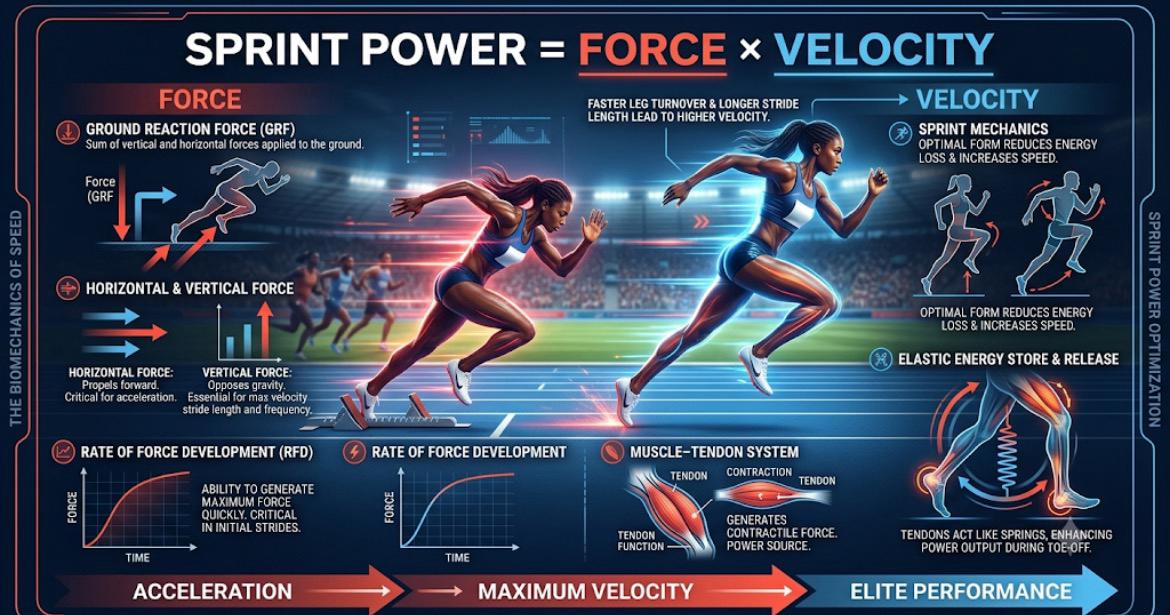
Sprinting speed depends entirely on how an athlete interacts with the earth through ground reaction force. When your spikes strike the track, the surface pushes back with equal magnitude in the opposite direction. During upright sprinting at maximum velocity, most of that force is directed vertically to keep the runner upright and rebound against gravity. In contrast, when evaluating sprint acceleration biomechanics, the decisive variable is not how much total force an athlete hammers into the synthetic rubber, but the precise vector of that force.
Sports scientists quantify this orientation as the ratio of horizontal to total ground reaction force. A sprinter who produces massive vertical force during the initial three steps will catapult upward into the air, creating excessive flight time and halting forward acceleration. Elite starters produce an aggressive backward push that drives their center of mass along a flat, piercing horizontal trajectory. Every millisecond spent airborne during the drive phase is wasted time because an athlete cannot accelerate while suspended in midair.
Generating this horizontal impulse requires extraordinary rate of force development. Ground contact times during the first step out of the blocks hover around 0.18 to 0.22 seconds, which is nearly double the brief contact of top-speed sprinting. This extended window gives the hip extensors, particularly the gluteus maximus and hamstrings, the necessary time to recruit high-threshold motor units and direct muscular tension backward against the track.
The acute angle dilemma and posture management
The iconic visual of a sprinter driving out of the blocks is an unbroken diagonal line extending from the rear ankle through the knee, hip, shoulder, and ear. This posture is not an aesthetic choice crafted by photographers; it is a structural mandate dictated by physics. To push backward against the ground, the body’s center of mass must remain ahead of the base of support.
Athletes frequently ruin their start by mistaking a flexed spine for an acute drive angle. When a sprinter bends at the waist while keeping their shins perpendicular to the track, they collapse their pelvic stability, shorten their hip extension range, and load excessive shearing force onto their lumbar spine. Understanding this posture is central to modern sprint acceleration biomechanics, which rejects the old coaching cue to simply tuck your chin and bend forward.
A true forward lean must originate from the ankle joint through closed-chain dorsiflexion while the entire torso remains an unyielding, rigid cylinder. Just as forensic analysts verify claims against cold data rather than intuition—much like how news verification mechanics reveal 4 proven rules to stop deceptive stories from polluting public trust—track biomechanists use high-speed optical capture to verify that an acceleration angle originates from the ankle rather than a bent waist. When the pelvis locks into neutral alignment, the gluteal muscles fire at peak leverage, propelling the athlete forward without mechanical leakage.
Four mechanical levers that govern explosive acceleration
Translating kinetic theory into repeatable track performance boils down to four distinct technical anchors, and these four mechanical levers govern sprint acceleration biomechanics across every explosive sport.
Positive shin angles and the braking force trap
Every time a foot contacts the ground ahead of the runner’s center of mass, it creates a braking impulse that actively decelerates forward momentum. In early acceleration, avoiding this braking effect requires maintaining sharp positive shin angles, meaning the shin must point forward toward the finish line rather than straight down or backward.
When an athlete strikes the ground with a positive shin angle, the foot lands underneath or slightly behind the projected center of mass. This alignment ensures that the very instant spikes grip the track, the lower leg acts as a propulsive lever rather than a pole-vault brake. Striking with a vertical shin in early acceleration forces the hamstrings to absorb devastating eccentric shock before any propulsive force can even begin.
Triple projection and the myth of prolonged pushing
Coaches have long preached triple extension, urging sprinters to lock out the ankle, knee, and hip joints simultaneously on every stride. While full extension of the drive leg is vital, modern kinematic capture reveals that fixating on an exaggerated push creates sluggish mechanics. The goal is triple projection, meaning the violent push against the track must be matched instantly by an aggressive forward projection of the opposite knee.
If a runner lingers on the ground trying to push through the final millimeter of the big toe, their recovery leg lags behind, forcing their torso to pop upright prematurely. The hip extensors must contract with lightning intensity, finish their impulse, and immediately release tension so the leg can snap forward into the next strike. Acceleration is an alternating rhythm of violent propulsion and rapid recovery.
Piston leg action and the geometry of low heel recovery
At top speed, the runner’s heel sweeps up near the glute in a circular, cyclic motion to shorten the swing leg’s lever arm. In contrast, the first five to seven steps of acceleration demand a linear, piston-like leg action. The foot must skim just above the surface of the track in what biomechanists call low heel recovery.
Coaches who misinterpret sprint acceleration biomechanics frequently demand that sprinters immediately cycle their legs in large circles, but lifting the heel high in the air during the first step wastes precious milliseconds. A low heel path keeps the recovery foot close to the ground, allowing it to reverse direction rapidly and drive back into the track. The legs should operate like industrial pistons punching horizontally, firing backward with relentless piston strikes until upright momentum takes over.
Pre-tensioned foot strikes and the whip from the hip
Ground contact during acceleration is not a passive collision; it is an intentional, aggressive attack. As the recovery thigh reaches maximum forward elevation, the athlete must initiate a violent backward and downward whip of the entire lower limb from the hip joint.
Simultaneously, the ankle must be aggressively dorsiflexed and pre-tensioned, turning the Achilles tendon and plantar fascia into a stiff spring. If the ankle joint goes soft or loose before ground contact, mechanical energy dissolves into the surrounding tissues like stepping into wet cement. A pre-tensed foot that strikes with active backward clawing ensures that the ground reaction force pushes the body forward the microsecond spikes make contact with the track.
Field diagnostics and resisted sprinting protocols
Implementing sprint acceleration biomechanics into an athletic development program requires tools that provide automatic sensory feedback. Athletes rarely learn proper body lean or ground reaction force through verbal cues alone; their central nervous system needs mechanical constraints that force proper kinematics into muscle memory.
Heavy sled towing has emerged as the premier diagnostic and developmental stimulus for early acceleration. High-level peer-reviewed investigations published in the Frontiers in Sports and Active Living biomechanics repository emphasize that heavy sled loads inducing a thirty to fifty percent velocity decrement force athletes into deep horizontal torso angles without compromising extension mechanics. The external resistance artificially lengthens the ground contact phase, allowing sprinters to feel exactly how horizontal ground reaction forces work.
Wall drive drills and hill sprints offer complementary benefits. Charging up a ten-degree incline instantly penalizes bad mechanics; if a runner casts their foot out front or fails to strike with a positive shin angle, their forward momentum collapses instantly. Hill work serves as an unsparing biomechanical coach, conditioning the neuromuscular system to project the center of mass with minimal braking resistance.
Sustaining drive phase discipline when fatigue sets in
The most common failure in competitive sprinting is popping up too soon. Under the psychological pressure of a race, athletes panic when they sense competitors nearby, instinctively raising their heads, dropping their hips, and shifting into upright running long before they have built sufficient momentum. This technical collapse truncates the drive phase and caps the athlete’s eventual top speed.
A flawless acceleration phase is a gradual, imperceptible rise. Each step from the blocks should lift the torso angle by only two or three degrees, unfurling the spine like an unfolding fan over the course of thirty meters. Maintaining an uncompromising grasp of sprint acceleration biomechanics gives athletes the confidence to stay patient during the opening fifteen meters, trusting that their violent horizontal impulses are building an unstoppable wave of speed that will overwhelm opponents down the track.
Great sprinters are not born merely with quick feet; they are forged through an unyielding adherence to mechanical physics. When every joint angle aligns, when every foot strike attacks backward, and when raw muscular power vectors horizontally through the track, speed ceases to be a mystery and becomes an inevitable mechanical consequence.