Options theta decay mechanics reveal 4 essential secrets to stop devastating portfolio bleed
Time decay is not a gentle slope but an accelerating mathematical trap that catches retail option buyers off guard. Uncover how derivative pricing models bleed extrinsic value and discover how disciplined market operators survive the clock.

Understanding options theta decay mechanics is the dividing line between amateur derivative speculators and seasoned market operators who respect mathematics. Almost every novice derivative buyer shares the same haunting experience. You identify an undervalued equity, select a call option, and watch the stock inch toward your target over the subsequent three weeks. Yet, when you log into your brokerage account, the position is down thirty percent. You were directionally right, yet financially decimated. The culprit is neither bad luck nor exchange manipulation. It is the steady, unyielding math of temporal erosion operating behind the bid-ask spread.
An option is a wasting asset with an absolute expiration date. Unlike an equity share that can be tucked away in a drawer for decades while management sorts out operational headwinds, an option contract holds an unforgiving hourglass. Every tick of the market clock removes value, regardless of whether the broader index moves an inch. For those who enter positions without understanding how pricing equations penalize idle capital, the loss is both confusing and permanent.
The Hidden Geometry of Option Value Erosion
To decode how an option loses value, one must split its total price into two separate components: intrinsic value and extrinsic value. Intrinsic value is simple arithmetic. It represents the concrete amount an option is in the money right now. If an underlying equity trades at one hundred and five dollars, a call option with a strike price of one hundred dollars possesses five dollars of intrinsic value. That value is immune to the passage of time. If the stock price stays unchanged until expiration, those five dollars remain intact.
Extrinsic value, commonly called time value, is an entirely different beast. It is the premium an investor pays for uncertainty, volatility, and future opportunity. Extrinsic value represents the probability that the contract will move deeper into the money before the closing bell rings on expiration day. This metric is modeled through partial differential equations developed by Fischer Black, Myron Scholes, and Robert Merton. Within those equations sits theta, the first-order Greek derivative measuring the rate of decline in contract value per day of elapsed time.
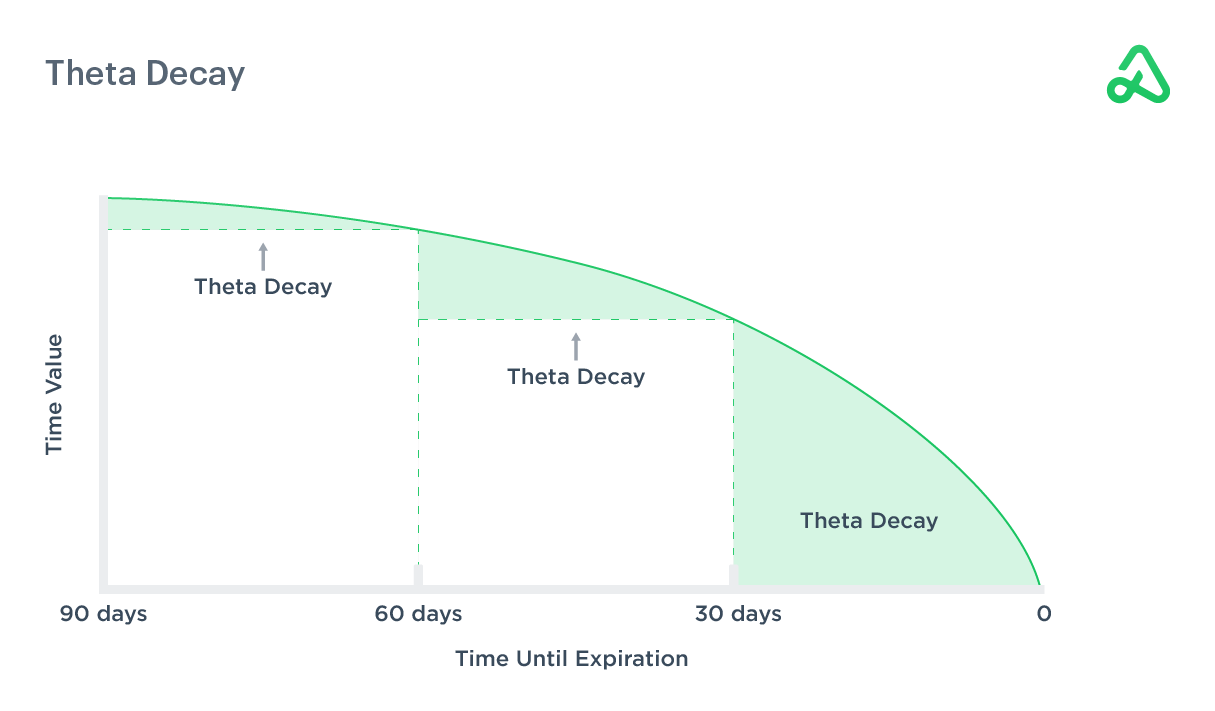
The critical misconception among struggling traders is treating time decay as a linear cost. People intuitively assume that a ninety-day contract loses one-ninetieth of its value each morning. In reality, derivative contracts decay along a parabolic curve governed by the square root of time. Early in a contract lifecycle, time decay is a gentle whisper. As the contract crosses into its final weeks, that whisper turns into a deafening roar. This structural erosion is why studying options theta decay mechanics provides the only realistic defense against the silent vanishing of premium.
Why Calendar Time Bleeds Value Long Before Expiration
Market participants often struggle because human psychology naturally gravitates toward linear progressions. When you drive down a highway at sixty miles per hour, each passing minute covers an identical distance. Options pricing does not operate on a highway; it operates on a gravitational cliff. During the first sixty days of a long-dated contract, the daily theta charge is minuscule. Market makers price the extrinsic value high because the distribution of potential outcomes remains wide open.
As days burn off the calendar without meaningful directional follow-through, the cone of probability narrows drastically. The chance of an out-of-the-money strike becoming profitable shrinks exponentially with every sunrise. When market participants misjudge this slope, the underlying options theta decay mechanics ensure that waiting for a miraculous rebound usually guarantees catastrophic capital destruction.
Four Critical Realities Behind Every Expiring Derivative Contract
Analyzing how options theta decay mechanics behave across shifting market regimes uncovers four vital realities that every trader must commit to memory before executing another order.
The Parabolic Acceleration Curve Beyond Thirty Days
The infamous theta hockey stick is the most dangerous zone on the derivative board. Between ninety and sixty days to expiration, theta decay ticks along at a glacial pace. Between sixty and thirty days, the slope steepens noticeably. Once a contract enters its final thirty days, the decay curve turns near-vertical for at-the-money contracts.
At this stage, an at-the-money option experiences maximum extrinsic value loss per hour. A contract that lost pennies per week two months ago now bleeds dollars per day. Novice traders frequently purchase thirty-day and weekly options because the low dollar premium feels cheap. In financial reality, they are buying the most structurally expensive time on the board. The math demands an immediate, violent move in the underlying asset simply to outrun the daily erosion of the premium.
The Persistent Weekend Decay Illusion
A widespread myth in trading forums suggests that selling options late on a Friday afternoon and repurchasing them early Monday morning generates effortless profit by collecting two days of decay while the market is closed. Traders often assume that Saturdays and Sundays offer free decay, yet options theta decay mechanics are priced continuously into derivative contracts by automated algorithmic market makers.
Institutional desks use pricing models that account for fractional calendar days rather than simple business hours. Market makers anticipate the weekend closure well before Friday afternoon. By mid-day Friday, theta decay for Saturday and Sunday has already been systematically shaved out of the bid-ask spread. Attempting to exploit weekend decay exposes retail accounts to massive weekend headline risk without capturing any genuine pricing edge.
The Double Edged Interplay With Implied Volatility
Theta does not operate in an academic vacuum; it exists in constant friction with Vega, the Greek that measures sensitivity to implied volatility. When an earnings release or regulatory decision approaches, implied volatility skyrockets as market participants rush to buy insurance. This spike in implied volatility can temporarily mask or even overpower the daily losses caused by theta decay.
The danger arrives immediately after the binary catalyst passes. The moment the earnings figures hit the wire, implied volatility collapses in what professional desks call the IV crush. In an instant, the artificial cushion propping up the extrinsic value vanishes. The contract absorbs both the sudden drop in volatility and several days of accumulated theta decay simultaneously, cutting the contract value in half even if the stock moved in the anticipated direction.
Tactical Discipline and the Psychology of Sunk Costs
The most brutal damage caused by temporal decay is psychological. As an option loses thirty, fifty, and then seventy percent of its value, retail traders often freeze. They shift from a speculative mindset to a desperate hope that a late-game rally will restore their original principal. In team athletics, maintaining operational discipline requires understanding when to pull an underperforming asset off the field, just as the strategic benching explored when Armando González Benched in 3 Crucial Olympiacos Clashes as Frustration Mounts demonstrates how tactical restraint beats stubborn overexposure.
In derivative markets, holding a rapidly melting contract out of pure emotional stubbornness guarantees complete capital forfeiture. Recognizing that a setup has failed to trigger within the expected time window requires immediate liquidation. Selling a position for thirty cents on the dollar may sting, but that remaining thirty cents represents the lifeblood capital needed to take the next high-probability setup.
Strategic Defensive Plays to Neutralize the Erosion
Surviving long-term in derivative markets requires shifting your mental model from that of an option buyer battling the calendar to an architect who controls the clock. Retail participants spend years attempting to pick the perfect stock, only to be ruined by the clock because they rely exclusively on buying naked single-leg options.
By constructing multi-leg spreads, seasoned investors learn to harness options theta decay mechanics rather than suffering beneath their relentless downward drag. Vertical debit spreads, for instance, involve purchasing an option with favorable characteristics while simultaneously selling an option further out of the money. The short option acts as an extrinsic anchor. While the long leg loses value to daily decay, the short leg gains value at an identical or even faster rate, effectively sterilizing the worst impacts of the clock.
Similarly, institutional investors frequently lean on comprehensive regulatory risk documentation such as the FINRA investor guidelines on options volatility and risk to benchmark how margin and decay interact during volatile regimes. If you insist on purchasing straight directional calls or puts, the safest operational adjustment is extending your duration. Purchasing contracts dated six to twelve months in advance drastically softens daily decay, granting the underlying thesis sufficient breathing room to develop without constant capital bleed.
Mastering Time as a Finite Trading Asset
Time is the only non-negotiable metric in the financial universe. While a balance sheet can be restructured, a debt facility refinanced, and a corporate strategy rewritten, an options expiration date is carved into granite. When the final bell sounds, every remaining drop of extrinsic value drops to zero.
The traders who consistently capture edge across years of shifting market cycles are those who cease viewing derivative contracts as simple lottery tickets on price. They evaluate the Greeks with the precision of civil engineers inspecting bridge stress loads. They calculate the daily holding cost before entering the order ticket, define their exit criteria based on calendar days as strictly as price levels, and refuse to let stubborn hope override mathematical certainty.
Ultimately, mastering options theta decay mechanics transforms derivative trading from a frantic race against the clock into an engineered discipline of risk management. When you cease fighting the mathematical certainty of temporal decay and begin aligning your execution with its fundamental laws, the market ceases to be an unpredictable casino and becomes a structured arena of calculated probability.