Maillard reaction mechanics and 4 proven rules that create unforgettable savory crusts
Surface browning is not mere color change; it is an intricate molecular explosion of aroma and umami. Discover the exact thermal and chemical mechanics that separate blistered restaurant crusts from gray, boiled disappointments.
Mastering Maillard reaction mechanics separates hesitant home cooks from culinary craftsmen who reliably produce deeply caramelized, savory crusts with intoxicating aromas. Walk past any bustling steakhouse kitchen or French patisserie, and the air smells distinctively electric, nutty, and savory. That seductive scent does not arise from simple burning or gentle simmering. It is the signature calling card of a profound molecular transformation that converts ordinary raw proteins and carbohydrates into complex flavor compounds that linger on the palate long after the meal ends.
Too many home cooks suffer through gray, flaccid steaks, limp roasted vegetables, and pale, insipid bread loaves without understanding why their high-end cookware fails to deliver. The problem rarely lies in the quality of the raw protein or the heat output of the burner. Instead, the failure stems from working blind against the fundamental physics of moisture, heat transfer, and molecular collisions that govern surface browning.
How Thermal Energy and Amine Compounds Collide on the Skillet
At its core, Maillard reaction mechanics encompass a staggering cascade of non-enzymatic browning reactions discovered in 1912 by the French physician and chemist Louis-Camille Maillard. Rather than a singular chemical event, this phenomenon represents an intricate network of hundreds of parallel, overlapping reactions that ignite when reducing sugars encounter amino acids under elevated heat.
When a cut of meat or a loaf of sourdough hits sustained heat above 280 degrees Fahrenheit (140 degrees Celsius), the carbonyl group of an open-chain sugar molecule bonds with the nucleophilic amino group of an amino acid. This fleeting marriage produces an unstable N-substituted glycosylamine, which quickly rearranges through an intricate molecular shift known as the Amadori rearrangement. From this tiny biochemical catalyst, the pathway splinters into a dizzying universe of aromatic compounds, including pyrazines, furans, oxazoles, and thiophenes.
According to American Chemical Society research on flavor chemistry, these reactive volatile intermediates are precisely what our brains register as roasted, nutty, malty, and savory. Without this cascade, a roasted chicken tastes merely of plain boiled poultry. With it, the skin becomes a shimmering, crackling mosaic of umami and complex aromatic depth.
Why Home Kitchens Accidentally Steam Their Steaks Instead of Searing Them
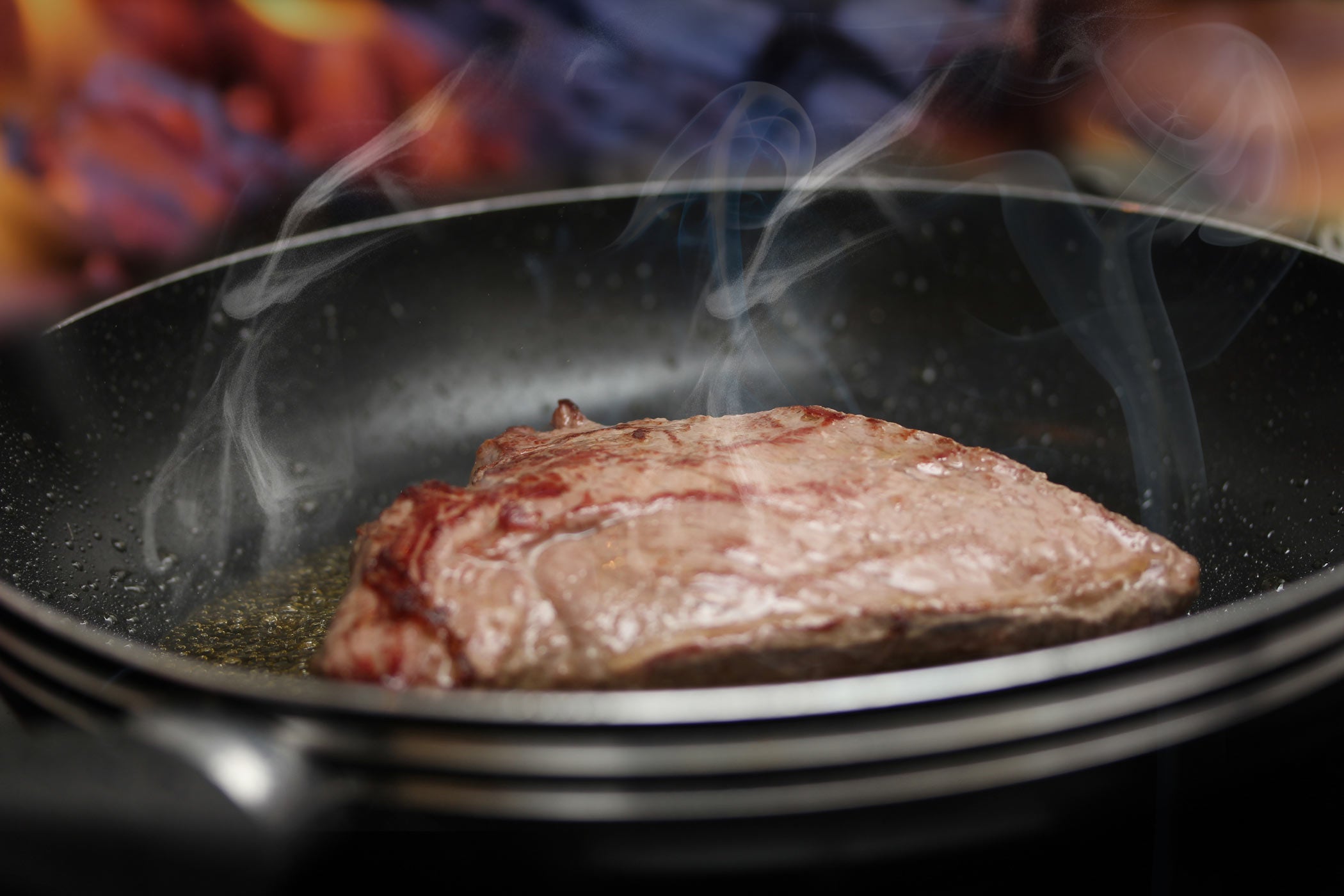
When amateur cooks misunderstand Maillard reaction mechanics, they invariably fall victim to the latent heat barrier. Water is the undisputed arch-nemesis of high-heat browning. Liquid water cannot exist above 212 degrees Fahrenheit (100 degrees Celsius) at standard atmospheric pressure; instead, it boils, transitions into steam, and stubbornly anchors the surface temperature of your food directly at the boiling point.
Because the sugar-amine cascade requires temperatures between 280 and 330 degrees Fahrenheit to accelerate rapidly, any residual moisture on the exterior of a steak or vegetable forces a catastrophic thermal pause. Until every microscopic droplet of surface water completely evaporates, the pan cannot transfer enough kinetic energy to push the protein into browning territory. Your expensive cut of dry-aged beef ends up boiling in its own purged juices, leaving behind a rubbery, drab gray surface devoid of aromatic nuance.
Four Proven Rules That Guarantee Unrivaled Flavor Development
Translating theoretical Maillard reaction mechanics into repeatable kitchen execution demands strict control over moisture, heat capacity, and contact geometry. If you follow these four non-negotiable operational principles, you will banish pale crusts and flabby roasts forever.
Rule 1 Eliminate Surface Moisture Through Unforgiving Desiccation
Blotting a protein with a single paper towel just seconds before tossing it into a smoking pan is entirely inadequate. To strip away the water layer that chokes off crust formation, you must leverage both osmotic dehydration and evaporative cooling well in advance of cooking.
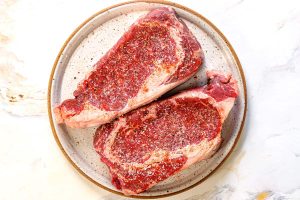
Generously season your meat with coarse kosher salt and place it uncovered on an elevated wire rack inside your refrigerator for 12 to 48 hours. The salt initially draws moisture out of the exterior muscle fibers through osmosis. Over several hours, that concentrated brine dissolves surface proteins and is partially reabsorbed back into the interior, while the constant dry airflow of the modern refrigerator desiccates the outermost millimeter of tissue. The result is a taut, glossy pellicle that browns instantaneously upon hitting the pan, requiring zero evaporative delay.
Rule 2 Maximize Pan Thermal Mass and Complete Surface Contact
Heat transfer is a physical contact sport. When cold meat lands on thin aluminum or stamped stainless steel, the metal instantly dumps its thermal reserves, dropping pan temperatures below the browning threshold. The skillet must possess sufficient mass to act as an immovable thermal flywheel that absorbs the cold shock of raw protein without flinching.
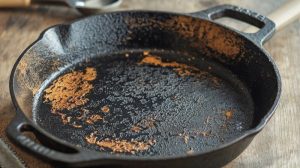
Heavy cast iron and thick carbon steel excel here. Just as mastering cast iron seasoning mechanics and 4 proven rules to build indestructible nonstick skillets builds an unflinching heat sink, respecting Maillard reaction mechanics ensures that thermal energy drives complex browning rather than stalling out. Pair that heavyweight pan with gentle downward pressure using a chef press or flat bacon weight. Meat inevitably curls and buckles as muscle fibers contract, creating microscopic air pockets that insulate the food from heat. Firm, even contact forces the entire surface area against the sizzling metal, creating edge-to-edge mahogany uniformity.
Rule 3 Modulate Heat Input Before Bitter Pyrolysis Destroys the Crust
There is a razor-thin line between sublime golden-brown browning and destructive carbonization. While the sugar-amine dance flourishes between 280 and 330 degrees Fahrenheit, pushing surface temperatures past 355 degrees Fahrenheit (180 degrees Celsius) triggers uncontrolled pyrolysis. At this threshold, delicate flavor molecules disintegrate into bitter, acrid carbonized ash, ruining both the texture and the health profile of the food.
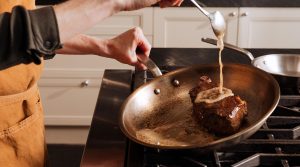
The secret lies in dynamic heat management. Start with intense radiant energy to kickstart initial crust formation during the first two minutes, then throttle the burner down to medium-low or baste vigorously with foaming butter. The water content inside foaming butter helps buffer surface temperatures around 250 to 300 degrees Fahrenheit, while the milk solids suspended in the fat supply additional proteins and lactose that turbocharge browning without crossing the line into bitter burning.
Rule 4 Manipulate Surface Alkalinity to Accelerate Carbon Bonding
The speed of non-enzymatic browning is profoundly dictated by environmental pH. Acidic conditions suppress the browning cascade because free protons bind to amino groups, rendering them neutral and chemically incapable of attacking reducing sugars. Conversely, an alkaline environment strips away protons, leaving amino groups hungry and chemically reactive.
You can exploit this quirk of biochemical engineering to achieve jaw-dropping culinary shortcuts. Dusting sliced onions with a microscopic pinch of baking soda raises their surface pH, allowing you to achieve rich, jammy French onion soup browning in 15 minutes rather than an hour. The same alkaline manipulation explains the gleaming, mahogany shell of Bavarian pretzels dipped in food-grade sodium hydroxide lye before baking. By subtly tilting the pH scale toward alkaline, you accelerate the carbon-bonding cascade at significantly lower temperatures.
Diagnosing Crust Failures and Unlocking Unrivaled Culinary Depth
Troubleshooting your pan work becomes instinctive once you view cooking through the lens of thermodynamics. If your proteins emerge pale with dark, isolated charred spots, your pan surface is uneven, or the oil pooled in low corners while the center bowed upward. Rectify this by using a flat-bottomed pan, distributing a thin film of high-smoke-point oil, and pressing the food flat during the opening thirty seconds of searing.
If you see copious quantities of bubbling liquid surrounding the meat instead of a violent, dry sizzle, your pan was overcrowded. Overcrowding traps evaporating steam beneath the ingredients, transforming a planned sear into an accidental braise. Always leave at least two inches of breathing room between items, cooking in disciplined batches if necessary.
Reading those color transitions gives you direct sensory feedback that your culinary technique harmonizes with Maillard reaction mechanics rather than battling against them. When surface amino acids and simple sugars collide uninhibited by moisture and unchecked heat, the result is unmistakable: a crackling, shatteringly crisp exterior packed with hundreds of newly minted flavor molecules, cradling a succulent, tender interior that commands genuine respect at the dining table.
Developing an instinctive command over Maillard reaction mechanics transforms mundane ingredients into unforgettable gastronomic showstoppers. The next time you reach for a raw ribeye, a head of cauliflower, or a batch of artisan rolls, remember that heat is merely the catalyst. Your true craft lies in managing moisture, thermal mass, and molecular reactivity to coax extraordinary depth out of everyday food.