Tennis topspin mechanics and 4 proven rules that create devastating heavy balls
Pure baseline power does not come from muscle, but from the violent rotational physics of the Magnus effect. Here is how elite players engineer dip, heavy bounce, and effortless depth without wrecking their wrists.

Mastering tennis topspin mechanics is the single greatest evolutionary leap an ambitious baseline player can make on the court. Without spin, every increase in swing speed brings a terrifying exponential risk of sending the ball sailing beyond the baseline. Flat hitters quickly find themselves hitting with defensive hesitation, trapped by the unforgiving geometry of the court. Elite players swing with uninhibited ferocity precisely because forward rotation bends the laws of traditional ballistics, forcing a rapidly traveling projectile to plummet sharply inside the lines before exploding off the court surface.
A genuinely heavy ball does not feel like an ordinary shot when it reaches the opponent. It feels weighted, jumping off the grit of the surface directly toward the recipient’s shoulders, jamming their stroke mechanics, and pushing them into passive court positioning. Unlocking this caliber of penetration requires casting aside obsolete coaching metaphors about gently rolling the wrist or brushing up the back of the felt. Generating modern topspin is a high-velocity physical process rooted in structural alignment, fluid dynamics, and precise kinetic uncoiling.
The aerodynamics of downward aerodynamic force and the Magnus illusion
Analyzing the physics underlying tennis topspin mechanics reveals that spin is never an ornamental aesthetic choice. It is a fundamental aerodynamic necessity that allows high racquet head speeds to coexist with pinpoint court control. When a tennis ball spins forward at speeds ranging between 2,500 and 3,500 revolutions per minute, the felt on its spherical surface drags a boundary layer of ambient air along with it. This dynamic creates a dramatic velocity differential between the upper and lower hemispheres of the ball.
As detailed in University of Sydney tennis biomechanics research, the forward rotation causes the air stream moving over the top of the ball to collide against the oncoming air flow, decelerating it and producing an area of elevated static pressure. Conversely, the air rushing along the bottom travels in the same direction as the surface rotation, accelerating fluid movement and generating localized low pressure. This differential creates the Magnus effect, generating an aggressive downward vector that forces the ball to drop far faster than gravity alone could ever pull it.
Amateur players often fall victim to the illusion that topspin is achieved by deliberately aiming downward or lifting the ball upward in two separate steps. The Magnus effect accomplishes the downward trajectory automatically. This aerodynamic phenomenon means a player can launch the ball three to four feet over the net with violent forward energy, confident that the invisible hand of air pressure will bend the trajectory back down into the court.
The broken kinetic chain that destroys heavy ball rotation
Far too many intermediate competitors misunderstand tennis topspin mechanics by reducing the entire movement to an isolated, violent wrist flick. This technical error leads directly to chronic medial epicondylitis, wrist tendonitis, and toothless floaters that sit up comfortably in the middle of the service box. A human wrist joint contains tiny, delicate muscle groups completely incapable of generating the torque needed to manipulate a compressed tennis ball traveling at speed.
In a biomechanically sound swing, the arm and wrist do not create the force. They serve merely as conduits that channel, multiply, and deliver energy originated by the ground. The kinetic chain begins with the initial unit turn, where the hips coil against the court surface to store elastic energy in the glutes and core musculature. As the forward movement initiates, that force is transferred upward through the kinetic link from ground reaction force to pelvis rotation, followed by thoracic uncoiling, shoulder elevation, and finally the passive lag of the racquet arm.
When this chain breaks, usually because a player attempts to muscle the stroke with their bicep or aggressively twist their hand at contact, racquet acceleration halts abruptly. The mass of the body disconnects from the ball. Achieving world-class rotational speed requires relaxing the upper extremities so the racquet head lags well behind the hand, storing dynamic whipping potential until the absolute last millisecond before impact.
Four proven rules that turn wristy brushing into heavy baseline power
Bridging the gap between an arm-dominated scraping stroke and executing flawless tennis topspin mechanics requires synchronizing four non-negotiable biomechanical checkpoints.
Establish a steep drop below the contact zone before driving forward
Vertical differential is the foundational prerequisite for forward rotation. If the racquet approaches the ball on a horizontal plane, topspin is physically impossible. Elite ball strikers accomplish this by dropping the racquet head at least twelve to eighteen inches below the intended height of impact during the final preparation phase.
This drop should never be an active muscular push with the hand. Instead, allow gravity and the unwinding of the non-dominant shoulder to create a natural racquet dip. The butt cap of the racquet should point directly forward toward the incoming ball, with the tip trailing behind. This steep vertical separation creates the runway required to accelerate the racquet upward along an inclined plane, guaranteeing that angular momentum will be imparted to the ball upon contact.
Drive directly through the ball along an inclined path before wiping
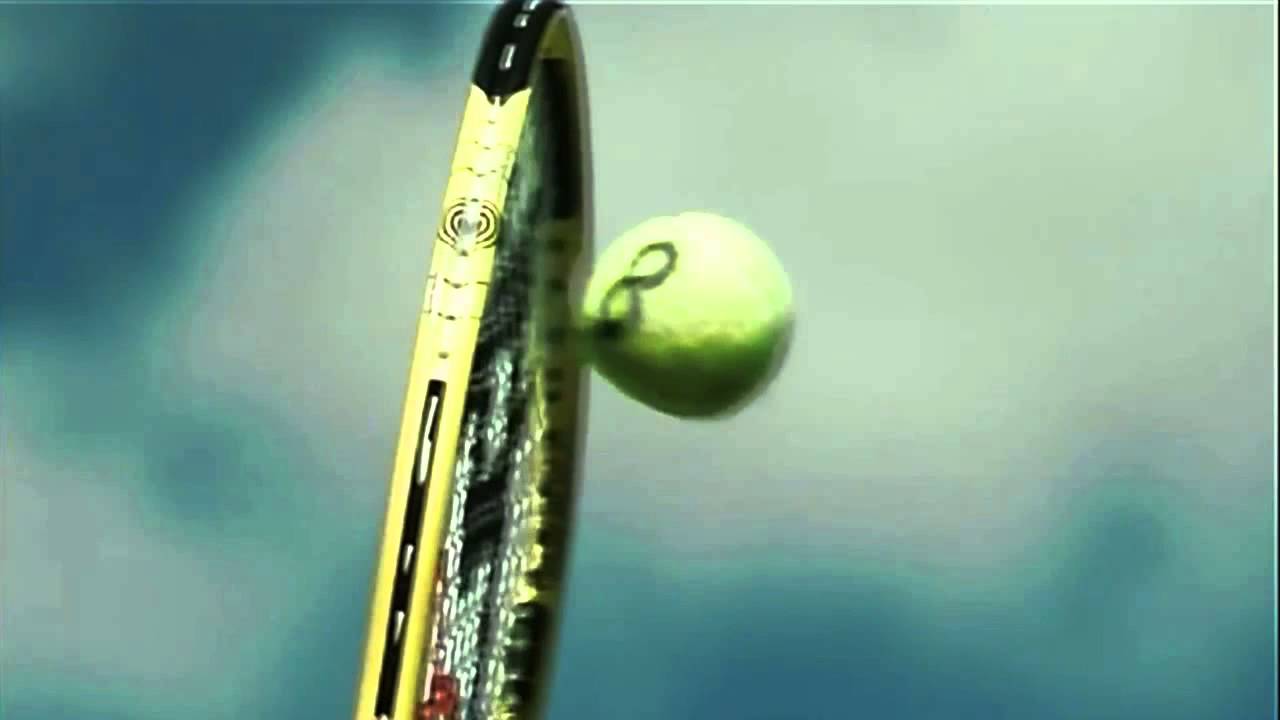
The single most destructive coaching cue in amateur tennis is the command to brush the ball. High-speed cameras prove that during impact, the ball flattens against the string bed for roughly four milliseconds, compressing across multiple main and cross strings. If you simply graze or brush the edge of the sphere, the ball slides off the strings without absorbing core kinetic energy, producing a weak, spin-heavy shot devoid of depth.
Heavy topspin requires you to hit directly through the ball before brushing upward. Imagine driving the string bed straight through the center core of the ball along an upward trajectory angled roughly thirty to forty degrees above the horizontal plane. You must flatten the ball against the string bed with forward momentum while simultaneously swinging upward. This combination of deep pocketing and rapid vertical climb is what compresses the ball, grips the felt, and releases a monstrous combination of linear speed and rotational RPM.
Coordinate forearm pronation rather than snapping the vulnerable wrist
The windshield wiper finish that defines modern groundstrokes is widely misunderstood. Novices watch slow-motion replays of tour professionals and assume the wrist is snapping violently over the top of the ball. In reality, the wrist joint remains relatively quiet and locked in slight extension throughout the entire collision phase to provide stability.
The rapid closure and upward roll of the racquet face is actually produced by internal shoulder rotation and dynamic forearm pronation. As the arm drives up into the strike zone, the forearm naturally rotates from a supinated position into pronation, rolling the string bed over the ball after contact has already been achieved. This physiological rotation distributes violent torque across the larger muscle groups of the forearm and shoulder girdle, preserving the delicate carpal ligaments while multiplying angular head speed.
Anchor dynamic balance against the lead hip through follow-through
Rotational force without structural deceleration creates chaotic, erratic ball flights. For the racquet head to whip violently around the body, the rotational momentum of the core must be anchored against a stable physical hinge. In a semi-open or neutral stance, the lead hip and leg serve as this emergency brake.
As the racquet enters the impact zone, the upward extension of the lead leg halts the forward drift of the body, allowing the stored momentum of the torso to crack the whip through the arm. If your head lunges forward, your upper spine tilts off-axis, or your back foot slides erratically during contact, the racquet head decelerates. By anchoring the dynamic balance over a centered base, your rotational energy has nowhere else to go except directly into the string bed.
Diagnosing swing path errors across hard courts and red clay
Adapting tennis topspin mechanics to differing court surfaces exposes how subtle environmental variables alter swing timing. A stroke that produces a towering, unreturnable bounce on porous red clay can become a liabilities-riddled miscue on slick, fast indoor hard courts where the ball skids through low and fast.
On fast courts, long loopy preparation loops consistently cause late contact points behind the lead hip. When contact occurs behind the body, pronation happens prematurely or not at all, spraying balls uncontrollably wide or into the netting. Fast surfaces demand a more compact preparation drop, an earlier forward drive, and a conscious intention to hit the ball out in front of the body.
Developing this intuitive physical calibration mirrors how precision works in other physical crafts. Just as mastering dry brining mechanics and 4 proven rules that create breathtakingly juicy roasts hinges on deep chemical diffusion rather than rapid surface treatments, authentic topspin demands methodical kinetic sequencing rather than hurried arm adjustments. On high-friction clay courts, you have the leisure of loading your legs deeper, dropping the racquet head significantly further below the ball, and exaggerating the vertical launch angle to send the ball arching deep toward the baseline fence.
Practical training progressions to permanently rewire your muscle memory
Sustainable tennis topspin mechanics cannot be cultivated by simply firing hundreds of unmonitored balls from a hopper. High-speed swing habits must be systematically deconstructed and rebuilt from static positions where the brain can map joint angles without the pressure of spatial movement.
Begin with the static drop-feed drill. Stand in your balanced semi-open stance at the baseline. Hold a ball out at shoulder height with your non-dominant hand, drop it without tossing, and allow it to reach the peak of its bounce. Focus entirely on lowering your racquet below the falling ball, establishing the butt-cap forward orientation, and driving through and up. Pay close attention to the sound. A brittle scrape signals an inefficient brush, while a loud, percussive crack followed by an aggressive forward hiss indicates true string compression coupled with heavy rotation.
Advance to short-court baseline trajectory games where you and a partner trade groundstrokes entirely inside the service boxes. To keep full-speed swings inside those short boundaries, you are forced to rely purely on heavy Magnus-effect rotation rather than dialed-back arm speed. If you slow down your swing, the ball floats long. You must swing fast to keep the ball short, retraining your central nervous system to trust vertical acceleration over defensive deceleration.
When genuine tennis topspin mechanics become automatic muscle memory, the boundaries of the tennis court seem to expand exponentially. The net effectively lowers, the baseline stretches backward, and shots that look destined for the back fence dive sharply inside the lines to torment opponents with heavy, relentless penetration.