Pan sauce emulsion mechanics and 4 proven rules that guarantee velvet restaurant finishes
Discover how surface tension, gelatin matrices, and lipid dispersion turn roasted drippings into flawless glazes. These four fundamental rules banish greasy, split pan sauces forever.
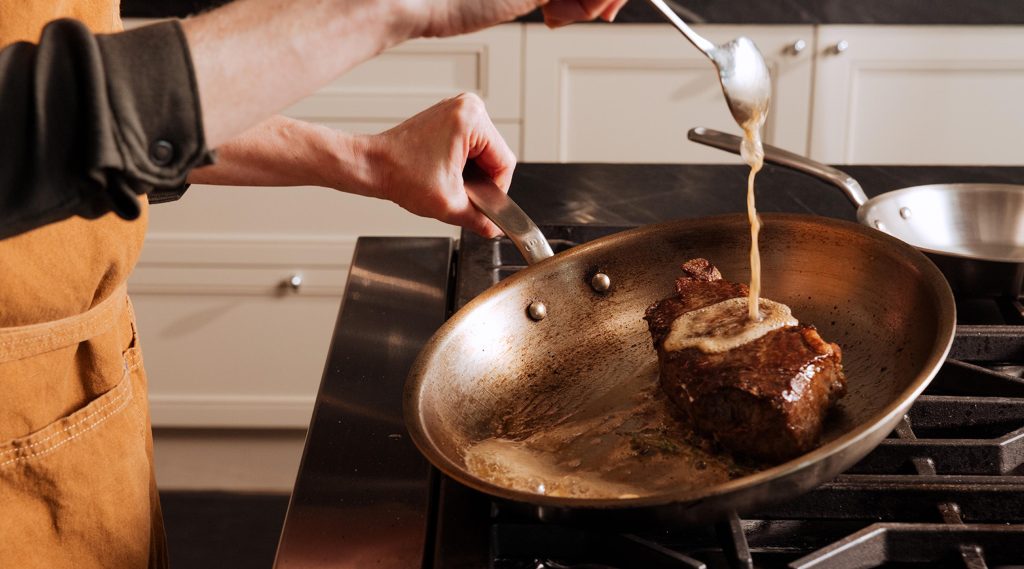
Mastering pan sauce emulsion mechanics marks the defining divide between an amateur scraping grease from a pan and a chef pouring pure silk. Every cook has witnessed the tragedy of a broken reduction. You sear a prime protein to mahogany perfection, set it aside to rest, deglaze the skillet with wine, reduce the liquid, and whisk in cold butter with high hopes. Instead of a glossy, spoon-coating nectar that clings to meat like liquid velvet, your pan separates into a greasy, translucent oil slick floating atop a muddy puddle of acidic sediment. The flavors might be decent, but the texture is ruined.
That heartbreaking failure is not bad luck or insufficient stirring. It is basic fluid dynamics asserting itself against an unprepared cook. When you treat sauce making as an intuitive sequence of tosses rather than an exact physical process, you gamble with thermodynamics. Transforming crusty pan residue and hard dairy fats into a unified, mirror-bright coating requires working with lipid droplet dispersion, surfactant chemistry, and temperature thresholds that dictate molecular stability.
The hidden molecular architecture of a velvet glaze
When you look at pan sauce emulsion mechanics through the lens of colloid science, a sauce is not a uniform fluid. It is a colloidal dispersion known as an oil-in-water emulsion. In this microscopic landscape, microscopic droplets of fat remain evenly suspended throughout a continuous water-based medium. Because oil and water possess radically different electrical polarities, they naturally repel one another. Water molecules are polar and bind tightly together through hydrogen bonding, squeezing out nonpolar lipid molecules. Left to their own devices, suspended fat droplets will inevitably collide, coalesce into larger globules, and float to the surface due to differences in specific gravity.
This natural separation is governed by Stokes’ Law, which explains the settling velocity of particles in a fluid. The rate at which fat droplets separate from your sauce depends directly on droplet diameter, the viscosity of the liquid, and the density difference between the fat and the water base. To prevent a sauce from splitting, you must keep fat droplets as tiny as possible while increasing the thickness of the surrounding liquid. If your lipid globules are sheared down to microscopic dimensions, Brownian motion keeps them suspended indefinitely, resisting the gravitational pull that threatens to break your sauce.
Creating this physical suspension requires significant mechanical energy. Simply tilting the pan back and forth does not produce enough kinetic energy to rupture fat molecules into microscopic droplets. You must force the butterfat and water molecules into such tight proximity that they have no choice but to interact, shearing the fat into droplets measured in single-digit microns. Yet shear force alone cannot preserve this fragile equilibrium. Without chemical mediators to keep those sheared droplets from fusing back together upon contact, your emulsion will disintegrate the moment the whisk stops moving.
The structural trinity that stabilizes pan liquids
A resilient culinary emulsion relies on a delicate balance between water, fat, and surfactants. In a classic pan reduction, the aqueous phase begins with your deglazing liquid, whether that is dry wine, fortified stock, vinegar, or verjus. This component supplies the necessary water volume, volatile aromatic compounds, and bright acidity needed to balance rich fats. The fat phase arrives through rendered cooking oils, roasted marrow, intramuscular lipid drippings, and, most importantly, the cold butter whisked in at the finish.
Surfactants serve as the essential molecular bridge connecting these two incompatible worlds. A surfactant molecule is amphiphilic, possessing a hydrophilic head that loves water and a lipophilic tail that binds to fat. When dispersed throughout a liquid, these molecules coat every individual oil droplet. Their fat-loving tails plunge straight into the lipid core, while their water-loving heads project outward into the surrounding broth. This creates a protective electrical shell around every droplet. When two fat droplets drift toward each other, the exterior charges repel, preventing them from fusing together. This structural triad dictates pan sauce emulsion mechanics at every stage of deglazing and reduction.
In classical restaurant cookery, your primary natural surfactants are gelatin, dissolved milk solids, and caramelized protein fragments known as the fond. As clarified by Harvard John A. Paulson School of Engineering and Applied Sciences culinary physics research, the physical behavior of culinary foams and emulsions relies profoundly on the concentration of these soluble macromolecules. Gelatin molecules, derived from the long, slow hydrolysis of collagen in connective tissues, do more than supply body. They physically weave through the aqueous phase, creating an elastic molecular web that dramatically increases viscosity, slows droplet movement, and locks suspended fats firmly in place.
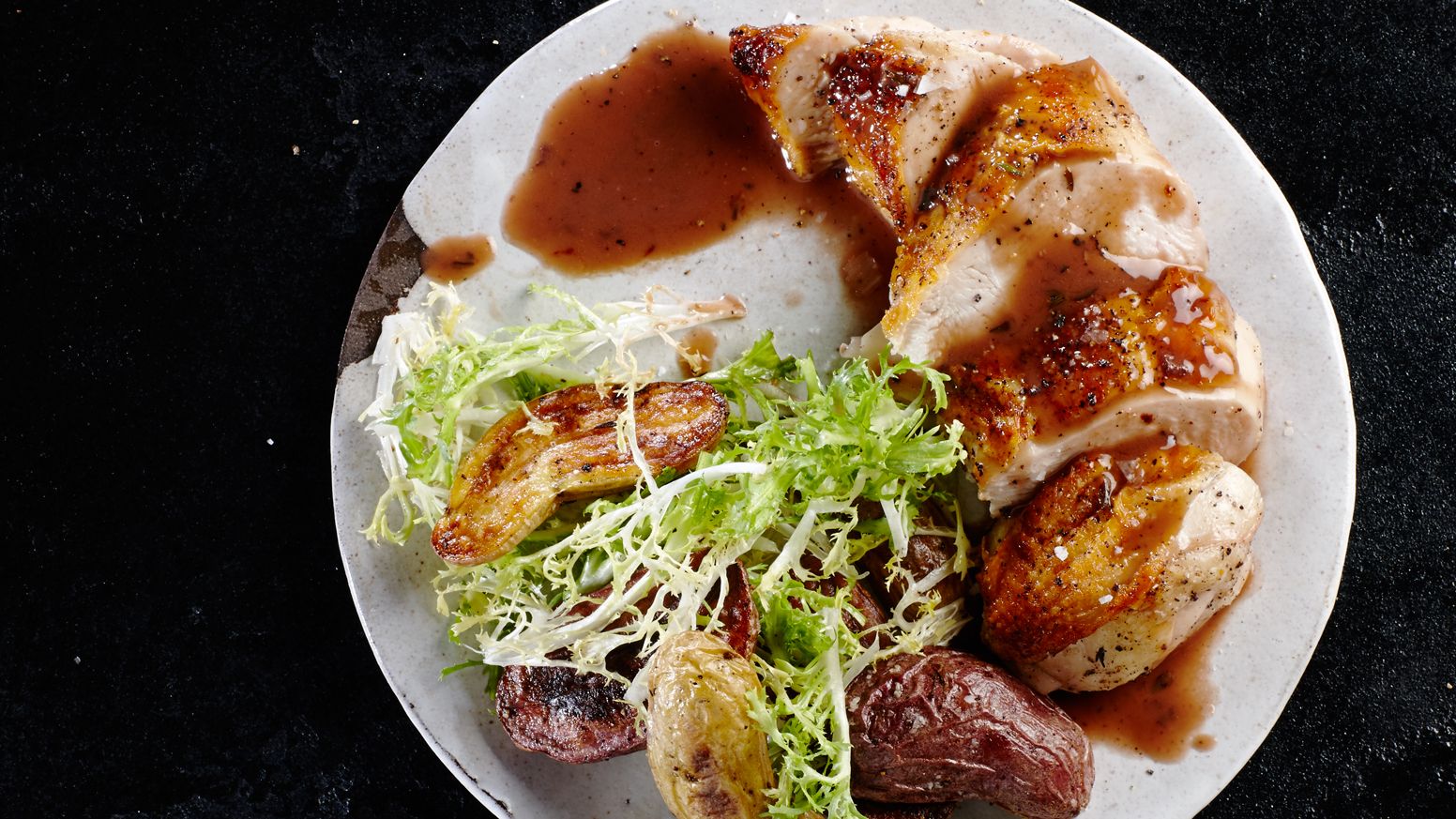
Four proven rules that eliminate broken pan sauces forever
By translating foundational pan sauce emulsion mechanics into actionable muscle memory, you can execute complex reductions without hesitation. Professional line cooks rarely measure their sauce liquids during a rush; instead, they gauge evaporation rates, listen to bubble dynamics, and read pan surface temperatures through visual cues. Implementing the following four operational rules eliminates guesswork and guarantees structural stability every time your pan hits the burner.
Dissolve the caramelized fond before introducing secondary fats
The dark glaze welded to the base of your skillet contains thousands of complex flavor compounds generated through the Maillard reaction and sugar pyrolysis. It also contains denatured proteins that act as rudimentary emulsifiers. However, if you pour rich dairy fat into a pan where the fond remains stuck to the metal, you trap those vital proteins beneath a layer of grease. The fond will scorch, lending a bitter char to the sauce, while the butterfat separates before it ever meets an aqueous binder.
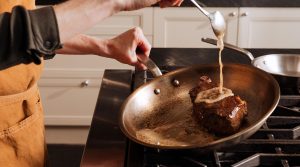
Always pour off any excess grease from your initial sear, leaving only a fine sheen in the skillet. Immediately hit the screaming-hot metal with your cold, acidic deglazing liquid. The sudden thermal shock creates explosive steam that lifts the caramelized proteins off the metal. Use a flat-edged wooden spatula or firm whisk to scrub the bottom clean, dissolving every speck of fond directly into the bubbling wine or broth. This step ensures that all soluble proteins are thoroughly incorporated into the water phase before a single cube of finishing butter touches the pan.
Harness natural gelatin as your invisible safety net
Commercial broths and boxed stocks are little more than salted water infused with industrial flavorings and yeast extracts. They lack the structural collagen found in real stock, making them terrible bases for silky pan reductions. If you attempt to reduce store-bought stock and mount it with butter, you will almost certainly break the sauce, because there is no gelatin matrix present to physically separate the fat droplets.
If you lack rich homemade bone stock, fortify commercial broth by blooming unflavored powdered gelatin directly into cold liquid before adding it to your skillet. Aim for roughly one packet of gelatin per two cups of stock. As this fortified liquid reduces in the pan, the triple-helix gelatin molecules unwind and distribute through the broth. The gelatin dramatically elevates liquid viscosity without adding starchy heaviness, creating a forgiving safety net that holds onto fat droplets even if your pan temperatures fluctuate.
Drop the thermal floor before beginning the butter mount
The technique known as monter au beurre is where most pan sauces meet their demise. Cooks often drop cold butter into a pan that is still boiling furiously over high heat. Boiling water reaches 212 degrees Fahrenheit, but whole butter is itself an emulsion of roughly eighty percent milk fat, sixteen percent water, and two to four percent milk solids. When butter exceeds 140 degrees Fahrenheit, its delicate native emulsion shatters instantly. The water flashes off or merges with the broth, while the naked butterfat melts into liquid grease.
To preserve your emulsion, pull the pan completely off the heat source or drop the burner to its lowest setting before adding the butter. Let the reduction settle until the violent boiling calms into a gentle simmer. Your pan surface temperature should drop below 135 degrees Fahrenheit. By adding cold butter to a warm liquid rather than a boiling one, you melt the butter slowly. This lets the cold dairy fat disperse into microscopic droplets while its native milk solids help stabilize the broader pan sauce emulsion mechanics across the pan.
Apply relentless kinetic shear instead of casual stirring
Dropping butter into a warm pan accomplishes nothing if the fat sits idle. Within the broader framework of pan sauce emulsion mechanics, mechanical agitation is the engine that shears lipid globules into sub-micron droplets. A passive stir with a wooden spoon simply pushes melting butter through hot wine. You need vigorous, high-shear agitation.
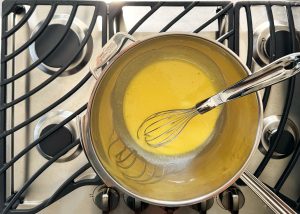
Use a sturdy balloon or coil whisk, moving it in tight circles while simultaneously swirling the skillet in a continuous orbital path. This dual-motion agitation generates high shear forces across the boundary layer of the liquid. As the cold butter melts against the pan wall, the whisk slices the lipid streams into trillions of microscopic particles, while the swirling momentum pulls them through the gelatin-rich reduction. The sauce will noticeably change before your eyes, shifting from a dark, watery translucence to an opaque, creamy liquid that leaves clean tracks across the bottom of the pan.
How to rescue an emulsion teetering on the edge of collapse
Even seasoned cooks occasionally misread a reduction. Perhaps a sudden flare-up pushes the skillet beyond its thermal ceiling, or excessive evaporation starves the emulsion of water, causing a sudden phase inversion. When an emulsion undergoes phase inversion, the oil-in-water system flips into a water-in-oil system, leaving you with an unappetizing puddle of greasy oil trapped over a curdled sludge of overcooked solids.
Panic in the kitchen mirrors panic in the markets; when volatility strikes, uninformed actors overcorrect and dump their holdings. Just as dramatic fiscal shifts trigger panic when CRWV Stock Plunges Under Heavy Pressure While 4 Major Forces Divide Wall Street, a home cook watching butter separate into yellow pools often overreacts by yanking the skillet off the burner or dumping in raw flour. Heavy-handed thickeners turn a delicate glaze into pasty wallpaper glue, dulling bright flavor notes and destroying the silky mouthfeel of your sauce.
A rigorous grasp of pan sauce emulsion mechanics makes diagnosis straightforward rather than mysterious. When a sauce breaks due to water starvation or excessive heat, remove the pan from heat immediately. Whisk in one single tablespoon of near-boiling water or fresh stock. The sudden addition of pure water restores the continuous aqueous phase, giving compressed fat droplets room to separate. Whisk vigorously; within seconds, the droplets will re-suspend, and the sauce will snap back into a glossy state. If thermal shock has permanently split the sauce, whisk half a teaspoon of Dijon mustard into a clean bowl, then slowly drip the broken sauce into the mustard while whisking constantly. Mustard contains natural plant mucilage that provides powerful surfactants, pulling even the most stubborn emulsion back from the brink of ruin.
The enduring craft of kinetic temperature mastery
A flawless pan sauce is not an accidental triumph of good luck. It is the calculated application of physical chemistry disguised as simple kitchen craft. When you stand over a hot pan, you are choreographing a complex dance between thermal energy, surface tension, and kinetic shear. Every sizzle, steam plume, and shift in viscosity communicates precise details about the state of your liquid suspension.
Relying on heavy starches or commercial thickeners may feel safe, but it blunts the clean, bright flavors of your food. True culinary confidence comes from embracing the science of the pan. By respecting the delicate nature of dairy fats, utilizing natural gelatin structures, and balancing heat with physical agitation, you take full command of your cooking. Ultimately, honoring pan sauce emulsion mechanics transforms routine weeknight skillet cooking into an exercise in effortless culinary authority.