Freestyle swimming propulsion mechanics and 4 proven keys to build devastating aquatic power
Water is nearly eight hundred times denser than air, transforming every stroke into a battle against resistance. Discover how mastering fluid dynamics and rotational torque unlocks blistering aquatic speed.
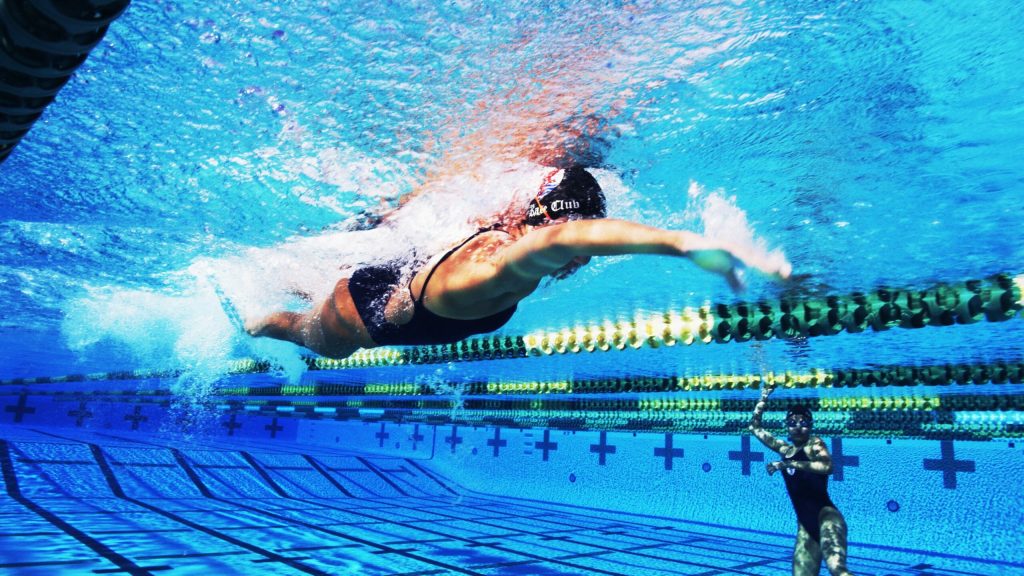
Mastering freestyle swimming propulsion mechanics separates swimmers who fight the water from athletes who glide forward with effortless, explosive speed. Most people assume that swimming fast is a test of raw muscular strength, an aquatic wrestling match where the biggest biceps haul the body across the lane. That assumption falls apart the moment a lean teenager effortlessly outpaces an imposing, muscular triathlete without breaking a sweat. Water is an unforgiving medium. Because liquid is roughly eight hundred times denser than air, brute force produces exponentially more turbulence than forward motion. When you muscle your way through a lap, water pushes back against every flailing joint, amplifying resistive drag and draining your energy reserves within minutes. True aquatic velocity requires an entirely different mindset. You must learn to manipulate fluid dynamics, turn your body into a sleek hydrofoil, and anchor your limbs against shifting currents to catapult your mass forward.
The paradoxical physics of moving through liquid resistance
When analyzing freestyle swimming propulsion mechanics through an engineering lens, one discovers that water is both your greatest adversary and your sole source of traction. Forward progress depends entirely on Newton’s third law of motion, stating that every action produces an equal and opposite reaction. To surge ahead, you must push water backward. Yet swimming introduces a frustrating complication known as the drag equation. Form drag, wave drag, and skin friction all increase quadratically as velocity rises. Double your swimming speed, and you experience four times the hydrodynamic resistance.
This fundamental reality means that reducing resistance yields far greater dividends than attempting to generate massive, uncontrolled torque. A swimmer who produces modest propulsive forces while maintaining an immaculate horizontal profile will always dominate an athlete generating massive thrust while dragging their hips and knees through the water column. Elite swimmers do not simply paddle harder. They treat the water like an elastic sheet, creating pocket high-pressure zones under their palms and forearms while maintaining a pencil-thin silhouette through the water. According to peer-reviewed research on swimming biomechanics and fluid resistance, optimizing the frontal surface area during stroke transitions accounts for the vast majority of propulsion efficiency gains across all swimming proficiencies.
The costly mistake of treating water like solid ground
The most destructive habit among novice and intermediate swimmers stems from terrestrial instinct. On land, your feet push off an unyielding substrate. The sidewalk does not slip away when your shoe makes contact; it offers total resistance, allowing you to project your center of mass forward with high cadence and direct downward force.
Water possesses no such rigidity. Liquid yields to pressure instantly, flowing away from high-force impacts into zones of lesser resistance. When an inexperienced swimmer jams their hand into the water and immediately wrenches their arm backward with maximum tension, they slice straight through the liquid, producing cavitation, bubbles, and turbulent churn. They work furiously, their heart rate spikes, yet their hips barely advance past the lane line. They are slipping the clutch.
Effective movement requires holding water rather than thrashing it. Instead of treating your hand like a rigid paddle that must tear backward at top speed, you must view your arm as an anchor point around which your torso rolls and vaults. When your catch locks onto still, undisturbed water, your hand remains relatively stationary relative to the bottom of the pool while your entire torso and lower body pivot over it.
Four proven adjustments that transform your stroke into unstoppable thrust
Applying sound freestyle swimming propulsion mechanics requires unlearning the intuitive urge to pull harder and adopting disciplined structural geometry instead. By systematically reorganizing how your limbs engage the water and how your kinetic chain delivers power, you transform chaotic splashing into silent, relentless momentum.
The early vertical forearm and high elbow catch
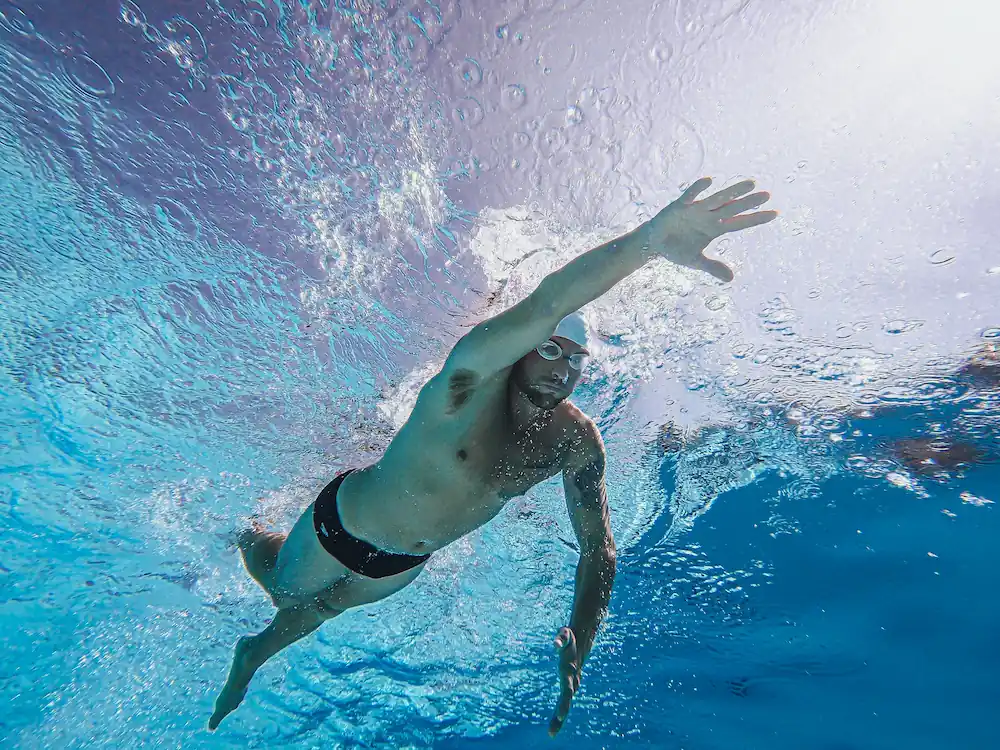
The single most decisive technical hallmark of fast swimming is the early vertical forearm, commonly abbreviated as EVF. When your hand enters the water past your head, the instinctive reaction is to press downward with a straight elbow. This common flaw lifts your head, depresses your hips, and creates zero forward movement, serving only to exhaust your shoulder stabilizers.
An authentic high elbow catch preserves elevation at the elbow joint while allowing the hand and forearm to rotate downward from the elbow hinge. Imagine reaching over a floating oil drum or wrapping your arm around the top of a giant barrel. Within a fraction of a second, your fingers, palm, and entire forearm form a vertical planar surface perpendicular to your swimming direction. This effectively doubles your propulsive surface area, converting your entire lower arm into an expansive hydro-paddle before you begin driving backward.
Kinetic chain integration through rhythmic thoracic rotation
A swimmer who pulls exclusively from the shoulders quickly falls victim to fatigue and acute impingement. Real aquatic torque originates deep inside the core, traveling through the hips, transverse abdominis, and latissimus dorsi before terminating at the hand. Much like on dry land, where athletes optimize sprint acceleration mechanics and 4 proven rules that unlock explosive human speed by directing force squarely through the ground, swimmers must direct reactive force precisely along their longitudinal axis.
Your torso should never remain flat like a barge resting on a pond. Instead, it must roll rhythmically from side to side along a continuous axis extending from the crown of your head through your spine. As you reach into the catch on your right side, your right hip drops roughly thirty to forty-five degrees, engaging the massive pulling sheets of the back. As you execute the stroke, an explosive uncoiling of the torso pulls the arm through the water, turning the torso roll into the primary driver of forward velocity. Rotational energy replaces fragile shoulder effort, which forms the absolute engine of freestyle swimming propulsion mechanics in competitive races.
The hydrodynamics of unsteady lift and micro vortex shedding
For decades, classical coaching treated the freestyle pull as pure drag propulsion, like a rowboat oar pushing directly backward. Modern fluid mechanics reveals a far more sophisticated reality. The human hand is not a flat board; it is an asymmetrical airfoil capable of generating unsteady lift forces as it sweeps through the water column.
As your hand accelerates through the stroke cycle, subtle lateral pitch adjustments cause water to flow faster over the back of the hand than across the palm. This pressure differential generates Bernoulli lift, pulling the hand forward and inward while maintaining firm contact with the liquid. More importantly, elite swimmers shed small, organized fluid vortices off the trailing edges of their fingers and wrists. By timing their hand acceleration to exploit these micro-vortices, they harvest kinetic energy from the swirling water behind them, transforming the stroke from a blunt push into an aerodynamic gliding mechanism.
Synchronized kick mechanics and streamline drag suppression
The flutter kick is widely misunderstood. Many endurance athletes assume kicking is merely an auxiliary motor designed to add horsepower. In reality, the metabolic cost of kicking is astronomical compared to its direct propulsive output; the leg muscles consume oxygen at a voracious rate for a marginal increase in speed.
The genuine, indispensable role of the kick is stabilization and drag reduction. A tight, compact flutter kick originating from the hip flexors prevents the lower body from fishtailing side to side in response to arm pulls. It acts as an aquatic rudder, locking your legs directly behind the draft of your torso. Point your toes, maintain soft flexibility in the knees, and keep the kick within the narrow slipstream of your shoulders. A disciplined kick keeps your pelvis skimming right at the surface, eliminating the parasitic drag that sinks poorly balanced swimmers.
Subtle technical flaws that silently destroy forward momentum
Even experienced swimmers often harbor hidden movement leaks that bleed kinetic energy with every stroke cycle. A widespread breakdown in freestyle swimming propulsion mechanics occurs when swimmers allow their elbows to drop prematurely during the mid-pull phase. Known colloquially as slipping through the catch, dropping the elbow causes the hand to slice through the water horizontally rather than pushing back, dumping all friction resistance and forcing the swimmer into a futile high-stroke-rate spin.
Another common saboteur is the overcrossing hand entry. When a swimmer reaches forward and crosses their hand over the imaginary centerline of their head, the body responds with an immediate fishtailing hip wiggle to balance the lateral torque. This wide lateral deviation instantly destroys the body’s natural hydrofoil shape, presenting a wide, diagonal cross-section to incoming water. Keep your entry tracks aligned squarely with your shoulders, sliding into the water as if pushing your hands along twin railroad tracks.
Calibrating your sensory feedback for effortless velocity in the water
True mastery of the stroke is not achieved through intellectual understanding alone; it must be felt in the nervous system. In practice, real refinement of freestyle swimming propulsion mechanics hinges on developing what legendary coaches call feel for the water, a heightened proprioceptive sensitivity that reads pressure changes on the skin in real time.
When your technique is dialed in, the water beneath your palm feels thick, viscous, and solid, almost like wet cement or heavy syrup. You no longer feel like you are raking your arm through thin liquid; you feel your body surging forward as your hand holds firmly against an immovable pillar of fluid. By prioritizing long, quiet strokes over frantic churning, you systematically train your neuromuscular pathways to seek out high-pressure water with surgical precision, demonstrating how dialed-in freestyle swimming propulsion mechanics turn liquid resistance into pure forward acceleration.