Sprint acceleration mechanics and 4 proven rules that unlock explosive human speed
True explosive speed is not built on frantic leg churn but on pure physics and horizontal force production. Here is how master sprinters weaponize biomechanics from their very first stride.

Mastering sprint acceleration mechanics separates athletes who merely exert effort from those who convert raw muscular torque into relentless, devastating forward momentum. When a sprinter leaves the starting blocks or charges out of a split-second athletic cut, static inertia works aggressively against forward displacement. Overcoming that resistance requires far more than rapid leg churn. Acceleration is an act of violent physical redirection, demanding an orchestrated cascade of ground strikes where body angles, contact duration, and muscular stiffness align to rocket the athlete forward.
Spectators often mistake the initial drive phase for frantic pedaling. In reality, elite acceleration is methodical, patient, and uncompromisingly forceful. Every foot strike during the initial ten to twenty meters must function as a directional piston rather than a stabilizing cushion. Without an unyielding grasp of these early kinematics, an athlete bleeds speed before they ever reach an upright posture, permanently capping their maximum velocity long before the finish line comes into view.
The biomechanical physics behind the horizontal drive phase
Linear movement adheres strictly to Newtonian laws, and human running speed is fundamentally governed by ground reaction force. The track cannot pull an athlete forward; it can only yield an equal and opposite reaction to the force directed backward into its surface. This basic reality, thoroughly outlined in foundational Journal of Experimental Biology research on sprinting ground reaction forces, explains why sprint acceleration mechanics prioritize directional force vectors over raw step cadence.
During early acceleration, velocity increases primarily through horizontal net impulse, which represents the magnitude of backward force multiplied by the duration of foot contact. At top speed, contact times drop to mere milliseconds as the athlete rebounds vertically against gravity. In contrast, the start of a sprint demands longer ground contact times, typically between 0.18 and 0.22 seconds on the initial steps. This prolonged contact is not an indicator of sluggishness. It is an evolutionary necessity that provides the hip extensors enough time to generate immense horizontal propulsion against static body weight.
When an athlete attempts to artificially spin their legs too quickly out of the gate, they cut their force application window short. The foot leaves the ground before the gluteus maximus and hamstrings finish discharging their elastic and contractile energy. As a consequence, forward displacement per stride plummets. Acceleration requires pushing the earth backward with sustained, deliberate intent, allowing speed to emerge as the natural byproduct of force rather than panic.
Why traditional coaching cues break down under real sprint loads
Generations of athletes grew up hearing simplistic instructions that inadvertently sabotaged their sprint form. Coaches who misunderstand sprint acceleration mechanics routinely yell at runners to stay low out of the blocks. In response, inexperienced sprinters bend dramatically at the waist, flexing their lumbar spine while dropping their chin directly against their chest. This artificial forward lean creates a severe structural breakdown that destroys acceleration capacity.
Bending at the pelvis closes down hip flexion, making it anatomically impossible for the swing leg to drive upward into front-side positioning. Worse still, dropping the chest shifts the athlete center of mass too far ahead of their base of support, causing them to stumble or place their feet prematurely to prevent falling. True low posture is never achieved by hunching the upper body; it is a straight line of integrated postural tension extending from the ankle through the knee, hip, spine, and crown of the head.
Another pervasive error is the obsession with full rear extension, often called the push-off myth. Athletes who focus on pushing until the trailing toe points backward end up spending far too much time behind their center of mass. This excessive backside mechanic delays swing recovery, forces the leg into a wide circular arc, and guarantees a sluggish, braking foot strike on the subsequent step. High-level acceleration is punchy and cyclical, not an elongated swan dive.
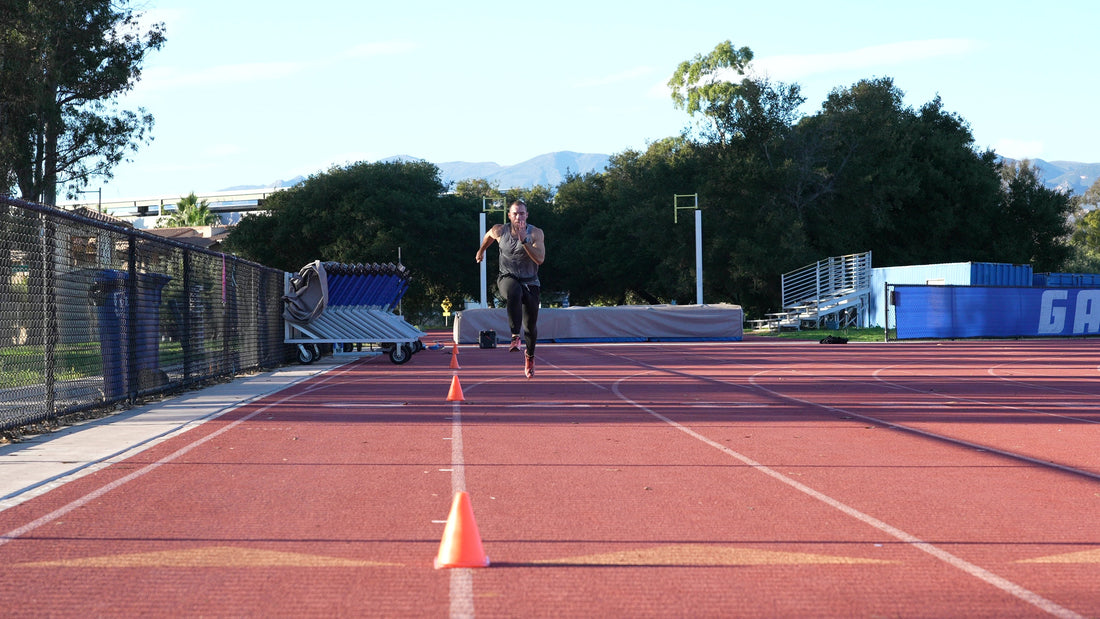
Four foundational pillars that govern elite acceleration
A granular breakdown of sprint acceleration mechanics reveals four foundational pillars that govern how elite athletes generate ground clearance and forward flight. When trained intentionally, these elements transform chaotic energy into a structured, repeatable weapon of pure athletic speed.
Kinetic vector alignment and projecting mass forward
Power means nothing if directed toward the wrong coordinate plane. In the drive phase, the entire skeleton must form an unbroken forty-five-degree vector relative to the ground. This acute angle ensures that when the hip extensors fire, the resulting ground reaction force propels the center of mass horizontally rather than bouncing the skull vertically toward the clouds.
Maintaining this lean requires immense core stability and transverse abdominis engagement. If the trunk goes soft, the hips buckle upward or drop into excessive anterior pelvic tilt, creating a severe hinge that leaks force with every footstrike. The athlete must imagine their body as a reinforced steel rod, launching from the line at a low trajectory where gravity is continuously combated by the downward and backward violence of each succeeding step.
Negative foot speed and the aggressive ground punch
Reaching forward during early acceleration is an athletic death sentence. Placing the foot ahead of the body center of mass produces an immediate braking impulse, driving impact shock straight up the tibia and arresting forward momentum. To accelerate relentlessly, the foot must be traveling backward relative to the hips before it ever touches the synthetic rubber.
This aggressive downward and backward trajectory is known as negative foot speed. As the thigh punches forward during the recovery stroke, the lower leg uncoils and immediately snaps backward beneath the pelvis. The foot strikes the surface directly beneath or marginally behind the hips in a vicious clawing motion. Instead of catching body weight, the foot attacks the ground, turning the friction of impact directly into horizontal propulsion.
Prioritizing front side recovery over trailing extension
Elite sprint velocity is manufactured in front of the body, never behind it. Once the stance foot leaves the ground, any microsecond spent lingering behind the hips is wasted time. Instead of prolonging the push, proper sprint acceleration mechanics rely on rapid heel recovery tight beneath the hip, pulling the swing foot immediately under the pelvis in a tight, compact lever.
This short swing radius accelerates leg recovery. By keeping the heel tucked close to the ischial tuberosity during the initial recovery arc, the moment of inertia of the swinging leg decreases dramatically. The knee punches upward and forward with exceptional velocity, positioning the foot to strike downward with maximum dynamic power. Front-side dominance ensures that the hips remain high, the pelvis remains neutral, and the kinetic chain remains primed to absorb and return elastic force.
Orchestrating rhythm to govern the uncoiling torso
Acceleration is not a static state; it is an evolving transition. The body angle must naturally adjust from forty-five degrees at step one to near verticality by step twenty or thirty. Attempting to hold a fixed low position across thirty meters is just as disastrous as popping upright on step two. The rise of the torso must unfold like an aircraft ascending from a runway.
This ascension is governed by step rhythm and increasing velocity. As the athlete speeds up, ground contact times inevitably shorten from 0.20 seconds down toward 0.10 seconds. Because contact time shrinks, the athlete physically lacks the temporal window required to apply force at extreme horizontal angles. The rhythm of the foot strikes must audibly shift from deliberate, heavy, booming thuds into rapid, crisp, machine-gun snaps, carrying the torso upward in micro-increments until full upright sprinting posture is secured.
Diagnostic audits for uncovering hidden kinetic leaks
When slow-motion video uncovers flawed sprint acceleration mechanics, the earliest warning sign is almost always foot casting. Casting occurs when an athlete kicks their lower leg forward like an open pendulum before contact, hoping to cover more track per stride. This error inevitably results in a heavy heel or flat-footed impact that stalls forward velocity instantly.
A critical kinetic component that prevents casting is ankle pre-tension. Before the foot meets the track, the ankle must be aggressively dorsiflexed, with toes pulled toward the shin and the calf complex co-contracted into an unyielding spring. If the ankle collapses into passive plantarflexion upon landing, the Achilles tendon cannot store and return elastic energy.
Systemic stiffness is the invisible differentiator in sports performance. Just as cellular structural integrity governs meat brining mechanics and 4 proven rules that prevent disastrously dry roasts, the human fascial architecture requires pre-tension before ground impact to prevent soft tissue collapse from dissipating kinetic output. When the foot strikes like a solid wooden block rather than a soft mattress, mechanical energy routes straight through the hip extensors and propels the hips forward.
Another common leakage point is excessive upper-body lateral rotation. When arms flail horizontally across the midline of the chest, they introduce rotational torque that the lumbar spine must fight to stabilize. Arm drive must be violently sagittal. The hands should travel from hip level to shoulder height, driving backward from the shoulder joint with locked elbows to counterbalance the massive rotational forces exerted by the pelvis and legs.
Transitioning explosive drive into sustainable maximum velocity
The true measure of a world-class acceleration phase is not simply leading the pack at twenty meters; it is how seamlessly that phase delivers the runner into maximum velocity mechanics. Acceleration is the foundational runway. If that runway is short, erratic, or structurally flawed, the top-end ceiling of the athlete collapses completely.
Athletes who rush their acceleration invariably experience speed deceleration long before their competitors. By expending their central nervous energy on frantic, high-frequency arm and leg cycling early in the race, their muscular systems fatigue prematurely, leaving no reserve capacity for maintaining upright flight mechanics through the closing stages. A disciplined drive phase distributes metabolic and neural resources evenly, building momentum systematically so top speed is achieved effortlessly at peak distance.
Ultimately, mastering sprint acceleration mechanics builds the indispensable foundation that dictates how fast an athlete can run once fully upright. By treating each early stride as a violent, calculated projection of mass, runners break free from the gravitational anchors of the starting line, turning raw human effort into an exhibition of fluid, explosive power.