Swimming propulsion mechanics and 4 proven tweaks that build effortless speed
Water is eight hundred times denser than air, mercilessly punishing raw muscular force while rewarding hydrodynamic alignment. Understanding the hidden physics of propulsion transforms exhausting thrashing into effortless forward glide.
Mastering swimming propulsion mechanics requires accepting an uncomfortable physical reality: water is roughly eight hundred times denser than air, relentlessly punishing raw muscular effort. When an athlete tries to muscle their way across a pool through sheer aggression, water pushes back with exponential resistance. The swimmer thrashes, their heart rate spikes, their shoulders burn, and yet their forward progress stalls against a wall of liquid drag. Elite competitors appear to glide across the surface without visible panic because they do not fight the medium. Instead, they treat the water as a solid anchor, applying precise leverage to slide their bodies over and past their hands.
Moving efficiently through water is not an innate human trait. Land-based locomotion rewards forceful ground contact, where friction provides immediate traction and air yields easily to forward motion. In an aquatic environment, that instinct betrays you. The moment you push backward with a slipping hand, you generate wasteful turbulence rather than sustainable velocity. Achieving true fluidity demands unlearning terrestrial movement patterns and adopting a framework grounded in fluid dynamics, kinetic sequencing, and refined hydrodynamics.
The Physics of Moving Through Dense Liquid Resistance
To understand why most swimmers plateau, one must look at the mechanical forces governing human displacement in water. Drag and propulsion exist in an unforgiving tug-of-war. Frontal drag acts as an invisible brake, increasing proportionally to the square of your velocity. Double your swimming speed, and the water pushes against your forward profile with four times the force. Consequently, reducing passive drag through impeccable body posture is always the primary prerequisite for speed, but body alignment alone does not create displacement.
This is where the foundation of true swimming propulsion mechanics rests on balancing Newtonian displacement with lift-based hydrodynamic forces. For decades, traditional coaches instructed swimmers to push water straight back toward their feet, citing Newton’s third law of motion: every action has an equal and opposite reaction. While pushing water backward certainly generates forward drive, pure drag propulsion has severe thermodynamic limits. Water is a fluid medium; when a hand pushes against it linearly, the water slips away, creating swirling vortices that dissipate energy into heat and churned foam.
Modern sports science reveals that the most effective swimmers also exploit lift forces, akin to how an airplane wing or a boat propeller functions. According to biomechanical research published by the National Institutes of Health, fluid forces generated during the underwater stroke result from a complex interaction between quasi-steady lift components and unsteady vortex shedding. By angling the hand and forearm at a slight pitch relative to the oncoming flow, an athlete creates pressure differentials between the palm and the back of the hand. This subtle sculling motion grabs undisturbed, high-density water molecules, giving the swimmer a dense column of liquid to lever against.
The Early Vertical Forearm and the Fallacy of Drag Only Pulling
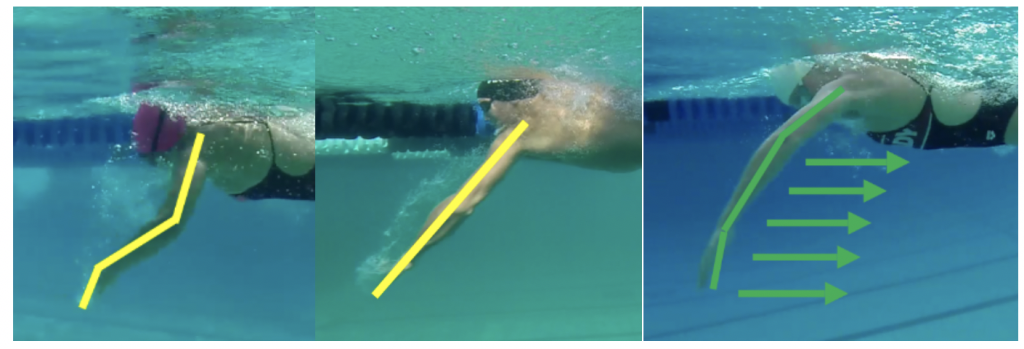
The single greatest mechanical flaw among recreational and intermediate swimmers is pulling with a dropped elbow. Swimmers who misunderstand swimming propulsion mechanics often pull through the water with dropped elbows, leading their stroke with the elbow joint while the forearm trails behind at a shallow angle. This motion feels deceptively powerful because it heavily recruits the small, vulnerable anterior deltoids and rotator cuff muscles. However, from a hydrodynamic standpoint, a dropped elbow presents virtually zero surface area against the direction of travel.
Instead of acting as a broad paddle, an arm with a dropped elbow simply slices through the water like a butter knife. The hand slips, the water spins out into unproductive eddies, and the athlete expends tremendous metabolic energy merely churning liquid without propelling their center of mass forward. To generate actual velocity, the entire lower arm must become an integrated propulsive surface.
This reality brings us to the early vertical forearm, widely known in competitive circles as EVF. The goal of EVF is simple yet physically demanding: immediately after the hand enters the water and completes its forward glide, the fingertips hinge downward, followed by the wrist, and finally the forearm flexes at the elbow. Throughout this initial setup, the elbow remains high and wide near the surface of the pool. By the time the hand reaches the depth of the chest, the entire structure from the fingertips to the elbow is oriented perpendicular to the bottom of the pool. The swimmer is no longer pulling with just a six-inch palm; they are anchoring a two-foot mechanical paddle against stationary water.
Four Proven Hydrodynamic Adjustments That Transform Stroke Velocity
Refining your personal swimming propulsion mechanics demands shifting your mindset from aggressive thrashing to disciplined hydrodynamic anchoring. When you stop trying to push water and start treating the water as an immovable ledge that your body must vault past, your propulsion skyrockets while your heart rate drops. Implementing four systemic adjustments creates this profound mechanical shift.
Anchoring the Early Vertical Forearm to Grip Undisturbed Water
The first phase of propulsion is not a pull; it is an anchor. When your hand reaches full extension during the catch, resist the urge to immediately yank backward with your shoulder. Rushing the pull causes the elbow to collapse instantly. Instead, establish the catch by flexing your wrist slightly downward and rotating your upper arm inward so your elbow points toward the side of the pool.
Think of this initial movement as reaching over a large floating barrel. Your fingertips point toward the bottom of the pool while your elbow remains positioned above the wrist. Only when your forearm forms a vertical wall against the water do you begin applying rearward pressure. By waiting for the vertical anchor to lock in place, you engage the massive, fatigue-resistant latissimus dorsi and core musculature rather than exhausting the delicate shoulders. You are no longer dragging your arm through the water; you are locking your arm onto undisturbed, high-pressure water and levering your torso over the top.
Aligning the Rotational Kinetic Chain from Hips to Fingertips
Propulsion does not originate in the arms; it begins deep within the pelvic girdle. Swimmers who stay flat on their bellies restrict their stroke length, stress their shoulder capsules, and generate weak, disjointed arm pulls. True aquatic propulsion relies on rotational torque transferred through the kinetic chain. Much like investigative reporters rely on anonymous source vetting mechanics and 4 proven rules that prevent catastrophic media scandals to eliminate false signals before publishing, elite swimmers systematically audit their kinetic chain to purge wasteful, drag-inducing movements.
As your anchored arm begins the press phase, your hips must snap into rotation along your longitudinal axis. This hip drive acts as a mechanical catapult. When your right hip drives down, it stretches the oblique and core muscles across your midsection, releasing elastic recoil energy directly into the right arm’s pull. You are effectively pulling with the full rotational mass of your hips and core rather than isolated arm strength. This kinetic synchronization simultaneously clears the recovering arm cleanly over the surface, maintaining a streamlined, hydrodynamic hull in the water.
Optimizing a Compact Flutter Kick to Eliminate Frontal Resistance
Few elements of swimming are as misunderstood as the flutter kick. Novice swimmers treat their legs like outboard boat engines, kicking frantically with wide, bicycling knee bends in an attempt to generate speed. In reality, a thrashing kick consumes massive amounts of oxygen while generating surprisingly little forward drive. Worse yet, an overly wide kick splays the legs outside the slipstream of the torso, creating massive frontal drag that wipes out any propulsion generated by the arms.
Developing elite swimming propulsion mechanics requires timing your kick so that downbeats coincide exactly with the opposite hand’s catch, serving primarily as a dynamic stabilizer and lift mechanism. The flutter kick must remain compact, rarely expanding beyond the diameter of the torso. The knees remain soft and flexible rather than rigid, with movement initiating from the hip flexors and glutes. The ankles must be supple and fully plantar-flexed, whipping the water like fish fins. A compact, rhythmic two-beat or six-beat kick keeps the hips elevated in the fastest surface layer of water, stabilizing the body against rotational torque without draining your cardiovascular reserves.
Eliminating the Dead Spot to Maintain Continuous Forward Momentum
Because water resistance increases exponentially with speed, any sudden drop in velocity is catastrophic to your overall pace. When a swimmer pauses during their stroke—often referred to as the dead spot, frequently occurring when breathing or during a lagging catch—their forward momentum abruptly decelerates. To regain lost cruising speed, the swimmer must exert massive energy to accelerate their dead weight all over again.
Maintaining continuous momentum requires seamless stroke timing. As one hand finishes its propulsive press past the hip and begins its outward release, the opposite forward hand must already be initiating its early vertical forearm catch. In freestyle, this timing is often cultivated through a catch-up or front-quadrant stroke rhythm, ensuring that propulsive force is applied almost continuously without stalling. Smooth, uninterrupted power output keeps the hull of your body planing steadily across the water, maximizing inertia and dramatically reducing the metabolic cost of travel.
Deliberate Pool Drills That Ingrain Flawless Propulsion Habits
Knowledge of hydrodynamics is useless if your nervous system cannot feel what the water is doing. The tactile feedback of water slipping or gripping against your skin requires neuromuscular conditioning. Integrating targeted pool drills directly recalibrates your swimming propulsion mechanics by stripping away compensation patterns.
The fist drill stands as one of the most effective tools for awakening forearm awareness. By swimming with tightly clenched fists, you instantly remove eighty percent of your hand’s surface area. If you attempt to pull with a dropped elbow while making a fist, you will slide uselessly in place. To generate any forward movement at all, your nervous system is forced to recruit the entire forearm as a vertical paddle. When you uncurl your fingers after several laps of fist swimming, your palms will suddenly feel massive, gripping the water with extraordinary authority.
Another indispensable practice is the sculling progression in both the front-scull and mid-scull positions. By floating horizontally with a snorkel and moving only your hands and forearms in sweeping figure-eight patterns, you learn to detect the high-pressure water pockets that provide lift. You begin to feel how micro-adjustments in pitch and wrist stiffness change the density of the water under your grip. This kinesthetic sensitivity is the hallmark of master swimmers, allowing them to adjust their catch continuously to account for moving turbulence.
The Lifelong Mastery of Moving With Water Rather Than Against It
Swimming quickly is ultimately an exercise in humility and physics. The pool does not reward brute force, stubborn tension, or muscular strain. Water yields effortlessly to gentle displacement, yet solidifies into an unyielding barrier against chaotic violence. When you align your body with fluid dynamics, swimming ceases to be a frantic fight against drowning and transforms into an elegant act of aquatic flight.
Every stroke cycle becomes an ongoing dialogue between surface area, leverage, and streamlined posture. As you ingrain the early vertical forearm, sync your arm pull to your hip rotation, and quiet your kick, you discover that speed is not something you force through effort. Rather, the genuine beauty of swimming propulsion mechanics lies in the quiet economy of a stroke that cuts cleanly through resistance, turning water from a relentless adversary into your most powerful ally.